Field of Science

Showing posts with label Aculeata. Show all posts

Williamsita

A while back, I wrote a post about the crabronid wasp genus Podagritus. This time, I'm going to cover another crabronid genus found here in Australia: Williamsita.

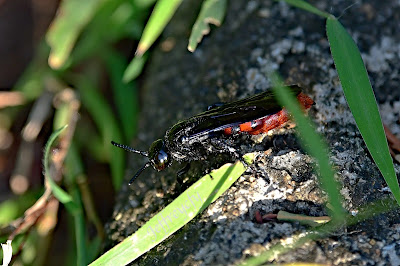
Williamsita sp., copyright David Francis.


Like Podagritus, Williamsita species are boldly coloured wasps, typically mostly black with contrasting yellow or orange markings. They differ from Podagritus species in being more robust with the base of the gaster not notably pedunculate. Other distinguishing features include the presence of distinct foveae (pits) against the margins of the eyes (occasionally less distinct in males), thirteen-segmented antennae in males, and a pygidial plate in both sexes that is narrowed and concave in females, quadrate in males. Williamsita species also do not have the palps reduced as in Podagritus, instead having the more typical arrangement of six segments in the maxillary palps and four segments in the labial palps (Bohart & Menke 1976).

To date, eleven species have been recognised in the genus Williamsita (Leclercq 2006). Most are found in Australia with a single species each known from New Caledonia and Vanuatu. Leclercq (1950) suggested dividing the genus between two subgenera with all species except the New Caledonian type species W. novocaledonica forming a subgenus Androcrabro. Features supporting the latter taxon included the presence of ventral notches on one or more segments of the antennae in males. However, Leclercq later suggested abandoning such a formal division, questioning its significance (Leclercq 2006). The Australian species of Williamsita are, nevertheless, distinct from the two insular species in being marked with much stronger punctation over the body.

Most Williamsita species remain little seen and poorly known. However, breeding habits have been recorded for two Australian species, W. bivittata and W. tasmanica (Maynard & Fearn 2021; McCorquodale et al. 1989). Both these species nest in branching holes in rotting wood, either commandeering burrows left by wood-boring insects or excavating their own. Prey consists of larger flies such as blow flies or soldier flies which were carried back to the nest by the wasp running with the fly carried below the body. Up to six paralysed flies might be placed lying on their backs in a nest cell with an egg laid across the 'throat' (i.e. at the joint between head and thorax) of one of the flies. The cell would then be closed with a plug of woody frass. McCorquodale et al. (1989) recorded W. bivittata constructing several such cells in a series along a single tunnel, whereas Maynard & Fearn (2021) found W. tasmanica more likely to place a single cell in a side-branch. As both observations were limited to a single location in a single season, though, one might reasonably question whether these represent true differences in species behaviour or were determined by available conditions. There's a limit to how deep a Williamsita can burrow.

REFERENCES

Bohart, R. M., & A. S. Menke. 1976. Sphecid Wasps of the World. University of California Press: Berkeley.

Leclercq, J. 1950. Sur les crabroniens orientaux et australiens rangés par R. E. Turner (1912–1915) dans le genre Crabro (subgenus Solenius). Bulletin et Annales de la Société Entomologique de Belgique 86 (7–8): 191–198.

Leclercq, J. 2006. Hyménoptères crabroniens d'Australie du genre Williamsita Pate, 1947 (Hymenoptera: Crabronidae). Notes Fauniques de Gembloux 59 (2): 115–119.

Maynard, D., & S. Fearn. 2021. Ecological and behavioural observations of a nesting aggregation of the endemic Tasmanian digger wasp Williamsita tasmanica (Smith, 1856) (Hymenoptera: Crabronidae: Crabroninae). Papers and Proceedings of the Royal Society of Tasmania 155 (1): 43–50.

McCorquodale, D. B., C. E. Thomson & V. Elder. 1989. Nest and prey of Williamsita bivittata (Turner) (Hymenoptera: Sphecidae: Crabroninae). Australian Entomological Magazine 16 (1): 5–8.

Velvet Photomorphs

The velvet ants of the family Mutillidae are a diverse but relatively little-studied group of insects. As well as their often retiring habits, studies of this family are hindered by the difficulty of associating sexes. Females are wingless and superficially resemble hairy ants. Males are usually winged and resemble more typical wasps (there is a small handful of species in which both sexes are flightless). What we do know of velvet ant diversity suggests a high level of endemicity with different regions each having their own distinct assemblages of genera and species. In North America, one of the most diverse recognised genera is Photomorphus.

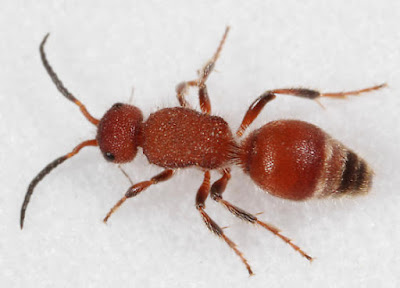
Female Photomorphus banksi, copyright Cotinis.


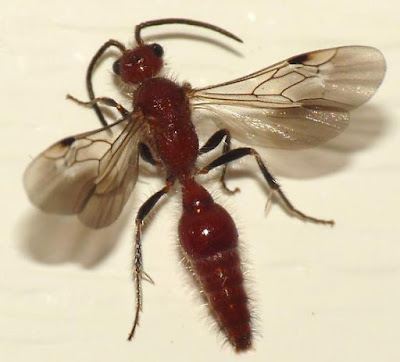
Species of Photomorphus are found across much of the United States and Mexico, being most diverse in the arid regions of the south-west (Brabant et al. 2010). The genus is currently divided between three subgenera, each originally described from males. Males have round, slightly protruding eyes, a more or less petiolate metasoma with a distinct constriction between the first and second segments, and a pair of ridges on the mesosternum behind the procoxae. The genus is currently divided between three subgenera: Photomorphus, Photomorphina and Xenomorphus. Males of subgenus Photomorphus have a distinct space between the mesocoxae and bidentate mandibles whereas Photomorphina males have the mesocoxae closely placed and tridentate mandibles (Manley & Pitts 2002). Females of Photomorphus have dense, silver setae on the mesosoma whereas females of Photomorphina have a less hairy mesosoma and typically have a band of plumose setae along the dorsal hind margin of the second metasomal segment (Brabant et al. 2010). The third subgenus, Xenomorphus, is known from a single Mexican species only and its female remains unidentified.

Male Photomorphus paulus, copyright J. C. Jones.


Photomorphus is part of a lineage of nocturnal mutillids common in arid regions of North America. Velvet ants develop as nest parasites of other wasps and bees; Photomorphus species are presumably no exception but their hosts are as yet unknown. A phylogenetic analysis of the North American nocturnal mutillids by Pitts et al. (2010) supported recognition of the group as a single clade but identified Photomorphus itself as polyphyletic. A clade corresponding to the subgenus Photomorphus was recovered but Photomorphina species were divided between multiple separate clades. This included the species P. myrmicoides which Brabant et al. (2010) had suggested should be moved from Photomorphina to subgenus Photomorphus. Females of P. myrmicoides have hair like that of subgenus Photomorphus but differs in the structure of the pygidial plate, a hairless area at the end of the metasoma. In the strict subgenus Photomorphus, this plate is completely smooth and shiny; in Photomorphina and P. myrmicoides, it is rough or marked by ridges. Clearly a reclassification of Photomorphus is on the cards but we are yet to see when we have the confidence to enact it.

REFERENCES

Brabant, C. M., K. A. Williams & J. P. Pitts. 2010. True females of the subgenus Photomorphina Schuster (Hymenoptera: Mutillidae). Zootaxa 2559: 58–68.

Manley, D. G., & J. P. Pitts. 2002. A key to genera and subgenera of Mutillidae (Hymenoptera) in America north of Mexico with description of a new genus. Journal of Hymenoptera Research 11 (1): 72–100.

Pitts, J. P., J. S. Wilson & C. D. von Dohlen. 2010. Evolution of the nocturnal Nearctic Sphaerophthalminae velvet ants (Hymenoptera: Mutillidae) driven by Neogene orogeny and Pleistocene glaciation. Molecular Phylogenetics and Evolution 56: 134–145.

The Hairy Digger Wasps of Hong Kong

Taylor, C., & C. Barthélémy. 2021. A review of the digger wasps (Insecta: Hymenoptera: Scoliidae) of Hong Kong, with description of one new species and a key to known species. European Journal of Taxonomy 786: 1–92.

On Christmas Eve, I received an e-mail from Christophe Barthélémy in Hong Kong to tell me that we'd gotten a Christmas present. Our big paper on the scoliid wasps of Hong Kong was now freely, publicly available! In this paper, we reviewed all sixteen species of Scoliidae known from the Hong Kong SAR to date, providing detailed descriptions and photographs of each. Nine of these had not previously been recorded from the region; one represented an entirely novel species. We also provided a detailed identification key and clarified some of the often convoluted taxonomy of this family.

Liacos erythrosoma, one of the larger scoliid species found in Hong Kong, copyright Jeffrey Cfy.


The Scoliidae, sometimes referred to as the hairy digger wasps or hairy flower wasps, are often large, striking wasps (the largest species found in Hong Kong get close to an inch in length) that are most often seen by observers when they visit flowers for food. They differ from other wasps in the structure of the wings which are shaped into radiating folds (often referred to as 'pseudoveins') towards the outer margins. In life, the wings have an iridescent appearance. Female scoliids are robust insects with powerful legs. This is so they can burrow into the ground in search of hosts for their larvae which develop as parasitoids on the larvae of scarabaeid beetles. Male scoliids are generally smaller and more slender than females. In some species (particularly members of the tribe Campsomerini), males can look very different from females, to the extent that it can be all but impossible to link one with the other in isolation. Males of some species can sometimes be found in large numbers as they form swarms in search of females.

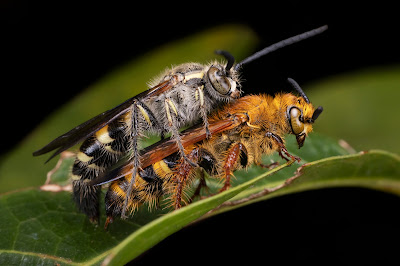
Mating pair of Phalerimeris phalerata (male on top), perhaps Hong Kong's commonest scoliid species. Copyright Daphne Wong.


Christophe and I had lit upon the idea of producing a review of the family as I was attempting to identify specimens collected as part of the Hong Kong mangrove survey. Christophe already had an extensive number of scoliids as part of his own amateur collection; these formed the greater part of the material we used. One of our primary challenges was making sense of the group's taxonomy. As well as the aforementioned difficulties in matching males to females, scoliid taxonomy has its own individual tangles. The system has historically been beset with confusion, questionable decisions, and disregard for priority. Species have often been subdivided into a bewildering array of subspecies, varieties and formae, often on the basis of quite superficial differences and often with little apparent consideration as to whether they represented distinct populations (individuals of different 'subspecies' may often be found at the same location). As a result, I had to spend a lot of time digging into archaic publications to make sure they had been correctly quoted by their successors. Fortunately (as long time readers of this site will probably know), this is exactly the sort of thing that I love doing*.

*With a shout-out here to the Biodiversity Heritage Library. An absolutely brilliant resource that has just revolutionised the way we do literature research.

While I mostly took care of the taxonomy, key, and the first drafts of the descriptions, Christophe produced the photos, distribution maps, and revisions of the descriptions after I returned to Australia (including male genital dissections of all the species we had on hand). The end result is a paper I feel very proud of. Thank you to Benoit Guénard and the Entomology lab of Hong Kong University for providing access to resources, and if you have any interest in the wonderful world of Hong Kong hairy flower wasps, you can check out the final product here.

Pompilus: Spider Wasps of the Dunes

I've commented before on the difficulties that can be attendent on identifying spider wasps (Pompilidae), one of those groups that combine a high species diversity with a tendency to be morphologically conservative. As a result, the taxonomic history of this group has been one of shifting generic concepts and ill-defined wastebaskets. Not surprisingly, one of the main victims of this uncertainty has been the type genus Pompilus. Historically used to cover a significant percentage of all spider wasps, the name Pompilus is now restricted to a small cluster of species inhabiting the Old World.

Pompilus cinereus, copyright Martin Grimm.


The genus Pompilus and its history were last revised in detail by Day (1981) who recognised seven species associated with more or less open, sandy habitats. The most widespread and best-known of these is Pompilus cinereus, found over wide parts of Eurasia, Africa and Australia, often alongside bodies of water. This species shows a wide range of morphological variation across its range but Day (1981) declared himself unable to sensibly correlate this variation with discrete populations. The possibility remains that further studies may identify P. cinereus as a species complex. The other species in the genus, P. mirandus of India and south-east Asia and five African species, are more restricted in range and little studied. Pompilus mirandus is more tolerant of vegetated habitats than P. cinereus. Conversely, P. niveus of northern Africa is a specialist of the sand dunes of the Sahara Desert. Species of Pompilus all have a black cuticle with a covering of short grey pubescence. The most distinctive feature of the genus is the possession by females of long, weakly curved mandibles with a single inner tooth (other spider wasps have shorter, thicker mandibles with more teeth). These modified mandibles are related to their distinctive manner of handling prey. Whereas other spider wasps will drag their spider victims backwards to their nest, females of Pompilus will lift the spider off the ground and run forward while carrying it.

Nesting behaviour has only been described for P. cinereus. Targeted prey comprises ground-running spiders such as wolf spiders or clubionids. After a spider has been captured, paralysed and carried near the intended nest site, it is temporarily buried in the sand while the female constructs a burrow (Day suggested that this preliminary burial was to prevent the spider being stolen). The simple burrow leads to a single nest cell a few inches deep. The female exhumes the spider, transports it into the burrow and then lays an egg on its abdomen near the front of the side. She then closes the entrance to the burrow with sand, tamping it down securely with the end of her metasoma.

Within the burrow, the spider begins to wake from its paralysis after a few hours. However, it remains in poor shape: its movements are slow and it begins to continuously exude silk from its spinnerets. By wandering about the cell in this distressed state, the spider ends up producing a silken purse that serves as extra protection for the nest's contents. This, of course, includes the wasp larva that within a couple of days will have begun to feed on the trapped spider.

Though details of breeding behaviour have not been observed for other Pompilus species, they might be expected to resemble P. cinereus. It might be noted, however, that the female of P. cinereus has a patch of flattened scales at the end of the metasoma that is less developed in P. mirandus. Is this an indication that P. mirandus is somehow less conscientious in sealing the nest burrow than P. cinereus? If you keep an eye out in the wastelands of India, you might just learn the answer.

REFERENCE

Day, M. C. 1981. A revision of Pompilus Fabricius (Hymenoptera: Pompilidae), with further nomenclatural and biological considerations. Bulletin of the British Museum (Natural History): Entomology 42 (1): 1–42.

The Stizus Sand Wasps

Some years ago, I presented a post on the sand wasps of the tribe Bembicini. Bembicini are just part of the broader range of sand wasps that have been variously classified as the Bembicidae, Bembicinae or Nyssoninae (Bohart & Menke 1976; Sann et al. 2018). Another diverse subgroup of the bembicids is the genus Stizus, of which more than 120 species are found in Eurasia, Africa and North America (but not in Australia or South America). Stizus species are relatively large wasps, getting up to 3.5 cm in length. Like Bembicini, they are often brightly coloured, black banded with yellow and/or red. They are otherwise fairly generalised in appearance: the labrum is exserted but is not remarkably long like that of bembicins, and the ocelli are not reduced (Bohart & Menke 1976).

Stizus pulcherrimus, copyright Phonon B.


The nesting behaviour of Stizus species was reviewed by Evans & O'Neill (2007). All known Stizus nests are constructed in soil and sand, sometimes in relatively damp locations such as salt marshes or near water bodies. Burrows of nests may be a foot or more deep and contain multiple cells; acessory burrows are common. Though females construct their burrows strictly single-handedly, they will often nest in clusters with other females. Polidori et al. (2008) found that this clustering behaviour in the European Stizus continuus was due to females being actively attracted to nests of other females, rather than just a side effect of limited nest sites. The most commonly used prey are various Orthoptera (grasshoppers or katydids); a handful of species instead prey on mantids. Prey are paralysed by repeated stinging before being flown back to the nest carried under the female. After the prey insect has been placed in a nest cell, the female lays an egg on its thorax. In most cases, cells are fully stocked with prey before laying, but females of S. continuus have been observed carrying fresh prey back to nests in which larvae have already hatched and begun eating.

Stizus perrisi female constructing nest, copyright David Genoud.


Mating between males and females generally occurs as the newly matured females emerge from the parent nest. Males often emerge before females and begin patrolling the nesting area, searching for females and chasing away other males. In some cases, they may begin actively digging for females emerging from burrows, and a newly emerged female may find herself surrounded by a pack of competing males. In their eagerness, males may become rather hasty: males of the Japanese S. pulcherrimus have been observed attempting to force themselves on females of the related genus Bembix!

REFERENCES

Bohart, R. M., & A. S. Menke. 1976. Sphecid Wasps of the World. University of California Press: Berkeley.

Evans, H. E., & K. M. O'Neill. 2007. The Sand Wasps: Natural History and Behavior. Harvard University Press.

Polidori, C., P. Mendiola, J. D. Asís, J. Tormos, J. Selfa & F. Andrietti. 2008. Female-female attraction influences nest establishment in the digger wasp Stizus continuus (Hymenoptera: Crabronidae). Animal Behaviour 75: 1651–1661.

Sann, M., O. Niehuis, R. S. Peters, C. Mayer, A. Kozlov, L. Podsiadlowski, S. Bank, K. Meusemann, B. Misof, C. Bleidorn & M. Ohl. 2018. Phylogenomic analysis of Apoidea sheds new light on the sister group of bees. BMC Evolutionary Biology 18: 71.

Podagritus in Australia

The digger wasps of the tribe Crabronini are a widespread group distinguished by a boxy head shape and relatively stout mesosoma. They are not dissimilar to hairless bees and indeed are close relatives of that group. There is a wide diversity of crabronins around the world; among their representatives here in Australia are members of the genus Podagritus.

Podagritus cf. tricolor, from Insects of Australia.


Podagritus species are medium-sized, elongate crabronins, generally in the region of a centimetre in length (give or take a few millimetres). The gaster is pedunculate (that is, the first segment of the metasoma is drawn into an elongate peduncle). Other, finer features distinguishing them from related genera of crabronins include a palpal formula of 5-3 (referring to the number of segments in the maxillary and labial palps, respectively; 5-3 indicates that both palps are slightly reduced from the ancestral count for crabronins) and often the presence of a sharp subvertical ridge, the omaulus, near the front of the mesopleuron (the median plate on the side of the mesosoma). If the omaulus is not present as such, there is still a distinct curve where it would have been so the planes of the mesopleuron on either side are more or less perpendicular. Females have a well defined triangular, flat pygidial plate and males often have one as well (Bohart & Menke 1976).

Thirty species of Podagritus were recognised from Australia by Leclercq (1998). Other species of the genus are known from New Zealand and South America. Historically, the Australian species have been treated as a distinct subgenus Echuca from Podagritus elsewhere, based on features such as a well defined, flat prepectus and a weakly sculpted metapleuron. Leclercq, however, questioned the value of this distinction, noting the existence of a couple of Australian species sharing notable features in common with species found elsewhere, and suggested abandoning subgenera until the genus could be revised as a whole.

The natural history of Podagritus species in Australia remains poorly known. One species found in the east of the continent, P. leptospermi, has been found nesting in a sloping gravel bank (Bohart & Menke 1976). Burrows were near vertical and close to a foot deep, and contained two or three cells placed at the ends of lateral galleries (one cell per gallery). Entrances were surrounded by flat mounds of sand six to ten centimetres wide and were not closed while the female was out hunting. Cells were stocked with flies (Tachinidae and Therevidae, so presumably reasonably large) that were initially stored at the bottom of the burrow before being placed in the cell head inwards and belly up, in lots of four to six. The egg was attached to a fly between the head and thorax, so when the larva hatched it would find itself already in place on a welcoming bed of food.

REFERENCES

Bohart, R. M., & A. S. Menke. 1976. Sphecid Wasps of the World. University of California Press: Berkeley.

Leclercq, J. 1998. Hyménoptères sphécides crabroniens d'Australie du genre Podagritus Spinola, 1851 (Hymenoptera, Sphecidae). Entomofauna 19 (18): 285–308.

Small Carpenters

It's time for another dip into the wide diversity of bees. The small carpenter bees of the tribe Ceratinini are small (often less than a centimetre in length), slender bees found on all continents except Antarctica, though their toehold in Australia is a very tenuous one indeed with only a single known species there. Though diverse, with hundreds of known species, the difficulty of breaking the tribe into clearly defined, monophyletic groups has lead recent authors to recognise a single genus Ceratina (Michener 2007). Distinctive subgroups previously treated as separate genera, such as the relatively large Megaceratina and the heavily punctate Ctenoceratina of Africa, and the both bright metallic and heavily punctate Pithitis of Africa and southern and eastern Asia, are now treated as subgenera. There are a lot of recognised subgenera, over twenty at last count, but there are also a lot of species not yet assigned to subgenus. Phylogenetic analysis of the ceratinins supports monophyly of most subgenera and a likely African origin for the clade as a whole, with multiple dispersals into Eurasia followed by a single dispersal to the Americas (Rehan & Schwarz 2015).

Ceratina sp., possibly C. smaragdula, copyright Vengolis.


Distinctive features of Ceratina compared to other bees include the absence of a pygidial plate, a flattened and hardened patch on the tip of the abdomen in females. As members of the family Apidae, Ceratina are long-tongued bees with a scopa (cluster of pollen-carrying hairs) on the hind legs, though the scopa does not enclose a bare patch for carrying a shaped pollen ball as in some other apids (for instance, the familiar honey bees). The scopa is less extensive in small carpenter bees than it is in other apids and the hairs on the body as a whole are rather short, so Ceratina look much shinier and less fuzzy than other bees. Ceratina are black or metallic green in colour (on rare occasions, the metasoma is red) and usually have yellow patches, particularly on the face.

Ceratina nest in a fennel stem, copyright Gideon Pisanty.


The name 'carpenter bee' refers to their practice of nesting in hollow stems or twigs, entered at broken ends. The absence of the pygidial plate is probably related to this manner of nesting: it is normally used by ground-nesting bees to tamp down soil when closing the nest. Most of the time, Ceratina are solitary nesters but two or more females may sometimes work on a nest together. In these cases, they adopt a proto-eusocial division of labour with one female laying eggs while the others act as 'workers' (I have no idea how they decide who gets to do what). Though a reduction in hairiness in bees is often associated with kleptoparasitism, no Ceratina species are known to behave in that manner (though some kleptoparasites are known among the members of the closely related and very similar tribe Allodapini). The reduction of the scopa may instead be associated with the bees carrying food supplies for the nest in their crop as well as on the legs. Cells are lined up in the nest stem with only simple partitions between them. These partitions are made from loose particles, mostly the pith of the stem, with no obvious adhesive holding them together. In at least some species, females will return to the nest after completion, dissembling and reassembling cell walls in order to clean out dead larvae and faeces that are then incorporated into the partitions. As such, while small carpenter bees are not directly on the evolutionary line leading to the more integrated colonies of the social bees, they do provide us with a model of what one stage in their evolution may have looked like.

REFERENCES

Michener, C. D. 2007. The Bees of the World 2nd ed. John Hopkins University Press: Baltimore.

Rehan, S., & M. Schwarz. 2015. A few steps forward and no steps back: long-distance dispersal patterns in small carpenter bees suggest major barriers to back-dispersal. Journal of Biogeography 42: 485–494.

Mooching Off the Relatives

Something I've referred to before but only (I think) in passing is that, among the enormous diversity of bees that inhabit this world, there are a large number of species that act as cleptoparasites*. That is, instead of constructing and provisioning their own nests, they lay their eggs in the nests of other bee species. When the eggs hatch, the emerging larvae feed on the provisions that the constructing bee intended for her own offspring. One lineage of these cleptoparasites is the megachilid genus Coelioxys.

*Depending on the source, you may see this term spelt as either 'cleptoparasite' or 'kleptoparasite'. Personally, I've never been able to decide just which I should be using.

Coelioxys sodalis, copyright jgibbs.


Coelioxys is a diverse, cosmopolitan genus with nearly 500 known species, closely related to the even more diverse leafcutter bees and resin bees of the genus Megachile. Species vary in size from half a centimetre to nearly an inch in length. They are fairly similar to species of Megachile in overall appearance, the most obvious difference being that (as with most cleptoparasitic bees) their covering of hair is greatly reduced. In particular, the dense scopa of hairs that covers the underside of the metasoma in female Megachile is absent. The primary function of the hairs in bees is to carry pollen; with no nest of their own to worry about, cleptoparasitic bees have no need for such dense hairs. Coelioxys females also differ from Megachile in the shape of the metasoma which is tapering and ends in a narrow tip. More on that in a moment.

As might be expected for such a large genus, Coelioxys has been divided between a number of subgenera. Until recently, the definitions of a number of these subgenera was somewhat uncertain. The biggest problem was that most revisions of the genus had been done on a regional level so (for instance) North American taxa were more finely subdivided than in the Old World. However, a recent phylogenetic analysis of the genus by da Rocha Filho & Packer (2017) redefined a number of subgenera and adjusted their definitions. For instance, the type subgenus Coelioxys, recognised as subcosmopolitan by Michener (2007), became restricted to just two species, the European C. quadridentata and the North American C. sodalis. Whereas Michener's concept of Coelioxys was essentially recognised by lacking the specialised features of other subgenera, the restricted Coelioxys sensu stricto can be recognised by having the outer margin of the pronotal lobe conspicuously rounded, as well as having the pilosity on the mesosoma suberect, long and thin, without spots of appressed hairs (da Rocha Filho & Packer 2017).

For the most part, Coelioxys species are cleptoparasites of Megachile though some have also been found mooching off Apidae species. Coelioxys quadridentata, for instance, has been found in association with nests of both Megachile and Anthophora. In most cases, a female Coelioxys will lay into a host nest before it is closed, while the constructor is away foraging for supplies. The narrow metasoma allows the Coelioxys to reach into the cavity containing the nest and insert her eggs into the nest wall where the host will not notice it. Often, multiple eggs will be laid in a single nest. After the nest is closed, the eggs hatch into larvae that look fairly unremarkable for their first one or two instars: like other bee larvae, not doing much more than sit there and eat. But upon reaching the second or third instar, the Coelioxys larva develops greatly enlarged mandibles that it uses to stir through the nest's food mass and execute any other larvae and eggs contained therein. Both the original host larva and any other Coelioxys larvae the nest may contain are dealt with in this manner (presumably the process of finding an appropriate host nest is difficult enough that the waste of eggs is still worth it for the parent Coelioxys to increase the chance that at least one reaches maturity). Its competitors thus removed, the larva them moults back to a more average form with nothing more agin to do but eat until the time to mature is reached.

REFERENCES

Michener, C. D. 2007. The Bees of the World 2nd ed. John Hopkins University Press: Baltimore.

Rocha Filho, L. C. da, & L. Packer. 2017. Phylogeny of the cleptoparasitic Megachilini genera Coelioxys and Radoszkowskiana, with the description of six new subgenera in Coelioxys (Hymenoptera: Megachilidae). Zoological Journal of the Linnean Society 180: 354–413.

The Colletinae: Going to Ground

In a recent post, I considered one of the families of short-tongued bees, the Halictidae. In this post, I'll turn my attention to members of one of the other short-tongued bee families, the Colletidae. Specifically, I'm looking at members of the subfamily Colletinae.

Mating ball of male ivy bees Colletes hederae, copyright Charles J. Sharp.


Members of the Colletidae differ from other bee families in that their glossa, the 'tongue' at the end of the proboscis, is apically bilobed or bifurcate. They are also distinctive in lining their nests with a plasticky, cellophane-like material. It has been thought that this material was made from dry saliva but the bulk of it is now known to come from a large gland in the abdomen that opens near the base of the sting (Almeida 2008). A nesting female will swallow droplets of the glandular secretion from her partially protruded sting then regurgitate it as she licks the wall of the nest cell. This waterproof lining both protects the cell from outside elements while preventing the loss of moisture from within. Many colletids, including colletines, leave the cell food provisions in a semi-liquid state; other bees whose nests are less watertight will dry and compact the provisions, presumably because the bulk of them would otherwise be lost before the larva hatched. In colletines, the egg is attached to the cell lining when laid, suspended above the provisions for the hatching larva to swandive into upon emergence. All colletids are solitary nesters with species nesting either in burrows in the ground or in hollows in vegetation; the majority of colletines are ground nesters*.

*One species, Colletes daviesianus, has apparently taken in Germany to boring its nests in the sandstone and mortar used in building construction.

Female Colletes daviesianus, copyright Donald Hobern.


In his 2007 edition of The Bees of the World, Charles Michener recognised five subfamilies within the Colletidae. The Colletinae were distinguished from three of these subfamilies by their retention of a covering of dense hair over the body (from the last subfamily, the Diphaglossinae, they differ in features of the glossa and wing venation). The hind leg of the female bears a well-developed scopa (dense arrangement of hairs for the carrying of pollen) on the femur and tibia with a corbicula (bare patch within the scopa where a ball of compacted pollen may be carried) on the underside of the femur. Hairiness is an ancestral characteristic for bees and phylogenetic studies have established that the Colletinae as recognised by Michener is a paraphyletic grouping (e.g. Almeida & Danforth 2009). As a result, it has been further subdivided with the name 'Colletinae' now restricted to what Michener had recognised as the tribe Colletini. As such, the Colletinae now includes just two genera of moderate-sized bees (seven to sixteen millimetres in length). The larger of these, Colletes, is found in temperate and tropical regions around the world except for the Indo-Australian region where it is notably absent. The other genus, Maurecolletes, is restricted to South America. One of the most distinctive features of Colletinae in the strict sense compared to other ex-colletines is the lack of the basitibial and pygidial plates, flattened and hardened plates possessed by other hairy colletids at the base of the hind tibia and at the end of the abdomen.

The absence of these plates is intriguing in light of the ground-nesting habits that seem to be the norm for Colletes (the nesting habits of Maurecolletes seem to be unknown). In other ground-nesting bees, the basitibial and pygidial plates are used to press the soil of the nest walls and opening into place. One would think this would mitigate against their loss. An explanation may be provided by the fact that some South American Colletes nest in the hollows of dead, pithy plant stems instead of in the ground, a characteristic shared with members of the less hairy colletid subfamilies belonging to the sister group of the colletines (Almeida & Danforth 2009). Ground-nesting Colletes species also bear noteworthy resemblances to stem-nesting colletids. Nest cells are closed with a layer of the cellophane-like wall membrane rather than the earthen plugs used by other ground-nesting bees. In many species, cells are lined up in a burrow divided by transverse partitions rather than placed in their own individual side branches. The possibility has been suggested that stem-nesting arose within the common ancestors of modern colletines and less hairy colletids. Ground-nesting in Colletes would then represent a secondary reversion by these species to the previous habit. When they did so, they retained the adaptations and habits that had originally been associated with their time in the twigs.

REFERENCES

Almeida, E. A. B. 2008. Colletidae nesting biology (Hymenoptera: Apoidea). Apidologie 39: 16–29.

Almeida, E. A. B., & B. N. Danforth. 2009. Phylogeny of colletid bees (Hymenoptera: Colletidae) inferred from four nuclear genes. Molecular Phylogenetics and Evolution 50: 290–309.

Michener, C. D. 2007. The Bees of the World 2nd ed. John Hopkins University Press: Baltimore.

The Halictidae: Short Tongues and Waxy Chambers

In an earlier post, I introduced you to the diverse group of bees known as the Halictinae. In this post, I'm going to take a step back and consider the family of bees to which the halictines belong, the Halictidae.

Nomia sp. feeding at a flower, copyright Graham Wise.


The Halictidae are one of the families of what are known as 'short-tongued bees' (the other short-tongued families recognised by Michener, 2007, are the Andrenidae, Colletidae and Stenotritidae). Bees have their mouthparts modified compared to those of other wasps to form a mobile proboscis. The tongue works in three main sections from base to tip. The first two sections work like the upper and lower parts of your arm, or of the arm of a crane, to extend and fold back the proboscis against the underside of the head. The third section beyond these two includes a flexible structure, the glossa, that may be thought of as working like the tongue proper to collect nectar and pollen from the inside of flowers. Somewhat self-explanatorily, this glossa is extremely long and slender in the families of 'long-tongued bees' (the Apidae and Megachilidae) but relatively shorter and broader in short-tongued bees. Naturally, these differences in tongue structure may be reflected in differences in which types of flowers the different types of bees chose to visit. Just to confuse matters, some species of Halictidae may have relatively long proboscides overall, but in this case the extra length is achieved by extending the length of the middle 'arm' section rather than of the glossa itself. The primary features separating Halictidae from the other families of short-tongued bees relate to the structure of particular sclerites incorporated into the proboscis that I'm not going to go into here, but notable points include that the glossa of Halictidae is pointed at the tip and hairs on it are usually branched or bifid at the tips.

Male Halictus tetrazonianellus with proboscis extended (the glossa is the orange structure at the end of the proboscis), copyright Gideon Pisanty.


For the most part, halictids are moderately built bees: neither remarkably slender nor particularly robust. Halictids vary extensively in size: many are small, even minute, but some may be relatively large by bee standards. Coloration is similarly variable, with both metallic and non-metallic species belonging to the family. Members of the genus Nomia (which tend to be relatively large for halictids) often bear contrasting bright bands across the back of the metasoma. Michener (2007) recognised four subfamilies within the halictids: the Rophitinae, Nomiinae, Nomioidinae and Halictinae, with the Halictinae being considerably more diverse species-wise than the other three. Nomioidines have sometimes been included by other authors within the Halictinae but, as there is a general agreement that nomioidines form the sister lineage of the halictines in the strict sense, the question of whether to combine them or not is purely a matter of semantics. Rophitines differ from other halictids in having a relatively large labrum whose tip remains visible between the mandibles when they are closed (other subfamilies have the labrum hidden by the closed mandibles). Rophitines, as well as kleptoparasitic halictines, also have the tip of the labrum simply truncate or rounded; in other subfamilies, the tip of the labrum in females is produced into a distinct process. Rophitines also have the scopa (the array of long pollen-carrying hairs on the hind leg) less developed on the trochanter and femur than on the tibia whereas other subfamilies (excluding, again, kleptoparasitic forms in which the scopa is reduced) generally have the longest scopal hairs on the femur. Nomiines commonly have the third submarginal cell on the wing (if present) as long as the first submarginal cell or at least more than twice the length of the second. In nomioidines and halictines, the third submarginal cell is much shorter. Another notable feature of the last two subfamilies is that the basal vein (the upper of the three veins radiating from the basal midline of the wing) is much more strongly curved near the base than in other bee families; this feature may or may not be discernable in rophitines and nomiines.

Just to show that bees can sometimes get insane: a male of the Colombian species Chlerogella anchicaya, from Engel et al. (2014).


For the most part, halictids construct their nests in burrows in the ground (some halictines nest in rotting wood). Cells of the burrows are generally lined with a wax-like membrane secreted by the parent bee. The membrane is duller and less watertight in Rophitinae than in other subfamilies; one rophitine genus, the southwest North American Protodufourea, appears to not produce such a membrane. Most non-halictine halictids are solitary nesters though some nomiines are known to work communally, and may even show low levels of division of labour. Kleptoparasitism is not known outside the Halictinae.

REFERENCE

Michener, C. D. 2007. The Bees of the World 2nd ed. John Hopkins University Press: Baltimore.

The Osmiin Mason Bees

As I'm sure I must have had cause to say before, the world of solitary bees is a spectacularly diverse. Literally tens of thousands of species have been described to date, and no doubt many more remain. The classification of bees was reviewed by in great detail by Charles Michener (2007) in his monumental Bees of the World, and it was there that I turned to learn about the subject of today's post, the osmiins.

Female Osmia ferruginea, copyright Gideon Pisanty.


The Osmiini are currently recognised as a tribe of the Megachilidae, one of the two families of long-tongued bees (the other is the Apidae, including, among others, the majority of social bees). Megachilids are most easily characterised by the position of the scopa, a dense array of hairs used by bees for carrying pollen. In most bees possessing a scopa (it tends to be reduced or lost in kleptoparasitic forms), it is located on the hind legs but in megachilids it covers the underside of the metasoma. Osmiins are distinguished from other megachilids by the combination of a well developed sting, elongate stigma on the fore wing, arolia between the claws, and the lack of a pygidial plate. They are often smaller bees, less than a centimetre in length, though the largest osmiins grow close to two centimetres. Some osmiins are also more or less metallic in coloration, an unusual condition for megachilids. No feature has been identified that is unique to osmiins as a whole and their monophyly relative to other megachilid tribes (particularly the Megachilini) has long been called into question. A number of authors have recognised a division of living osmiins between two subtribes, the Osmiina and Heriadina. Osmiina have generally been distinguished from Heriadina by features such as a smaller stigma in the fore wing, a mesopleuron (a plate forming much of the side of the mesosoma) that is shorter ventrally than dorsally, and a propodeum that generally slopes downward from the base (rather than being initially flat). Again, however, the validity of this division has been questioned as no one feature uniformly distinguishes the two groups. A phylogenetic analysis of the Megachilidae by Gonzalez et al. (2012) did not support monophyly for Osmiini or either of its subtribes, but a proper revision of the group's higher classification remains to be done.

Female Hoplitis parana, copyright Gideon Pisanty.


Like other solitary bees, osmiins nest in cavities (a handful are kleptoparasites that do not construct their own nests). They often do not construct these cavities themselves but occupy pre-existing ones such as abandoned beetle burrows and hollows in wood, or crevices between rocks. Some species of Osmia have a predilection for nesting in empty snail shells. Cells are most commonly demarcated in the nest by walls constructed of chewed leaves, often held together with a sticky substance such as mud, resin or (more rarely) nectar. In some cases, the amount of leaf material used is reduced or abandoned, so the cell walls are made entirely of mud or resin. In some European species of Hoplitis, the cells are lined with petals; the species H. papaveris, for instance, lines its cells with bright red poppy petals. Osmia brevicornis, a species found in southern Europe and central Asia, is unusual in that its nest is not divided into cells. Instead, the nest cavity (an abandoned beetle burrow) is uniformly packed with pollen, with eggs being progressively inserted into the pollen mass as it is laid down. The larvae feed on the pollen around them after they hatch, and cocoons end up randomly scattered through the remains of the mass as they mature.

REFERENCES

Gonzalez, V. H., T. Griswold, C. J. Praz & B. N. Danforth. 2012. Phylogeny of the bee family Megachilidae (Hymenoptera: Apoidea) based on adult morphology. Systematic Entomology 37: 261–286.

Michener, C. D. 2007. The Bees of the World 2nd ed. John Hopkins University Press: Baltimore.

Agenioideus: Average Spider Hawks

I have commented in earlier posts on the challenges of identifying spider hawks of the family Pompilidae, resulting from this wasp family's combination of high species diversity with a mostly conservative body plan. As a result of this conservatism, pompilid classification has tended to drift towards a situation where the majority of species are included in a relatively small number of somewhat vaguely defined genera. Each of the species included in one of these genera can be associated with other species in the genus, and groups of species approach each other closely enough that clear lines cannot be settled upon, but identifying features shared by all members of the genus can prove difficult. A good example of one such genus is Agenioideus.

Female Agenioideus birkmanni, from the University of Texas at Austin.


Species assigned to Agenioideus can be found pretty much worldwide though the greatest diversity occurs in warmer parts of the Holarctic. Though there does not seem to be a great deal of disagreement over which species should be placed in this genus, it seems a little difficult to say exactly what makes an Agenioideus. If anything, Agenioideus species seem to be associated by how relentlessly average they are, possessing a unique combination of characters that are none of them individually unique. They have wings with three submarginal cells, a broad metapostnotum in front of the propodeum, and legs ending in a small arolium with a weak comb of setae between a pair of long claws, mostly with a single small ventral tooth (Krogmann & Austin 2012). If you don't know exactly what those terms mean, just know that they are all quite unspecialised features for pompilids. Males often have asymmetrical claws on the forelegs, with the inner claw strongly bent and bifid while the outer claw is like those on the other legs, and the pterostigma (the dark node at the front of the fore wings) is relatively large compared to other genera. Females often have a comb of longer spines on the inner margin of the fore tarsi. But these last, more derived, features may not be universally present across all species of the genus.

Female Agenioideus nigricornis with redback spider Latrodectus hasselti as prey, copyright Mark Newton.


As befits their unspecialised appearance, most Agenioideus species (as far as we know) are relatively unspecialised in their nesting behaviour (Shimizu 1997). Like other pompilids, they lay their eggs on paralysed spiders that will provide food for the larva when it hatches. Most Agenioideus species construct simple nests with a single brood cell containing a single spider for each nest. One European species, A. nubecula, is known to produce slightly more extensive nests with up to four cells. The nest may be made by digging in loose soil or by using a pre-existing cavity; whether the wasp is more likely to do one or the other is correlated with whether she possesses a well-developed tarsal comb. A Japanese species, A. ishikawai, is known to at least partially dig a nest before capturing a spider, completing construction after bringing it back. The most specialised provisioning behaviour known for the genus, however, is found in another European species, A. coronatus. This species hunts jumping spiders which she paralyses with her sting as is standard. The paralysis, however, is only temporary, lasting just a few minutes, just long enough for the female to deposit an egg near the base of the spider's abdomen where it cannot easily remove it. The spider is then freed to go about its business without being placed in a nest, until the wasp larva hatches and feeds on its host in the manner of a parasitoid.

REFERENCES

Krogmann, L., & A. D. Austin. 2012. Systematics of Australian Agenioideus Ashmead (Hymenoptera: Pompilidae) with the first record of a spider wasp parasitizing Latrodectus hasselti Thorell (redback spider). Australian Journal of Entomology 51: 166–174.

Shimizu, A. 1997. Taxonomic studies on the Pompilidae occurring in Japan north of the Ryukyus: the genus Agenioideus Ashmead (Hymenoptera). Japanese Journal of Entomology 65 (1): 143–167.

The Ageniellini: Nest Evolution in Spider Wasps

The Pompilidae, commonly known as spider wasps or spider hawks, are a distinctive and often conspicuous group of wasps, well known for their practice of capturing spiders and sealing them paralysed into nest cells to serve as food for their developing larvae. Though spider hawks come in a wide range of sizes and colours, I can say from experience that they are often a challenging group of animals to work with taxonomically. Their superficial diversity often masks a certain structural sameness that makes it hard to develop a reliable system for the family. Nevertheless, one subgroup of the pompilids that has long been recognised as distinct is the subject of today's post, the Ageniellini.

Female Ageniella arcuata carrying a lynx spider, copyright Edward Trammel.


Agniellins are generally smaller spider wasps whose distinguishing features include a more or less constricted base to the metasoma, forming a petiole. Females have a collection of relatively long, forward-directed setae on the prementum, a sclerite on the underside of the head that forms the rear margin of the mouthparts (you could think of it as the wasp's 'chin'). As befits their smaller size, they provision their nests with smaller and medium-sized spiders. As well as paralysing the spider with their sting in the usual way, ageniellins will also often remove its legs before sealing it into a cell, though Barthélémy & Pitts (2012) observed that this might not be done with small spiders. The Ageniellini have been further divided between two subtribes, the Ageniellina and Auplopodina. In Ageniellina, the premental setae are relatively fine and the end of the metasomal dorsum (the pygidium) in females is rounded and hairy. In Auplopodina, the premental setae are further modified into strong, thick bristles and the female pygidium is more or less flattened and smooth. However, the aformentioned characters of Ageniellina are primitive and shared with non-ageniellin spider wasps. A phylogenetic analysis of the Ageniellini by Shimizu et al. (2010) reinforced the suggestion that 'Ageniellina' might be paraphyletic with regard to the monophyletic Auplopodina.

Auplopus carbonarius, copyright Fritz Geller-Grimm.


Ageniellini are of particular interest among spider wasps for the variety of nesting behaviours they exhibit, which were reviewed in detail by Evans & Shimizu (1996). The primitive nesting behaviour for pompilids, shared by species of 'Ageniellina', is to dig nest cells in holes in the ground. 'Ageniellina' construct short holes from pre-existing openings in the soil such as caves, crevices or the burrows of animals. The holes are closed by patting down soil using the end of the metasoma. The origin of the Auplopodina, however, saw a seemingly small innovation that was to have significant consequences: the evolution of the ability to carry a small amount of water in the crop. Initially, this allowed the wasps to nest in firmer ground than was previously possible, using water to soften the soil before digging. Many Auplopodina species still nest in this fashion. They could also carry balls of mud under the head using the basket of premental bristles, using the mud to close up holes. Eventually, they started using mud to build barrel-shaped nest cells above ground, bypassing the need to dig, and/or closing up suitable pre-existing cavities such as hollow plant stems or abandoned cells from other wasps. The most basic mud cells are still vulnerable to damage from rain and water so are built in sheltered locations such as attached to plant rootlets protruding from overhanging banks. However, some Auplopodina species have learnt to cover the outside of the cell with a coating of resin to provide water resistance and so are able to build in more exposed places such as underneath plant branches or leaves. Species of one genus, Poecilagenia, are kleptoparasites, breaking into the nests of other pompilids and closing them back up after depositing their own eggs inside.

Macromerella honesta females on a communal nest, from Barthélémy & Pitts (2012).


The greatest advance in nesting behaviour known from a handful of Auplopodina species is the appearance of communal behaviour, potentially derived from multiple factors. The need for suitable sheltered sites for nest-building places a premium on location, increasing the likelihood of intra-specific encounters. The ability to break down and re-purpose pre-existing nest cells rather than building entirely from scratch makes it worthwhile for females to linger around their own place of hatching. In one eastern Asian species, Machaerothrix tsushimensis, dominance behaviour has been observed around nests with one female largely monopolising cell construction and provisioning while other females remain largely inactive, only constructing their own cells when the dominant female is elsewhere. In other communal Auplopodina species, females will share in the construction and guarding of nest cells.

True eusocial behaviour as found in vespid wasps and bees is unknown in pompilids. It has been suggested that their practice of provisioning brood cells only at the time of the construction, without providing subsequent meals, may be a hindrance to sociability as there is little incentive for females to provide for the larvae of other individuals. Nevertheless, the Ageniellini demonstrate that basic communality is not beyond the abilities of spider wasps.

REFERENCES

Barthélémy, C., & J. Pitts. 2012. Observations on the nesting behavior of two agenielline spider wasps (Hymenoptera, Pompilidae) in Hong Kong, China: Macromerella honesta (Smith) and an Auplopus species. Journal of Hymenoptera Research 28: 13–35.

Evans, H. E., & A. Shimizu. 1996. The evolution of nest building and communal nesting in Ageniellini (Insecta: Hymenoptera: Pompilidae). Journal of Natural History 30 (11): 1633–1648.

Shimizu, A., M. Wasbauer & Y. Takami. 2010. Phylogeny and the evolution of nesting behaviour in the tribe Ageniellini (Insecta: Hymenoptera: Pompilidae). Zoological Journal of the Linnean Society 160: 88–117.

Ants in Bright Velvet

A paper that I've been intermittently working on for a while now finally saw publication last week. Authored by myself, Mark Murphy, Yvette Hitchen and Denis Brothers, the paper describes four new species of velvet ant from here in Western Australia.

Female Aglaotilla chalcea, photographed by yours truly.


Velvet ants are not actually ants but a distinct group of typically hairy wasps forming the family Mutillidae. They are strongly sexually dimorphic: females are wingless like ants but males have fully developed wings. They develop as kleptoparasites in the nests of other wasps, with the velvet ant larva feeding on the prey left to provision the host and/or on the host larva itself. Taxonomically, velvet ants are perhaps one of the more difficult wasp groups to work with. The high sexual dimorphism means that it is often impossible to match males with females unless one is lucky enough to catch them in the act of mating, and the mesosoma of females is highly sclerotised and fused with many of the characters useful for identifying other wasp groups no longer visible. The taxonomy of Australian velvet ants is particularly uncertain, almost to comical levels. A large number of species (possibly numbering in the hundreds) remain undescribed, and many of those species that have been described are yet not readily identifiable. No extensive survey of the Australian fauna has appeared since 1898 and most Australian species have been placed in a single genus Ephutomorpha. This genus was established by French entomologist Ernest André in 1902 with a definition that can basically be summarised as "Ugh, I can't even right now": it was explicitly intended as a dumping ground for Australian velvet ants that André was unable to sort more appropriately at the time. A vague promise to get onto it later never eventuated. Even at its time of establishment, Ephutomorpha included taxa that had already been designated as type species for genus names Bothriomutilla and Eurymutilla that should have taken precedence.

A few years ago, I was engaged in identifying wasp specimens collected by Mark Murphy as part of his research into pollinator ecology in the Western Australian wheatbelt. For those of you unfamiliar with the area, the Wheatbelt refers to a band of land inland from Perth. Most of the wheatbelt is rolling, semi-arid terrain that has been cleared for the growth of the eponymous wheat, with the indigenous forest largely reduced to isolated stands and reserves. Mark was studying the diversity of pollinator wasps in these remnant stands, most of which are dominated by wandoo Eucalyptus wandoo. As an example of the difficulties I was referring to above, I was able to recognise over two dozen morphospecies of velvet ants among specimens collected by Mark, only a couple of which I was able to even tentatively connect to known species. The specimens which formed the basis of the new publication came from a particular one of Mark's study methods, nest traps. Mark would leave wooden blocks into which holes had been drilled out in the field for a number of months, over which time they would hopefully be colonised by nesting wasps and bees (Mark was visiting traps once a month to check for nests). The holes were lined with paper tubes and if Mark found one that contained a nest, he would slide out the tube and take it back to the lab to be reared to maturity. Emerging wasps and bees were identified to species both by morphological examination and via the extraction of DNA for fingerprinting. Mark also found that he reared a number of parasitoids and kleptoparasites that were treated in the same way.

The male of Aglaotilla chalcea, also by yours truly.


I realised that this gave us an excellent opportunity regarding the mutillids, of which four identifiable species had emerged from Mark's nest samples. Because of Mark's rearing experiments, we had host data for all four species. Because of the use of DNA fingerprinting, we were able to identify both males and females of three of the four species (the fourth was recorded from a single nest that only provided us with female specimens). And at least two of the species appeared to be completely new to science. It didn't hurt that they were also all very attractive animals with brilliant metallic colours. So I prepared a manuscript describing all four species with myself, Mark and Yvette (who had done the DNA sequencing for the specimens) as authors and submitted it to the journal Zootaxa for consideration.

It was rejected.

That, as it turned out, was a good thing. One of the original reviewers was Denis Brothers of the University of KwaZulu-Natal, one of the world's leading authorities on velvet ants. Denis agreed that, while the paper couldn't stand as originally submitted, there was a definite value in what we were presenting. So he offered to help us with the composition. As well as correcting some misunderstandings I was guilty of regarding mutillid morphology (see my earlier comment on the difficulty of identifying features of the female mesosoma), Denis was able to confirm that all four of our species was actually new. He also informed us that they could be placed in a group of species that he had identified as part of as-yet unpublished research on Australian velvet ants and suggested that we establish a new genus for this group. This new genus was named Aglaotilla by Brothers (2018). Denis also added a new section to our manuscript summarising the recorded host data for Australian mutillids.

Aglaotilla species are mostly metallic in coloration, predominantly blue, green or purple (describing the colours of metallic wasps can be a challenge because the exact shade observed depends a lot on the incident lighting). One of our species, A. micra, has the mesosoma reddish with a purple gloss whereas an earlier described species A. discolor has the mesosoma entirely red. Females often have prominent spots or bands of clustered white hairs on the metasoma. Depending on the species, the colour pattern of the sexes may be similar or distinct. One of our new species, A. lathronymphos, has a species name that means 'secretly married' because without the DNA fingerprinting we would have had no reason to associate the bright blue males with the reddish-purple females. Females lack the rake-like spines on the fore legs and flattened plate at the end of the metasoma found in many other female mutillids. This almost certainly relates to their life cycle. Female velvet ants parasitising ground-nesting hosts use their fore legs to dig into the host nest and the terminal plate to tap down the ground after closing it back up. Aglaotilla females, where known, parasitise hosts that nest above ground in holes in trees and so do not need adaptations for digging. Three of the species we described, A. chalcea, A. lathronymphos and A. micra, were reared from the nests of crabronid wasps belonging to the genus Pison. The fourth species, A. schadophaga, was reared from the nests of resin bees. Aglaotilla species are very unusual among velvet ants in that more than one larva may grow to maturity in a single host nest cell; in all other mutillids for which host data is available, only a single individual will ever emerge from a single host.

A likely live female of Aglaotilla in search of a suitable host nest, copyright Mark A. Newton.


The Australian mutillid fauna includes a number of enticing taxa that deserve further examination: the strikingly patterned Australotilla species and the weird ant-associated Ponerotilla are just a couple of examples. Not to mention the hordes of new species that don't even have names yet. I have been pleased to make some contribution to this much-neglected family.

REFERENCES

André, E. 1902 Hymenoptera. Fam. Mutillidae. Genera Insectorum 11: 1–77, 3 pls.

Brothers, D. J. 2018. Aglaotilla, a new genus of Australian Mutillidae (Hymenoptera) with metallic coloration. Zootaxa 4415 (2): 357–368.

Taylor, C. K., M. V. Murphy, Y. Hitchen & D. J. Brothers. 2019. Four new species of Australian velvet ants (Hymenoptera: Mutillidae, Aglaotilla) reared from bee and wasp nests, with a review of Australian mutillid host records. Zootaxa 4609 (2): 201–224.

Miscophus littoreus

Face of Miscophus littoreus, from Andrade (1960).


For this post's semi-random subject, I drew the crabronid wasp species Miscophus littoreus. This small, mostly black wasp (about five millimetres in length) was described from Morocco by Nuno Freire de Andrade in 1960, with the original description seeming to still be the only source for information about it. Miscophus is a cosmopolitan genus, found on all continents except Australia and Antarctica (though its presence in South America seems marginal). They are characterised by wings with the outer veins reduced or lost so they have at most two submarginal and two discoidal cells, with the second submarginal cell (if present) triangular and petiolate, and mid-coxae that are very closely placed or touching each other along the midline. Miscophus littoreus is one of a group of closely related species within this genus found between north Africa and central Asia with the fuller complement of wing cells, and the features distinguishing it from other species in this group are rather fine: a slightly longer clypeus, a shinier and less punctate mesosoma. The wings are darker shaded towards the ends, and females have a tarsal comb (a series of longer spines along the front edge of the fore tarsus).

Another species of Miscophus, M. ater, from here.


There don't seem to have been any natural history observations made for M. littoreus itself but we can infer that it is probably similar in behaviour to other species of Miscophus. North American Miscophus species dig nests as short burrows in sandy soil, only a few centimetres in length (Bohart & Menke 1976); this is why the females have the tarsal comb. Nests have at most only a few cells each, often only one. The cells are stocked with small spiders, often juveniles (though I suspect the preference for juvenile spiders has more to do with size preference than anything else. The tendency in many Miscophus species to show a reduction in the wing venation is related to a broader tendency in the genus to not be enthusiastic fliers. Most Miscophus females run along the ground rather than fly when hunting prey, and they do the same when carrying prey back to the nest. At most, they may make only short hopping flights. Miscophus individuals on the ground may be mistaken for ants, which they often hang around while foraging, hoping to avoid attention while they search for unsuspecting spiders.

REFERENCES

Andrade, N. F. de. 1960. Palaearctic Miscophus: bicolor group and isolated species (Hymenoptera, Sphecidae). Memórias e Estudos do Museu Zoológico da Universidade de Coimbra 262: 3–136.

Bohart, R. M., & A. S. Menke. 1976. Sphecid Wasps of the World. University of California Press: Berkeley.

Sweat Bees

For many people, the common domestic honey bee may be the only bee species that they are aware of. In fact, bees are incredibly diverse, with well over 17,000 species known worldwide (and counting). Not all bees live in social hives like honey bees: the majority are solitary, with individual females each constructing their own nest and stocking it with food stores for their young. One particularly diverse group of bees is the Halictinae.

Foraging Lasioglossum, copyright Beatriz Moisset.


Halictines are mostly small bees, sometimes referred to as 'sweat bees' owing to the predilection of many species for lapping up sweat from the skin of hot humans and other animals (a habit that, while generally harmless, can be rather annoying). They can be distinguished from other bees by a distinctive curve at the base of the basal vein in the forewing. Michener (2007) recognised two tribes within the Halictinae, the cosmopolitan Halictini and the strictly Western Hemisphere Augochlorini. Augochlorins are often bright metallic in coloration; Halictini are less commonly so. Even among bee specialists, halictines can be notorious for the difficulties involved in trying to make sense of them. For instance, the cosmopolitan genus Lasioglossum alone comprises over 1300 known species, and having spent my own time attempting to identify bee specimens back in Australia I can confirm that there are times when it feels like all Lasioglossum, all the time. The majority of halictines construct their nests in burrows in soil; some species build in rotting wood.

Female Augochlora pura mosieri, copyright Bob Peterson.


The Halictinae are a particularly interesting group for studies of bee evolution because they include both solitary and social species. Indeed, some species may be either depending on circumstances. The most common nest type in Halictinae involves a long central tunnel with radiating side branches leading to globular brood cells. In most Augochlorini and species of the genus Halictus, however, the cells are arranged in a single cluster that is suspended within an underground cavity, held in place by earthen struts or by the rootlets of plants. The cells are lined with a protective waxy membrane rich in lactones, secreted by the builder from a gland near the base of the sting. Some species may be communal, with more than one female sharing a single burrow but each building and laying in its own cells (such communality is not necessarily a step on the road towards true sociality but may be a response to a shortage of good nesting opportunities). In social species, the queen is commonly not that different in appearance from associated workers, and if the queen dies the workers may begin producing eggs of their own (if, indeed, they were not already doing so while the queen was alive). Some species, though, may exhibit development of a distinct soldier or major class among the workers with massively enlarged heads and mandibles. In the Australian species Lasioglossum hemichalceum, there may be similarly large-headed males. These big-headed males also have reduced wings, rendering them flightless and bound to the nest. No more than one major male may be present in a colony; if another such male is present, the two will fight to the death. Unlike honey bees, halictine colonies do not often live for more than one season; instead, males and reproductive females usually mate near the end of the growing season, followed by the death of the males. The females hibernate over winter before beginning construction of their own nests the following spring.

Sphecodes albilabris, copyright Fritz Geller-Grimm.


In contrast, a number of halictine species, such as members of the genus Sphecodes, do not construct their own nests but instead lay their eggs in the nests of other bees. This behaviour, known as kleptoparasitism, has arisen in many bee lineages and is usually associated with a recurring set of evolutionary trends. Many kleptoparasites are closely related to their hosts: most kleptoparasitic halictines attack the nests of other halictines though some Sphecodes species mooch off bees in more distant subfamilies and families. Kleptoparasitic bees are commonly less hairy than their self-sufficient relatives, as they have little or no need of the pollen-carrying hairs used by other bees. Many kleptoparasites are more heavily armoured than other bees, to protect them against host resistance. Female Sphecodes have blunt spines on the outside of the hind tibia that may help them push into a host nest. Females of most kleptoparasitic halictines destroy the host egg in a nest cell before laying their own egg; in contrast, bees of other kleptoparasitic lineages usually leave the host egg undisturbed and it is the parasitic larva that executes the host. In most cases, the kleptoparasitic female abandons the nest once she has laid there, but in some species parasitising social hosts, the kleptoparasite may remain in the nest and inveigle herself into society there, continuing to enjoy the fruit's of her hosts' labours.

REFERENCE

Michener, C. D. 2007. The Bees of the World 2nd ed. John Hopkins University Press: Baltimore.