Field of Science

Showing posts with label Gunneridae. Show all posts

Eriogonum spergulinum, the Spurry Buckwheat

Wandering around sandy highlands of the southwest United States, you may encounter a sparse, wiry weed growing between five and forty centimetres in height. This is the spurry buckwheat Eriogonum spergulinum.

Spurry buckwheat Eriogonum spergulinum, copyright Dcrjsr.


Members of the buckwheat family Polygonaceae are found worldwide but tend to be easily overlooked as low, scrubby weeds. In North America, one of the most diverse genera is Eriogonum, known from about 250 species though many are difficult to readily distinguish (Hickman 1993). Eriogonum spergulinum is one of the more recognisable species in the genus. As mentioned above, it grows in sandy soils, particularly those dominated by worn-down granite, and is found at altitudes between 1200 and 3500 metres. It is an annual herb with basal leaves of a linear shape, less than two millimetres wide but up to thirty millimetres long. The greater part of the plant's height is made up by the slender, cyme-like inflorescence bearing unribbed, four-toothed involucres on slender stalks. The flowers are up to three millimetres in diameter with a white perianth marked by darker stripes. Overall, E. spergulinum in flower resembles a drifting cloud of small white stars.

Close-up on Eriogonum spergulinum flowers, copyright Tom Hilton.


Three varieties of Eriogonum spergulinum have been recognised though they are not always distinct and tend to intergrade with each other. In most parts of the species' range, plants belong to the variety E. spergulinum var. reddingianum. This variety is characterised by erect inflorescences with glandular axes and flowers about two millimetres in diameter. The other two varieties are both restricted to the Sierra Nevada mountains of California. Eriogonum spergulinum var spergulinum resembles var. reddingianum but produces larger flowers, about three millimetres in diameter. Eriogonum spergulinum var. pratense is more distinctive. Inflorescences are prostrate to ascending, only about two to five millimetres in height, and lack glands on the axes. Flowers are only 1.5 millimetres across. Pratense is also a higher-altitude variety, found at heights above 2500 metres. The Sierra Nevada varieties are both uncommon; if any variety is likely to be found, it is the widespread reddingianum.

REFERENCE

Hickman, J. C. (ed.) 1993. The Jepson Manual: Higher Plants of California. University of California Press: Berkeley (California).

Centaurea acaulis, Stemless Star-thistle

In an earlier post, I commented on the diversity of species of the star-thistle genus Centaurea. Among the many, many species that have been assigned to this genus is the stemless star-thistle Centaurea acaulis* of northern Africa.

*Though dissolution of the polyphyletic Centaurea may lead to this species changing places. Banfi et al. (2005) listed it under the name of Colymbada acaulis.

Patch of stemless star-thistles Centaurea acaulis, from L'herbiel de Gabriel.


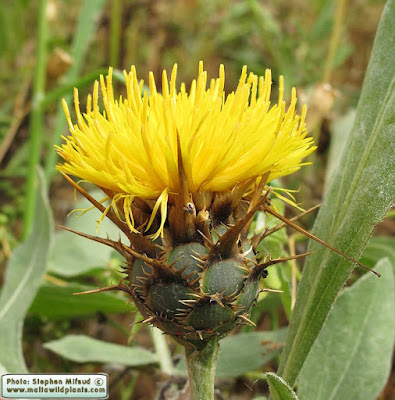
Centaurea acaulis is an inhabitant of dry, rocky habitats that is native to Tunisia and northeastern Algeria. As indicated by both the vernacular and botanical names, its growth habit lacks a central stem. Instead, the long, lobed leaves (which can be up to about a foot in length going by photos provided by Agut Escrig et al., 2021) lie prostrate on the ground. These leaves end in a large, ovate apical section with lobes running down the side of the central rib, becoming smaller towards the base. Flower heads are solitary and carry a mass of bright yellow florets. The involucral bracts (the 'scales' around the outside of the base of the flower head) are flat and green with darker longitudinal veins. The distal section of the bracts is triangular with a membranous, ciliate margin and typically (though not always) ends in a long spine. A closely related species found in northwestern Algeria and Morocco, C. oranensis, has historically been treated as a subspecies of C. acaulis (under the name C. acaulis ssp. boissieri, because botanical nomenclature is weird). However, C. oranensis was raised to species level by Greuter & Aghababian (in Greuter & von Raab-Straube, 2005) on the basis of its distinct involucral bracts, which are distally blackish, ovate and concave, with a margin of dense, long, stiff setae.

Close-up of flower head of Centaurea acaulis, copyright Stephen Mifsud.


Recent years have seen this species extending its range northwards with populations now found in Spain, Italy and Malta. In Malta, it was initially found grown in a disturbed area with particularly alkaline soil (Buttigieg & Lanfranco 2001). The mechanism of its arrival is uncertain. It could have dispersed naturally across the Mediterranean, or it may have arrived mixed into bird seed. However it got there, one might expect that as the south of Europe becomes increasingly hotter and drier, the stemless star-thistle will continue to spread.

REFERENCES

Agut Escrig, A., J. P. Solís Parejo & P. Urrutia Uriarte. 2021. Noticias sobre la presencia de Centaurea acaulis L. (Asteraceae) en la Península Ibérica. Flora Montiberica 81: 51–54.

Banfi, E., G. Galasso & A. Soldano. 2005. Notes on systematics and taxonomy for the Italian vascular flora. 1. Atti Soc. It. Sci. Nat. Museo Civ. Stor. Nat. Milano 146 (2): 219–244.

Buttigieg, R., & E. Lanfranco. 2001. New records for the Maltese flora: Centaurea acaulis L. (family: Asteraceae). Central Mediterranean Naturalist 3 (3): 147–148.

Greuter, W., & E. von Raab-Straube (eds) 2005. Euro+Med notulae, 1. Willdenowia 35: 223–239.

Leandra

I'm sure I've noted before that there are a number of plant families that form significant components of the world's flora but tend to glide under the radar of popular representation owing to their largely tropical distributions. One of the prime examples is the Melastomataceae, an assemblage of over 5000 known species that represents one of the ten largest recognised plant families. Melastomes often stand out from other tropical plants by their distinctive leaves, which are opposite with acrodromous venation (several strong longitudinal veins arch outwards from the base to converge near the tip) and flowers that often bear large, colourful anthers (New York Botanical Garden). They are most diverse in the Neotropics with one of the significant genera found in this region being Leandra.

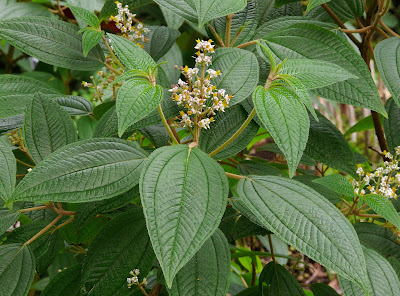
Leandra subseriata, copyright James Gaither.


As currently recognised, Leandra includes over two hundred species with the highest diversity centred in southeastern Brazil. Leandra forms part of the tribe Miconieae, distinguished by flowers with more or less inferior ovaries and fleshy berry fruits. Genera within the Miconieae have historically been difficult to define; as early as 1891, the Belgian botanist Alfred Cogniaux declared that they were essentially arbitrary. Leandra was supposed to be defined by its acute petals and terminal inflorescences but it has not always been clear whether a given species can be said to possess these features or not. It should therefore come as no surprise that the genus Leandra proved to be polyphyletic with the advent of molecular analysis (Martin et al. 2008). Nevertheless, a large clade centered on southern Brazil has continued to be referred to as Leandra sensu stricto.

There appear to be few if any direct observations of pollination in Leandra but flower morphology and comparison with related genera suggests that they are buzz-pollinated with pollinators taking pollen as a reward (Reginato & Michelangeli 2016b; buzz-pollination referring to pollination by bees where the bee's buzzing induces the flower to release pollen). Apomixis, with seeds being produced directly from ovule tissue without pollination, is not uncommon and may even be the majority condition (Reginato & Michelangeli 2016a). Seeds are dispersed by birds feeding on the berries. Many Leandra species appear very localised in distribution and they are particularly diverse in a number of high altitude areas. Species vary in their preferred habitat from disturbed to undisturbed; those species found in undisturbed locations are rare components of the understory, but those found in disturbed habitats may be among the most abundant shrubs in the area.

REFERENCES

Martin, C. V., D. P. Little, R. Goldenberg & F. A. Michelangeli. 2008. A phylogenetic evaluation of Leandra (Miconieae, Melastomataceae): a polyphyletic genus where the seeds tell the story, not the petals. Cladistics 24: 315–327.

Reginato, M., & F. A. Michelangeli. 2016. Diversity and constraints in the floral morphological evolution of Leandra s.str. (Melastomataceae). Annals of Botany 118: 445–458.

Reginato, M., & F. A. Michelangeli. 2016. Untangling the phylogeny of Leandra s.str. (Melastomataceae, Miconieae). Molecular Phylogenetics and Evolution 96: 17–32.

Herbs of Dragons and Worms

Preparing for this post has inspired me to some low-key experimentation. When it came time to assign myself its topic, I landed on the plant genus Artemisia. This is the genus that, among others, includes the culinary herb tarragon, Artemisia dracunculus. Which got me thinking that I wasn't sure if I'd ever actually eaten tarragon. I asked Christopher if he was familiar with it; he responded that all he knew about tarragon was that you had to consume it in the 1970s. Without access to a functioning Delorean, I did the next best thing and prepared a dish of tarragon chicken myself. The verdict: very tasty, though I could appreciate why tarragon might have a reputation for being somewhat difficult as it had a light flavour that I could imagine being easily overwhelmed.

Tarragon Artemisia dracunculus, copyright Cillas.


Tarragon is not the only species of Artemisia of significance to humans. This genus of composite-flowered plants comprsises over five hundred species and subspecies of herbs and small shrubs. The greatest diversity is found in arid and semi-arid regions of the Northern Hemisphere temperate zone (Sanz et al. 2008). The genus is characterised by its distinctive pollen with surface spinules reduced or absent. This pollen type is associated with the wind pollination typical of the genus, though some species do exhibit features such as sticky pollen and colourful flower-heads associated with insect visitation (Hayat et al. 2009). The flower-heads or capitula (a reminder that the 'flowers' of composite plants such as daisies and thistles actually represent a fusion of multiple flowers) of Artemisia are either disciform, with an outer circle of reduced ray florets surrounding the inner disc florets, or discoid, with disc florets only. In disciform capitula, the outer limb of the ray florets is reduced to a membranous vestige, not readily visible without minute examination. The ray florets are female whereas the disc florets are ancestrally hermaphroditic (more on that shortly). In discoid capitula, where the ray florets have been lost, all florets are uniformly hermaphroditic.

Mugwort Artemisia vulgaris, copyright Christian Fischer.


Historically, there has been some variation in the classification of Artemisia but a popular system divides the genus between five subgenera. A phylogenetic analysis of Artemisia and related genera by Sanz et al. (2008) found that the genus as currently recognised is not monophyletic, with a handful of small related genera being embedded within the clade. Time will tell whether this inconsistency is resolved by subdividing Artemisia or simply rolling in these smaller segregates, but for the purposes of this post they can be simply set aside. The subgenus Dracunculus, including tarragon and related species, falls in the sister clade to all other Artemisia. As well as being united by molecular data, members of this clade are distinguished by disciform capitula in which the central disc florets have become functionally male (female organs have been rendered sterile).

Wormwoood Artemisia absinthium, copyright AfroBrazilian.


The second clade encompasses the subgenera Artemisia and Absinthium, with disciform capitula, and Seriphidium and Tridentatae, with discoid capitula. Not all authors have supported the distinction of Artemisia and Absinthium, and Sanz et al. identify both as non-monophyletic, both to each other and to the discoid subgenera. Because of their similar flower-heads, most authors have presumed a close relationship between the Eurasian Seriphidium and the North American Tridentatae (commonly known as sagebrushes). Some have even suggested the former to be ancestral to the latter. However, Sanz et al.'s results questioned such a relationship, instead placing the Tridentatae species in a clade that encompassed all the North American representatives of the Artemisia group.

As well as the aforementioned tarragon, economically significant representatives of Artemisia include wormwood A. absinthium, best known these days as the flavouring agent of absinthe (though historically it has also been used for more innocuous concoctions). Mugworts (A. vulgaris and related species) have also been used for culinary and medicinal purposes. Sagebrushes are a dominant component of the vegetation in much of the Great Basin region of North America, providing crucial habitat for much of the region's wildlife. Artemisia species have shaped the lives of many of their co-habitants, both animal and human.

REFERENCES

Hayat, M. Q., M. Ashraf, M. A. Khan, T. Mahmood, M. Ahmad & S. Jabeen. 2009. Phylogeny of Artemisia L.: recent developments. African Journal of Biotechnology 8 (11): 2423–2428.

Sanz, M., R. Vilatersana, O. Hidalgo, N. Garcia-Jacas, A. Susanna, G. M. Schneeweiss & J. Vallès. 2008. Molecular phylogeny and evolution of floral characters of Artemisia and allies (Anthemideae, Asteraceae): evidence from nrDNA ETS and ITS sequences. Taxon 57 (1): 66–78.

The Cordia Clade

The tropics are home to a wide diversity of plant species, many of them belonging to groups less familiar in cooler regions of the world. Prominent among these are members of the family Cordiaceae, a group of about 350 known species of mostly trees and shrubs. The Cordiaceae (alternatively treated as the subfamily Cordioideae of the family Boraginaceae) are a well distinguished clade both molecularly and morphologically. Most members of the clade have flowers with the stigma divided between four lobes, fruits with an undivided endocarp, and plicate cotyledons (Miller & Gottschling 2007).

Beach cordia Cordia subcordata, copyright Tauʻolunga.


Historically, most members of the clade have been assigned to a single genus, Cordia. This arrangement was revised by Miller & Gottschling (2007) who recognised the separate genus Varronia for about 100 species of multi-stemmed shrubs native to the New World. The remaining 250 or so species, most of them single-trunked trees, remained in the pantropical Cordia. The two genera also generally differ in their leaves (most Varronia have leaves with serrate margins whereas Cordia have entire margins) and inflorescences (most Cordia have broad cymose inflorescences whereas Varronia have smaller, more compact inflorescences). Few species of Cordiaceae are not assigned to either Cordia or Varronia. Three previously recognised small genera, Auxemma, Patagonula and Saccellium, are now synonymised with Cordia. The small African genus Hoplestigma and the prostrate annual herb Coldenia procumbens are placed in Cordiaceae primarily on the basis of molecular data (Miller & Gottschling 2007; Weigend et al. 2014).

Black sage Varronia curassavica, copyright Mauricio Mercadante.


A number of Cordia species are grown for their wood, with South American species providing timbers known as bocote, freijo (C. alliodora), and ziricote (C. dodecandra). These are only moderately strong woods but strikingly patterned and are more often used for aesthetic rather than structural purposes (such as cabinet veneers and musical instruments). Cordia alliodora has become an invasive in regions where it has been planted outside its native range such as Africa and Vanuatu. Various species are also grown for their edible fruits, such as the Assyrian plum C. myxa and the fragrant manjack C. dichotoma. These fruits are decidedly gooey when ripe and are often given names reflecting this fact such as glue berries, clammy cherries or, here in Australia, snotty gobbles (though this name is more widely used for fruits of the unrelated genus Persoonia). Pulp from unripe fruits of C. myxa can supposedly also be used as a type of glue. Your office reports may not be informative but they will at least be tasty!

REFERENCES

Miller, J. S., & M. Gottschling. 2007. Generic classification in the Cordiaceae (Boraginales): resurrection of the genus Varronia P. Br. Taxon 56 (1): 163–169.

Weigend, M., F. Luebert, M. Gottschling, T. L. P. Couvreur, H. H. Hilger & J. S. Miller. 2014. From capsules to nutlets—phylogenetic relationships in the Boraginales. Cladistics 30: 508–518.

Tears of a Baby

For many people, the most familiar members of the plant family Urticaceae are the stinging nettles. However, the nettles make up only one part of this cosmopolitan family and there are many representatives that do not sting. One such plant is Soleirolia soleirolii, commonly referred to by the vernacular name of baby's tears.

Baby's tears Soleirolia soleirolii growing around dwarf horsetail Equisetum scirpoides, copyright Carnat Joel.


The only species of its genus, Soleirolia soleirolii is a small creeping herb with more or less succulent stems and subcircular leaves half a centimetre or less in diameter (Harden 1990). It grows in damp habitats and may even grow submerged in water. Baby's tears form a dense flat mat with stems rooted at the nodes. The tiny white flowers reach only a millimetre in size. Wikipedia lists a number of vernacular names for this plants, such as baby's tears, angel's tears, Corsican creeper, or mind-your-own-business (I have no idea what this last name refers to).

In its native range, Soleirolia soleirolii is mostly restricted to islands of the western Mediterranean, including Corsica, Sardinia and Majorca, with a localised mainland population near Rome in Italy (Schüßler et al. 2019). A population was also recently discovered near the coast of Algeria (Hamel & Boulemtafes 2017). On the basis of molecular phylogenetic dating, Schüßler et al. (2019) suggested that its current range may be relictual, having gone extinct over most of mainland Europe as the climate changed. However, as those who glanced at the references for this post may have already guessed, Soleirolia has now become established in many parts of the world outside its native range. It has often been grown as a ground cover or houseplant. If it finds itself somewhere it likes, it may become invasive; though easily uprooted, its proclivity for vegetative reproduction means that it can easily return if not thoroughly cleared. And so we have a paradox, where what is regarded as a valuable relict in one location may be considered a vexatious weed in another.

REFERENCES

Hamel, T., & A. Boulemtafes. 2017. Découverte d'une endémique tyrrhénienne Soleirolia soleirolii (Urticaceae) en Algérie (Afrique du Nord). Flora Mediterranea 27: 185–193.

Harden, G. J. (ed.) 1990. Flora of New South Wales vol. 1. New South Wales University Press.

Schüßler, C., C. Bräuchler, J. A. Reyes-Betancort, M. A. Koch & M. Thiv. 2019. Island biogeography of the Macaronesian Gesnouinia and Mediterranean Soleirolia (Parietarieae, Urticaceae) with implications for the evolution of insular woodiness. Taxon 68 (3): 537–556.

The New Centaury

In an earlier post, I described the South American flowering herbs known as the Coutoubeinae. In this post, I'm going to take a step back and look at a clade of which the coutoubeines form a part, the Chironieae.

Seaside centaury Centaurium littorale, copyright Anne Burgess.


The Chironieae are one of the major tribes of the flowering plant family Gentianaceae, including about 160 known species. Representatives are found in most parts of the world, though as part of the native flora in Australasia they do not extend past the north of Australia (some exotic species have been introduced further south). The Chironieae seem to primarily be supported as a clade on the basis of molecular data (Struwe et al. 2002). All members are herbs, from annuals to short-lived perennials. Most have an erect growing habit; members of the Caribbean genus Bisgoeppertia are annual climbers and some species of the Mexican genus Geniostemon are creeping perennials. There may or may not be a basal rosette of leaves, and a number of genera have winged stems. Flowers are solitary or borne in cymose or racemose inflorescences. These flowers are most commonly salver-shaped (that is, shaped like a flat dish) or tubular, and usually have four or five petals (some species may have up to twelve). The calyx is usually comprised of fused sepals and is unwinged and tubular. The fruit is usually a septicidal capsule (splitting along the septa between carpels), more rarely a berry.

Yellow centaury Cicendia filiformis, copyright Hajotthu.


Members of the Chironieae are divided between three subtribes that are mostly distinct both morphologically and biogeographically. As described in the previous post, the Neotropical Coutoubeinae are characterised by releasing their pollen in tetrads whereas the other subtribes shed individual pollen grains. The Canscorinae are mostly found in the Old World tropics and have white or cream-coloured flowers (less commonly yellow, pink or purple) with the calyx tube longer than the calyx lobes. The Chironiinae mostly includes found in northern temperate regions, as well as the southern African genera Chironia and probably the South American Zygostigma. Their flowers come in a range of colours—pink, yellow, purple or blue, but less commonly white or cream-coloured—and may have calyx lobes longer than the tube. Many chironiine flowers also have anthers that become spirally twisted after releasing pollen whereas those of Canscorinae are always straight. Molecular data usually support the monophyly of the three subtribes and the majority view seems to be that the temperate Chironiinae represent the sister group of a tropical clade of Canscorinae and Coutoubeinae.

Cultivated Eustoma, copyright Rameshng.


Perhaps the best known members of the Chironieae are the centauries of the genus Centaurium. Historically, about fifty species across the Holarctic have been included in this genus. However, phylogenetic studies have demonstrated that this broad sense of the genus is polyphyletic and thus it has been cut down to a group of about twenty species found in Europe and western Asia. The name 'centaury' refers to the use of common centaury Centaurium erythraea as a medicinal herb, after the legendary centaur healer Chiron. Other Old World species are now placed in the genus Schenkia whereas North American species form the genera Gyrandra and Zeltnera. The yellow centauries of Cicendia are small, filiform annuals native to Europe and the Americas that have been introduced to Australia. The rose gentians Sabatia of North America bear pinkish-purple flowers, often in lax cymes. There are also the prairie gentians of the genus Eustoma. Native to southern North America, these plants bear large, showy flowers that have become popular in cultivation. Commercially, they are labelled as lisianthus. This is not to confused with Lisianthius, a distinct genus of Gentianaceae, or Lisyanthus, a name that has been used in the past for members of yet another gentianaceous genus. Both of these belong to completely different tribes in the family, and may be subjects for another day.

REFERENCE

Struwe, L., J. W. Kadereit, J. Klackenberg, S. Nilsson, M. Thiv, K. B. von Hagen & V. A. Albert. 2002. Systematics, character evolution, and biogeography of Gentianaceae, including a new tribal and subtribal classification. In: Struwe, L., & V. A. Albert (eds) Gentianaceae: Systematics and Natural History pp. 21–309. Cambridge University Press: Cambridge.

The Spread of Carrots

Carrots are one of the staple vegetables in this part of the world as well as in a great many others. Indeed, Wikipedia informs us that about forty million tonnes of carrots and turnips were produced worldwide in 2018, and I would have to think that carrots accounted for the greater part of that number. Wild carrots are also a widespread weed that can commonly be seen growing in disturbed, open habitats such as roadside verges. This post is about the group of plants that carrots typify, the subtribe Daucinae.

Wild carrot Daucus carota in flower, copyright Cwmhiraeth.


Daucinae is a subgroup of the plant family Apiaceae, historically known as the Umbelliferae. The latter name refers to the characteristic production of flowers in dense, flat-topped inflorescences known as umbels. Anyone who is familiar with the appearance of carrot flower-heads is familiar with the form of an umbel; the wild form of carrot is often known as "Queen Anne's lace" in reference to said appearance. The fruit of Apiaceae species is a schizocarp, a dry fruit that splits at maturity into segments (called mericarps), each containing a single seed, that are dispersed independently. In Daucinae and related group of umbellifers, the mericarps carry longitudinal ribs, both primary ribs containing a vascular bundle and secondary ribs without. The secondary ribs of Daucinae are often modified to form broad wings or curved spines that function in the mericarp's dispersal.

Broad-leafed sermountain Laserpitium latifolium seedheads, showing wings, copyright Krzysztof Ziarnek, Kenraiz.


Historically, these differences in mericarp morphology have been used to assign the species bearing them to different tribes. However, more recent phylogenetic analyses have indicated that changes between wings and spines have occurred on multiple occasions due to changes in mode of dispersal (Wojewódzka et al. 2019). Mericarps bearing wings are generally anemochorous (dispersed by wind) whereas those bearing spines are epizoochorous (carried by animals, such as stuck to a mammal's fur). The distinction is not 100% immutable: winged seeds may sometimes get caught in fur, spined seeds may be carried slightly further by wind than smooth ones. Phylogenies indicate that anemochory was the ancestral condition for Daucinae, retained in genera such as Laserpitium and Thapsia. Epizoochorous species do not form a single clade within the Daucinae (indeed, the genus Daucus includes both anemochorous and epizoochorous species) but it is unclear to what degree epizoochory arose on multiple occasions versus reversions to anemochory from epizoochorous ancestors. Two species of Daucinae, Daucus dellacellae from the Cyrenaica region of northern Africa and Cryptotaenia elegans from the Canary Islands, have neither spines nor wings on their mericarps which are therefore dispersed by gravity alone. In the case of C. elegans, at least, it has been suggested that it evolved from epizoochorous ancestors that lost the spines because of the absence of suitable dispersing animals on the islands (Banasiak et al. 2016).

Though the carrot Daucus carota is perhaps the most widely grown daucine umbellifer, it is not the only economically significant member of the group. Cumin Cuminum cyminum, whose seeds are widely used as a spice, is either a daucine or a close relative of daucines (Banasiak et al. 2016). Cuminum does differ from other daucine genera in that its mericarps lack appendages on the secondary keels, however. Gladich Laser trilobum is a perennial found growing in Europe and western Asia whose seeds are used as a condiment. Certain species of the deadly carrot genus Thapsia have a history of medicinal usage though, as their vernacular name suggests, their use does require caution. One species, T. garganica, is among the suggested candidates for the identity of the mysterious silphium of the Romans (used, among other things, as an abortifacient) though perhaps not the most likely contender. That, perhaps, is a story for another time.

REFERENCES

Banasiak, Ł., A. Wojewódzka, J. Baczyński, J.-P. Reduron, M. Piwczyński, R. Kurzyna-Młynik, R. Gutaker, A. Czarnocka-Ciecura, S. Kosmala-Grzechnik & K. Spalik. 2016. Phylogeny of Apiaceae subtribe Daucinae and the taxonomic delineation of its genera. Taxon 65 (3): 563–585.

Wojewódzka, A., J. Baczyński, Ł. Banasiak, S. R. Downie, A. Czarnocka-Ciecura, M. Gierek, K. Frankiewicz & K. Spalik. 2019. Evolutionary shifts in fruit dispersal syndromes in Apiaceae tribe Scandiceae. Plant Systematics and Evolution 305: 401–414.

Five-fingers and Lancewoods

Longtime readers of this blog will know that my knowledge of plants has always been fairly rudimentary. As a young'un, I only ever learnt to distinguish some of the more common and visible varieties. As a student, I did take a few botany classes, but only really enough to learn that plant biology is complicated and terrifying. Since then, I've continued in much the same vein. But for today's post, I'm looking at something I do recall being aware of in my youth: the lancewoods and five-fingers of the genus Pseudopanax.

Horticultural variant of coastal five-finger Pseudopanax lessonii, copyright Leonora Enking.


Pseudopanax is a genus of a dozen species of small tree (mostly growing about five to seven metres in height) found only in New Zealand (Perrie & Shepherd 2009). Various species have also been assigned to the genus from locations around the Pacific (China, Tasmania, New Caledonia and Chile) but recent studies have lead to their exclusion. A handful of New Zealand species previously included in Pseudopanax have also been separated as the genus Raukaua (Mitchell et al. 1997). The historical taxonomy of the group is confusing, with species being variously attributed to genera Panax, Nothopanax, Neopanax and Polyscias. Things seem to have settled down a bit in recent years but there is still the possibility we may one day see Neopanax rise again (Perrie & Shepherd 2009).

Chatham Islands lancewood Pseudopanax chathamicus, copyright Krzysztof Ziarnek, Kenraiz.


Pseudopanax belongs to the family Araliaceae, a group that is primarily composed of tropical and subtropical shrubs and trees. Araliaceae are commonly referred to as "the ivy family", after one of their best-known members, the common ivy Hedera helix, but, as is not uncommon when a tropical family gets named after one of their European outliers, ivy is pretty weird by Araliaceae standards. Pseudopanax species are perhaps a bit more typical. They have large leaves, often more or less toothed or lobed along the margins. In a number of species, the leaves are palmately divided into three or five separate leaflets, hence the aforementioned vernacular name of 'five-finger'. In one group of species, the lancewoods, the lateral leaflets have been lost and the now undivided leaf is more or less long and narrow. Hybrids between five-fingers and lancewoods may have multiple leaflets like a five-finger but the leaflets shaped like those of a lancewood; New Zealand botanist Leon Perrie has written a post about hybridisation in this genus that you can read here. The trees are usually dioecious (male and female flowers are borne on separate trees) and the individually small flowers are borne aggregated in compound umbels. Fruits are fleshy berries.

Collection of lancewoods P. crassifolius showing the variation in leaf form, copyright Petra Gloyn. Two individuals on the left are young tress with hanging leaves; to the right is a more mature individual with spreading leaves.


Within Pseudopanax, the lancewoods are particularly renowned for their exhibition of heteroblasty, a phenomenon where the appearance of the leaves changes significantly as the tree matures. Juvenile leaves of the common lancewood P. crassifolius and toothed lancewood P. ferox are remarkably long, slender, strongly toothed along the margin, stiff and leathery, and hang downwards around the young tree like a skirt. As the tree approaches its mature height, it starts producing shorter, softer, less serrate leaves that are held in a more or less horizontal position.

Changes in growth habit with maturity seem to be surprisingly common among New Zealand plants and there has been a lot of discussion about why this might be. One suggestion that has certainly received a lot of public attention is that it is a relic of browsing by the large herbivorous birds such as moa that dominated the New Zealand environment prior to human settlement. Juvenile plants developed a habit that was energetically expensive but discouraged browsing by birds; as they grew high enough to escape the reach of such browsers, they changed to a less demanding form. I personally tend to be skeptical of these kinds of claims of historical baggage, not least because the extinction of one-half of the equation makes them very hard to test in any way, but I will admit that this case does perhaps have a bit more credibility than, for instance, claims elsewhere of giant fruits being dependent on long-extinct megafauna. Alternatively, it has been suggested that changes in growth habit may be related to climatic conditions; the juvenile leaves of P. crassifolius dissipate heat more effectively than those of mature trees (Gould 1993). Heteroblasty is less pronounced in the montane lancewood P. linearis of the South Island and almost absent in the Chatham Islands lancewood P. chathamicus, an insular derivative of P. crassifolius. Were these species insulated from the selective pressures affecting the other two? It should also be pointed out that the two proposals mentioned here are not mutually exclusive; the consideration of one as a factor does not automatically rule out the other.

REFERENCES

Gould, K. S. 1993. Leaf heteroblasty in Pseudopanax crassifolius: functional significance of leaf morphology and anatomy. Annals of Botany 71: 61–70.

Mitchell, A. D., D. G. Frodin & M. J. Heads. 1997. Reinstatement of Raukaua, a genus of the Araliaceae centred in New Zealand. New Zealand Journal of Botany 35 (3): 309–315.

Perrie, L. R., & L. D. Shepherd. 2009. Reconstructing the species phylogeny of Pseudopanax (Araliaceae), a genus of hybridising trees. Molecular Phylogenetics and Evolution 52: 774–783.

The Coutoubeines

Members of the family Gentianaceae, the gentians, are for the greater part associated with cooler climes. Residents of areas subject to heavy snowfalls have often commented on the appearance of their showy flowers with warming weather in the spring. But not all subgroups of the gentians are so temperate: some, such as the Coutoubeinae, are inhabitants of the tropics.

Schultesia guianensis, copyright João de Deus Medeiros.


The Coutoubeinae are a group of about thirty known species divided between five genera found in Central and South America (Struwe et al. 2002). A single species, Schultesia stenophylla, is found in western Africa but, as it is also found in Brazil alongside related species, it can be reasonably presumed to be a recent immigrant to that region. Like most other members of the Gentianaceae, species of the Coutoubeinae are low herbs, often found growing in open habitats. With the exception of the genus Deianira, most lack a basal rosette of leaves. Flowers are usually white or pink, and are quadrimerous (with four corolla lobes) in the majority of species (one species, Schultesia pachyphylla, has blue pentamerous flowers; Guimarães et al. 2013). Perhaps the most characteristic feature of the group is that pollen is released in tetrads (clumps of four). I haven't come across any specific comments on the functional significance (if any) of this feature in coutoubeines but it has been suggested that pollen clumping in plants may correlate with visits from pollinators being relatively uncommon (and getting a decent amount of pollen transported at a time becomes more important than increasing the chance of pollen being transported to multiple targets).

Coutoubea spicata, copyright Alex Popovkin.


The largest genus of coutoubeines is Schultesia, including about twenty species. Schultesia species are annual herbs with long-lanceolate leaves and tube-shaped, usually pink (occasionally yellow or blue) flowers with the calyx tube at least as long as the lanceolate corolla lobes. The species Xestaea lisianthoides, sometimes included in Schultesia, differs from Schultesia in the arrangement of stamens (inserted unevenly in the corolla rather than in the upper part of the tube) and the shape of the stigmatic lobes (oblong rather than rounded). Coutoubea species have white, salver-shaped flowers with triangular corolla lobes. Symphyllophyton caprifolium, a rare species restricted to southern Brazil, is a short-lived perennial with perfoliate leaves and yellow to cream salver-shaped flowers with the calyx tube shorter than the corolla lobes. Finally, Deianira includes suffrutescent herbs with a basal rosette of leaves and salver-shaped flowers with a short calyx tube.

REFERENCES

Guimarães, E. F., V. C. Dalvi & A. A. Azevedo. 2013. Morphoanatomy of Schultesia pachyphylla (Gentianaceae): a discordant pattern in the genus. Botany 91: 830–839.

Struwe, L., J. W. Kadereit, J. Klackenberg, S. Nilsson, M. Thiv, K. B. von Hagen & V. A. Albert. 2002. Systematics, character evolution, and biogeography of Gentianaceae, including a new tribal and subtribal classification. In: Struwe, L., & V. A. Albert (eds) Gentianaceae: Systematics and Natural History pp. 21–309. Cambridge University Press: Cambridge.

Australasian Mistletoes

Australia is home to a fair diversity of parasitic mistletoes, nearly ninety species in all. In a previous post, I described one of our most remarkable species, the terrestrial Nuytsia floribunda. But, of course, the remaining species occupy the more typical aerial mistletoe habitat, growing directly attached to the branches and trunk of their host. And within Australia, the most diverse mistletoe genus is Amyema.

Amyema pendula growing on Acacia, copyright Groogle.


Species of Amyema are found in southeast Asia, Australia, and islands of the Pacific as far east as Samoa. A revision of the genus by Barlow (1992) recognised 92 species with the greatest diversity in the Philippines, Australia and New Guinea. They are found in a range of habitats, from wet rainforests to arid woodlands. Some species (particularly in arid habitats) grow from a single central haustorium (the structure by which a parasitic plant attaches to and draws nutrients from its host); others (particularly rainforest species) produce numerous haustoria from runners stretching along the outside of the host. Most rainforest species tend to have low host specificity but those growin in arid habitats may be more likely to restrict themselves to a small number of host species. Those species which restrict themselves to a single host may have leaves closely resembling that host, making them difficult to spot within the host canopy.

Amyema species are mostly characterised by their flowers which are typical borne in triads with the triads often then being clustered in loose umbels. In some species, the triads are reduced to pairs or single flowers. The flowers themselves are bird-pollinated and have four to six long petals that are generally separated right to the base, at most forming only a very short tube at the base of the flower. The flowers are hermaphroditic though a study of some Australian species by Bernhardt et al. (1980) found a tendency for anthers to mature before the stigma, presumably to prevent self-pollination.

Flowers of Amyema miquelii, copyright Kevin Thiele.


Not surprisingly, attention on mistletoes in Australia has commonly been focused on their effect on host trees. Mistletoe infestations may be heavy and have commonly been blamed for tree mortalities. However, one might legitimately question whether mistletoes themselves cause fatalities: does mistletoe infestation cause a host tree to become unhealthy, or are unhealthy trees more vulnerable to infestation by mistletoes? A study by Reid et al. (1992) on Amyema preissii infesting Acacia victoriae found that, though there was a relationship between mistletoe volume and host mortality, they were unable to demonstrate that mistletoe removal improved host survival. Conversely, such a positive effect was found by Reid et al. (1994) for removal of Amyema miquelii growing on two Eucalyptus species (the methods of this latter study also include the great line, "the highest mistletoes had to be shot down with a .22 rifle"). However, the authors remained conservative when it came to advocating mistletoe removal. Not only do a number of native birds and other animals depend on mistletoes for food and nesting sites, mistletoe removal can be an expensive process and may not itself be devoid of adverse effects on the host tree. Where rates of infestation are not extreme, it may still be better to just live and let live.

REFERENCES

Barlow, B. A. 1992. Conspectus of the genus Amyema Tieghem (Loranthaceae). Blumea 36: 293–381.

Bernhardt, P., R. B. Knox & D. M. Calder. 1980. Floral biology and self-incompatibility in some Australian mistletoes of the genus Amyema (Loranthaceae). Australian Journal of Botany 28: 437–451.

Reid, N., D. M. Stafford Smith & W. N. Venables. 1992. Effect of mistletoes (Amyema preissii) on host (Acacia victoriae) survival. Australian Journal of Ecology 17: 219–222.

Reid, N., Z. Yan & J. Fittler. 1994. Impact of mistletoes (Amyema miquelii) on host (Eucalyptus blakelyi and Eucalyptus melliodora) survival and growth in temperate Australia. Forest Ecology and Management 70: 55–65.

White by Evening in the American Southwest

Though various species of it may be found around the world, the evening primrose family Onagraceae reaches its highest diversity in the south-west of North America. For this post, I'm looking at a genus endemic to this region, Eremothera.

Eremothera boothii, copyright Kerry Woods.


Eremothera is one of several genera of evening primroses newly recognised by Wagner et al. (2007). The species included in this genus had previously been included in the broader genera Oenothera or Camissonia, but these genera were progressively broken down owing to polyphyly and poor definitions. Eremothera species are annual herbs with more or less erect stems. Leaves are arranged on the stem alternately; those near the base are carried on a long petiole of up to six centimetres. The genus is distinguished from its close relatives by having mostly white flowers that open in the evening (in rare cases they my be pink or red, fading as they age). Pollination is by moths when the flowers first open, with small bees visiting the flowers the following morning. The fruit is a long capsule that arises directly from the main stem without a subtending stalk.

Eremothera refracta with flowers and green fruits, copyright Stan Shebs.


Seven species of Eremothera were recognised by Wagner et al. (2007). Eremothera nevadensis is a specialist of clay soil that occupies a relatively small range in Nevada, around Reno. Eremothera refracta is a widespread species in the south-west United States with fruit that are of an even diameter along their length (Hickman 1993). Eremothera chamaenerioides is a self-pollinating derivative of E. refracta with smaller flowers in which the stigma is surrounded and overtopped by the anthers. Eremothera boothii and E. minor (both also widespread) have fruits that are wider at the base than at the tip. In E. minor the inflorescence is held erect; in E. boothii the flowers nod. Two localised species, E. gouldii and E. pygmaea, are self-pollinating derivatives of E. boothii. Eremothera minor is also self-pollinating, and may in some cases even be cleistogamous with pollen being transferred to the stigma without the flower even opening.

REFERENCES

Hickman, J. C. (ed.) 1993. The Jepson Manual: Higher Plants of California. University of California Press: Berkeley (California).

Wagner, W. L., P. C. Hoch & P. H. Raven. 2007. Revised classification of the Onagraceae. Systematic Botany Monographs 83: 1–240.

Canterbury Bells

Bellflowers or harebells are one of the classic plants associated with the English country garden. For today's post, I'll be covering the family of plants that bellflowers belong to.

Fairy's thimble Campanula cochleariifolia, copyright Jerzy Opioła.


The Campanulaceae are a family of over 2300 plant species found almost worldwide (Crowl et al. 2016). The family is, however, divided between five subfamilies that some authors would treat as separate families, in which case 'Campanulaceae' would be restricted to the 600 or so species of the subfamily Campanuloideae. It is this subfamily that includes the bellflowers. The vernacular name, of course, refers to the shape of the flowers produced by these plants, as indeed does the botanical name: Campanula translates as 'little bell'. These flowers are radiately symmetrical with all petals more or less the same size and shape and evenly arranged in a circle. Other subfamilies of the Campanulaceae in the broad sense, the largest of which is the lobelias of the Lobelioideae, produce more bilaterally symmetrical flowers with petals differing in size and/or with some petals closer together than others. Fruits are most commonly a capsule, with the seeds dispersed by wind, but some lobelioids produce fleshy fruits that attract birds. The lobelioids are most diverse in the southern continents, and it is thought that this may have been the original home of the family as a whole when it arose sometime close to the end of the Cretaceous, possibly in Africa. At some time in the early Cenozoic, however, the campanuloids arrived in and underwent a significant radiation in the Palaearctic. This dispersal may be related to the different flower morphology of the campanuloids, as they adapted from the bird, bat and butterfly pollinators of the tropics to the bee and fly pollinators of more temperate habitats.

Glandular threadplant Nemacladus glanduliferus var. orientalis, copyright Stan Shebs.


The genetics of Campanulaceae, specifically of their chloroplasts, should also not go unnoticed. The structure of the chloroplast genome in plants is usually very stable, with few changes in gene arrangement and order. However, at various points in the history of Campunulaceae, large chunks of foreign DNA have been inserted in the original plastid chromosome, with a number of these insertions also associated with inversions in the direction of adjoining sections of the original genes (Knox 2014). This kind of insertion is unique among flowering plants: changes in the gene content of plastids more usually involve genes being transferred out of the plastid. The source of this extra DNA is uncertain: it may have come from the plant's own nucleus, or it may have come from an as-yet-unknown endosymbiont. Also unknown is the functional significance of these rearrangements, if any. Some insertions have clearly resulted in pseudogenes, with their sequences rapidly breaking down through subsequent genetic drift. But others have preserved the structure of functional genes, suggesting continued selection for their retention.

Cyanea duvalliorum, an arborescent Hawaiian lobeliad, copyright Forest & Kim Starr.


The majority of Campanulaceae are small perennial herbs. Two genera of distinctive enough to be assigned to their own subfamilies include annual herbs: the threadplants Nemacladus of southwestern North America, and the little-known Chilean Atacama desert endemic Cyphocarpus. Some members of the Lobelioideae are woody subshrubs, and at some point one of these woody lobelioids managed to make its way to the Hawaiian archipelago where it gave rise to one of the world's most remarkable insular radiations, and the single largest such radiation in plants. Over 120 species of lobeliads are known from the Hawaiian islands, varying from single-stemmed succulents to straggling vines to trees over 18 metres in height. There are inhabitants of lowland forests, of upland bogs, and of rocky cliffs. There are species producing fruit as dry capsules; others produce fleshy berries. So varied are the Hawaiian lobeliads that previous authors have inferred their origin from multiple seperate colonisations, but a study by Givnish et al. (2009) supported a single origin from a single colonist arriving about thirteen million years ago. This would have been before any of the current major Hawaiian islands existed (the oldest, Kaua'i, is a little less than five million years old); the implication is that the ancestor of the Hawaiian lobeliad arrived on a pre-existing island, perhaps corresponding to the modern Gardner Pinnacles or French Frigate Shoals. As the lobeliads diversified, they continued to disperse onto new islands as they arrived, while their original homeland eroded away.

Sadly, a depressing percentage of the species forming this incredible radiation are now threatened with extinction, the victims of pressures such as loss of habitat, the decline of their pollinators and dispersers, or grazing by introduced mammals. The cliff-dwelling pua 'ala Brighamia rockii of Moloka'i is now restricted to five locations with an estimated total wild population of less than 200 individuals. A related species on Kaua'i, the olulu Brighamia insignis, may be extinct in the wild, having last been recorded in the form of a single individual in 2014 (it still survives in cultivation). As we earlier saw with the Hawaiian honeycreepers, there is barely a single section of the Hawaiian biota not marked by tragedy.

REFERENCES

Crowl, A. A., N. W. Miles, C. J. Visger, K. Hansen, T. Ayers, R. Haberle & N. Cellinese. 2016. A global perspective on Campanulaceae: biogeographic, genomic, and floral evolution. American Journal of Botany 103 (2): 233–245.

Givnish, T. J., K. C. Millam, A. R. Mast, T. B. Paterson, T. J. Theim, A. L. Hipp, J. M. Henss, J. F. Smith, K. R. Wood & K. J. Sytsma. 2009. Origin, adaptive radiation and diversification of the Hawaiian lobeliads (Asterales: Campanulaceae). Proceedings of the Royal Society of London Series B—Biological Sciences 276: 407–416.

Knox, E. B. 2014. The dynamic history of plastid genomes in the Campanulaceae sensu lato is unique among angiosperms. Proceedings of the National Academy of Sciences of the USA 111 (30): 11097–11102.

Of Shrimp Plants and Bear's Breeches

For today's semi-random post, I drew the plant subfamily Acanthoideae. As recognised by Scotland & Vollesen (2000), the Acanthoideae is the largest of the subfamilies of the Acanthaceae by a considerable margin, including about 95% of the family's 2500+ species. Though perhaps not hugely familiar to readers in more temperate climes, the Acanthoideae are one of the dominant groups of herbs and shrubs in tropical parts of the world.

Golden shrimp plant Pachystachys lutea, copyright Dryas.


The Acanthoideae have been recognised as a morphological group since the late 1800s and their integrity has been confirmed by more recent molecular studies. They are distinguished from related plants (within the Lamiales, the order that also includes such plants as the mints and snapdragons) by having capsular fruits that dehisce explosively when mature to scatter their seeds. The seeds are attached within the capsule by hook-shaped stalks called retinacula that presumably play a role in determining how the seeds are released. A classification of Acanthaceae published in 1965 by Bremekamp restricted the family to species with explosive fruits and retinacula, dividing them between two subfamilies, the Acanthoideae and Ruellioideae, based on the absence or presence, respectively, of cystoliths. These are outgrowths of the epidermal cell walls that are impregnated with calcium carbonate. They are visible in the stems and leaves, at least in dried specimens, as hard white streaks. As phylogenetic studies have supported division of Acanthoideae in the broad sense between a cystolith-possessing and a cystolith-lacking clade, the decision whether to recognise 'Ruellioideae' as a separate subfamily comes down to a ranking choice only. At lower levels, the classification of Acanthoideae is less straightforward. Over two hundred genera of Acanthoideae are recognised but just three of those—Justicia, Strobilanthes and Ruellia—account for about half the total number of species. Each of these mega-genera is morphologically diverse and likely to be para- or polyphyletic with regard to related taxa, raising the distinct likelihood of future revisions.

Spiny bear's breeches Acanthus spinosus, copyright Magnus Manske.

Economically, few of the Acanthoideae are of great significance except for a number of species being grown ornamentally. One such species is Acanthus mollis, which goes by the vernacular name of 'bear's breeches' (why, I have absolutely no idea). Acanthus was a popular decorative motif in classical Greece and forms the basis for the design of Corinthian columns. Its use as an ornamental has lead to it becoming regarded as an invasive weed in some regions, largely because this is one of those garden plants that Just Will Not Die, spreading easily from seeds and tubers. We've got some in a pot outside that is currently flourishing despite having been burnt down to a nub by the searing Perth summer sun, metaphorically shouting its defiance at an uncaring world.

REFERENCE

Scotland, R. W., & K. Vollesen. 2000. Classification of Acanthaceae. Kew Bulletin 55 (3): 513–589.

Scurvy and Cress

Without the subject of today's post, it's just possible that my home country of New Zealand could have had quite a different history. Sometimes, one shouldn't overlook the importance of cress.

Pepperwort Lepidium heterophyllum, copyright Anne Burgess.


Lepidium is a genus of herbs and subshrubs belonging to the Brassicaceae, the same family as cabbages, radishes and cauliflowers. The genus is found worldwide, and more than 150 species have been recognised to date. The fruit is a type of dry capsule called a silicle which is usually dehiscent (one subgroup of Lepidium, previously separated as the genus Cardaria, has indehiscent fruit), with strongly keeled or winged valves, and contains a single pendulous seed in each locule. The seeds are usually copiously covered in mucilage (Mummenhoff et al. 2001). Like other members of the Brassicaceae, Lepidium has not been overlooked for culinary uses. Leaves and stems of number of species in the genus, such as garden cress Lepidium sativum and dittander Lepidium latifolium, are used as pot or salad herbs. A South American species, maca Lepidium meyenii, is grown as a root vegetable.

Because of its wide distribution, some early authors suggested that Lepidium was a very ancient genus whose members had diverged with the break-up of the Mesozoic supercontinents. However, more recent phylogenetic analyses (Mummenhoff et al. 2001) have suggested just the opposite: the crown group of Lepidium may have originated in the Mediterranean-Central Asian region little more than two million years ago. The mucilaginous seeds of many species become sticky when damp, and can easily be carried long distances adhered to birds' feet and other such dispersal agents. Perhaps the most dramatic suggestion of intercontinental dispersal in the genus involves a clade of species found in Australia and New Zealand that phylogenetic analysis suggests originated via hybridisation between two divergent species—with one parent being native to South Africa and the other to California (Mummenhoff et al. 2004).

Cook's scurvy grass Lepidium oleraceum, copyright Andrea Brandon.


It was one of the members of the latter clade that played a small but significant role in New Zealand history. Lepidium oleraceum is an endemic New Zealand species that was once found growing over much of the country. It is commonly known as 'Cook's scurvy grass', because Captain James Cook was able to collect it while surveying New Zealand to provide vitamin C to stave off the scurvy that could have otherwise devastated his crew. Sadly, this once common plant is now extremely rare: the disappearance of mainland-nesting seabirds means that they are no longer around to provide the guano-enriched soils on which this plant thrived. It also proved extremely palatable to introduced herbivores. As a result, Cook's scurvy grass is now almost exclusively found on small offshore islets.

REFERENCES

Mummenhoff, K., H. Brüggemann & J. L. Bowman. 2001. Chloroplast DNA phylogeny and biogeography of Lepidium (Brassicaceae). American Journal of Botany 88 (11): 2051–2063.

Mummenhoff, K., P. Linder, N. Friesen, J. L. Bowman, J.-Y. Lee & A. Franzke. 2004. Molecular evidence for bicontinental hybridogenous genomic constitution in Lepidium sensu stricto (Brassicaceae) species from Australia and New Zealand. American Journal of Botany 91 (2): 254–261.

The Mancos Saltbush: Life in the Badlands

Thanks to your support, I am nearly 40% of the way towards success at my crowdfunding drive. But with only two days left on the clock, I'm going to need everyone's help if I'm to be succesful. Please visit my page at Experiment.com and consider offering your support!

Mancos saltbush Proatriplex pleiantha, from here.


Proatriplex pleiantha, the Mancos saltbush, is arguably not much to look at. It never grows very large (only about half a foot in height) and though a single plant may produce a lot of flowers, they are not very showy. Nevertheless, this little fleshy-leaved annual is something of a survivor. It grows on badlands in only a few localities in northern New Mexico and southern Colorado, and may be the only vegetation to be found on the eroded clays that it calls home. It persists in this hostile environment by not persisting; instead, each individual plant will produce hundreds, if not thousands, of seeds during its short life that may lie dormant in the soil for several years, waiting for the flash of rain that will allow it to emerge.

The Mancos saltbush was first described in 1950; its vernacular name refers to the original collection locality near the Mancos River. It was originally described in the genus Atriplex, a diverse cosmopolitan assemblage of herbs and shrubs in the family Chenopodiaceae commonly known as saltbushes and oraches (the garden orache or mountain spinach A. hortensis has long been grown as a vegetable in Europe). However, right from the start it was considered distinctive enough to be placed in its own subgenus, later raised to the status of a distinct genus by Stutz et al. (1990). A molecular phylogenetic analysis by Kadereit et al. (2010) later confirmed that Proatriplex pleiantha is not a direct relative of Atriplex, instead being associated with other small North American Chenopodiaceae genera Grayia and Stutzia. Features distinguishing Proatriplex from true Atriplex include the succulent leaves, the flowers being borne in groups of three to seven in the axil of a single bract, and the presence of a five-segmented perianth around female flowers (Atriplex flowers are borne singly to a bract, and lack a perianth).

Because of its restricted range, the Mancos saltbush may be vulnerable to disturbances in its habitat; for instance, one of its main population centres in New Mexico is in close proximity to the Navajo coal mine. Nevertheless, this species is not currently listed by the US Fish & Wildlife service as being of concern, due to its being locally abundant in the areas where it does occur. Surveys of this species have been complicated by the dependence of its germination on suitable weather conditions: in years with little rainfall, it may appear to be almost absent, but the advent of a wetter year may prove otherwise. All it takes is a decent drop of rain, and you may see the badlands bloom.

REFERENCES

Kadereit, G., E. V. Mavrodiev, E. H. Zacharias & A. P. Sukhorukov. 2010. Molecular phylogeny of Atripliceae (Chenopodioideae, Chenopodiaceae): implications for systematics, biogeography, flower and fruit evolution, and the origin of C4 photosynthesis. American Journal of Botany 97 (10): 1664–1687.

Stutz, H. C., G.-L. Chu & S. C. Sanderson. 1990. Evolutionary studies of Atriplex: phylogenetic relationships of Atriplex pleiantha. American Journal of Botany 77 (3): 364–369.

Checker Mallows

The crowdfunding campaign for my research on New Zealand harvestmen is still active. So far we're about 25% of the way towards the goal! Please click on the link above, and do your part to support your favourite arachnologist.

Flowering spike of Sidalcea nelsoniana, copyright Rhiannon Thomas.


Regular readers may have noticed that it's been a bit quiet around here lately. The last few weeks at chez Christopher have been... hectic. I have been writing posts but not had the time to publish them. So over the next few days, you'll be seeing a bit of a run of short posts in quick succession. Keep your eyes out.

The handsome plant you see above is a representative of Sidalcea, a genus of about thirty species found in the north of Mexico and the western United States. Members of this genus are commonly known as checker mallows (apparently because of the pattern of veins on the petals of some species); in the British gardening trade, they are also known as prairie mallows. As indicated by their vernacular names, Sidalcea species belong to the mallow family Malvaceae, and are hence related to other flowering plants such as cotton or hibiscus. These affinities are also reflected by their genus name, which is a portmanteau of the names of two other genera of Malvaceae, Sida and Althaea. Checker mallows differ from other members of the Malvaceae in having flowers with stamens that separate from the stamineal column in two tiers, an inner and an outer ring.

Most species of checker mallow are herbs; a few may develop into subshrubs. The genus includes both perennial and annual species. Stems of checker mallows are mostly more or less erect though they are often basally reclining or decumbent towards the base;it is not uncommon for decumbent stems to become secondarily rooted into the ground and develop into spreading stolons (or 'rhizomes'). Flowers of checker mallows are usually various shades of purple; a small number of species have white flowers (or white forms may occur in usually purple species). Many species of this genus are supposed to be difficult to identify: hybridisation is not uncommon, and some species are quite plastic in their own right. Young plants may also have a quite different appearance, including differently shaped leaves, from mature plants.

Sidalcea campestris, photographed by Amy Bartow.


The primary monograph of Sidalcea was published by E. M. F. Roush in 1931. She divided the genus between three subgenera, two of which contained only a single species each with all the remainder placed in her subgenus Eusidalcea (since the publication of Roush's monograph, a third non-Eusidalcea species has been recognised). These species are all perennials that, among other features, lack the variation in leaf shape with growth seen in Eusidalcea. More recent molecular analyses have supported Roush's arrangement arangement (Andreasen & Baldwin 2003). However, they have not supported Roush's division of Eusidalcea into separate sections for the annual and perennial species; instead, it appears that one or the other habit (it is unclear which) has arisen multiple times.

Like other diverse plant genera found in the California region, Sidalcea has attracted a certain degree of research into its evolutionary dynamics. Comparison of evolutionary rates between species has found that, as might be expected, annual lineages evolve faster than perennial ones (Andreasen & Baldwin 2001). Most species within each life-history class appeared to evolve at similar rates to each other, except for three perennial species: the three non-Eusidalcea species referred to above. One of these species, Sidalcea stipularis (the only one not known to Roush in 1931) showed evidence of an unusually high evolutionary rate for a perennial; this species is restricted to a very small population (only a few hundred plants may exist in the wild) and may have been subject to a higher rate of effective genetic drift. In contrast, the other two species have diverged more slowly than expected. One of these species, S. malachroides, is a presumably slow-lived subshrub; the other, S. hickmanii, commonly germinates after fires from seeds that may have remained in the ground for a number of years. In both cases, the overall result is that particular genotypes may persist in the population longer than in species with a more rapid turnover.

Oregon checkerbloom Sidalcea oregana ssp. spicata, copyright Dcrjsr.


Another feature of Sidalcea population dynamics to have attracted interest is the occurrence in several species of gynodioecy, a phenomenon where some individuals of a population have flowers with both male and female organs whereas other individuals have female organs only. The persistence of such an arrangement raises questions: because hermaphroditic individuals have the potential to contribute to more reproductive pairings than female-only individuals, shouldn't the former end up out-competing the latter and eliminating them from the population? This has lead to the inference that some factor(s) must give the female-only individuals an advantage that allows them to persist. Ashman (1992) found in germination tests of Sidalcea oregana spp. spicata that seeds that came from female-only plants tended to germinate into healthier, more vigorous offspring than those from hermaphrodites. It may be that plants that can only produce seed by outcrossing are less vulnerable to the effects of inbreeding, or perhaps not having to invest energy in making pollen means that the parent can put more energy into producing seeds.

REFERENCES

Andreasen, K., & B. G. Baldwin. 2001. Unequal evolutionary rates between annual and perennial lineages of checker mallows (Sidalcea, Malvaceae): evidence from 18S–26S rDNA internal and external transcribed spacers. Mol. Biol. Evol. 936–944.

Andreasen, K., & B. G. Baldwin. 2003. Reexamination of relationships, habital evolution, and phylogeography of checker mallows (Sidalcea; Malvaceae) based on molecular phylogenetic data. American Journal of Botany 90 (3): 436–444.

Ashman, T.-L. 1992. The relative importance of inbreeding and maternal sex in determining progeny fitness in Sidalcea oregana ssp. spicata, a gynodioecious plant. Evolution 46 (6): 1862–1874.

Roush, E. M. F. 1931. A monograph of the genus Sidalcea. Annals of the Missouri Botanical Garden 18 (2): 117–244.