Field of Science

Showing posts with label Pelmatozoa. Show all posts

The Pelecocrinidae

The latter part of the Palaeozoic represented a peak in crinoid diversity. More families of crinoid have been recognised from the Carboniferous and Permian than any period before or since. Among the various families of the Late Palaeozoic were representatives of the Pelecocrinidae.

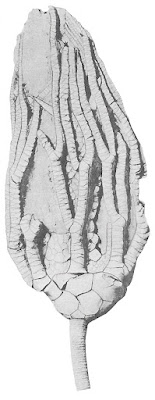
Pelecocrinus insignis, from Moore & Teichert (1978).


The fossil record of the pelecocrinids was long-lasting but patchy. They are known from the early Carboniferous of North America (Pelecocrinus) and Great Britain (Forthocrinus), the late Carboniferous of North America (Exoriocrinus), and the late Permian of Italy (Tetrabrachiocrinus) and Indonesia (Drepaocrinus, Malaiocrinus). These locations largely correspond to what would have been a distribution along the northern coast of the Palaeotethys Ocean, possibly becoming extinct in the west as the gap between North America and the southern continent of Gondwana closed to form the Pangean supercontinent. Pelecocrinids seem to be so far unknown from the southern continents.

In life, pelecocrinids were characterised by a high crown arising from a low, bowl-shaped cup. The stem could be round or pentagonal. The base of the cup was flattened or shallowly concave, so the infrabasals (the lowest circle of plates above the stem) were barely or not visible where the cup to be observed from the side. The articulations between the upper plates of the cup and the bases of the arms were angled downwards and outwards with the articular facets being somewhat narrower than the plates they sat on. The arms themselves had a wedge-shaped cross-section and divided into equal branches two or more times along their length. Each arm bore one or two rows of pinnules. The anal sac, as described for Pelecocrinus, was relatively short and slender and summited by heavy, spinose plates.

The structure of the arm articulations and pinnules indicates that the arms would have been subject to muscular control with individual arms being able to be moved in more than one plane. This arrangement became increasingly common among crinoids from the Carboniferous onwards, allowing them to function in more high-current habitats. The position of the arms and pinnules could be adjusted to optimise filtration from the water column, while the current provided lift to the crown so it did not need to be mechanically supported by the stem alone. The effectiveness of this arrangement is attested to by the long history of the pelecocrinids. Nevertheless, the end-Permian extinction was to end their lineage along with that of so many of their contemporaries.

REFERENCE

Moore, R. C., & C. Teichert (eds) 1978. Treatise on Invertebrate Paleontology pt T. Echinodermata 2. Crinoidea vol. 2. The Geological Society of America, Inc.: Boulder (Colorado), and The University of Kansas: Lawrence (Kansas).

Taxocrinus

Below is an example of Taxocrinus, a genus of fossil crinoids known from the later Devonian and earlier Carboniferous of Europe and North America. It is a relatively plesiomorphic representative of the flexible crinoids, one of the major crinoid lineages of the Palaeozoic era.

Taxocrinus colletti, copyright James St. John.


Flexible crinoids are characterised by arms that lack pinnules, the small side-branches found on the arms of most other crinoids. As a result, the preserved arms have a somewhat tentacle-like appearance, and are commonly preserved coiled in over the oral surface of the central cup. In Taxocrinus, the arms were regularly and isotomously bifurcated: that is, they divided between two branches of more or less equal size. The central cup itself in flexible crinoids was (somewhat counter-intuitively) quite inflexible, with the plates of the aboral surface firmly jointed together. The oral surface bore a more flexible covering of small plates, and an anal tube (visible near the midline of the fossil above) directed waste away from the mouth. The stem was round in cross section and lacked lateral cirri (Moore 1978).

Flexible crinoids were around for a very long time but it is rare for them to be found in abundance. As such, they were probably specialised for particular habitats that were either uncommon or less likely to be preserved. It has been suggested that, because their pinnule-less arms would have been poorly suited for filtering particles from strong currents, flexible crinoids may have inhabited calm, low-energy waters (Breimer 1978) (though I do wonder if enlarged tube feet may have partially filled the role of pinnules; is it possible to estimate the size of the tube feet from the preserved skeleton?) Crinoids living in such habitats will often hold the arms in a bowl arrangement so they may capture particles settling from higher in the water column. In the case of the flexible crinoids, moving the arms in and out may have created local water movements to further draw such particles in.

Though Taxocrinus itself would disappear in the mid-Carboniferous, flexible crinoids as a whole would persist to the end of the Permian. In more derived forms, the branching of the arms was often unequal, with the smaller branches effectively replacing the missing pinnules. In the end, though, the specialised flexibles were yet another casualty of the end-Permian cataclysm that so shook the composition of life on this planet.

REFERENCES

Breimer, A. 1978. Autecology. In: Moore, R. C., & C. Teichert (eds) Treatise on Invertebrate Paleontology pt T. Echinodermata 2 vol. 1 pp. T331–T343. The Geological Society of America, Inc.: Boulder (Colorado), and The University of Kansas: Lawrence (Kansas).

Moore, R. C. 1978. Flexibilia. In: Moore, R. C., & C. Teichert (eds) Treatise on Invertebrate Paleontology pt T. Echinodermata 2 vol. 2 pp. T759–T812. The Geological Society of America, Inc.: Boulder (Colorado), and The University of Kansas: Lawrence (Kansas).

The Pisocrinidae: Babyface Crinoids

One question that I haven't yet found an answer to is why the Palaeozoic marine fauna seems to have included so many filter feeders. Cystoids, blastoids, graptoloids... so many of the distinctive taxa occupying this niche would be gone by the period's end, without leaving any clear analogues behind them. What was the cause underlying this abundance? Is it simply a misapprehension caused by the filtering effect of history, with the modern fauna containing fewer major lineages but no fewer actual species? Is it the distorting lens that causes us to tend to assign a higher 'rank' to those lineages arising earlier in time, whatever their practical levels of disparacy? Or was there actually something different about what could be found in Palaeozoic seawater?

Reconstructions of short-armed and long-armed species of Pisocrinus, from Rozhnov (2007).


The Pisocrinidae are one of those distinctive Palaeozoic marine groups, known from around the world during the Silurian and Devonian. As crinoids, they were perhaps not as immediately unfamiliar to the modern eye as some of the other taxa that could be found at that time, but they were certainly different from any modern crinoid. The majority of the crinoids that have ever lived can be assigned to one of two main clades. One, the cladid lineage, includes all the crinoids alive today. Pisocrinids belong to the other major lineage, the disparids, which were prominent for most of the Palaeozoic era but failed to make it past the end of the Permian. Disparids differed from cladids in that their calyx included a single circlet of plates (the inferradials) beneath the circlet of the radials (the large plates making up the main body of the calyx) whereas cladids (at least to begin with) had two such circlets. Many disparid sublineages showed a tendency towards reduction and/or simplification of the calyx. In pisocrinids, most of the calyx was made up of just three plates: two large radials (representing the A and D rays of the basic crinoid calyx) and a greatly enlarged B inferradial. The B, C and E radials were all reduced in size. The arms of pisocrinids mostly lacked lateral pinnules and were undivided; one genus, Cicerocrinus, had bifurcating arms bearing lateral ramules (Moore et al. 1978). The length of the arms varied considerably between species: in some they were quite short and broad, in others they were remarkably long. Because their derived morphology made it difficult to compare pisocrinids to related families, their origins have been regarded as mysterious. Rozhnov (2007) suggested a derivation from an earlier, more typical crinoid family, the Homocrinidae, via paedomorphosis, possibly as a result of the evolution of a longer larval period in the life cycle (he specifically suggested that this extended larval phase may have allowed the ancestors of pisocrinids to spread across the Iapetus Ocean between the then-existing continents of Laurentia and Baltica). A direct pisocrinid-homocrinid connection was not supported in the phylogenetic analysis of disparids by Ausich (2018) but Rozhnov's overall model of pisocrinid paedomorphosis remains a possibility.

Assemblage of Triacrinus, from here.


During the Silurian, pisocrinids were among the most abundant, if not the most abundant, groups of crinoids. They were found in a variety of habitats but were particularly abundant around reefs in deeper waters. At first glance, the non-pinnulate arms of pisocrinids appear poorly suited for filter feeding, and one might be inclined to propose a more tentacular method of obtaining food items. However, such a method would seem unlikely for the short-armed species, whose arms would have been almost entirely inflexible. Even the long-armed species sometimes had arms made up of relatively long segments whose flexibility may have been limited. An alternative possibility, I suppose, is that in life pisocrinids may have had long tube feet that took the place of the missing pinnules. Meanwhile, the absence of the pinnules meant that the arms could be lain tightly alongside each other when the crown was closed. Earlier authors presumed that, because of their preference for deeper waters, pisocrinids were rheophobic (that is, they were found in places where the water lacked a noticeable current). However, Ausich (1977) proposed that they were low-energy rheophilic, seeking locations where a moderate but steady current prevailed. The current would provide a steady supply of organic particles that could be captured by the crown, and the ability to close the arms tight would protect the oral region during occasional bouts of rougher conditions.

REFERENCES

Ausich, W. I. 1977. The functional morphology and evolution of Pisocrinus (Crinoidea: Silurian). Journal of Paleontology 51 (4): 672–686.

Ausich, W. I. (in press, 2018) Morphological paradox of disparid crinoids (Echinodermata): phylogenetic analysis of a Paleozoic clade. Swiss Journal of Palaeontology.

Moore, R. C., N. G. Lane, H. L. Strimple, J. Sprinkle & R. O. Fay. 1978. Inadunata. In: Moore, R. C., & C. Teichert (eds) Treatise on Invertebrate Paleontology pt T. Echinodermata 2. Crinoidea vol. 2 pp. T520–T759. The Geological Society of America, Inc.: Boulder (Colorado), and The University of Kansas: Lawrence (Kansas).

Rozhnov, S. V. 2007. Changes in the Early Palaeozoic geography as a possible factor of echinoderm higher taxa formation: delayed larval development to cross the Iapetus Ocean. Palaeogeography, Palaeoclimatology, Palaeoecology 245: 306–316.