Field of Science

Showing posts with label Campanulidae. Show all posts

Centaurea acaulis, Stemless Star-thistle

In an earlier post, I commented on the diversity of species of the star-thistle genus Centaurea. Among the many, many species that have been assigned to this genus is the stemless star-thistle Centaurea acaulis* of northern Africa.

*Though dissolution of the polyphyletic Centaurea may lead to this species changing places. Banfi et al. (2005) listed it under the name of Colymbada acaulis.

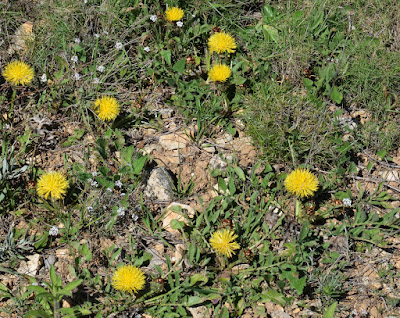
Patch of stemless star-thistles Centaurea acaulis, from L'herbiel de Gabriel.


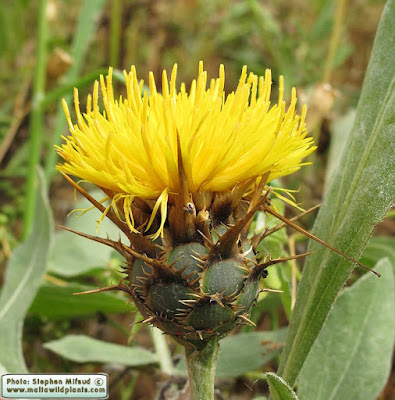
Centaurea acaulis is an inhabitant of dry, rocky habitats that is native to Tunisia and northeastern Algeria. As indicated by both the vernacular and botanical names, its growth habit lacks a central stem. Instead, the long, lobed leaves (which can be up to about a foot in length going by photos provided by Agut Escrig et al., 2021) lie prostrate on the ground. These leaves end in a large, ovate apical section with lobes running down the side of the central rib, becoming smaller towards the base. Flower heads are solitary and carry a mass of bright yellow florets. The involucral bracts (the 'scales' around the outside of the base of the flower head) are flat and green with darker longitudinal veins. The distal section of the bracts is triangular with a membranous, ciliate margin and typically (though not always) ends in a long spine. A closely related species found in northwestern Algeria and Morocco, C. oranensis, has historically been treated as a subspecies of C. acaulis (under the name C. acaulis ssp. boissieri, because botanical nomenclature is weird). However, C. oranensis was raised to species level by Greuter & Aghababian (in Greuter & von Raab-Straube, 2005) on the basis of its distinct involucral bracts, which are distally blackish, ovate and concave, with a margin of dense, long, stiff setae.

Close-up of flower head of Centaurea acaulis, copyright Stephen Mifsud.


Recent years have seen this species extending its range northwards with populations now found in Spain, Italy and Malta. In Malta, it was initially found grown in a disturbed area with particularly alkaline soil (Buttigieg & Lanfranco 2001). The mechanism of its arrival is uncertain. It could have dispersed naturally across the Mediterranean, or it may have arrived mixed into bird seed. However it got there, one might expect that as the south of Europe becomes increasingly hotter and drier, the stemless star-thistle will continue to spread.

REFERENCES

Agut Escrig, A., J. P. Solís Parejo & P. Urrutia Uriarte. 2021. Noticias sobre la presencia de Centaurea acaulis L. (Asteraceae) en la Península Ibérica. Flora Montiberica 81: 51–54.

Banfi, E., G. Galasso & A. Soldano. 2005. Notes on systematics and taxonomy for the Italian vascular flora. 1. Atti Soc. It. Sci. Nat. Museo Civ. Stor. Nat. Milano 146 (2): 219–244.

Buttigieg, R., & E. Lanfranco. 2001. New records for the Maltese flora: Centaurea acaulis L. (family: Asteraceae). Central Mediterranean Naturalist 3 (3): 147–148.

Greuter, W., & E. von Raab-Straube (eds) 2005. Euro+Med notulae, 1. Willdenowia 35: 223–239.

Herbs of Dragons and Worms

Preparing for this post has inspired me to some low-key experimentation. When it came time to assign myself its topic, I landed on the plant genus Artemisia. This is the genus that, among others, includes the culinary herb tarragon, Artemisia dracunculus. Which got me thinking that I wasn't sure if I'd ever actually eaten tarragon. I asked Christopher if he was familiar with it; he responded that all he knew about tarragon was that you had to consume it in the 1970s. Without access to a functioning Delorean, I did the next best thing and prepared a dish of tarragon chicken myself. The verdict: very tasty, though I could appreciate why tarragon might have a reputation for being somewhat difficult as it had a light flavour that I could imagine being easily overwhelmed.

Tarragon Artemisia dracunculus, copyright Cillas.


Tarragon is not the only species of Artemisia of significance to humans. This genus of composite-flowered plants comprsises over five hundred species and subspecies of herbs and small shrubs. The greatest diversity is found in arid and semi-arid regions of the Northern Hemisphere temperate zone (Sanz et al. 2008). The genus is characterised by its distinctive pollen with surface spinules reduced or absent. This pollen type is associated with the wind pollination typical of the genus, though some species do exhibit features such as sticky pollen and colourful flower-heads associated with insect visitation (Hayat et al. 2009). The flower-heads or capitula (a reminder that the 'flowers' of composite plants such as daisies and thistles actually represent a fusion of multiple flowers) of Artemisia are either disciform, with an outer circle of reduced ray florets surrounding the inner disc florets, or discoid, with disc florets only. In disciform capitula, the outer limb of the ray florets is reduced to a membranous vestige, not readily visible without minute examination. The ray florets are female whereas the disc florets are ancestrally hermaphroditic (more on that shortly). In discoid capitula, where the ray florets have been lost, all florets are uniformly hermaphroditic.

Mugwort Artemisia vulgaris, copyright Christian Fischer.


Historically, there has been some variation in the classification of Artemisia but a popular system divides the genus between five subgenera. A phylogenetic analysis of Artemisia and related genera by Sanz et al. (2008) found that the genus as currently recognised is not monophyletic, with a handful of small related genera being embedded within the clade. Time will tell whether this inconsistency is resolved by subdividing Artemisia or simply rolling in these smaller segregates, but for the purposes of this post they can be simply set aside. The subgenus Dracunculus, including tarragon and related species, falls in the sister clade to all other Artemisia. As well as being united by molecular data, members of this clade are distinguished by disciform capitula in which the central disc florets have become functionally male (female organs have been rendered sterile).

Wormwoood Artemisia absinthium, copyright AfroBrazilian.


The second clade encompasses the subgenera Artemisia and Absinthium, with disciform capitula, and Seriphidium and Tridentatae, with discoid capitula. Not all authors have supported the distinction of Artemisia and Absinthium, and Sanz et al. identify both as non-monophyletic, both to each other and to the discoid subgenera. Because of their similar flower-heads, most authors have presumed a close relationship between the Eurasian Seriphidium and the North American Tridentatae (commonly known as sagebrushes). Some have even suggested the former to be ancestral to the latter. However, Sanz et al.'s results questioned such a relationship, instead placing the Tridentatae species in a clade that encompassed all the North American representatives of the Artemisia group.

As well as the aforementioned tarragon, economically significant representatives of Artemisia include wormwood A. absinthium, best known these days as the flavouring agent of absinthe (though historically it has also been used for more innocuous concoctions). Mugworts (A. vulgaris and related species) have also been used for culinary and medicinal purposes. Sagebrushes are a dominant component of the vegetation in much of the Great Basin region of North America, providing crucial habitat for much of the region's wildlife. Artemisia species have shaped the lives of many of their co-habitants, both animal and human.

REFERENCES

Hayat, M. Q., M. Ashraf, M. A. Khan, T. Mahmood, M. Ahmad & S. Jabeen. 2009. Phylogeny of Artemisia L.: recent developments. African Journal of Biotechnology 8 (11): 2423–2428.

Sanz, M., R. Vilatersana, O. Hidalgo, N. Garcia-Jacas, A. Susanna, G. M. Schneeweiss & J. Vallès. 2008. Molecular phylogeny and evolution of floral characters of Artemisia and allies (Anthemideae, Asteraceae): evidence from nrDNA ETS and ITS sequences. Taxon 57 (1): 66–78.

The Spread of Carrots

Carrots are one of the staple vegetables in this part of the world as well as in a great many others. Indeed, Wikipedia informs us that about forty million tonnes of carrots and turnips were produced worldwide in 2018, and I would have to think that carrots accounted for the greater part of that number. Wild carrots are also a widespread weed that can commonly be seen growing in disturbed, open habitats such as roadside verges. This post is about the group of plants that carrots typify, the subtribe Daucinae.

Wild carrot Daucus carota in flower, copyright Cwmhiraeth.


Daucinae is a subgroup of the plant family Apiaceae, historically known as the Umbelliferae. The latter name refers to the characteristic production of flowers in dense, flat-topped inflorescences known as umbels. Anyone who is familiar with the appearance of carrot flower-heads is familiar with the form of an umbel; the wild form of carrot is often known as "Queen Anne's lace" in reference to said appearance. The fruit of Apiaceae species is a schizocarp, a dry fruit that splits at maturity into segments (called mericarps), each containing a single seed, that are dispersed independently. In Daucinae and related group of umbellifers, the mericarps carry longitudinal ribs, both primary ribs containing a vascular bundle and secondary ribs without. The secondary ribs of Daucinae are often modified to form broad wings or curved spines that function in the mericarp's dispersal.

Broad-leafed sermountain Laserpitium latifolium seedheads, showing wings, copyright Krzysztof Ziarnek, Kenraiz.


Historically, these differences in mericarp morphology have been used to assign the species bearing them to different tribes. However, more recent phylogenetic analyses have indicated that changes between wings and spines have occurred on multiple occasions due to changes in mode of dispersal (Wojewódzka et al. 2019). Mericarps bearing wings are generally anemochorous (dispersed by wind) whereas those bearing spines are epizoochorous (carried by animals, such as stuck to a mammal's fur). The distinction is not 100% immutable: winged seeds may sometimes get caught in fur, spined seeds may be carried slightly further by wind than smooth ones. Phylogenies indicate that anemochory was the ancestral condition for Daucinae, retained in genera such as Laserpitium and Thapsia. Epizoochorous species do not form a single clade within the Daucinae (indeed, the genus Daucus includes both anemochorous and epizoochorous species) but it is unclear to what degree epizoochory arose on multiple occasions versus reversions to anemochory from epizoochorous ancestors. Two species of Daucinae, Daucus dellacellae from the Cyrenaica region of northern Africa and Cryptotaenia elegans from the Canary Islands, have neither spines nor wings on their mericarps which are therefore dispersed by gravity alone. In the case of C. elegans, at least, it has been suggested that it evolved from epizoochorous ancestors that lost the spines because of the absence of suitable dispersing animals on the islands (Banasiak et al. 2016).

Though the carrot Daucus carota is perhaps the most widely grown daucine umbellifer, it is not the only economically significant member of the group. Cumin Cuminum cyminum, whose seeds are widely used as a spice, is either a daucine or a close relative of daucines (Banasiak et al. 2016). Cuminum does differ from other daucine genera in that its mericarps lack appendages on the secondary keels, however. Gladich Laser trilobum is a perennial found growing in Europe and western Asia whose seeds are used as a condiment. Certain species of the deadly carrot genus Thapsia have a history of medicinal usage though, as their vernacular name suggests, their use does require caution. One species, T. garganica, is among the suggested candidates for the identity of the mysterious silphium of the Romans (used, among other things, as an abortifacient) though perhaps not the most likely contender. That, perhaps, is a story for another time.

REFERENCES

Banasiak, Ł., A. Wojewódzka, J. Baczyński, J.-P. Reduron, M. Piwczyński, R. Kurzyna-Młynik, R. Gutaker, A. Czarnocka-Ciecura, S. Kosmala-Grzechnik & K. Spalik. 2016. Phylogeny of Apiaceae subtribe Daucinae and the taxonomic delineation of its genera. Taxon 65 (3): 563–585.

Wojewódzka, A., J. Baczyński, Ł. Banasiak, S. R. Downie, A. Czarnocka-Ciecura, M. Gierek, K. Frankiewicz & K. Spalik. 2019. Evolutionary shifts in fruit dispersal syndromes in Apiaceae tribe Scandiceae. Plant Systematics and Evolution 305: 401–414.

Five-fingers and Lancewoods

Longtime readers of this blog will know that my knowledge of plants has always been fairly rudimentary. As a young'un, I only ever learnt to distinguish some of the more common and visible varieties. As a student, I did take a few botany classes, but only really enough to learn that plant biology is complicated and terrifying. Since then, I've continued in much the same vein. But for today's post, I'm looking at something I do recall being aware of in my youth: the lancewoods and five-fingers of the genus Pseudopanax.

Horticultural variant of coastal five-finger Pseudopanax lessonii, copyright Leonora Enking.


Pseudopanax is a genus of a dozen species of small tree (mostly growing about five to seven metres in height) found only in New Zealand (Perrie & Shepherd 2009). Various species have also been assigned to the genus from locations around the Pacific (China, Tasmania, New Caledonia and Chile) but recent studies have lead to their exclusion. A handful of New Zealand species previously included in Pseudopanax have also been separated as the genus Raukaua (Mitchell et al. 1997). The historical taxonomy of the group is confusing, with species being variously attributed to genera Panax, Nothopanax, Neopanax and Polyscias. Things seem to have settled down a bit in recent years but there is still the possibility we may one day see Neopanax rise again (Perrie & Shepherd 2009).

Chatham Islands lancewood Pseudopanax chathamicus, copyright Krzysztof Ziarnek, Kenraiz.


Pseudopanax belongs to the family Araliaceae, a group that is primarily composed of tropical and subtropical shrubs and trees. Araliaceae are commonly referred to as "the ivy family", after one of their best-known members, the common ivy Hedera helix, but, as is not uncommon when a tropical family gets named after one of their European outliers, ivy is pretty weird by Araliaceae standards. Pseudopanax species are perhaps a bit more typical. They have large leaves, often more or less toothed or lobed along the margins. In a number of species, the leaves are palmately divided into three or five separate leaflets, hence the aforementioned vernacular name of 'five-finger'. In one group of species, the lancewoods, the lateral leaflets have been lost and the now undivided leaf is more or less long and narrow. Hybrids between five-fingers and lancewoods may have multiple leaflets like a five-finger but the leaflets shaped like those of a lancewood; New Zealand botanist Leon Perrie has written a post about hybridisation in this genus that you can read here. The trees are usually dioecious (male and female flowers are borne on separate trees) and the individually small flowers are borne aggregated in compound umbels. Fruits are fleshy berries.

Collection of lancewoods P. crassifolius showing the variation in leaf form, copyright Petra Gloyn. Two individuals on the left are young tress with hanging leaves; to the right is a more mature individual with spreading leaves.


Within Pseudopanax, the lancewoods are particularly renowned for their exhibition of heteroblasty, a phenomenon where the appearance of the leaves changes significantly as the tree matures. Juvenile leaves of the common lancewood P. crassifolius and toothed lancewood P. ferox are remarkably long, slender, strongly toothed along the margin, stiff and leathery, and hang downwards around the young tree like a skirt. As the tree approaches its mature height, it starts producing shorter, softer, less serrate leaves that are held in a more or less horizontal position.

Changes in growth habit with maturity seem to be surprisingly common among New Zealand plants and there has been a lot of discussion about why this might be. One suggestion that has certainly received a lot of public attention is that it is a relic of browsing by the large herbivorous birds such as moa that dominated the New Zealand environment prior to human settlement. Juvenile plants developed a habit that was energetically expensive but discouraged browsing by birds; as they grew high enough to escape the reach of such browsers, they changed to a less demanding form. I personally tend to be skeptical of these kinds of claims of historical baggage, not least because the extinction of one-half of the equation makes them very hard to test in any way, but I will admit that this case does perhaps have a bit more credibility than, for instance, claims elsewhere of giant fruits being dependent on long-extinct megafauna. Alternatively, it has been suggested that changes in growth habit may be related to climatic conditions; the juvenile leaves of P. crassifolius dissipate heat more effectively than those of mature trees (Gould 1993). Heteroblasty is less pronounced in the montane lancewood P. linearis of the South Island and almost absent in the Chatham Islands lancewood P. chathamicus, an insular derivative of P. crassifolius. Were these species insulated from the selective pressures affecting the other two? It should also be pointed out that the two proposals mentioned here are not mutually exclusive; the consideration of one as a factor does not automatically rule out the other.

REFERENCES

Gould, K. S. 1993. Leaf heteroblasty in Pseudopanax crassifolius: functional significance of leaf morphology and anatomy. Annals of Botany 71: 61–70.

Mitchell, A. D., D. G. Frodin & M. J. Heads. 1997. Reinstatement of Raukaua, a genus of the Araliaceae centred in New Zealand. New Zealand Journal of Botany 35 (3): 309–315.

Perrie, L. R., & L. D. Shepherd. 2009. Reconstructing the species phylogeny of Pseudopanax (Araliaceae), a genus of hybridising trees. Molecular Phylogenetics and Evolution 52: 774–783.

Goldenrod

Growing up as a child in rural New Zealand, I remember the community social events that would sometimes be held at the local district hall. On one evening, if I recall correctly, the event being held was a quiz night modelled after then-popular game show It's in the Bag. For those unfamiliar with this long-running institution, contestants on the show who successfully answered a series of general knowledge questions asked by Selwyn Toogood, a large avuncular man with an appropriately fruity voice, would be offered the choice between a cash prize up front or a 'bag' containing an unknown prize. This prize could potentially be something worth a lot more than the money on offer, such as a trip away or a home appliance (game shows in the 1980s often included whiteware among their top tier prizes). On the other hand, it could be worth a lot less, potentially even being effectively worthless (as viewers at home, of course, we always hoped for the latter). On this occasion, one of the 'prizes' on offer was a packet of seeds from 'the pretty yellow flowers that grow so vigorously in the region'. Everyone in the audience would instantly recognise the flowers in question as ragwort Senecio jacobaea, a pernicious weed much maligned due to its toxicity to livestock. Ragwort probably arrived in New Zealand as a contaminant in grass seed, but for today's post, I'm looking at another member of the daisy family which became a weed after being more deliberately spread around.

Tall goldenrod Solidago gigantea, copyright Pethan.


Solidago, the goldenrods, is a genus of perennial herbs with a woody caudex or rhizome and usually bright yellow flowers. About 100 to 120 species are currently recognised in the genus, the great majority of which are native to North America. Other species are found in South America and Eurasia, and a number of the North American species have been spread around the world by human activity. The number of species to be recognised is somewhat disputed because, as with many decent-sized plant genera, goldenrods have a tendency to laugh in the face in clear species concepts. Differences between species can be difficult to observe and hybrids are not uncommon. Individuals belonging to the same species may vary notably with geography and growth conditions and determining whether variation is genetic or environmental has historically required extensive growth experiments cultivating seed collections at varying locations. Vegetative spreading through rhizomes may lead to isolated populations of near-clonal individuals that may come to be recognised as 'microspecies'. As a result, what one author may recognise as a number of distinct species may be treated by another author as variants of a single species. For example, a study of altitudinal variants of the European S. virgaurea in Poland by Kiełtyk & Mirek (2014) lead them to recognise two species that had previously been confused, the lowland S. virgaurea and the montane S. minuta. The two were best distinguished by relatively fine-scale features of the flower heads, most notably the number of tubular florets in each head.

Canada goldenrod Solidago canadensis, copyright Olivier Pichard.


In a review of the North American Solidago species, Semple & Cook (2006) divided the genus between two sections. The smaller section Ptarmicoidei, including only half a dozen species, is characterised by clustering of flower heads in flat-topped arrays. The remaining species in the much larger section Solidago may have heads in rounded, conical or club-shaped arrays, or bear flower heads in axillary clusters. The distinctiveness of section Ptarmicoidei is enough that some authors have placed it as a separate genus Oligoneuron. Research is ongoing concerning the phylogeny of Solidago and its precise relationships with related genera.

Historically, the European Solidago virgaurea was valued for its supposed medicinal qualities (hence the genus name, which can be translated as 'becoming whole'). But while the dried flowers may still be used in making herbal tea, goldenrod does not seem to be currently regarded as of much pharmaceutical significance. As long ago as 1597, John Gerard noted in his Herball that the once highly prized herb had plummeted in value and regard once it was found to be growing wild in England, making it a mere local weed instead of an exotic import*. In the 1920s, Thomas Edison experimented with using goldenrod as a source of rubber. Investigations in this line were later continued in the 1940s by agrarian scientist George Washington Carver (under the patronage of Henry Ford), partially to counter rubber shortages during World War II. However, rubber yield from goldenrod is low and the rubber produced of low quality, so it never became a commercially significant source.

*'...in my remembrance, I haue known the dried herbe which came from beyond the ſea ſold in Bucklersbury in London for halfe a crowne an ounce. But ſince it was found in Hampſtead wood, euen as it were at our townes end, no man will giue halfe a crowne for an hundred weight of it: which plainely ſetteth forth our inconſtancie and ſudden mutabilitie, eſteeming no longer of any thing, how pretious ſoeuer it be, than whileſt it is ſtrange and rare. This verifieth our Engliſh proverbe, Far fetcht and deare bought is beſt for Ladies.'

Woundwort Solidago virgaurea var. leiocarpa, copyright Alpsdrake.


As alluded to above, a number of North American goldenrod species have been carried to temperate regions around the world as ornamentals or to provide nectar for bees. Unfortunately, some of these species have become significant invasive weeds in their adopted homes. Canada goldenrod Solidago canadensis can have an allelopathic effect on surrounding vegetation, producing water-soluble compounds that may inhibit the germination and growth of seeds (Werner et al. 1980). It may also act as a reservoir for pathogens of crop plants. Goldenrod is also commonly accused of causing hay fever but, in this regard at least, it seems to be largely innocent. Goldenrod plants shed relatively little pollen; as the flowers are insect-pollinated, the pollen is relatively unlikely to enter the air column. Instead, it seems that the conspicuous goldenrod flowers are blamed for the more copious pollen shed by less visible plants such as ragweeds flowering at the same time.

REFERENCES

Kiełtyk, P., & Z. Mirek. 2014. Taxonomy of the Solidago virgaurea group (Asteraceae) in Poland, with special reference to variability along an altitudinal gradient. Folia Geobotanica 49: 259–282.

Semple, J. C., & R. E. Cook. 2006. Solidago Linnaeus. In: Flora of North America Editorial Committee (eds) Flora of North America vol. 20. Asteraceae, part 2. Astereae and Senecioneae pp. 107–166. Oxford University Press: New York.

Werner, P. A., I. K. Bradbury & R. S. Gross. 1980. The biology of Canadian weeds. 45. Solidago canadensis L. Canadian Journal of Plant Science 60: 1393–1409.

Canterbury Bells

Bellflowers or harebells are one of the classic plants associated with the English country garden. For today's post, I'll be covering the family of plants that bellflowers belong to.

Fairy's thimble Campanula cochleariifolia, copyright Jerzy Opioła.


The Campanulaceae are a family of over 2300 plant species found almost worldwide (Crowl et al. 2016). The family is, however, divided between five subfamilies that some authors would treat as separate families, in which case 'Campanulaceae' would be restricted to the 600 or so species of the subfamily Campanuloideae. It is this subfamily that includes the bellflowers. The vernacular name, of course, refers to the shape of the flowers produced by these plants, as indeed does the botanical name: Campanula translates as 'little bell'. These flowers are radiately symmetrical with all petals more or less the same size and shape and evenly arranged in a circle. Other subfamilies of the Campanulaceae in the broad sense, the largest of which is the lobelias of the Lobelioideae, produce more bilaterally symmetrical flowers with petals differing in size and/or with some petals closer together than others. Fruits are most commonly a capsule, with the seeds dispersed by wind, but some lobelioids produce fleshy fruits that attract birds. The lobelioids are most diverse in the southern continents, and it is thought that this may have been the original home of the family as a whole when it arose sometime close to the end of the Cretaceous, possibly in Africa. At some time in the early Cenozoic, however, the campanuloids arrived in and underwent a significant radiation in the Palaearctic. This dispersal may be related to the different flower morphology of the campanuloids, as they adapted from the bird, bat and butterfly pollinators of the tropics to the bee and fly pollinators of more temperate habitats.

Glandular threadplant Nemacladus glanduliferus var. orientalis, copyright Stan Shebs.


The genetics of Campanulaceae, specifically of their chloroplasts, should also not go unnoticed. The structure of the chloroplast genome in plants is usually very stable, with few changes in gene arrangement and order. However, at various points in the history of Campunulaceae, large chunks of foreign DNA have been inserted in the original plastid chromosome, with a number of these insertions also associated with inversions in the direction of adjoining sections of the original genes (Knox 2014). This kind of insertion is unique among flowering plants: changes in the gene content of plastids more usually involve genes being transferred out of the plastid. The source of this extra DNA is uncertain: it may have come from the plant's own nucleus, or it may have come from an as-yet-unknown endosymbiont. Also unknown is the functional significance of these rearrangements, if any. Some insertions have clearly resulted in pseudogenes, with their sequences rapidly breaking down through subsequent genetic drift. But others have preserved the structure of functional genes, suggesting continued selection for their retention.

Cyanea duvalliorum, an arborescent Hawaiian lobeliad, copyright Forest & Kim Starr.


The majority of Campanulaceae are small perennial herbs. Two genera of distinctive enough to be assigned to their own subfamilies include annual herbs: the threadplants Nemacladus of southwestern North America, and the little-known Chilean Atacama desert endemic Cyphocarpus. Some members of the Lobelioideae are woody subshrubs, and at some point one of these woody lobelioids managed to make its way to the Hawaiian archipelago where it gave rise to one of the world's most remarkable insular radiations, and the single largest such radiation in plants. Over 120 species of lobeliads are known from the Hawaiian islands, varying from single-stemmed succulents to straggling vines to trees over 18 metres in height. There are inhabitants of lowland forests, of upland bogs, and of rocky cliffs. There are species producing fruit as dry capsules; others produce fleshy berries. So varied are the Hawaiian lobeliads that previous authors have inferred their origin from multiple seperate colonisations, but a study by Givnish et al. (2009) supported a single origin from a single colonist arriving about thirteen million years ago. This would have been before any of the current major Hawaiian islands existed (the oldest, Kaua'i, is a little less than five million years old); the implication is that the ancestor of the Hawaiian lobeliad arrived on a pre-existing island, perhaps corresponding to the modern Gardner Pinnacles or French Frigate Shoals. As the lobeliads diversified, they continued to disperse onto new islands as they arrived, while their original homeland eroded away.

Sadly, a depressing percentage of the species forming this incredible radiation are now threatened with extinction, the victims of pressures such as loss of habitat, the decline of their pollinators and dispersers, or grazing by introduced mammals. The cliff-dwelling pua 'ala Brighamia rockii of Moloka'i is now restricted to five locations with an estimated total wild population of less than 200 individuals. A related species on Kaua'i, the olulu Brighamia insignis, may be extinct in the wild, having last been recorded in the form of a single individual in 2014 (it still survives in cultivation). As we earlier saw with the Hawaiian honeycreepers, there is barely a single section of the Hawaiian biota not marked by tragedy.

REFERENCES

Crowl, A. A., N. W. Miles, C. J. Visger, K. Hansen, T. Ayers, R. Haberle & N. Cellinese. 2016. A global perspective on Campanulaceae: biogeographic, genomic, and floral evolution. American Journal of Botany 103 (2): 233–245.

Givnish, T. J., K. C. Millam, A. R. Mast, T. B. Paterson, T. J. Theim, A. L. Hipp, J. M. Henss, J. F. Smith, K. R. Wood & K. J. Sytsma. 2009. Origin, adaptive radiation and diversification of the Hawaiian lobeliads (Asterales: Campanulaceae). Proceedings of the Royal Society of London Series B—Biological Sciences 276: 407–416.

Knox, E. B. 2014. The dynamic history of plastid genomes in the Campanulaceae sensu lato is unique among angiosperms. Proceedings of the National Academy of Sciences of the USA 111 (30): 11097–11102.

Stars and Blessings

Yellow starthistle Centaurea solstitialis, copyright Franco Folini.


The first thing that struck me when I was looking up material on Centaurea was how evocative some of the vernacular names associated with this genus are: starthistle, blessed thistle, dusty miller, sweet sultan. Centaurea, the starthistles and knapweeds, is a genus of composite-flowered plants native to Eurasia and northern Africa, with the highest diversity of species in the Mediterranean region. A handful of species have been spread to other parts of the world in association with humans; a handful of these are significant pasture pests such as spotted knapweed C. maculosa and yellow starthistle C. solstitialis, whereas others such as dusty miller C. cineraria are grown as garden plants. Centaurea is a large genus: depending on how you count them, it may contain anywhere between 300 and 700 species. The greater number of species are perennial herbs, but the genus varies from small spiny shrubs to low spreading annuals (Wagenitz 1986). Some arise from a single central tap-root; others grow from spreading rhizomes. Some species have spiny leaves and conform to our general idea of a 'thistle'; others do not. The leaves are often deeply divided at the base of the plant, becoming entire towards the top. Flowerheads may be borne singly or in a corymbiform arrangement (a flat-topped cluster); the phyllaries (the bracts surrounding the flowerhead) often extend outwards around the head, and may be themselves tipped with spines.

Squarrose knapweed Centaurea triumfettii, copyright Kristian Peters.


With a genus of this size, it should be hardly surprising that taxonomic complications are involved. Long recognised as morphologically diverse, it has been confirmed as polyphyletic by more recent molecular analyses (Garcia-Jacas et al. 2001). The majority of Centaurea species fall within a single derived clade within the composite subtribe Centaureinae, united both by molecular data and by a number of morphological synapomorphies including adaptations for myrmecochory, dispersal of the seeds by ants (the seeds carry an attached oily body called an elaiosome; ants carry the seeds back to their nest where they may eat the elaiosome but leave the seed to sprout). A handful of species, though, lack these synapomorphies and lie in scattered segregate clades among the remainder of the Centaureinae. Some of these segregate clades, such as the former section Psephellus, have been straightforwardly promoted to the status of separate genera. One small segregate clade, however, is a little more problematic because it happens to include the north African Centaurea centaurium, the original type species of the genus Centaurea. Under normal circumstances, then (other than lumping the entirety of centaureines in a single genus), the name Centaurea would apply only to this small clade (including only about a dozen species) while the hundreds of species in the main 'Centaurea' clade would have to be renamed. In this case, the name with priority for this large clade would be Cnicus, generally used to date for only a single species, the blessed thistle Cnicus benedictus (no, I haven't been able to establish why it is called the 'blessed thistle'; I have found references to a tradition of medicinal use for this species, including its supposedly encouraging milk production in nursing mothers, but I haven't been able to confirm if this is the reason for the name). In order to stave off this nomenclatural turmoil, it has been proposed that the official type species of Centaurea be changed to a member of the main clade (Greuter et al. 2001), so this clade keeps the name Centaurea (and the blessed thistle becomes referred to as Centaurea benedicta) whereas the small clade including the prior type species becomes known as the genus Rhaponticoides. I haven't found whether a final decision has been made on this proposal (the process for such nomenclatural decisions is a bit more involved for plants than animals, requiring an open vote at an international botanical conference rather than just being decided on directly by a select committee) but it seems to have general support. Less certain is the status of the cornflowers of the section Cyanus, which some have proposed recognising as a separate genus but which is closely related to the main clade, making the case for its separation a bit less compelling.

REFERENCES

Garcia-Jacas, N., A. Susanna, T. Garnatje & R. Vilatersana. 2001. Generic delimitation and phylogeny of the subtribe Centaureinae (Asteraceae): a combined nuclear and chloroplast DNA analysis. Annals of Botany 87: 503–515.

Greuter, W., G. Wagenitz, M. Agababian & F. H. Hellwig. 2001. (1509) Proposal to conserve the name Centaurea (Compositae) with a conserved type. Taxon 50: 1201–1205.

Wagenitz, G. 1986. Centaurea in south-west Asia: patterns of distribution and diversity. Proceedings of the Royal Society of Edinburgh, Section B, Biological Sciences 89: 11–21.

Teasels and Scabious: the Dipsacaceae

Scabiosa cretica, copyright Ori Fragman Sapir.


As recognised plant families go, the Dipsacaceae is not a particularly large one. It includes only a few hundred species, of which the majority are found in arid regions around the Mediterranean and the remainder elsewhere in Africa and Eurasia. The economic significance of the family is also relatively low. Some species are cultivated as ornamental plants. Dipsacus fullonum, teasel, gets its vernacular name because its bottle-brush-like flower-heads were used to tease the fibres of woollen cloth. Various species of Dipsacaceae, particularly the genus Scabiosa, are known as 'scabious' because they were apparently once used somehow in treating scabies. I also came across a reference in Duke (2008) to Syrian scabious Cephalaria syriaca having had a certain notoriety in the past due to its seeds being similar in appearance to wheat grain, meaning that they could be inadvertently sown into fields, or impart an unpleasant taste if ground into flour.

Flowers and fruits of Sixalix atropurpurea, copyright Manuel M. Ramos. Members of this genus grow on sand; their fruits have a reduced membranous wing, and disperse by rolling.


Nevertheless, the Dipsacaceae are not without their points of interest. One intriguing characteristic of the family is that they bear numerous small flowers clustered onto a single shared receptacle, similar to those of the much more diverse Asteraceae. Like Asteraceae, there may even be a differentiation in the appearance of flowers on the inner part of the receptacle from those around the outer rim. The Dipsacaceae are not directly related to the Asteraceae; rather, the two families have developed their capitate flower-heads independently. Which is not to say that they are incomparable: species of both Asteraceae and Dipsacaceae exhibit duplications of genes that are believed to affect the development of floral symmetry (Carlson et al. 2011), and it is possible that similar processes have lead to the evolution of compound flower-heads in both.

Flowers and fruits of Scabiosa sicula, copyright Jose Rodriguez. The fruiting head in focus shows the membranous wings that function in dispersal.


Past authors have divided the Dipsacaceae into three tribes, largely on the basis of characters related to seed dispersal. Each of the small flowers on a dipsacacean flower-head develops into a dry fruit containing a single seed. The epicalyx (an outer protective layer of the flower base) persists as an outer coating of the mature fruit, like a second skin. In the largest of the three previously recognised tribes, the Scabioseae, the epicalyx is often modified for wind dispersal, either by plumose hairs on top of a dorsal tube (the same sort of set-up as seen in dandelions) or by a membranous wing around the fruit. In contrast, the fruit of the genus Knautia, widow flowers, which has been placed in its own separate tribe, bears an elaiosome, a fleshy, hemispherical lump. The elaiosome attracts ants, who carry the fruit away to their nest; after the ants have eaten the elaiosome, the remaining seed is able to germinate where they leave it. Finally, the third tribe Dipsacaceae includes only the genera Dipsacus and Cephalaria; the mature fruit of these genera lack adaptations for either wind or ant dispersal, and seed dispersal is largely controlled by the break-up of the flower-head itself.

Bassecoia bretschneideri, copyright Dave Boufford.


More recent molecular analyses, however, have not entirely supported this three-way division of the Dipsacaceae (Carlson et al. 2009). While Knautia and the Dipsaceae are both likely to be monophyletic, the Scabioseae are not. Instead, a small clade including the eastern Asian genus Bassecoia is sister to the remaining members of the family. These fall into two major clades: one, that has been referred to as the Scabioseae 'sensu stricto', includes the majority of the taxa previously included in the Scabioseae, such as Scabiosa, Lomelosia and Pterocephalus. The other clade, which has been dubbed the 'dipknautids', includes Knautia and the Dipsaceae, together with a few smaller 'ex-Scabioseae' genera. While the original Dipsacaceae may have been wind-dispersed, they have not been above looking at alternatives.

REFERENCES

Carlson, S. E., D. G. Howarth & M. J. Donoghue. 2011. Diversification of CYCLOIDEA-like genes in Dipsacaceae (Dipsacales): implications for the evolution of capitulum inflorescences. BMC Evolutionary Biology 11: 325. doi:10.1186/1471-2148-11-325.

Carlson, S. E., V. Mayer & M. J. Donoghue. 2009. Phylogenetic relationships, taxonomy, and morphological evolution in Dipsacaceae (Dipsacales) inferred by DNA sequence data. Taxon 58 (4): 1075-1091.

Duke, J. A. 2008. Duke's Handbook of the Medicinal Herbs of the Bible. CRC Press.

What is Inula verbascifolia?

By recommendation of the Committee for Spermatophyta (Brummitt 2005), this is. Photograph by L.R.


Inula verbascifolia is a herbaceous, composite-flowered plant from the eastern Mediterranean. It is mostly found in the Balkan region, but it also reaches into south-eastern Italy and Anatolia. It is closely related to another Greek species, I. candida, and the two have been treated as a single species, but they can be distinguished by features of the leaves (Tan et al. 2003).

The reason for my question, though, is that Inula verbascifolia has been the subject of an application to have its name conserved (Tan et al. 2003). The rules for naming organisms are often assumed to be complicated, and to a certain extent they are, but the underlying principles can be summed up into two rules: (1) every species should have one name that is different from all other species, and (2) when two names are in conflict, the older name is the correct one. However, like all rules of life, sometimes the best thing to do is not follow the rules. Maybe using the older name would be too confusing, if the newer name is much the better known. To account for such scenarios, all of the various bodies governing the naming of organisms (there are separate bodies for animals, plants and bacteria) make allowances for researchers on the organisms concerned to apply for the rules to be temporarily set aside in some way.

In the case of Inula verbascifolia, the plant currently known by that name was not the first to be called that. The German botanist Heinrich Haussknecht recognised the Balkan species as Inula verbascifolia in 1895. Prior to that, it gone under the name of Conyza verbascifolia, coined by Carl von Willdenow in 1803. However, in 1813 Jean Poiret of France had used the name I. verbascifolia for a plant growing the gardens of the Jardin des Plantes in Paris that had originally come from the Caucasus. 1813 beats 1895, so under strict application of the rules the name Inula verbascifolia should apply to the Caucasian plant, not the Balkan one. But the Caucasian plant had not been known by this name since 1819, whereas the Balkan plant was well-known by that moniker, so Tan et al. (2003) applied for the Balkan plant to be allowed to keep it.

I should point out that I'm an animal taxonomist by training, so I have only a basic awareness of the rules that apply to naming plants. One thing that interests me in this case is that things would have played out differently had the organisms in question been animals. The Zoological Code differs from the Botanical Code in that it doesn't regard the genus name as an integral part of the species name, so even if a species name is moved between genera, it still takes its priority from when it was first coined. In this case, for the Zoological Code the important date would not be 1895 when Haussknecht transferred verbascifolia to Inula, but 1803 when Willdenow called it verbascifolia in the first place. So under the Zoological Code, Willdenow's verbascifolia would be older than Poiret's verbascifolia, and there would be no need for the former to be specially upheld.

Another difference between the Zoological and Botanical Codes is in the process of deciding on applications. In the Zoological Code, an appointed body of taxonomists (the Commission) directly makes each decision themselves. In the Botanical Code, on the other hand, each application goes to a Committee (there are separate committees for seed plants, algae, fungi, etc.) who then vote on a recommendation whether or not to accept the application. The final decision is not made by the Committee, but is voted on by the attendees of the next International Botanical Congress, a conference that anyone is allowed to attend (if they're willing to pay the attendance fee, of course). In the case of Inula verbascifolia, the Committee on Spermatophyta recommended that the application be accepted (Brummitt 2005), but I don't know if it has been finally voted upon. I also don't know if Congress votes often go against Committee recommendations (I wouldn't expect them to, but passions can run high in the world of taxonomy).

Inula verbascifolia ssp. methanea, photographed by Giorgos Gioutlakis. (Update: Christine K. tells me that this photo has been misidentified. See her comment below.)


Tan et al.'s application had to save more than just the species name. Haussknecht's Inula verbascifolia shows enough variation over its range that it has been divided between five subspecies. The photograph at the top of this post, taken in Italy, shows the type subspecies I. verbascifolia ssp. verbascifolia. The photograph just above shows another subspecies from Greece. But when Tan et al. looked at the original specimens examined by Willdenow, they found that they did not belong to the subspecies that had since come to be known as the type. Therefore, they designated a new type specimen belonging to the recognised type subspecies: otherwise ssp. methanea might have had to be called ssp. verbascifolia, and ssp. verbascifolia would have had to be called something else. It is possible that Willdenow had himself seen a specimen of the type subspecies that has since been lost: according to Tan et al., he gave the distribution of Conyza verbascifolia as Sicily, Greece and Armenia. Tan et al. pointed out that Inula verbascifolia's distribution in Italy is in Gargano, not Sicily, so regarded Willdenow's record as an error. What they had evidently overlooked was that, in 1803, Gargano was still part of the Kingdom of Sicily.

And if you're still around after all of that, then you may find the newest cartoon from xkcd oddly apropos:

REFERENCES

Brummitt, R. K. 2005. Report of the Committee for Spermatophyta: 56. Taxon 54 (2): 527-536.

Tan, K., J. Suda & T. Raus. 2003. (1582) Proposal to conserve the name Inula verbascifolia (Willd.) Hausskn. against I. verbascifolia Poir. (Asteraceae) and with a conserved type. Taxon 52: 358-359.

Ginseng and Ivy

Pate Schefflera digitata, photographed by Kahuroa.


The Araliaceae are a family of nearly 1500 species of flowering plants found around the world, but primarily in the Old World tropics. Most of its members are trees or shrubs, but there are also some herbaceous or climbing species. Many Araliaceae have palmate leaves, and they often produce inflorescences in umbels. Not that many Araliaceae hold much economic prominence: Tetrapanax papyriferus is used to make rice paper, while the genus Panax includes the ginsengs that are widely regarded as something of a wonder-drug for no apparent good reason. Some other species are well known as garden plants, such as ivy Hedera helix. Back in my home country of New Zealand, Araliaceae include some of the most familiar small native trees such as pate Schefflera digitata and the five-fingers and lancewoods of the genus Pseudopanax.

A young lancewood Pseudopanax crassifolius, photographed by Mike Hudson. Lancewood is notable for its differing growth habits over its lifespan: this individual is just beginning to change from its juvenile to its mature foliage. When the plant is young, the long, narrow, tooth-edged leaves hang down around the trunk. As the tree matures, it produces leaves that are shorter, broader and with less strong teeth, and that are held upwards and outwards. The juvenile and mature trees are so different in appearance that they were initially described as different species.


The Araliaceae have long been recognised as close relatives of the Apiaceae, the family including carrots and celery, to the extent that some authors have combined the two in a single family. Most recent researchers have maintained the distinction, but phylogenetic studies have indicated that some genera previously treated within the Apiaceae, notably the water and marsh pennyworts of the genus Hydrocotyle, are better treated as basal Araliaceae (Plunkett et al. 1997). Relationships within the Araliaceae are somewhat less straightforward, as molecular phylogenetic studies have indicated that there has been a great deal of homoplasy in morphological characters (Plunkett et al. 2004). Some of the larger genera in the family (notably the genus Schefflera, to which nearly half the species of Araliaceae have been assigned) appear to be significantly polyphyletic, some of them not even resolving in particularly proximate clades. The difficult nature of many araliaceous genera has long been realised: in 1868, the botanist Berthold Seemann referred to the then-poorly defined Panax as "one of the great lumber rooms of our science" (Wen et al. 2001).

American ginseng Panax quinquefolius, from here. Red ginseng is derived from the root of this species and the Asian P. ginseng; however, over-harvesting has lead to the endangerment of wild populations of the latter.


REFERENCES

Plunkett, G. M., D. E. Soltis & P. S. Soltis. 1997. Clarification of the relationship between Apiaceae and Araliaceae based on matK and rbcL sequence data. American Journal of Botany 84 (4): 565-580.

Plunkett, G. M., J. Wen & P. P. Lowry II. 2004. Infrafamilial classifications and characters in Araliaceae: Insights from the phylogenetic analysis of nuclear (ITS) and plastid (trnL-trnF) sequence data. Plant Systematics and Evolution 245 (1-2): 1-39.

Wen, J., G. M. Plunkett, A. D. Mitchell & S. J. Wagstaff. 2001. The evolution of Araliaceae: a phylogenetic analysis based on ITS sequences of nuclear ribosomal DNA. Systematic Botany 26 (1): 144-167.

Thistle Be The One (Taxon of the Week: Carduoideae)


The cardoon Cynara cardunculus with humans to scale. Photo from here.


The composite-flowering plants of the Asteraceae are one of the largest (23,000 species, according to Wikipedia) and most distinctive plant groups out there - even a complete botanical dunce like yours truly can usually recognise an example of Asteraceae. Asteraceae include such plants as daisies and chrysanthemums in which the "flower" is in fact a large number of tiny flowers all pressed together, hence the old name for the family of "Compositae". Different authors have proposed different classifications within Asteraceae over the years, but twelve subfamilies were recognised by Panero & Funk (2008). The subfamily Carduoideae as recognised by these authors includes the three tribes Dicomeae, Tarchonantheae and Cardueae (earlier authors had used the name to cover a broader paraphyletic assemblage, or restricted it to include only Cardueae). The genus Oldenburgia may be included in Tarchonantheae or it may be placed in its own separate tribe (Funk et al., 2009). No unique morphological features characterise this subfamily (though most species have a ring of papillae on the style underneath the stigmatic branches), but it is well supported molecularly.

The tribes Dicomeae and Tarchonantheae are primarily found in Africa and Madagascar (two species of Dicomeae and one of Tarchonantheae are found in Asia). The seventeen species of Tarchonantheae (including Oldenburgia) are all shrubs or trees; the 75-100 species of Dicomeae include herbs, shrubs and trees. Tarchonantheae includes the genus Brachylaena, species of which predominate in southern African and Madagascan woodlands. Brachylaena species are noted for producing dense, high quality wood, and are also among the largest of the Asteraceae, reaching 40 m in height (Beentje, 2000).


Brachylaena discolor from southeastern Africa. Photo from here.


The largest by far of the three tribes is the Cardueae*, the thistles, with some 2500 species distributed through Eurasia from the Mediterranean to central Asia. The majority of Cardueae are herbs, though there are a few small shrubs or even small trees in the tribe. Most members of Cardueae have distinctive discoid flower heads** and, of course, many have spiny leaves.

*I have just been through the painful, arduous and not-entirely-productive process of trying to decide whether 'Cardueae' or 'Cynareae' is the correct name for this tribe; both names are used regularly. Lamarck & de Candolle published the name 'Cynarocephalae' in 1806 (Reveal, 1997); Cardueae was published by Cassini in 1819 (Solbrig, 1963). The question therefore hinges on whether the '-cephalae' in Cynarocephalae represents a suffix like '-idae' or '-aceae' or whether the name is descriptive of plants with 'heads like Cynara'; if the former, Cynareae has priority from 1806; if the latter, Cynareae was not published until 1830 (and illegitimately so at that) and Cardueae has priority. Botanists still seem to be in the process of duking out which interpretation is corrent, and I suspect that it may take the ICBN stepping in to settle the matter.

**Composite flower heads may contain both 'ray' and 'disk' florets (the little individual flowers). If you think of a daisy, the 'ray' florets are the ones around the edge that carry the large petals while the 'disk' florets are the central ones without petals. Discoid flower heads like those of Cardueae contain only disk florets and no ray florets.


Side view of flower head of Atractylis cancellata, a Mediterranean thistle species in which the rosette of (particularly evil-looking) leaves around the flower head curls upwards to surround it. Photo by Manuel Ramos.


Species of Cardueae most often bring themselves to humanity's attention through the fact that a number of them are significant weed species, and very few Cardueae are regarded with any sort of affection. The Scotch thistle Onopordum acanthium is of course popular in Scotland where it is the national flower; according to legend, a Scottish encampment was saved from a sneak attack by Vikings when one of the invaders yelled out after stepping on a thistle, alerting the sentries to their presence. Also granted a certain regard is Cynara cardunculus, the cardoon/globe artichoke. Earlier classifications recognised two species, the cardoon C. cardunculus grown for its edible stalks and the artichoke C. scolymus grown for its similarly edible flower heads, but there is no doubt that the latter is a horticulturally derived variety of the former. Perhaps the best demonstration of this is that escaped seeds from artichoke fields in California and Australia have given rise to wild populations of 'cardoons' (Sonnante et al., 2007). I will also note that artichokes would also be a feature of my ideal garden - not because I'm a fan of eating artichokes (I think they're pretty tasteless) but because these two-metre tall thistles are such spectacular plants.

And that's all you'll be hearing from me for a little while - five-thirty tomorrow morning, I leave for two weeks in the field. Feel free to talk among yourselves until I get back.

REFERENCES

Beentje, H. J. 2000. The genus Brachylaena (Compositae: Mutisieae). Kew Bulletin 55 (1): 1-41.

Funk, V. A., A. Susanna, T. F. Steussy, & H. E. Robinson. 2009. Classification of Compositae. In Systematics, Evolution, and Biogeography of Compositae (V. A. Funk, A. Susanna, T. F. Stuessy & R. J. Bayer, eds) pp. 171-189. International Association for Plant Taxonomy (IAPT): Vienna.

Panero, J. L., & V. A. Funk. 2008. The value of sampling anomalous taxa in phylogenetic studies: major clades of the Asteraceae revealed. Molecular Phylogenetics and Evolution 47 (2): 757-782.

Reveal, J. L. 1997. Early suprageneric names in Asteraceae. Compositae Newsletter 30: 29-45.

Solbrig, O. T. 1963. Subfamilial nomenclature of Compositae. Taxon 12 (6): 229-235.

Sonnante, G., A. V. Carluccio, R. Vilatersana & D. Pignone. 2007. On the origin of artichoke and cardoon from the Cynara gene pool as revealed by rDNA sequence variation. Genetic Resources and Crop Evolution 54 (3): 483-495.