Field of Science

Showing posts with label Euchelicerata. Show all posts

Platybunus: the Wide-Eyed Harvestmen of Europe

The western Palaearctic region (that is, Europe and the immediately adjacent parts of Asia and northern Africa) is home to a diverse and distinctive fauna of harvestmen. Among the various genera unique to this part of the world are the forest- and mountain-dwellers of the genus Platybunus.

Platybunus pinetorum, copyright Donald Hobern.


Platybunus species are moderate-sized long-legged harvestmen of the family Phalangiidae, the central body in larger individuals being about eight millimetres long (Martens 1978). Their most characteristic feature is a relatively large eye-mound, distinctly wider than long and occupying a large section of the anterior carapace. As with other European phalangiids, they eye-mound is ornamented with a row of denticles each side though the body lacks denticles over the remainder of the dorsum. The body is often comparatively slender, tapering towards the rear (particularly in males), and is marked on the dorsum by a darker median band. The pedipalps have a pair of well-developed setose apophyses on the inner distal ends of the patella and tibia, and a series of long spine-like tubercles on the underside of the femur. These tubercles presumably function in the capture of prey, forming a basket that can be closed around the harvestman's victims. External sexual dimorphism in Platybunus is fairly minimal though females are overall larger and fatter. The penis is notably long and slender with a relatively small glans, offset from the shaft by a more or less marked constriction.

Platybunus bucephalus, copyright Adrian Tync.


Martens (1978) recognises four species of Platybunus found in higher altitude regions of central Europe with the species P. bucephalus and P. pinetorum occupying much of the genus' range. Platybunus bucephalus may be distinguished from P. pinetorum by, among other features, its relatively shorter legs. Platybunus pallidus is endemic to the Carpathians, and the tiny P. alpinorelictus inhabits the Garda Mountains of northern Italy. Another species, P. anatolicus, was described from Turkey by Roewer (1956)*. In general, Platybunus species inhabit alpine and subalpine forests, being found among the herbaceous undergrowth, under bark or on rock faces. Where their ranges overlap, P. bucephalus is more accustomed to extending beyond the forest margins than P. pinetorum and may be found above the tree-line. In recent years, the range of P. pinetorum has extended northwards, being first recorded from the UK in 2010 and Sweden in 2015 (Fritzén et al. 2015). At least some populations of P. pinetorum are capable of reproducing parthenogenetically and this may have played a part in its spread.

*Platybunus mirus was described by Loman (1892) on the basis of two male specimens that supposedly came from Sumatra. Though the identity of this species has never been resolved (Loman's illustration of the penis is at least suggestive of a true Platybunus), the claimed locality seems almost certain to be an error of some kind.

The internal classification of the Phalangiidae remains in need of further investigation. Platybunus has been recognised by some authors as forming a subfamily Platybuninae with a cluster of other western Palaearctic genera bearing similar ventrally spined pedipalps (Zhang & Zhang 2012). However, other authors have not separated this group from the subfamily Phalangiinae. The platybunines may represent a phylogenetically coherent grouping, or their shared features may reflect adaptations to a similar life style. The genital morphology of Platybunus is recognisably distinct from that of other platybunines which may argue against any relationship (Martens 1978). On the other hand, platybunines might possibly be distinguished from phalangiines by the chemical composition of their repugnatorial gland secretions (Raspotnig et al. 2015). A formal analysis of the family's evolution would be a welcome advance.

REFERENCES

Fritzén, N. R., V. Rinne, M. Sunhede, A. Uddström, S. Van de Poel & P. De Smedt. 2015. Platybunus pinetorum (Arachnida, Opiliones) new to Sweden. Memoranda Soc. Fauna Flora Fennica 91: 37–40.

Loman, J. C. C. 1892. Opilioniden von Sumatra, Java und Flores. In: M. Weber (ed.) Zoologische Ergebnisse einer Reise in Niederländisch Ost-Indien vol. 3 pp. 1–26, pl. 1. E. J. Brill: Leiden.

Martens, J. 1978. Spinnentiere, Arachnida: Weberknechte, Opiliones. Gustav Fischer Verlag: Jena.

Raspotnig, G., M. Schaider, P. Föttinger, V. Leutgeb & C. Komposch. 2015. Benzoquinones from scent glands of phalangiid harvestmen (Arachnida, Opiliones, Eupnoi): a lesson from Rilaena triangularis. Chemoecology 25: 63–72.

Roewer, C. F. 1956. Über Phalangiinae (Phalangiidae, Opiliones Palpatores). (Weitere Weberknechte XIX). Senckenbergiana Biologica 37 (3–4): 247–318.

Zhang, C., & F. Zhang. 2012. On the subfamilial assignment of Platybunoides (Opiliones: Eupnoi: Phalangiidae), with the description of a new species from China. Zootaxa 3190: 47–55.
In Honour of Amblyseius

At this point in time, the Phytoseiidae are one of the most intensely studied families of mites. They are the only group of mesostigmatan mites to have significantly diversified among the foliar environment (on and around plant leaves) where they are mostly predators on other small invertebrates. The taxonomic history of phytoseiids is storied and complex but one taxon that has been consistently recognised as a major part of the family is the genus Amblyseius.

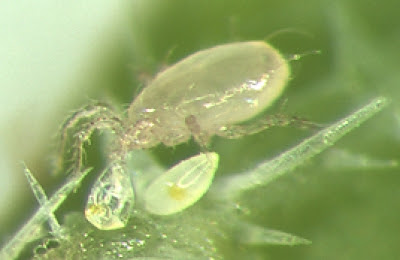
Swirski mite Amblyseius swirskii, from here.


When reviewed by Chant & McMurtry in 2004, Amblyseius was a sizeable assemblage of close to 350 known species (I quite expect that number to have expanded by now). Species of Amblyseius are lightly sclerotised, mostly pale in colour, and usually have a smooth shield covering most of the dorsum. The genus is characterised by the presence of eighteen or nineteen pairs of setae on the dorsum of the idiosoma (the central body) with three sublateral pairs being particularly long: one about the level of the third pair of legs (referred to as the s4 pair) and the other two towards the rear of the body. Except for a few pairs forward of the s4 setae, the remaining dorsal setae are all minute.

The primary focus of human interest in phytoseiids has been their role as predators of crop pests. I described some of the ways in which phytoseiids have been commercially utilised in an earlier post. Species used in this way include several Amblyseius though matters are complicated slightly by changes in taxonomy (for instance, one species which has been widely traded as Amblyseius cucumeris is now placed in the genus Neoseiulus). One of the most widely used of the commercial phytoseiids in recent years has been Amblyseius swirskii, commonly known as the Swirski mite (E. Swirski being an acarologist after whom the species was named). This species was first described in 1962 from almond trees in Israel and subsequently identified from a wide range of plant and crop species. Its history in pest control has been described in detail by Calvo et al. (2015).

The Swirski mite feeds on a range of prey, including mite, thrips and whitefly species, as well as on pollen and micro-fungi. It was first promoted as a commercial control for silverleaf whitefly Bemisia tabaci in the early 2000s. However, it did not get taken up in a big way until media publicity about pesticide residues on capsicum crops in Spain led to a crash in demand. Farmers in that country were forced to look for alternative means of pest control and found great success with A. swirskii (previous attempts to use the cooler-clime preferring Neoseiulus cucumeris in Spain had not been promising). Since then, the Swirski mite has been adopted in numerous countries for use on a range of crops to control various pests such as western flower thrips Frankliniella occidentalis. Because of its ability to grow and thrive on non-insect foods, including artificial diets, this mite is easily cultured commercially. It may also be released on crops before pest infestations develop, building up numbers on a diet of pollen until suitable prey presents itself. For the same reason, Swirski mite populations do not crash before pest control is complete. Overall, a remarkable success and a prime example of the value of Amblyseius species to mankind.

REFERENCES

Calvo, F. J., M. Knapp, Y. M. van Houten, H. Hoogerbrugge & J. E. Belda. 2015. Amblyseius swirskii: what made this predatory mite such a successful biocontrol agent? Experimental and Applied Acarology 65: 419–433.

Chant, D. A., & J. A. McMurtry. 2004. A review of the subfamily Amblyseiinae Muma (Acari: Phytoseiidae): part III. The tribe Amblyseiini Wainstein, subtribe Amblyseiina n. subtribe. International Journal of Acarology 30 (3): 171–228.

A Spider for Christmas

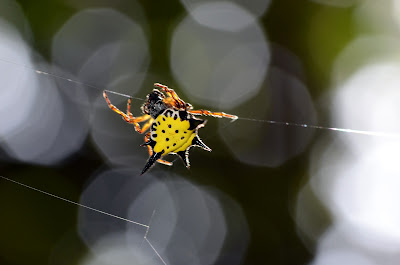
Hasselt's spiny spider Macracantha hasselti, copyright Patrick Randall.


In many warmer parts of the Old World, the spiny orb-weavers of the subfamily Gasteracanthinae are among the most eye-catching of all spiders. As well as constructing complex, easily seen webs in the manner of other orb-weavers, these spiders draw attention by their bright colours and ornate structure, often with prominent arrangements of spines on the abdomen. Here in Australia, their dramatic appearance has lead to their often being referred to as "Christmas spiders". The exact reason for this drama is uncertain. The spines are generally presumed to be for defence but the coloration has been subject to multiple proposals from an aposematic warning to functioning as a lure for flying insects.

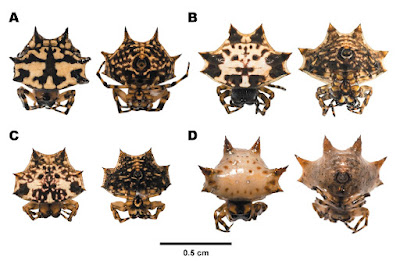
Variants of Gasteracantha kuhli, from Macharoenboon et al. (2021).


The taxonomic history of the Christmas spiders is a complicated one, going back to the early years of arachnology. Not surprisingly for such distinctive animals, a large number of species were described by early authors. However, species of spiny orb-weavers are often very variable, leading to a significant number being described as new on more than one occasion. As with other orb-weavers, males are much smaller than females, and the spines on the abdomen tend to be more poorly developed. Coloration within a species can vary considerably in brightness, tone, and patterning. Structural features such as the arrangement of spines and the development of sigilla (impressions on the dorsal surface of the abdomen that mark the placement of internal muscles) can still provide reliable indicators of species identity, as (of course) can features of the genitalia. You have to learn to look past the superficial daubings and focus on the underlying form.

The Dermacentor Ticks

Pacific Coast tick Dermacentor occidentalis, copyright Jerry Kirkhart.


Among the ticks of most concern to humans are species of the genus Dermacentor. This genus of about forty known species is widely distributed in Africa, Eurasia and the Americas. Examples include the meadow tick D. reticulatus in Europe, and the wood tick D. variabilis and Rocky Mountain wood tick D. andersoni in North America. They are parasites of mammals, including both generalist and more host-specific species; records of Dermacentor individuals from reptiles and even carpenter bees (Goddard & Bircham 2010) presumably represent incidental and/or accidental associations. Species of Dermacentor are responsible for the spread of bacteria causing diseases such as Rocky Mountain spotted fever (which, despite sounding like a 1950s dance craze, is presumably not much fun), Q fever and tularemia. The ticks can also be more directly hazardous, as their bites inject a toxin that can cause tick paralysis.

Distinguishing features of Dermacentor species relative to other ticks include a rectangular base to the capitulum, relatively short, broad palps, well-developed eyes and the presence of festoons (impressed divisions of the posterior margin of the body) (Keirans 2009). Most are ornate—that is, marked on the dorsum with contrasting pale patterns—with the notable exception of the tropical horse tick D. nitens of the Americas (until recently, often treated as forming its own genus Anocentor). The function of such markings is unknown though suggestions include environmental protection, warning predators of distastefulness, or sexual signalling.

Meadow tick Dermacentor reticulatus, copyright Ferran Turmo Gort.


The majority of Dermacentor species have a three-host life cycle, dropping off the host between each of the life stages of larva, nymph and adult, and seeking out a new host after moulting. However, at least two New World species, the aforementioned D. nitens and the winter tick D. albipictus (a parasite of deer), are one-host ticks that remain on their original host between instars. In general, Dermacentor species are more resilient to dry climates than many other tick species. Individual species can differ in their climate tolerance, however. In North America, the geographical divide between D. variabilis in the east of the continent and D. andersoni in the west seems to be driven by the need for the latter of drier conditions (Yoder et al. 2007). Older instars also tend to be hardier than younger. Females of the ornate sheep tick D. marginatus, a European species, leave their host after gorging at the beginning of winter and then wait for more amoenable spring conditions before laying their delicate eggs (Dörr & Gothe 2001).

Higher relationships within the genus do not appear to have been extensively studied. A preliminary molecular phylogeny of hard ticks has suggested the possibility of a basal division between Afrotropical, Eurasian and New World lineages (Barker & Murrell 2004). Comparison with related tick genera raises the possibility of an Afrotropical origin for Dermacentor, though the genus has only a relictual presence in that continent now. However, with only a handful of species subjected to broad phylogenetic analysis to date, further testing is demanded. Does the continental divide hold true? Do the one-host species form a single clade within the genus? Inquiring minds wish to know.

REFERENCES

Barker, S. C., & A. Murrell. 2004. Systematics and evolution of ticks with a list of valid genus and species names. Parasitology 129: S15–S36.

Dörr, B., & R. Gothe. 2001. Cold-hardiness of Dermacentor marginatus (Acari: Ixodidae). Experimental and Applied Acarology 25: 151–169.

Goddard, J., & L. Bircham. 2010. Parasitism of the carpenter bee, Xylocopa virginica (L.) (Hymenoptera: Apidae), by larval Dermacentor variabilis (Say) (Acari: Ixodidae). Systematic and Applied Acarology 15: 195–196.

Keirans, J. E. 2009. Order Ixodida. In: Krantz, G. W., & D. E. Walter (eds) A Manual of Acarology 3rd ed. pp. 111–123. Texas Tech University Press.

Yoder, J. A., D. R. Buchan, N. F. Ferrari & J. L. Tank. 2007. Dehydration tolerance of the Rocky Mountain wood tick, Dermacentor andersoni Stiles (Acari: Ixodidae), matches preference for a dry environment. International Journal of Acarology 33 (2): 173–180.

Pied Harvestmen of the Antilles

Harvestmen of the Neotropical family Cosmetidae have been featured on this site a couple of times before. Each time, I've commented on the dire taxonomic state of this diverse family, with many genera being poorly or inaccurately defined. Thanks to extensive (and continuing) studies in recent years by Braxilian researchers and their associates, this situation has been progressively improving, but we still have a lot to learn.

Cynortoides sp., copyright Damion Laren Whyte.


Cynortoides is a genus currently holding ten species of cosmetid. Most of these are found on the islands of the Greater Antilles—Cuba, Jamaica and Hispaniola—though the genus has also been recorded from adjoining regions of Mexico and Venezuela (Kury 2003). As with other cosmetids, Cynortoides has historically been defined largely be features of the external spination, including a lack of spines on the legs, two pairs of spines in the rear part of the dorsal scutum, and no spines on the free abdominal segments (Mello-Leitão 1933). Also as with other cosmetid genera, Cynortoides species are colourfully patterned. The name of one species, C. v-album, refers to its characteristic bright white V marking on the back (though personally, I would describe the pattern as more of a Y).

Though this genus does not yet appear to have been revised in detail, some of its species were included in a recent broader study of cosmetid phylogeny by Medrano et al. (2021). They found strong support for an association between the Cuban C. cubanus and the Hispaniolan C. v-album, together with two other Cuban species previously included in the related genus Cynorta. These last two species were consequently transferred to Cynortoides though Medrano et al. did not comment on whether this affected the genus' established diagnosis. The authors speculated that further studies might prove Cynortoides to be a strictly Greater Antillean genus with mainland records being misplaced. Cynortoides would not be unique in this regard: the islands of the Caribbean are home to a number of lineages found nowhere else, reflecting a long history independent of the adjoining continents.

REFERENCES

Kury, A. B. 2003. Annotated catalogue of the Laniatores of the New World (Arachida, Opiliones). Revista Ibérica de Aracnología, special monographic volume 1: 1–337.

Medrano, M., A. B. Kury & A. C. Mendes. In press 2021. Morphology-based cladistics splinters the century-old dichotomy of the pied harvestmen (Arachnida: Gonyleptoidea: Cosmetidae). Zoological Journal of the Linnean Society.

Mello-Leitão, C. F. de. 1933. Notas sobre os opiliões do Brasil. Descritos na obra postuma de Sörensen: "Descriptiones Laniatorum". Boletim do Museu Nacional 9 (1): 99–114.

The Microzetid Enigma

The armoured mites of the Oribatida include their fair share of ornately ornamented species but perhaps the most grotesque of all are to be found under members of the family Microzetidae. These typically fairly small oribatids (the average size is about a third of a millimetre) are primarily found in soil and litter deposits around the world. They include a handful of species found in the far north but are primarily found in warmer regions with the greatest known diversity in the Neotropics (Woas 2002).

Dorsal, ventral and lateral views of Acaroceras galapagoensis, from Heinrich Schatz & Jose Palacios-Vargas.


The microzetids are primarily distinguished by elaborate outgrowths of the cuticle around the front of the body. In many oribatids, a pair of thin lamellae run down either side of the prodorsum (the part of a mite that might at first glance be taken for the 'head'). In microzetids, these lamellae have become massively enlarged and detached from the prodorsum over much of their length. As a result, they form a kind of hood over the front of the body. They are flanked on either side by similar lateral extensions called tutoria. The prodorsum as a whole is often remarkably large compared to the rear part of the dorsum, the notogaster. Indeed, the notogaster is often as wide as or wider than it is long. A pair of wing-like extensions, pteromorphs, extend on either side of the front of the notogaster; in microzetids, the pteromorphs are typically sharply pointed. To top all these excrescences off, the insertions of the first pair of legs are also shielded by well-developed flanges called pedotecta.

What, if anything, is the purpose of all these anatomical extravagances is a question I am unable to answer: whether they are related in some way to defense or water retention, for instance. They also make it difficult to understand the position of microzetids relative to other oribatids. The presence of pteromorphs has commonly been thought characteristic of a group of oribatids that have been referred to as the Poronoticae. However, microzetids lack any sign of another distinctive feature of poronotic oribatids: the array of glandular openings on the cuticle known as the octotaxic system. Some oribatids are known to have reduced octotaxic systems, and microzetids do bear a certain resemblance to a definitely poronotic family in the Oribatellidae, so it is possible they represent poronotic mites in which the octotaxic system has been lost. However, other features of microzetids further support affinities outside the Poronoticae. In particular, nymphs of microzetids carry scalps. As they moult from one instar to the next, the shed cuticle of the notogaster is retained in place like a cap. Over successive instars, this cap becomes a stack of scalps that potentially assist in defence (a would-be predator attempting to grab onto the notogaster finds itself holding only an empty scalp). This is generally thought to be a primitive bahaviour that was lost in the ancestor of the poronotics. So are the microzetids primitive relatives of the poronotics, descended from ancestors that had acquired pteromorphs but not yet lost the scalp-carrying habit? Are they derived poronotics that eschewed the octotaxic system and taken up their scalps once more? Further research into oribatid phylogeny is needed to know.

REFERENCE

Woas, S. 2002. Acari: Oribatida. In: Adis, J. (ed.) Amazonian Arachnida and Myriapoda: Identification keys to all classes, orders, families, some genera, and lists of known terrestrial species pp. 21–291. Pensoft: Sofia.

Where There's a Whip, There's a Scorpion

As our understanding of the higher relationships between organisms has improved vastly in recent decades, the arachnids have remained an intransigent bunch. Proposed connections between the various historically recognised orders have remained poorly supported and, even now, there are few that do not continue to jump about with gleeful abandon with each successive analysis. One small bastion of reliable support, however, has been been the tropical clade known as the Pedipalpi.

Whip spider Phrynus exsul, copyright Michel Candel.


Members of the Pedipalpi have traditionally been divided between two or three distinct orders: the whip spiders or tailless whip scorpions of the Amblypygi, the whip scorpions of the Uropygi, and the micro-whip scorpions of the Schizomida (alternative classifications have combined the last two in a single order Uropygi or Thelyphonida). All have a broad distribution in tropical and subtropical regions of the world. Representatives of the Pedipalpi are active hunters, united by the possession of large, raptorial pedipalps used in the capture of prey. All three groups also have the first pair of legs modified to become elongate and whip-like (Shultz 2007). These legs are not used in walking but are held forwards to function like antennae. The Uropygi and Schizomida are further united by the possession of a terminal appendage on the body, the 'whip' of a 'whip scorpion'. There is also a general agreement in recent years that the Pedipalpi are in turn the sister lineage to the spiders. Some researchers have argued for a closer relationship of the Amblypygi to the spiders rather than the whip scorpions, reflecting their (among other things) similar habitus, but this remains a minority view.

Syntype (one of the original described specimens) of Paracaron caecus, from Garwood et al. (2017). Scale bar = 5 mm.


Globally, the Pedipalpi are not a hugely diverse lineage, with a bit more than 600 known species overall. About 190 species belong to the Amblypygi, the whip spiders. As noted above, these arachnids are quite spider-like in appearance owing the lack of a terminal flagellum and the presence of a well-defined waist between cephalothorax and abdomen, but they lack the poison fangs and spinnerets of a spider. Most whip spiders have a distinctly flattened habitus, allowing them to enter narrow spaces under bark or between rocks. They also have the most remarkably elongate first legs among the Pedipalpi. Living whip spiders can be divided between two lineages, referred to as the Paleoamblypygi and Euamblypygi (Garwood et al. 2017). The Paleoamblypygi are represented in the modern fauna by only a single known (but little known) species, Paracharon caecus, a blind inhabitant of termite nests in western Africa. Paracharon caecus differs from other living whip spiders in retaining a vertical plane of motion of the pedipalps, like those of whip scorpions. In the Euamblypygi, the orientation of the pedipalps has shifted so they move in a horizontal plane only. In some whip spiders, the pedipalps have become remarkably long, perfect for clasping prey in a fatal hug.

Giant whip scorpion Mastigoproctus giganteus, copyright David Bygott.


The whip scorpions of the Uropygi are the least diverse of the three lineages of Pedipalpi, with about 110 known species. They are large, robust arachnids characterised by their long, filamentous terminal flagellum. Glands at the base of the flagellum produce noxious chemicals used in defense, giving some species the alternative name of 'vinegaroons'. The Schizomida are the most diverse subgroup of the Pedipalpi, including about half the known species. Some species have become widespread as a result of human transportation in association with greenhouses whereas others have even been collected among ice and snow in California (Harvey 2003). Schizomids are smaller and softer-bodied than the Uropygi and the terminal flagellum is shorter (as in Uropygi, the flagellum is flanked by repugnatorial glands). In male schizomids, the flagellum is often distinct in shape from that of the females, becoming bulbous. Schizomids also differ from most other arachnids in the presence of visible dorsal divisions between the segments of the cephalothorax.

Female schizomid Hubbardia briggsi, copyright Marshal Hedin.


In all subgroups of the Pedipalpi, reproduction involves mating displays in which the male deposits a spermatophore on the ground and then guides the female over it (Harvey 2003). The exact manner in which the male guides the female differs between subgroups. In schizomids, the female grasps onto the male's flagellum and he leads her. In Uropygi, the male grasps the female's fore legs with his pedipalps before turning to face the same direction as her with himself in front, and pulls her over the spermatophore. He then turns, embraces her abdomen with his pedipalps, and manually inserts the spermatophore into her genital operculum. Amblypygi have perhaps the most graceful option of the three: the male stands facing the female then gently beckons her forward, allowing her to approach and collect the spermatophore of her own volition.

REFERENCES

Garwood, R. J., J. A. Dunlop, B. J. Knecht & T. A. Hegna. 2017. The phylogeny of fossil whip spiders. BMC Evolutionary Biology 17: 105.

Harvey, M. S. 2003. Catalogue of the Smaller Arachnid Orders of the World: Amblypygi, Uropygi, Schizomida, Palpigradi, Ricinulei and Solifugae. CSIRO Publishing.

Shultz, J. W. 2007. A phylogenetic analysis of the arachnid orders based on morphological characters. Zoological Journal of the Linnean Society 150 (2): 221–265.

Mites of Southern Sediment

Water mites of the clade Hydrachnidiae are one of the few groups of arachnids that have not only adopted an aquatic lifestyle but have thrived and diversified there. Over fifty families are currently recognised within this clade, some of which can be found in almost every body of fresh water worldwide. Others, however, are notable for their restricted ranges. One of these latter examples is the Omartacaridae.

Ventral view of female Omartacarus elongatus, from Cook (1963).


Omartacaridae is a small family currently recognised as including only two genera, Omartacarus and Maharashtracarus. They have a somewhat elongated body with a soft integument, contrasting with the more globular form of many other water mites. They are also distinguished by the arrangement of the coxae (the basal segments of the legs on the underside of the body) which are clustered together with the medial edges of the anterior pairs much longer than those of the posterior pairs (Walter et al. 2009) so the third pair of coxae are triangular in shape. As far as is known, omartacarids are restricted to interstitial habitats or the hyporheic zone of sediment beneath and alongside stream beds. I am unaware of any direct observations of omartacarid behaviour but they are presumably predators like other water mites. Most of the (rather limited) attention that has been given to omartacarids has focused on discussions of their distribution. Species of Omartacarus are found in South and southern North America, as well as in Australia. Maharashtracarus species are known from India and Costa Rica. It has been presumed that this reflects an ancestral Gondwanan distribution, spreading into North America from South America as the continents joined.

The larval stage of omartacarids is, to date, unknown. Larvae of other water mites live as parasites of water-associated insects such as midges and omartacarid larvae are presumably also parasitic. But in what capacity? Do mature omartacarids emerge from their subterranean habitats at some particular time of year in search of a host for their eggs? Do they somehow manage to find a host while remaining safely sequestered underground? The secret remains to be uncovered.

REFERENCE

Walter, D. E., E. E. Lindquist, I. M. Smith, D. R. Cook & G. W. Krantz. 2009. Order Trombidiformes. In: Krantz, G. W., & D. E. Walter (eds) A Manual of Acarology 3rd ed. pp. 233-420. Texas Tech University Press.

Atropacarus

The little guy pictured above (photo copyright Scott Justis) is a representative of the box mite genus Atropacarus, members of which can be found in most parts of the world. Atropacarus is a genus of the Phthiracaroidea, a group of box mites characterised by the plates on the underside of body being relatively wide, in contrast to the narrow ventral plates of its sister group, the Euphthiracaroidea (members of which have featured on this site before: here and here). The difference in configuration of these plates reflects a difference in the way that the body is contracted to allow legs and prosoma to be withdrawn beneath the protective cover of the notogaster. In euphthiracaroids, the sides of the notogaster are contracted inwards; in phthiracaroids, the ventral plates of the body are lifted upwards (Schmelzle et al. 2015).

The classification of phthiracaroids is subject to conflict with two main systems in the recent literature. In one, championed by the Polish acarologist Wojciech Niedbała, the phthiracaroids are divided between two families with Atropacarus in the Steganacaridae. Species of Atropacarus have the surface of the notogaster extensively covered with dimples. The dorsal seta on the tibia of the fourth leg is short and closely associated with a solenidion (a type of specialised sensory hair). The setae of the genital plate are arranged in a more or less straight row along the inner margin of the plate with the fifth and sixth setae further apart than the fourth and fifth (Niedbała 1986). Niedbała divides Atropacarus between two subgenera. In Atropacarus sensu stricto, there are sixteen or more pairs of setae on the notogaster and the second adanal seta is moved inwards on the ano-adanal plate to form a more or less straight line with the anal setae. In Hoplophorella, there are fifteen pairs of setae on the notogaster and the second adanal seta is distinctly laterally placed relative to the anal setae.

The super-hairy Atropacarus niedbalai, from Liu & Zhang (2013). Scale bar = 100 µm.


In the competing system, used for instance by Subías (2019), Atropacarus and Hoplophorella are treated as distinct genera and each is in turn divided into subgenera by the number of setae on the ano-adanal plate. To a certain extent, of course, the question of whether to treat Atropacarus and Hoplophorella as genera or subgenera is arbitrary. Nevertheless, this arguably cosmetic distinction does relate to an underlying difference in theory. The classification of phthiracaroids used by Subías (2019) is a largely diagnostic one, inspired by a desire to facilitate specimen identifications. Niedbała's classification, in contrast, is intended to reflect phylogenetic relationships. Simple setal counts may be convenient when composing keys but one might question its overall phylogenetic significance. Neotrichy (increases in setal count by multiplication of the original setae) is not uncommon in phthiracaroids, particularly on the notogaster. Setal counts may vary between individuals of a single species and overall neotrichy reaches an extreme in the New Zealand species Atropacarus niedbalai. In this species, the basic count of fifteen or sixteen pairs of notogastral setae has been increased to 109 or 115 pairs, with further neotrichy on the prodorsum and ventral plates (Liu & Zhang 2013). Subías (2019) defends his choice of classification by arguing that Niedbała's key features are often difficult to discern. I sympathise with the difficulty but, as a wise man once said, species are under no obligation to evolve with regard to the convenience of taxonomists.

REFERENCES

Liu, D., & Z.-Q. Zhang. 2013. Atropacarus (Atropacarus) niedbalai sp. nov., an extreme case of neotrichy in oribatid mites (Acari: Oribatida: Phthiracaridae). International Journal of Acarology 39 (6): 507–512.

NiedbaÅ‚a, W. 1986. Système des Phthiracaroidea (Oribatida, Euptyctima). Acarologia 27 (1): 61–84.

Schmelzle, S., R. A. Norton & M. Heethoff. 2015. Mechanics of the ptychoid defense mechanism in Ptyctima (Acari, Oribatida): one problem, two solutions. Zoologischer Anzeiger 2015: 27–40.

Subías, L. S. 2019. Nuevas adiciones al listado mundial de ácaros oribátidos (Acari, Oribatida) (14a actualización). Revista Ibérica de Aracnología 34: 76–80.

Caloppiidae

The concept of ranks in taxonomy is ultimately an arbitrary one. There is no real definition of what constitutes an 'order', a 'family' or a 'subfamily'. What determines the rank that a given taxon is recognised at is a combination of tradition, convenience, and the taxon's relationships to other recognised taxa. As such, the question of whether a given classification is overly 'split' or 'lumped' is a meaningless one and arguing the point is a complete waste of time. That said, the classification of the 'higher' oribatid mites is massively oversplit.

A big part of the reason why oribatid classification seems such a mess, with large numbers of small families containing only a handful of genera and/or species apiece, can be attributed to simple ignorance. We simply do not have a good handle on how many oribatid taxa are related to each other and as a result we find ourselves with a great many orphan taxa still hunting for a good home. The Caloppiidae may be regarded as one such taxon.

Dorsal view of Luissubiasia microporosa, from Ermilov (2016). Scale bar = 100 µm; labels with 'A' indicate areae porosae.


Caloppiids are a pantropical group of about thirty species of poronotic oribatids (the group of oribatids exhibiting the octotaxic system, an arrangement of glandular openings on the notogaster), with three genera recognised in the family by Ermilov (2016): Zetorchella, Brassiella and Luissubiasia. Zetorchella, which includes the majority of the family's species, is also pantropical in distribution. Brassiella is known from the Indo-Pacific region and Liussubiasia is known from a single species from Cuba. Past authors have often referred to Zetorchella and the Caloppiidae by the names Chaunoproctus and Chaunoproctidae, respectively, but as the name Chaunoproctus had already had dibs called on it before the mite was named (by a bird, the now-extinct Bonin grosbeak Chaunoproctus ferreorostris), their respective most senior synonyms have to take over. Caloppiids are more or less egg-shaped in dorsal view. They lack the distinct pteromorphs of most other poronotics though they may have quadrangular projections in the humeral region (the 'shoulders'). The integument is usually heavily sculpted and foveate. The legs end in three claws apiece. The most characteristic feature of the group is that the openings of the octotaxic system on the notogaster, of which five pairs are present, are extremely small. The octotaxic system can take two forms, recessed saccules or porose patches. Those of caloppiids have usually been described as saccules but Ermilov (2016) states that, at least in some species, they are very small porose areas.

Going by their overall appearance, caloppiids are classified within the superfamily Oripodoidea. However, one of the most characteristic features of the Oripodoidea as an evolutionary group is that their nymphs have notogastral setae borne on individual off-centred sclerites (oribatid nymphs often look very different from their adults and are often more soft-bodied). At this point in time, we simply do not know what the nymphs of caloppiids look like so we cannot say whether they possess this crucial feature. Conversely, with their lack of pteromorphs, caloppiids bear a distinct similarity to the more diverse oripodoid family Oribatulidae. The two families have mostly been separated on the basis of caloppiids supposedly having an octotaxic system of saccules rather than porose areas, a distinction that I've already noted may not hold up. There's also something of an open question whether the distinction between saccules and porose areas is really as significant as it has been thought in the past. So, at present, we can't say with confidence whether caloppiids are true oripodoids... or whether they are not only oripodoids but don't even warrant recognition as a distinct family from oribatulids.

REFERENCE

Ermilov, S. G. 2016. Luissubiasia microporosa gen. nov., sp. nov. (Acari, Oribatida, Caloppiidae) from Cuba. International Journal of Acarology 42 (2): 127–134.

Oribatid Time Again

The oribatid mite genus Neogymnobates was first recognised from Illinois in 1917. Since then, the genus has been found to be more widespread in North America and has also been described from Korea and Tibet. Species of Neogymnobates are known from arboreal habitats or in association with fallen wood, and live as grazers of micro-vegetation such as lichens.

Neogymnobates luteus, copyright Monica Young.


Neogymnobates belongs to the Ceratozetidae, a diverse family of oribatids whose characteristic features include a tutorium (a projecting tooth-like structure) on the side of the prodorsum and immovable pteromorphs on either side of the front of the notogaster. Neogymnobates has the lamellae on either side of the prodorsum widely separated from each other and connected by a transverse translamella at the front. There are thirteen pairs of setae on the notogaster and four pairs of porose areas (Balogh & Balogh 1992). One species, N. marilynae of British Columbia and Washington State, is known to have an extra unpaired porose area on the midline near the rear of the notogaster (Behan-Pelletier 2000), an unusual feature among oribatids but one whose significance is uncertain). Their legs end in three claws, a feature that (as I've commented before) correlates with their arboreal habits.

Half a dozen species of Neogymnobates have been recognised to date (Subías 2004). The species are distinguished by features such as the size and appearance of the setae, and the development of the prodorsal lamellae and translamella. One Korean species, N. parvisetiger, has been awarded its own subgenus Koreozetes due to its particularly small, almost indiscernable notogastral setae and its anteriorly notched rather than rounded rostrum (Aoki 1974). Most species are only known from limited ranges except one, N. luteus, for which separate subspecies have been recognised in northern North America and in Korea. Rather unexpectedly, this last species has also recently been recorded from Zanzibar (Ermilov & Khaustov 2018). This is a remarkable range increase, both geographically and ecologically (enough so that I can't help feeling it would benefit from double-checking) that raises the possibility that we may yet have a lot to learn about this oribatid genus.

REFERENCES

Aoki, J. 1974. Oribatid mites from Korea. I. Acta Zoologica Academiae Scientiarum Hungaricae 20 (3–4): 233–241.

Balogh, J., & P. Balogh. 1992. The Oribatid Mites Genera of the World vol. 1. Hungarian Natural History Museum: Budapest.

Behan-Pelletier, V. M. 2000. Ceratozetidae (Acari: Oribatida) of arboreal habitats. Canadian Entomologist 132: 153–182.

Ermilov, S. G., & A. A. Khaustov. 2018. A contribution to the knowledge of oribatid mites (Acari, Oribatida) of Zanzibar. Acarina 26 (2): 151–159.

Subías, L. S. 2004. Listado sistemático, sinonímico y biogeográfico de los ácaros oribátidos (Acariformes, Oribatida) del mundo (1758–2002). Graellsia 60 (número extraordinario): 3–305.

Austrotritia: Jack-in-the-Box Mites

We just keep coming back to the oribatids, don't we?

In an earlier post, I introduced you to Oribotritia, one of the genera of box mites. These, you may recall, are the armoured mites that have evolved the ability to curl the front of the body under themselves and tuck back their legs to form a solid case (in the Oribotritiidae, that mechanical defense is supplemented by the production of a defensive chemical, chrysomelidial, from glands in the cuticle—Shimizu et al. 2012). In the earlier post, I also gave you a quick overview of the families of what are known as the 'true' box mites. Today's post is for another component of the family Oribotritiidae, the genus Austrotritia.

Austrotritia lebronneci, copyright R. Penttinen.


Austrotritia accounts for nearly twenty species of box mite, the great majority of which are found in Australasia and southern and eastern Asia (Liu et al. 2009). Outliers are A. engelbrechti in South Africa, A. herenessica in the Canary Islands and, most unexpected of all, A. finlandica in Finland. Austrotritia differs from all other oribotritiids except the small Bornean genus Terratritia in lacking any division between the genital and aggenital plates on the underside of the body. The distinction between Austrotritia and Terratritia perhaps requires reassessment: Niedbała (2000) distinguished them by the presence of five-segmented palps and a single pair of exobothridial setae in Austrotritia versus three-segmented palps and two pairs of exobothridial setae in Terratritia (the bothridia are the structures bearing large sensory setae on the prodorsum of the mite; exobothridial setae are thus setae sitting alongside the bothridia). However, Liu & Zhang (2014) redescribed the widespread species Austrotritia lebronneci as having three-segmented palps but only a single pair of exobothridial setae. Note that classification of oribatids has mostly been conducted from a diagnostic rather than a phylogenetic perspective; it would not surprise me if Terratritia turned out to be a derived subgroup of Austrotritia.

Schematic of jump performance by Indotritia cf. heterotrichia from Wauthy et al. (1998); the solid line represents observed jumps, the dashed lines modelled jumps. Line drawings represent (a) body posture when beginning jump, (b) rotation during jump, and (c) enclosed posture after jumping.


As well as the aforementioned defenses standard for box mites, Austrotritia and the related genus Indotritia stand out from other oribotritiid genera in that at least some species have the ability to jump. The mechanics of jumping were described for a species of Indotritia by Wauthy et al. (1998) who recorded the mites jumping nearly a centimetre in height over a distance of just under an inch (for perspective, the mite itself is about half a millimetre in length). Jumping was preceded by compressing the notogaster while raising the ventral plates under the opisthosoma, together with lowering the prosoma and bringing the legs together under the body. Small hooks at the end of femur of the first pair of legs were used to catch ridges on the side of the prodorsum in order to hold the body compression. The force for the jump was presumably supplied by the release of the hydraulic compression of the body fluids when the legs disengaged from the prodorsum, propelling the mite backwards while the body rolled forwards: essentially, the mite would star-jump away. The mite would curl up after jumping to lie in an enclosed state.

Whether all Austrotritia species are jumpers is not entirely certain. The femoral hooks that seem to play a significant role in jumping have not been described in all species. However, it is not clear if this lack of observation represents an actual absence or whether this minute feature has simply been overlooked. I also wonder whether the aforementioned fusion of the ventral plates in Austrotritia is related to their jumping abilities (Indotritia species also have the genital and aggenital plates fused anteriorly though they retain a degree of separation at the rear of the plates; non-jumping Oribotritia have the plates entirely separated). As always, there's still a lot we could potentially find out.

REFERENCES

Liu, D., J. Chen & G. Qiao. 2009. Review of Austrotritia (Acari: Oribatida: Oribotritiidae), with descriptions of two new species from China. Zootaxa 2144: 54–64.

Liu, D., & Z.-Q. Zhang. 2014. Redescription of Austrotritia lebronneci (Oribotritiidae) and descriptions of two new species of Euphthiracaridae (Acari, Oribatida) from Australian region. International Journal of Acarology 40 (1): 43–51.

Niedbała, W. 2000. The ptyctimous mites fauna of the Oriental and Australian regions and their centre of origin (Acari: Oribatida). Polskie Towarzystwo Taksonomiczne: Wrocław (Poland).

Shimizu, N., R. Yakumaru, T. Sakata, S. Shimano & Y. Kuwahara. 2012. The absolute configuration of chrysomelidial: a widely distributed defensive component among oribotritiid mites (Acari: Oribatida). Journal of Chemical Ecology 38: 29–35.

The Ornithocheyletiini: Making a Living off Birds

In an earlier post, I commented on the carnivorous mites of the family Cheyletidae. These rapacious micropredators are commonly associated with the nests and burrows of terrestrial vertebrates, attacking debris-feeders drawn in by the host's leavings. With such a close association already in place, it should come as little surprise that some lineages within the Cheyletidae have learnt to bypass scavenger predation and go directly to the source, becoming parasites of the vertebrate hosts themselves.

Slide-mounted female of Bakericheyla chanayi (left; scale bar = 50 µm) and nest webs on the skin of a heavily parasitised chaffinch Fringilla coelebs (right), from Filimonova (2013).


One such lineage is the Ornithocheyletiini, members of which are parasites of birds. Like other parasitic cheyletids, ornithocheyletiins have a relatively small, simple gnathosoma (the 'head' of the mite), no eyes, and lack the large, pectinate, claw-like setae found on the palps of free-living predatory cheyletids (instead, the setae at this position are small and smooth though they do still have hooked ends). Ornithocheyletiins are further distinguished from other cheyletids by having particularly large claws at the end of each leg that are overhung by a well developed knob on the end of the tarsus (Bochkov & Fain 2001).

Ornithocheyletiins live on the skin of their bird hosts. In the genera Ornithocheyletia and Bakericheyla, the mites spin a protective web beneath which they live and feed. Members of the tribe have been recorded from a number of bird orders, mostly smaller land birds (Passeriformes, Columbiformes, Piciformes, Coraciiformes, Psittaciformes and Apodiformes). At least one species of Ornithocheyletia was described from the Natal spurfowl Pternistis natalensis, a galliform. Members of the genus Apodicheles are restricted to species of Apodiformes (swifts) but other genera are found on a wider range of hosts. One cosmopolitan species, Bakericheyla chanayi, has been found on hosts of both the orders Passeriformes and Coraciiformes. The exact method of exploiting their host may vary: species of Bakericheyla feed on blood whereas Ornithocheyletia species feed on lymph fluid.

Historically, parasitic cheyletids were treated as a separate family Cheyletiellidae but are now classified with their free-living relatives. The exact relationships between free-living and parasitic cheyletids remain open to question. A morphological phylogenetic analysis of cheyletids by Bochkov & Fain (2001) did recover the parasitic forms as a clade but this result was questioned by the authors themselves. Instead, they suggested that the various parasitic tribes of Cheyletidae represented independent lineages whose shared features represented convergent adaptations to the parasitic lifestyle. The Ornithocheyletiini might, for instance, be compared to tribes such as the Cheletosomatini that inhabit the quills of bird feathers but feed on other quill-inhabiting mites rather than the birds themselves. Did ornithocheyletiins evolve from using birds as hunting grounds to using birds as food, or did they carry their parasitic habits with them from some other host?

REFERENCE

Bochkov, A. V., & A. Fain. 2001. Phylogeny and system of the Cheyletidae (Acari: Prostigmata) with special reference to their host-parasite associations. Bulletin de l’Institut Royal des Sciences Naturelles de Belgique, Entomologie 71: 5–36.

Zerconids

Slide-mounted male of Zercon gurensis, copyright Holger Müller.


The animal depicted above is a mite of the Zerconidae, one of the numerous families in the major mite clade known as the Mesostigmata. This family is mostly found in soil habitats such as leaf litter, mosses, decaying vegetation, or occasionally in animal nests (Lindquist et al. 2009). The zerconids are restricted to the Northern Hemisphere and are most diverse in temperate to Arctic regions; those species found in tropical parts of the world are restricted to high altitudes away from the hot lowlands (Ujvári 2012). Like many other Mesostigmata, they have the dorsal surface of the body mostly covered by shields of hardened cuticle. In most zerconids, separate shields cover the front (podonotal) and rear (opisthonotal) sections of the dorsum; the opisthonotal shield wraps around the rear margin of the mite and forms a continuous unit with the ventrianal shield that usually protects most of the underside of the mite behind the legs. Among the most noticeable features of the zerconids are two pairs of large openings near the rear of the opisthonotal shield (the four orange-segment-like structures in the photo above). These represent the openings of secretory glands, but I don't know if it has been established just what they're secreting; comparable structures in other mites may secrete pheromones, or defensive chemicals, or oils that prevent debris from sticking to the body. Other features of the zerconids include slender, relatively simple chelicerae that lack the modifications seen in the males of some other Mesostigmata, and peritremes (grooves on the underside of the body that channel air to the openings of the respiratory stigmata) that are relatively short. These peritremes are longer in zerconid nymphs, but become shortened when the mite moults to maturity.

Zerconids are another of those mite groups where the vast majority of what has been written about them relates to their basic taxonomy, with little yet known about their natural history. Several genera of zerconids are recognised, distinguished by features such as the shape of the body's various shields and the appearance of various setae. The form of their chelicerae indicates that zerconids are predatory like many other Mesostigmata. Because they are mostly found at ground level rather than on vegetation they have not attracted the economic interest of other predatory mites, but those few species that have been observed feeding were chowing down on nematodes. Mating does not appear to have been directly observed in zerconids, but again their anatomy and comparison with other mesostigs allows us to infer that the male fertilises the female by using his chelicerae to pass a spermatophore from his own genital opening on the underside of the body between the legs to hers. Where she then lays her eggs, and how her offspring spend their time to maturity, seem to be questions still awaiting an answer.

REFERENCES

Lindquist, E. E., G. W. Krantz & D. E. Walter. 2009. Order Mesostigmata. In: Krantz, G. W., & D. E. Walter (eds) A Manual of Acarology 3rd ed. pp. 124–232. Texas Tech University Press.

Ujvári, Z. 2012. Draconizercon punctatus gen. et sp. nov., a peculiar zerconid mite (Acari: Mesostigmata: Zerconidae) from Taiwan. Opusc. Zool. Budapest 43 (1): 79–87.

Hastocularis: A Fossil Harvestmen Allows Us to See

Sometimes the fossil record just gives us a gift, something that moves our understanding to an all-new level. One such gift saw publication a couple of years ago, but unfortunately I didn't have time to write about it then. I think it's about time I corrected that lacuna.

Reconstruction of Hastocularis argus, from Garwood et al. (2014).


By this point in time, we have a pretty good understanding of the basal framework of harvestmen evolution. The mite-like harvestmen of the Cyphophthalmi are well established as the sister group to all other Opiliones (which form a clade called the Phalangida). Unique features of the Phalangida include an intromittent penis in the males (phalangids are one of the few groups of arachnids to possess such a feature) and a central eyemound with a single pair of eyes. The Cyphophthalmi are more heavily armoured than most phalangids, and have a characteristic pair of raised cones (the ozophores) on either side of the carapace near the front that support the openings of odour-producing repugnatorial glands. Until recently, it was thought that most Cyphophthalmi lack eyes, but tiny, lens-less remnant eyes are now known to be present at the base of the ozophores in many cyphophthalmid subgroups.

There had long been questions about the nature of the cyphophthalmid eyes. The original arachnids possessed multiple pairs of eyes, and there is a good case to be made that the basal arrangement for arachnids as a whole is a single pair of larger median eyes in the middle of the carapace, and a number of pairs (up to three) of smaller lateral eyes at the margin. In some arachnid groups the median eyes have been lost; in others, the lateral eyes have become reduced in number or lost. In spiders, the lateral eyes have become enlarged and shifted about so the lateral/median distinction is less applicable (for the record, the posterior median eyes in spiders correspond to the original median eyes). Mites, of course, being mites, mess the whole system up entirely. Most mite eyes correspond to the original lateral eyes, but some mites possess a single median eye whose relation to the original arachnid median eye pair is up for grabs.

Phalangids, with their single central eyemound and single pair of eyes, had obviously kept the original median eyes and lost the lateral eyes. But what had happened with the Cyphophthalmi? Did their single pair of eyes near the edge of the carapace represent a single remnant pair of lateral eyes, or did they correspond to the median eyes of other Opiliones? It should be noted that some derived groups of undoubted Phalangida have lost the eyemound and have their eyes sitting directly on the carapace, and in some cases these unraised eyes may be widely separated. Arguments for both interpretations of cyphophthalmid eyes had been put forward by different authors, but the matter had certainly not been decided.

A representative member of Phalangida, Platybunus pinetorum, showing the central eyemound, from Opiliophilia.


That was until the description by Garwood et al. (2014) of Hastocularis argus, a remarkably preserved fossl harvestman from the Carboniferous of France. The appearance of this animal was established in some detail by the use of microtomography, allowing a number of details about it to be established. It was a heavily armoured animal with long legs, and like modern Phalangida it possessed a central eyemound on which there had been a pair of eyes (the eyes themselves were not preserved, but the sockets that had originally contained them were). The use of microtomography also allowed the identification of an intromittent penis like a phalangid. But Hastocularis also possessed a pair of raised ozophores like modern Cyphophthalmi, and at the base of those was preserved another socket indicating the presence of a second pair of eyes. There really could not be a more perfect answer to the cyphophthalmid eye question: the immediate ancestor of the Opiliones possessed two pairs of eyes, and the eyes of Cyphophthalmi do indeed correspond to the lateral eyes of other non-harvestmen arachnids and not to the median eyes of phalangids*.

*Pedantically speaking, Hastocularis is not the first four-eyed taxon assigned to the Opiliones. In 1875, an Austrian biologist by the name of Stecker described a remarkable animal from the Sudeten Mountains of Bohemia under the name of Gibbocellum sudeticum. Gibbocellum bore an overall resemblance to the Cyphophthalmi, except for possessing two pairs of eyes on raised cones, as well as two pairs of spiracles (other Opiliones possess a single pair). Despite enthusiastic searches, no other naturalist was ever able to find further specimens of Stecker's species, and at least one author suggested that it might be a poorly interpreted pseudoscorpion. However, a close criticism of various irregularities in Stecker's publications on Gibbocellum eventually lead Hansen & Sørensen (1904) to the conclusion that it had not merely been misrepresented, but was in fact a complete fabrication on that author's part.

A phylogenetic analysis of Hastocularis lead Garwood et al. (2014) to believe that it was more closely related to Cyphophthalmi than to Phalangida; together with another Carboniferous fossil species, Eophalangium sheari, they placed it within a new taxon Tetrophthalmi (meaning, of course, 'four eyes'). The main features cited in support of this relationship were the complete fusion of the dorsal surface (the only other harvestmen to show this feature are a southeast Asian family, the Oncopodidae, who are too deeply nested within the Phalangida to be a likely direct relative of Hastocularis) and the genital opening being a broadly open gonostome (in Phalangida, the genital opening is covered by an operculum). This implies that the immediate ancestor of all Opiliones was relatively long-legged, with the short legs of Cyphophthalmi a derived feature. However, I personally find the presence of an intromittent penis in Tetrophthalmi (it is also known to be present in Eophalangium) somewhat problematic in this regard. As noted above, the phalangid intromittent penis that directly injects sperm into the female ovipositor is highly unusual among arachnids. Cyphophthalmi do possess a penis-like structure (called the spermatopositor) but it is much shorter than in any phalangid and does not function as an intromittent organ. Instead, Cyphophthalmi males produce an encapsulated spermatophore that is attached by the spermatopositor to the female's underside, a more typical sort of arrangement for arachnids as a whole. An intromittent penis in the cyphophthalmid stem group would imply that Cyphophthalmi somehow reverted towards a more primitive-seeming reproductive arrangement at some point in the past. One possibility is that the penis of Tetrophthalmi did not function in exactly the same manner as that of Phalangida: perhaps tetrophthalmids still produced a spermatophore but were able to insert it more deeply in the female than Cyphophthalmi? Another possibility may be that Tetrophthalmi are stem-phalangids rather than stem-cyphophthalmids; only further analyses can possibly tell us more.

REFERENCES

Garwood, R. J., P. P. Sharma, J. A. Dunlop & G. Giribet. 2014. A Paleozoic stem group to mite harvestmen revealed through integration of phylogenetics and development. Current Biology 24: 1017–1023.

Hansen, H. J., & W. Sørensen. 1904. On Two Orders of Arachnida: Opiliones, especially the suborder Cyphophthalmi, and Ricinulei, namely the family Cryptostemmatoidae. University Press: Cambridge.

The Adaeines: South Africa's Cryptic Micro-Giants

Adaeulum sp., copyright Charles Haddad.


The Triaenonychidae are the family of Gondwanan harvestmen. While there are other families of harvestmen with a Gondwanan distribution (such as my own favoured family, the Neopilionidae), none of them are nearly as widespread and diverse as the triaenonychids. Despite their diversity, however, our understanding of triaenonychid relationships remains uncertain, and the family's classification poorly defined.

Within their range in Africa, Australasia and South America, triaenonychids can easily be distinguished from most other families of short-legged harvestmen by the structure of the claws on the hind two pairs of legs. Whereas members of other families bear a pair of simple claws on these legs, triaenonychids have a single claw with side branches on each leg. Branched claws are also found in the New Zealand genus Synthetonychia, which occupies its own distinct family, but that genus is easily recognised by its unusual body shape without a distinct eyemound. The Gondwanan Triaenonychidae were divided by Roewer into three subfamilies (Triaenonychinae, Triaenobuninae and Adaeinae) based on the shape of the sternum (the plate running along the underside of the body between the leg coxae). The significance of this feature was later questioned by Forster (1954) who recognised two subfamilies Triaenonychinae and Soerensenellinae on the basis of claw morphology (soerensenellines having longer side branches on the claws than triaenonychines) and reduced Roewer's subfamilies to tribes of Triaenonychinae. No large-scale analysis of triaenonychid phylogeny has been done so far, so it remains unestablished whether we should prefer one classification or the other (or possibly neither).

Typical triaenonychine (left) and adaeine (right) sternal shapes, from Forster (1954).


The Adaeinae or Adaeini may be one of the better defined of Roewer's original subgroups and recent authors have expressed the opinion that this may indeed turn out to be a natural clade. Whereas members of the Triaenonychinae sensu stricto and Triaenobuninae have a sternum that has a spearhead-shaped expansion at the front end and a broadened base at the back, members of the Adaeinae have a sternum that is a triangular or wedge shape without a posterior expansion. The adaeines are likely to be endemic to southern Africa; Kury et al. (2014) did list a single Australian species, Dingupa glauerti, in the Adaeinae but I would hazard a guess that future study proves this species to be misplaced (as has been found with other Australasian 'adaeines').

About forty species of adaeines are currently recognised, all from South Africa, but it is entirely likely that more remain to be described. The hard, granular body surface of adaeines inevitably picks up a covering of dirt and grit, making them exceedingly difficult to spot when not moving. Nevertheless, adaeines can be quite large as harvestmen go, with some being up to a centimetre in body length. Conversely, Micradaeum rugosum, a species found in the vicinity of Cape Town, is only about three-and-a-half millimetres in body length (Lawrence 1929). As with other species of Triaenonychidae, the large, raptorial pedipalps are larger and more robust in male adaeines than in females, and often have more pronounced spines. In some species of the genus Larifuga, nowever, spines or denticles may be more prominent on the female's pedipalps than on the male's, though the male's pedipalps are still larger and stronger overall (Lawrence 1937).

REFERENCES

Forster, R. R. 1954. The New Zealand harvestmen (sub-order Laniatores). Canterbury Museum Bulletin 2: 1–329.

Kury, A., A. Mendes & D. Souza. 2014. World checklist of Opiliones species (Arachnida). Part 1: Laniatores—Travunioidea and Triaenonychoidea. Biodiversity Data Journal 2: e4094. doi: 10.3897/BDJ.2.e4094

Lawrence, R. F. 1929. The harvest-spiders (Opiliones) of South Africa. Annals of the South African Museum 29 (2): 341–508.

Lawrence, R. F. 1937. The external sexual characters of South African harvest-spiders. Transactions of the Royal Society of South Africa 24 (4): 331–337, pls 14–15.

Metereca: Crossing the Divide

The crowdfunding campaign for my research on New Zealand harvestmen is still active. So far we're about 25% of the way towards the goal! Please click on the link above, and do your part to support your favourite arachnologist.

Dorsal view and pedipalp of Metereca papillata, from Roewer (1935).


There can be little doubt that the continent with the least studied harvestmen fauna relative to its likely diversity is Africa. Africa is home to a wide range of harvestmen lineages, some of which are found nowhere else on earth, but many remain unrevised. Among these poorly known elements are numerous members of the family Assamiidae. Among these are the members of the genus Metereca, which I drew as the semi-random subject for this post.

The Assamiidae are a family of short-legged harvestmen found in tropical regions of the Old World: Africa, Asia and Australia. I've spoken enough in the past about the shadow of Carl-Friedrich Roewer that hangs heavy over harvestmen systematics. Recent years have seen a large amount of research being conducted on the harvestmen of the Neotropics, resulting in a vast improvement in our taxonomic understanding for that part of the world. The harvestmen of the Old World, unfortunately, are yet to attract the same attention. Assamiids were last extensively reviewed by Roewer in 1935. He divided them between 17 subfamilies but in the usual Roewerian way these were mostly based on fairly superficial features (numbers of subsegments in the leg tarsi, whether the palp femur has long spines or only short denticles, etc.) that may not be that significant. Staręga (1992) published a checklist of African harvestmen in which he synonymised assamiid 'genera' that Roewer had placed in separate subfamilies, thus implicitly synonymising the subfamilies they were tied to.

Metereca is a genus of about fifteen known species of assamiid found across Africa. Roewer (1935) placed it in his subfamily Erecinae, supposed features of which included simple claws and the absense of a pseudonychium (a 'false claw' between the two real claws) on the third and fourth tarsi, two subsegments in the first telotarsus, small denticles on the pedipalp femur, concealed spiracles, and no median spine on the front margin of the carapace. However, the Erecinae as defined in this way included genera from all three of the Old World continents. Considering that other harvestmen groups have turned out to have a strong correlation between geography and phylogeny, I'd be willing to put money on Roewer's Erecinae not being monophyletic.

That same doubt applies to Metereca (though I'm not sure I'd put money on it this time), which is one of the larger erecine genera currently recognised. Supposed features of Metereca include a lack of dorsal spines on the body, and a four-segmented first tarsus and two-segmented second telotarsus. Species have been assigned to this genus from widely separated parts of the continent: the Congo, Tanzania, Mozambique. But not only is this a genus defined primarily by the absence of features (always a bit suspect), but other groups of harvestmen have tended to show a division between western and eastern Africa. It would be worth someone's time in the future, I think, to confirm whether Metereca really does cross the divide that others don't.

REFERENCES

Roewer, C. F. 1935. Alte und neue Assamiidae. Weitere Weberknechte VIII. (8. Ergänzung der "Weberknechte der Erde" 1923). Veröffentlichungen aus dem Deutschen Kolonial- und Uebersee-Museum in Bremen 1 (1): 1–168, pls 1–9.

StarÄ™ga, W. 1992. An annotated catalogue of Afrotropical harvestmen, excluding the Phalangiidae (Opiliones). Annals of the Natal Museum 33 (2): 271–336.

New Zealand Harvestmen: Please Help

The cave-dwelling Forsteropsalis photophaga, a remarkable harvestman species described in Taylor & Probert (2014).


As regular readers of this blog will be well aware, I've been working for several years now, off and on, on the taxonomy of long-legged harvestmen of the family Neopilionidae from Australia and New Zealand. In the past few years, this has been a bit more off than on: the necessities of earning a crust have meant that I haven't had the time to dedicate to full-time harvestman research. Nevertheless, I've been putting things together here and there where I can and an enormous amount of progress has been made. Back when I first decided to investigate this group of animals in 2000/2001, there were a handful of named species, often with descriptions amounting to nothing more than a couple of vague lines, all but unidentifiable in practice. Over time, I've redescribed each of these species in turn, as well as describing and naming a pile of new ones. We've learnt things about these animals we never knew before, such as the presence in many populations of a remarkable divergence within males to the extent that to the uninitiated they might be (and have been) mistaken for completely different species. We've seen the incredible range of forms in this group, from long-jawed monsters like to one at the top of this post, to heavily armoured cryptic soil-dwellers like in this photo by Stephen Thorpe.

After many years, I feel I'm finally approaching the point where I can put the finishing touches on my revision of the New Zealand neopilionids (for a given value of 'finish', of course, because there is no group of organisms for which the work is ever truly finished). Ideally, I would like to publish something incorporating a complete overview of this group of animals, a complete guide to all the known species offering a one-stop-shop to allow anyone, anywhere to confidently identify any specimen that might come to their hand. It's also important to me that I publish this guide in an open-access format so that it's also available at any time.

But to do that, I need your help. In order to be able to travel to the New Zealand museums that hold types and other crucial specimens that I need to examine, and to cover the publication fees of the resulting product, I've started a crowdfunding drive. Head over to https://experiment.com/projects/how-can-we-distinguish-species-of-new-zealand-harvestmen and you'll be able to support my research, follow the results as they become available, and receive full acknowledgement in the resulting publication(s). Even if you can't support me directly myself, you would be helping immensely if you inform others of my campaign, whether through social media, in person, or any other medium that makes itself available. Together, we can bring this truly incredible group of animals the recognition they so richly deserve!

If you want to see some of my work on harvestmen that's already come out, check out the links below:

Remarkable things
Possibly the coolest thing I had published this year
Score one for biogeography
How to wipe out a family
The saga of Forsteropsalis fabulosa
More on the New Zealand Opiliones
Bye, bye, Spinicrus
The eater of light
New Zealand fills a biogeographical gap

New Zealand Fills a Biogeographical Gap

Lateral view of the holotype (and only known specimen) of new species Americovibone remota.


Taylor, C. K. 2016. First record of a representative of Ballarrinae (Opiliones: Neopilionidae), Americovibone remota sp. nov., from New Zealand. Journal of Arachnology 44 (2): 194–198.

New paper, and new species of phalangioid harvestman, out! And one that I'm pretty excited by, even if the vagaries of time allocation mean that I haven't been able to get the post out until a couple of weeks after it happened. After several years of studying New Zealand's long-legged harvestman fauna, I have to confess I was getting a bit complacent about. I certainly knew that I had not seen every species that the country had to offer, but I still thought that there were no real surprises remaining. The overall outline had become clear; any species of long-legged harvestman remaining to be described from New Zealand would be fairly closely akin to those already known.

Oh boy, was I wrong.

At some point last year (or maybe the year before), I was sorting through a jarful of specimens that were still waiting on my attention. In one of the vials, its contents collected in a remote part of the south-west South Island, was a tiny, wispy specimen that I at first glance paid little mind to. Newly-hatched juveniles are not uncommonly collected; they are almost always unidentifiable and end up being just chucked back into the jar never to be looked at again. Nevertheless, I pulled the specimen out to confirm that my first impression was correct. I placed the specimen in a dish under the microscope and glanced through the eyepiece. Then looked again, my eyes doubtless boggling. I may have even sworn a little. Not only was the specimen not a juvenile but fully adult, it was something I had long given up on seeing from New Zealand: a ballarrine.

Dorsal view of the main body.


The Ballarrinae are an unusual group of harvestmen that were not recognised until fairly recently. The group was named by Hunt & Cokendolpher in 1991 with species found in South Africa, Australia and South America. The South African species Vibone vetusta was the only one described prior to Hunt & Cokendolpher's (1991) paper, and until now no further species had been described since. The main reason these animals were overlooked previously is probably their size: ballarrines include some of the smallest of all harvestmen (the specimen I was looking at, for instance, has a central body only a bit over a millimetre long). Ballarrines differ from other harvestmen in the form of their pedipalps which are relatively long and have the patella much longer than the tibia (the converse is usually the case). Whereas other phalangioid harvestmen have the patella and tibia of the pedipalp more or less in a straight line or have the tibia bent slightly downwards, Hunt & Cokendolpher (1991) were struck by how the ballarrines had the tibia reflexed upwards relative to the patella. Ballarrine pedipalps also lack a terminal claw, and have only a relatively few glandular hairs instead of the denser covering of simple hairs found in other harvestmen. As noted in an earlier post and paper that I was associated with (Wolff et al. 2016), the overall pedipalp form is adapted for preying on small animals such as springtails: the long pedipalp acts like a tentacle that can be whipped forward to trap prey with its sticky hairs.

Until this point, New Zealand had been a puzzling gap in the Ballarrinae's otherwise classic Gondwanan distribution (long-term readers may recall that this is the second time I've seen a puzzling biogeographical lacuna filled). I didn't have any idea why that should be absent but even after looking at probably thousands of harvestmen specimens from all corners of the country I still hadn't seen any. Hence my immediate excitement about the find, but said excitement was also leavened with a certain degree of caution. Harvestmen taxonomy is heavily dependent on features of the males (particularly the male genitalia) with females of closely related species often being indistinguishable. Unfortunately, the only specimen of New Zealand ballarrine I had on hand was female. Sorting through the remainder of the collection I was working on failed to turn up any more. I even considered whether I could wrangle a trip to the original collection locality to see if I could find more specimens, but that proved unfeasible. The ballarrine had been collected by J. Dugdale in 1980 at a spot called the Dart Hut, which lies at the summit of the Rees-Dart walking track in Mount Aspiring National Park. This is a pretty isolated part of the country with no permanent population and no nearby roads. Travelling to the Dart Hut by foot takes a minimum of two days each way; the usual time taken to travel the Rees-Dart is five days (its supposed to be a nice hike that travels through similar terrain to the more famous Milford Trail without the massive crowds of the latter). What is more, at the time I was looking into it, the Rees-Dart was closed until further notice due to flooding earlier in the year taking out one of the bridges along it. Nevertheless, I eventually decided that the value of publicising the presence of this significant group in New Zealand outweighed the risk of not yet being able to confirm male morphology. Unfortunately, the nature of the specimen (spindly legs everywhere!) meant that I found myself unable to get good photographs and the resulting paper had to be illustrated with (always somewhat ropey when I do them) hand-drawn illustrations; nevertheless, the best photos I got are here in this post.

The tentacle-y pedipalp of A. remota is considerably longer than the central body; it's nearly as long as one of the legs!


Fortunately, sexual dimorphism within ballarrines tends to be low. I was very interested to see that the New Zealand ballarrine was more similar to the South American species Americovibone lanfrancoae than to any of the Australian species; so much so, in fact, that I ended up assigning it to the same genus as Americovibone remota. Americovibone lanfrancoae is also a very rare species, being described from only two known specimens from the Tierra del Fuego region. The most obvious difference between A. remota and A. lanfrancoae is that, in the former, the tibia of the pedipalp is not reflexed back above the patella as in every other ballarrine but is bent slightly downwards in a more standard position for phalangioids. This has some very interesting implications for ballarrine phylogeny. A molecular phylogenetic study of long-legged harvestmen by Groh & Giribet (2014) that included two ballarrines (the South African Vibone vetusta and the Australian Ballarra longipalpis) failed to unite the two as a clade. If accurate, this result would require the distinctive ballarrine pedipalp to have evolved on more than one occasion. The observation that A. remota may retain a more plesiomorphic pedipalp morphology could provide some correlation for this possibility.

But if Ballarrinae are indeed present in New Zealand, why are they apparently so rare? Part of the reason may be to do with habitat. Both the New Zealand and South American species of Americovibone are known from forests dominated by Nothofagus, southern beech. This tree genus is widespread in upland and colder parts of New Zealand. A bit north of the collection locality for A. remota, however, is an area where the beech forests disappear for a distance of a couple of hundred kilometres: this has been referred to as the "Nothofagus gap". Studies on other groups of organisms show that this gap is a significant one for New Zealand biogeography, with many beech-associated species restricted to one side or the other of the gap. Could A. remota be a specialist of the south-west beech forests of the South Island? If so, it is unique to one of New Zealand's least known corners.

REFERENCES

Hunt, G. S., & J. C. Cokendolpher. 1991. Ballarrinae, a new subfamily of harvestmen from the Southern Hemisphere. Records of the Australian Museum 43: 131–169.

Wolff, J. O., A. L. Schönhofer, J. Martens, H. Wijnhoven, C. K. Taylor & S. N. Gorb. 2016. The evolution of pedipalps and glandular hairs as predatory devices in harvestmen (Arachnida, Opiliones). Zoological Journal of the Linnean Society 177 (3): 558–601.