Field of Science

Showing posts with label Tenebrionoidea. Show all posts

Lichen Darklings

The beetles of the family Tenebrionidae, often referred to as the darkling beetles, are a diverse bunch. Members of this family have adapted to a wide range of lifestyles, coming in a variety of body types. Among the more obscure representatives of the tenebrionids are the members of the Southern Hemisphere tribe Titaenini.

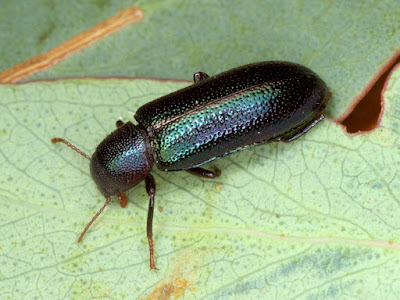
Titaena sp., copyright Martin Lagerwey.


Members of the Titaenini have a typical Gondwanan distribution, being known from southern and eastern Australia, New Zealand, New Caledonia and southern South America (Matthews & Bouchard 2008). They grow up to about a centimetre and a half in length with an elongate, parallel-sided body shape that is more or less cylindrical. The prothorax is relatively short, allowing the head to be held vertically in the Australian genus Titaena. Antennae are short with fairly simple segments not forming a club at the end. Legs have similarly simple tarsi. The tribe is distinguished from other, similar darkling beetles by the epipleura (the flattened underside of the elytral margins) which are shortened, not reaching the elytral apex. Members of the Titaenini have large repugnatorial glands opening near the end of the abdomen. In the Australian genus Titaena, at least, species are usually metallic blue or green in coloration.

The habits of the Titaenini are poorly known. As far as we do know, their larvae are specialised feeders on lichen. Adults probably pursue a similar diet. This is an exposed lifestyle, one in which you could easily come to the attention of predators, and the bright coloration of Titaena probably functions to warn off any such unwelcome interest.

REFERENCE

Matthews, E. G., & P. Bouchard. 2008. Tenebrionid Beetles of Australia: Descriptions of tribes, keys to genera, catalogue of species. Australian Biological Resources Study: Canberra.

Allendesalazaria nymphoides, the Hidden Blister Beetle

The blister beetles of the family Meloidae have attracted attention for a number of reasons. One is their production of caustic defensive chemicals which may be powerful enough to cause severe injury to humans or their livestock. Another is their remarkable life cycles. Many blister beetles develop as nest predators or kleptoparasites of bees. The larvae of these species are hypermetamorphic with the first instar being more mobile than later stages. These mobile larvae will find bees and latch onto them so that they can be carried to the host's nest.

Allendesalazaria nymphoides, copyright Stanislav Krejcik.


This association reaches an extreme in Allendesalazaria nymphoides of north-west Africa. This reclusive species has, to date, been recorded from localities in Morocco, Algeria and Mauritania (Bologna & Aberlenc 2002). It is readily distinguished from other blister beetles by its much-reduced elytra which are oval and widely separated from each other. It is also distinguished by claws that lack the free lower blade found in most other meloids (Bologna & Pinto 2002). Whether they produce the noxious chemicals known from other members of their family, I haven't found a record.

Allendesalazaria nymphoides develops in the nests of solitary burrowing bees of the genus Anthophora. Adults of A. nymphoides do not feed, and never emerge from the nest in which they matured. Instead, they lay their own eggs within that same nest. Dispersal is then left to the hatching larvae that (I presume) latch onto those emerging bees that escaped their parents' depredations. Eventually, the new generation of bees will establish nests of their own. And when they do, the blister beetles will be ready for them.

REFERENCES

Bologna, M. A., & H.-P. Aberlenc. 2002. Allendesalazaria, un nouveau genre de Meloidae pour la faune saharienne (Coleoptera). Bulletin de la Société Entomologique de France 107 (2): 191–192.

Bologna, M. A., & J. D. Pinto. 2002. The Old World genera of Meloidae (Coleoptera): a key and synopsis. Journal of Natural History 36 (17): 2013–2102.

The Ant-like Beetles

As I've commented before, the world is home to an overwhelming diversity of small brown beetles, most of them (for me, at least) inordinately difficult to distinguish. One group of tiny beetles that is quite recognisable, though, is the ant-like beetles of the genus Anthicus.

Anthicus cervinus, copyright Robert Webster.


Over a hundred species around the world have been attributed to this genus. Few of them grow more than a few millimetres in length. They are elongate with the elytra more or less rounded and often covered in short hair. The legs are relatively long. The prothorax is globular and generally narrower towards the base. The head is inclined and carried on a narrow neck (Ferté-Sénectère 1848). Many species have the elytra contrastingly patterned with bands or spots. As the vernacular name indicates, the overall appearance is reminiscent of a small ant though I'm not sure if this indicates a protective mimicry or is merely coincidence.

Anthicus antherinus, copyright Udo Schmidt.


The natural history of most Anthicus species is poorly known. The greater number of species are saprophages, found in association with rotting vegetation or scavenging on dead insects. One species, Anthicus floralis, is found worldwide as a storage pest, infesting seed and grain stores. One of the larger North American species, A. heroicus, has larvae that attack masses of dobsonfly eggs on midstream boulders (Davidson & Wood 1969). The larvae feed on the eggs from the inside, using them for shelter as well as nutrition, before emerging from the eggs to pupate.

REFERENCES

Davidson, J. A., & F. E. Wood. 1969. Description and biological notes on the larva of Anthicus heroicus Casey (Coleoptera: Anthicidae). Coleopterists Bulletin 23 (1): 5–8.

Ferté-Sénectère, M. F. de la. 1848. Monographie des Anthicus et genres voisins, coléoptères hétéromères de la tribu des trachélides. Sapia: Paris.

Blister Beetles

Zonitis sayi, copyright Carol Davis.


This is a blister beetle of the genus Zonitis. Blister beetles, the family Meloidae, get their name from their production of cantharidin, a defensive chemical that can burn the skin of would-be predators. Zonitis is a widespread genus of blister beetles with over 100 species described from around the world. However, it should be noted that its wide distribution may relate to the genus being poorly defined and future revisions may divide its members between other genera (as I believe has already happened for the Australasian 'Zonitis'). As it is, Zonitis species are characterised by fully developed elytra and functional wings, and cleft tarsal claws with two rows of teeth on the upper section (Enns 1956). Adult Zonitis are flower-feeders, visiting composite plants (i.e. daisies and similar plants), and some species have the mouthparts modified into a tube for sucking nectar.

Most blister beetles exhibit what is known as hypermetamorphism or hypermetaboly, where the larvae pass through morphologically differentiated stages before reaching pupation. Zonitis species develop as parasitoids or kleptoparasites of bees. Females lay large numbers of eggs (up to and exceeding 500 in a batch) on their host plant, most commonly on the flowers though sometimes on the undersides of leaves. The eggs hatch into active, long-legged larvae that attach to bees visiting the flowers and so get carried to the bee's nest. Once there, they moult into a less mobile stage and feed on the food stores laid aside for the bee's larva, and potentially on the larva itself. In the North American species Zonitis atripennis flavida, the beetle larva completes its development in a single cell but European species consume the contents of two bee cells before reaching maturity. Following the initial active instar, meloid larvae pass through four feeding instars before entering a quiescent, immobile stage called the hypnotheca or prepupa. The hypnotheca moults into another feeding instar before the larva finally enters the pupal stage (Bologna et al. 2008). What the point (if anything) of the hypnotheca is, I have no idea. However, it is worth noting that hypnothecae of another meloid species, Hornia boharti, have been recorded surviving for multiple years without feeding before moulting to the next instar.

Once adults emerge from the host cell, they of course disperse to conduct their own affairs. Natural history data is patchy but indications are that many species are picky in their choice of host plant. From an economic perspective, their damaging role as a parasite of pollinating bees may be partially counterbalanced by their potential role as pollinators in their own right, but who can say which way the scales lean?

REFERENCES

Bologna, M. A., M. Oliverio, M. Pitzalis & P. Mariottini. 2008. Phylogeny and evolutionary history of the blister beetles (Coleoptera, Meloidae). Molecular Phylogenetics and Evolution 48: 679–693.

Enns, W. R. 1956. A revision of the genera Nemognatha, Zonitis, and Pseudozonitis (Coleoptera, Meloidae) in America north of Mexico, with a proposed new genus. University of Kansas Science Bulletin 37 (2): 685–909.

Darklings, Tok Toks and Pie-dishes

False wireworm beetle Gonocephalum sp., copyright EBKauai.


It has been noted to the point of cliché that the Creator has an inordinate fondness of beetles. Even within the massive range of beetle diversity, though, certain families stand out as particularly diverse. One such family is the Tenebrionidae, with over twenty thousand known species worldwide. The family is sometimes referred to as the darkling beetles but no one vernacular name is really sufficient for this group. Not only are tenebrionids taxonomically diverse, they are morphologically diverse, varying from long-legged and elongate to hemi-spherical and robust, from smooth and shining to ornate and hairy, from dull-coloured and retiring to bright and striking. Habits vary from detritivorous to xylophagous (feeding on decaying wood) to herbivorous to mycetophagous, with even a few predators. Larvae of some species are of economic significance as pests: the false wireworms feed on the roots of crops or lawns, while mealworms and flour beetles attack stored products (mealworms are, of course, also used as pet food and occasionally even as human food). Several species live as inquilines of social insects such as ants or termites. The highest diversity of tenebrionids is in relatively arid regions; some species, such as the tok tok beetles of southern Africa and the pie-dish beetles of Australia, are familiar sights in such habitats.

Pie-dish beetle Helea sp., copyright Australian Museum.


With such high diversity, it is not easy to define this group without encountering exceptions, but generally tenebrionids have the antennae eleven-segmented and inserted below lateral expansions of the genae. The procoxal cavities are usually closed externally, and the legs of most species have a 5-5-4 tarsal formula. The first three sternites of the abdomen are fused (Kergoat et al. 2014). Several subfamilies are recognised, but they are commonly grouped into three clusters known as the lagrioid, pimelioid and tenebrionoid branches of the family (Matthews & Bouchard 2008). Many members of the lagrioid and tenebrionoid branches possess well-developed defensive glands in the abdomen. The rear sternites of the abdomen in these species are hinged on the sides rather than along the midline as in more primitive forms, allowing the abdomen to expand as the gland reservoirs fill with a repugnant fluid that can be expelled when required. Many larger tenebrionids have a tendency to walk with their rear ends tilted upwards, ready to unleash at a moment's notice.

Allecula rhenana, copyright Stanislav Krejčík.


Members of the pimelioid branch, including the subfamilies Pimeliinae and (possibly) Zolodininae, lack abdominal defensive glands. In many parts of the world, pimelioids are the dominant tenebrionids in dry habitats. The lagrioid branch includes the single subfamily Lagriinae, defined by features of the genitalia. Matthews & Bouchard (2008) also listed the small subfamily Phrenapatinae in this branch but a molecular phylogenetic analysis of the family by Kergoat et al. (2014) placed this latter subfamily in the tenebrionoid branch. The tenebrionoid branch also includes the Tenebrioninae, Diaperinae, Alleculinae and Stenochiinae, though monophyly of the Tenebrioninae and Diaperinae is uncertain (Kergoat et al. 2014). Diaperines include a number of shiny, sometimes strikingly coloured species; members of the tribe Leiochrinini look more like ladybeetles of the Coccinellidae than typical tenebrionids. The Tenebrioninae include such notable members as the false wireworms of the tribe Opatrini, the mealworms of the Tenebrionini and the flour beetles of the Triboliini. Finally, the Alleculinae are a distinctive group of often relatively soft-bodied tenebrionids readily distinguished from other members of the family by their pectinate claws; in some older classifications, alleculines were treated as a separate family of their own.

REFERENCES

Kergoat, G. J., L. Soldati, A.-L. Clamens, H. Jourdan, R. Jabbour-Zahab, G. Genson, P. Bouchard & F. L. Condamine. 2014. Higher level molecular phylogeny of darkling beetles (Coleoptera: Tenebrionidae). Systematic Entomology 39: 486–499.

Matthews, E. G., & P. Bouchard. 2008. Tenebrionid Beetles of Australia. Australian Biological Resources Study.