Field of Science

Showing posts with label Holometabola. Show all posts

Melanterius Weevils

Here in the Antipodes, we have a long history of environmental upheaval from exotic taxa unwisely released. As a result, one can't help but feel an odd twinge of perverse patriotism when hearing of the inverse, some native of the Antipodes causing grief elsewhere. In South Africa, Australian acacias have become something of an issue, inciting a search for potential control agents. Among the candidates selected are weevils of the genus Melanterius.

Melanterius servulus, copyright Sally Adam.


Melanterius is a diverse genus of small black or brown weevils (ranging from about three to seven millimetres in length) that feed as both adults and larvae on the developing seeds of acacias. About eighty species have been recognised in the genus to date and possibly many more remain to be described. In general, Melanterius weevils are heavily punctate, usually without prominent hairs but with a covering of scales. The rostrum is reasonably long, reaching more or less back to the mesosternum at rest but not sitting in a distinct ventral groove, and may be variably curved (going by figures in Zimmerman 1992).

Melanterius semiporcatus, copyright Victor W. Fazio III.


As with other weevils, the prominent rostrum is used by females to chew into an appropriate spot on the host plant, in this case chewing holes into the developing acacia seed pods, into which eggs are laid. Melanterius species go through one generation per year. Larvae burrow into and feed on the developing seeds before emerging and dropping to the ground to pupate in the soil. Mature adults emerge well before the host acacias begin to set seeds, usually having to wait about six months (Auld 1989). They usually spend the intervening period largely inactive, sheltering in concealed places close to the host plant and occasionally emerging to briefly feed on developing buds.

Under peak conditions, Melanterius infestations may cause a complete failure of seed production. No wonder, then, that they have been considered a worthwhile instrument of biological control.

REFERENCES

Auld, T. D. 1989. Larval survival in the soil and adult emergence in Melanterius Erichson and Plaesiorhinus Blackburn (Coleoptera: Curculionidae) following seed feeding on Acacia and Bossiaea (Fabaceae). Journal of the Australian Entomological Society 28: 235–238.

Zimmerman, E. C. 1992. Australian Weevils (Coleoptera: Curculionoidea) vol. 6. Colour plates 305–632. CSIRO Australia.

Opening Dors

My current dayjob mostly revolves around identifying and counting dung beetles. When Europeans settled Australia, they brought their farm animals with them. Unfortunately, the large piles of dung produced by cattle and horses proved rather daunting to native scavengers used to the more compact droppings of kangaroos and possums. And if you've ever experienced an Australian summer, you'll know that flies are definitely a thing. To help with this situation, Australia has had a long-running programme introducing exotic dung beetles that are better able to clean up after livestock. Most of these are members of the typical dung beetle family Scarabaeidae but one species, Geotrupes spiniger, represents a different subgroup of the superfamily Scarabaeoidea. These are the earth-boring dung beetles or dor beetles of the Geotrupidae.

Dor beetle Geotrupes spiniger, copyright Udo Schmidt.

The geotrupids are medium-sized to very large beetles, ranging in size from half a centimetre to 4.5 cm in length (Jameson 2002). Like many other members of the Scarabaeoidea, they have broad fore legs used for digging. Their short, eleven-segmented antennae end in the asymmetrical club typical of scarabaeoids but they may be distinguished from other families in that the basal segment of the three-segmented club is expanded to form a 'cup' against which the other segments may be tightly closed. The body of geotrupids is strongly convex, and is smooth and shiny dorsally but hairy underneath. In many species, the males may bear elaborate horns and/or processes on the head and pronotum.

Male Taurocerastes patagonicus, copyright Nicolás Lavandero.


Despite their size, geotrupids are secretive animals, spending most of their time in burrows underground (which may be up to three metres in depth) and usually only emerging at night. Various species feed on animal dung or decaying matter; some feed on subterranean fungi. In at least some species, eggs are laid in brood chambers within the parent's home burrow and multiple life stages may share a single burrow. Burrows may also be shared between multiple adults when conditions demand. Though adults do not directly tend to larvae, they may stock brood chambers with food supplies. In some Australian species of the subfamily Bolboceratinae, females lay a single gigantic egg at a time that may be up to 56% the size of its layer (Houston 2011). Larvae hatching from such an egg are able to develop right through to maturity without feeding.

Adult geotrupids produce a stridulating noise when disturbed which is the origin of the alternate vernacular name of "dor beetle" ("dor" being an old word for a buzzing insect). Larvae may or may not be capable of stridulation, depending on the species.

Male Blackburnium rhinoceros, copyright Edward Bell.


The classification of geotrupids is the subject of ongoing investigation. A recent classification divides the family between three subfamilies, the widespread Geotrupinae and Bolboceratinae and the South American Taurocerastinae. Morphological differences between these subfamilies, particularly at the larval stage, have lead some researchers to question whether the Geotrupidae in the broad sense represents a monophyletic group. Molecular analyses thus far seem ambiguous; an analysis by McKenna et al. (2015) placed geotrupids as part of a polytomy near the base of the scarabaeoids. As an aside, my supervisor recently asked myself and a retired colleague whether Geotrupes spiniger was the only species of geotrupid found in Australia. I replied "yes", our colleague responded "no". Our conflict, of course, was based on whether Australia's wide diversity of Bolboceratinae contributed to the count.

REFERENCES

Houston, T. F. 2011. Egg gigantism in some Australian earth-borer beetles (Coleoptera: Geotrupidae: Bolboceratinae) and its apparent association with reduction or elimination of larval feeding. Australian Journal of Entomology 50: 164–173.

Jameson, M. L. 2002. Geotrupidae Latreille 1802. In: Arnett, R. H., Jr, M. C. Thomas, P. E. Skelley & J. H. Frank (eds) American Beetles vol. 2. Polyphaga: Scarabaeoidea through Curculionoidea pp. 23–27. CRC Press.

McKenna, D. D., B. D. Farrell, M. S. Caterino, C. W. Farnum, D. C. Hawks, D. R. Maddison, A. E. Seago, A. E. Z. Short, A. F. Newton & M. K. Thayer. 2015. Phylogeny and evolution of Staphyliniformia and Scarabaeiformia: forest litter as a stepping stone for diversification of nonphytophagous beetles. Systematic Entomology 40: 35–60.

Lichen Darklings

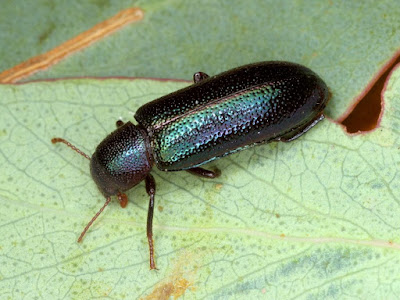
The beetles of the family Tenebrionidae, often referred to as the darkling beetles, are a diverse bunch. Members of this family have adapted to a wide range of lifestyles, coming in a variety of body types. Among the more obscure representatives of the tenebrionids are the members of the Southern Hemisphere tribe Titaenini.

Titaena sp., copyright Martin Lagerwey.


Members of the Titaenini have a typical Gondwanan distribution, being known from southern and eastern Australia, New Zealand, New Caledonia and southern South America (Matthews & Bouchard 2008). They grow up to about a centimetre and a half in length with an elongate, parallel-sided body shape that is more or less cylindrical. The prothorax is relatively short, allowing the head to be held vertically in the Australian genus Titaena. Antennae are short with fairly simple segments not forming a club at the end. Legs have similarly simple tarsi. The tribe is distinguished from other, similar darkling beetles by the epipleura (the flattened underside of the elytral margins) which are shortened, not reaching the elytral apex. Members of the Titaenini have large repugnatorial glands opening near the end of the abdomen. In the Australian genus Titaena, at least, species are usually metallic blue or green in coloration.

The habits of the Titaenini are poorly known. As far as we do know, their larvae are specialised feeders on lichen. Adults probably pursue a similar diet. This is an exposed lifestyle, one in which you could easily come to the attention of predators, and the bright coloration of Titaena probably functions to warn off any such unwelcome interest.

REFERENCE

Matthews, E. G., & P. Bouchard. 2008. Tenebrionid Beetles of Australia: Descriptions of tribes, keys to genera, catalogue of species. Australian Biological Resources Study: Canberra.

Allendesalazaria nymphoides, the Hidden Blister Beetle

The blister beetles of the family Meloidae have attracted attention for a number of reasons. One is their production of caustic defensive chemicals which may be powerful enough to cause severe injury to humans or their livestock. Another is their remarkable life cycles. Many blister beetles develop as nest predators or kleptoparasites of bees. The larvae of these species are hypermetamorphic with the first instar being more mobile than later stages. These mobile larvae will find bees and latch onto them so that they can be carried to the host's nest.

Allendesalazaria nymphoides, copyright Stanislav Krejcik.


This association reaches an extreme in Allendesalazaria nymphoides of north-west Africa. This reclusive species has, to date, been recorded from localities in Morocco, Algeria and Mauritania (Bologna & Aberlenc 2002). It is readily distinguished from other blister beetles by its much-reduced elytra which are oval and widely separated from each other. It is also distinguished by claws that lack the free lower blade found in most other meloids (Bologna & Pinto 2002). Whether they produce the noxious chemicals known from other members of their family, I haven't found a record.

Allendesalazaria nymphoides develops in the nests of solitary burrowing bees of the genus Anthophora. Adults of A. nymphoides do not feed, and never emerge from the nest in which they matured. Instead, they lay their own eggs within that same nest. Dispersal is then left to the hatching larvae that (I presume) latch onto those emerging bees that escaped their parents' depredations. Eventually, the new generation of bees will establish nests of their own. And when they do, the blister beetles will be ready for them.

REFERENCES

Bologna, M. A., & H.-P. Aberlenc. 2002. Allendesalazaria, un nouveau genre de Meloidae pour la faune saharienne (Coleoptera). Bulletin de la Société Entomologique de France 107 (2): 191–192.

Bologna, M. A., & J. D. Pinto. 2002. The Old World genera of Meloidae (Coleoptera): a key and synopsis. Journal of Natural History 36 (17): 2013–2102.

The Feared Mosquito

It's one of those standard pub-quiz "trick" questions. What animal kills the most people? The hope is that contestants will nominate the 'obvious'—snakes, sharks, bears, whatever—before being blind-sided by the revelation that mosquitoes kill over a million people. They don't kill them directly, of course; their victims die from the diseases they spread*. The statistic also glosses over the point that there are many hundreds of species of mosquito that vary significantly in the nature and severity of their role as disease vectors. Nevertheless, for this post I'm considering the group that includes some of the most notorious vectors: the genus Anopheles.

*For the record, if the question was confined to active killings, the most dangerous animal to humans is other humans. Dogs come a distant second.

Anopheles punctipennis feeding, with the long palps extended in front of the head, copyright Nathan D. Burkett-Cadena/University of Florida.


Anopheles is one of the most divergent genera of mosquitoes, being placed in a distinct subfamily Anophelinae (along with a couple of small related genera) from the bulk of mosquitoes in the subfamily Culicinae. Adult Anopheles can be readily distinguished from culicine mosquitoes by their palps which are about as long as the proboscis (in other mosquitoes, the palps are distinctly shorter). Larvae of Anopheles lack the long respiratory siphons at the end of the abdomen found in other mosquito larvae so they rest parallel with the water surface rather than hanging below it. The genus is found around the world; over 450 named species are currently known (Harbach 2013) with many more waiting to be described. The genus is currently divided between seven subgenera though one of the largest of these, the cosmopolitan subgenus Anopheles, is not monophyletic. The remaining subgenera are better supported with the largest of these, Cellia, being found in the Old World. Between them, the subgenera Anopheles and Cellia account for over 400 of the known Anopheles species. The remaining small subgenera are mostly Neotropical with a single Oriental species being awarded its own subgenus.

Anopheles maculipennis, copyright Ryszard.


Anopheles is of most concern to humans, of course, for its role as a disease vector. As with other mosquitoes, the transmission of disease is done entirely by females taking blood meals to provide nutrients for their developing eggs. Males are not blood feeders, instead feeding entirely on sugar sources such as nectar (females also feed on nectar for their own nutrition). The main disease spread by Anopheles is malaria, but they may also spread malaises such as filariasis and arboviruses (Krzywinski & Besansky 2003). As noted above, species may vary significantly in their importance as disease vectors, even between quite closely related taxa. Many historically recognised vector "species" have proved, on close inspection, to represent species complexes of which some may be vectors and others not. For instance, one of the most important transmitters of malaria, the African A. gambiae, has been divided between at least eight different species (Coetzee et al. 2013). Misidentification of vectors can be a significant issue. For instance, mosquito control regimes in central Vietnam during the 1990s focused on two species, A. dirus and A. minimus, that were each active at different times of year. However, Van Bortel et al. (2001) found that A. minimus was in fact very rare in this area, with specimens previously thought to be A. minimus proving to be another species, A. varuna. Anopheles varuna is not a significant malaria vector, feeding almost entirely on animals such as cattle rather than on humans. Large amounts of resources would have been wasted trying to control a mosquito that was of little concern. What is more, the fact that malaria was not being transmitted by A. minimus raises the possibility that it was being spread by yet another species, one that had managed to escape attention. Remember, kids: bad taxonomy kills.

REFERENCES

Coetzee, M., R. H. Hunt, R. Wilkerson, A. Della Torre, M. B. Coulibaly & N. J. Besansky. 2013. Anopheles coluzzii and Anopheles amharicus, new members of the Anopheles gambiae complex. Zootaxa 3619 (3): 246–274.

Harbach, R. E. 2013. The phylogeny and classification of Anopheles. In: S. Manguin (ed.) Anopheles Mosquitoes: New insights into malaria vectors. InTechOpen.

Krzywinski, J., & N. J. Besansky. 2003. Molecular systematics of Anopheles: from subgenera to subpopulations. Annual Review of Entomology 48: 111–139.

Van Bortel, W., R. E. Harbach, H. D. Trung, P. Roelants, T. Backeljau & M. Coosemans. 2001. Confirmation of Anopheles varuna in Vietnam, previously misidentified and mistargeted as the malaria vector Anopheles minimus. American Journal of Tropical Medicine and Hygiene 65 (6): 729–732.

Hydroglyphus pusillus, the Tiny Tiger

Hydroglyphus pusillus, copyright Udo Schmidt.


Let's take another visit to the world of diving beetles. Above is Hydroglyphus pusillus, one of the few representatives in northern Europe of a genus that otherwise includes close to ninety species spread through the Old World, primarily in the tropics. Hydroglyphus species are tiny diving beetles, only about two or three millimetres in length, with an elongate oval body shape. Characteristic features of the genus include basal striae on the pronotum and elytra, sutural striae on the elytra, and no transverse stria on the top of the head (Watts 1978, as Guignotus, a subsequently synonymised name). Species are often marked with distinctive colour patterns of streaks and blotches.

Hydroglyphus pusillus attacking larva of mosquito Culex pipiens, from Bellini et al. (2000).


Despite their small size, Hydroglyphus species are (like other diving beetles) voracious predators of other aquatic insects. Bellini et al. (2000) investigated the possible role of H. pusillus in controlling mosquito larvae in flooded rice fields in Italy. The larvae of H. pusillus mostly kept to the bottom sediment (so might be expected to be hunting prey other than mosquitoes) but adults were the most abundant diving beetle in the water column at the surveyed locations. One might expect that H. pusillus would not be effective predators of mosquito larvae that greatly outsized them. One would be wrong: not only are they indeed capable of taking down mosquitoes, Bellini et al. went so far as to describe their effects as "a real slaughter". A diving beetle latching onto a mosquito larva would soon find itself joined by others seemingly scenting haemolymph in the water. Between them, this mob of beetles could destroy a larva in a matter of seconds. Tiny, but terrifying.

REFERENCES

Bellini, R., F. Pederzani, R. Pilani, R. Veronesi & S. Maini. 2000. Hydroglyphus pusillus (Fabricius) (Coleoptera Dytiscidae): its role as a mosquito larvae predator in rice fields. Boll. Ist. Ent. "G. Grandi" Univ. Bologna 54: 155–163.

Watts, C. H. S. 1978. A revision of the Australian Dytiscidae. Australian Journal of Zoology, Supplementary Series 57: 1-166.

Tillinae

Tillus elongatus, copyright Gilles San Martin.


The above individual is a representative of a species of the subfamily Tillinae of the beetle family Cleridae. Clerids are a widespread group of moderate-sized beetles, larger individuals being about a centimetre in length, but most species tend to attract little attention from humans. They are mostly predators in confined spaces (Gunter et al. 2013): larvae hunt down wood-boring insects in their burrows, or the young of bees and wasps in their nests, whereas adults hunt for other insects under bark. Adults are more or less elongate in shape and commonly have an even covering of setae and a prominently punctate dorsum. The legs have five-segmented tarsi, each tarsus often with multiple segments lobed. Clerids are commonly referred to as 'checkered beetles' in reference to the contrasting colour patterns of many species but, as you can clearly see, not all clerids have such checkered patterns.

The subfamilial classification of clerids has shifted around a lot in the past but the Tillinae have been one of the more consistently recognised subfamilies. The feature most consistently separating tillines from other clerids is that the fore coxal cavities are both externally and internally closed: that is, the external rim and internal collar around the fore coxae are both complete rather than being interrupted posteriorly. Other distinctive features of the tillines are that all five tarsal segments are well developed and distinct, the pronotum is campanulate (bell-shaped) or bisinuate, and the eyes usually have coarse ommatidia (Burke & Zolnerowich 2017).

Cylidrus megacephalus, copyright Udo Schmidt.


The taxonomy of tillines is (as always) in great need of study. Around 550 or more species have been assigned to the subfamily worldwide, with the highest diversity in the Afrotropical and Oriental regions. However, many species can be quite variable in appearance and it is suspected that many previously described species may turn out to be synonyms. The situation is not helped by many species being rarely collected. For instance, Bostrichoclerus bicornis is a remarkable species distinguished by the presence of a pair of prominent, apically bifurcate horns arising alongside the antennal insertions. To date, this species is known from just two specimens, collected at separate locations in Baja California and southern California (Burke & Zolnerowich 2017).

A molecular phylogenetic analysis of the Cleridae by Gunter et al. (2013) suggested that the Tillinae represent the sister group of all other clerids. While unexpected from a morphological perspective, this result does tally with the long recognition of the tillines as a distinctive group. They may prove to have interesting things to tell us about the evolution of the clerids as a whole.

REFERENCES

Burke, A., & G. Zolnerowich. 2017. A taxonomic revision of the subfamily Tillinae Leach sensu lato (Coleoptera, Cleridae) in the New World. ZooKeys 179: 75–157.

Gunter, N. L., J. M. Leavengood, J. S. Bartlett, E. G. Chapman & S. L. Cameron. 2013. A molecular phylogeny of the checkered beetles and a description of Epiclininae a new subfamily (Coleoptera: Cleroidea: Cleridae). Systematic Entomology 38 (3): 626–636.

Snakes and Lace

The holometabolous insects—that is, the clade containing most insects with a complex life cycle including differentiated larval and pupal stages—is one of the most extensive radiations of animals on this planet. Much of this diversity is assigned to four major orders: wasps, moths, beetles and flies. But there are also a number of smaller lineages making up the holometabolous insects. Among these are the lacewings and their relatives in the clade Neuropterida.

Female snakefly Puncha ratzeburgi, copyright Hectonichus.


Modern members of the Neuropterida are generally recognised as belonging to three orders—the lacewings and ant-lions in the Neuroptera, the snakeflies in the Raphidioptera, and the alderflies and dobsonflies in the Megaloptera—though go back a few decades and you may find texts referring to a single order Neuroptera. A number of authors have advocated for use of the name 'Planipennia' for the lacewing order to avoid confusion with the broader sense of Neuroptera but, while a case could certainly be made for this usage, it's just never really caught on. Most neuropteridans are fairly similar in overall appearance: long-bodied insects with well developed wings with numerous crossveins. Of the living holometabolous insects, they probably bear the greatest overall resemblance to the clade's ancestors and hence they are commonly thought of as 'relicts'. However, they do possess their own specialisations and are not primitive in every regard (for instance, the most primitive egg-laying apparatus among holometabolous insects belong to wasps). Species of Neuropterida are mostly predators as larvae. The larvae of the lacewing family Ithonidae may possibly feed on decaying plant matter though we don't know for certain (Grimaldi & Engel 2005). Adults are predators and/or pollen-feeders, or may not feed at all in some short-lived forms.

Male (above) and female dobsonflies Corydalus cornutus, copyright Didier Descouens.


The exact relationships between the neuropteridan orders have been debated over the years. Though most of their obvious similaities to each other represent shared ancestral features, there is a broad consensus that they do indeed form a clade. There has also been little, if any, question of the monophyly of the Raphidioptera and Neuroptera; the monophyly of Megaloptera has been more debated but seems more likely than not. Most recent studies have suggested that the Raphidioptera are the sister group to a clade of the other two orders (Engel et al. 2018). Raphidioptera are the least diverse of the generally recognised living orders of insects with about 250 known species. They are found in cooler regions of the Northern Hemisphere—in the temperate zone or at higher elevations in lower latitudes—and are completely absent from the Southern Hemisphere (Aspöck & Aspöck, 1991, refer to a failed attempt to introduce them to Australia and New Zealand but provide no details why such a thing was tried in the first place). They are characterised by a notably elongate prothorax (the first segment of the thorax) which explains the vernacular name of 'snakefly'. Larvae live under bark or in litter and moult into pupae with the onset of cold weather. The pupae of Raphidioptera and Megaloptera are primitive in aspect, with legs separate from the body wall, and are highly mobile. Engel et al. (2018) even refer to the pupae of Raphidioptera as 'active predators' but I've not been able to find corroborating details for that remarkable description.

The Megaloptera are often particularly large neuropteridans, reaching up to twenty centimetres in wingspan, and comprise a bit less than 400 species worldwide, mostly found in temperate regions. Larvae are aquatic, living under rocks and debris, and characterised by the presence of filamentous lateral gills on the abdomen. Adults are short-lived and feed little if at all. Male dobsonflies (of the subfamily Corydalinae) possess spectacularly large, curved mandibles of largely unknown purpose; certainly they do not seem to use them for biting.

Mantisfly Mantispa styriaca, a raptorial lacewing, copyright Gilles San Martin.


The largest of the three orders, by a considerable margin, is the Neuroptera with over 5700 known species. Needless to say, this level of species diversity is associated with a high diversity of appearances and lifestyles, too many to cover adequately here. The larvae of two families of Neuroptera, the Nevrorthidae and Sisyridae, are aquatic and there has been a long-running debate whether this aquatic habit is an ancestral feature of the order shared with the Megaloptera (Nevrorthidae larvae are generalist predators, Sisyridae are specialised feeders on freshwater sponges and bryozoans). However, recent phylogenetic studies (e.g. Vasilikopoulos et al. 2020) do not agree with earlier hypotheses that the Nevrorthidae represent the sister taxon of the remaining Neuroptera. Instead, Nevrorthidae and Sisyridae may form a clade with the Osmylidae, a family whose larvae are not aquatic but often inhabit damp stream banks. The aquatic Neuroptera probably entered the water independently of the alderflies. The current favourites for the sister clade of other neuropterans are the dustywings of the Coniopterygidae, a group of small neuropterans with reduced wing venation that have historically been difficult to place owing to their derived features.

An unidentified dustywing, Coniopterygidae, copyright Katja Schulz.


A fourth order has often been associated with the Neuropterida, the extinct Glosselytrodea. Glosselytrodeans are small insects known from the Late Permian to the Jurassic, characterised by wings bearing dense cross-veins of which the fore pair would have had a leathery appearance in life (not dissimilar in texture to the fore wings of grasshoppers and other Orthoptera). Other than the wings, the features of glosselytrodeans are poorly known: they seem to have been hypognathous (i.e. had the head directed downwards) with slender legs (Grimaldi & Engel 2005). Connections to Neuropterida are based on features of the wing venation but cannot be considered strongly supported. Other authors have regarded them as of uncertain position within the broader holometabolous clade, or even as more closely related to the Orthoptera than any Holometabola. Unless more complete remains should come to light, it seems likely that the question will remain open.

REFERENCES

Aspöck, H., & U. Aspöck. 1991. Raphidioptera (snake-flies, camelneck-flies). In: CSIRO. The Insects of Australia: A textbook for students and research workers 2nd ed. vol. 1 pp. 521–524. Melbourne University Press.

Engel, M. S., S. L. Winterton & L. C. V. Breitkreuz. 2018. Phylogeny and evolution of Neuropterida: where have wings of lace taken us? Annual Review of Entomology 63: 531–551.

Grimaldi, D., & M. S. Engel. 2005. Evolution of the Insects. Cambridge University Press: New York.

Vasilikopoulos, A., B. Misof, K. Meusemann, D. Lieberz, T. Flouri, R. G. Beutel, O. Niehuis, T. Wappler, J. Rust, R. S. Peters, A. Donath, L. Podsiadlowski, C. Mayer, D. Bartel, A. Böhm, S. Liu, P. Kapli, C. Greve, J. E. Jepson, X. Liu, X. Zhou, H. Aspöck & U. Aspöck. 2020. An integrative phylogenomic approach to elucidate the evolutionary history and divergence times of Neuropterida (Insecta: Holometabola). BMC Evolutionary Biology 20: 64.

Dealing with a Clingy Male

Diving beetles of the family Dytiscidae are a distinctive component of the freshwater environment in most regions of the world. They have an oval, streamlined body form and powerful hind legs, usually with fringes of stiff setae, that are ill-suited for movement on land but make them adept swimmers. They are also almost always capable fliers, allowing them to find their way to water bodies of any size from large lakes to small, temporary pools. Both adults and larvae are active hunters, preying on other aquatic arthropods or even small vertebrates. Most diving beetles are fairly dull in coloration but exceptions are found among members of the tribe Aciliini.

Sunburst diving beetle Thermonectus marmoratus, from Insectarium de Montréal, René Limoges.


Members of the Aciliini are moderately sized diving beetles, generally between one or two centimetres in length. Dorsally they have a yellow to red base coloration with contrasting dark markings. The hind legs are robust with the hind tibia short and broad. Males have the base of the tarsus of the front legs broadened into a round palette with setae on the underside modified into sucking discs, used to hang onto the females when mating; this discs may be present on the tarsus of the mid pair of legs as well. They are strong swimmers, often venturing into the open waters of lakes and pools, and contrast with other diving beetles in that they may be found in pools lacking submerged vegetation (Roughley & Larson 2001; Bergsten & Miller 2006). Larvae have a distinctive arched body shape with a small head (Bukontaite et al. 2014), kind of shrimp-like, and also tend to be more pelagic than the larvae of other diving beetles. Females have gonocoxae (the appendages at the end of the abdomen that function as the ovipositor) that are relatively long with a broadened, spoon-like ending (Miller 2001); these are used to insert eggs into damp moss or under loose bark of vegetation lying just above the waterline. There is usually just one generation per year and adults in cold regions overwinter in larger water bodies that remain unfrozen.

Alternate morphs of female Graphoderus zonatus with granular (left) and smooth elytra, from Holmgren et al. (2016).


Perhaps the most intriguing aspect of aciliin diving beetles regards their sexual dimorphism. As noted above, males have a set of suckers on the fore legs for hanging onto females when mating. However, females of some species have sculpted elytra rather than the smooth elytra of males, such as a granular surface in Graphoderus species or long, setose sulci in female Acilius. The uneven surface produced by these features presumably functions to reduce the efficacy of the males' suckers, allowing the females more control when selecting a mate. That such a conflict exists is supported by the observation that the more developed the males' sucker arrays in a population, the more likely the females are to have repellent sculpturing. Males of some diving beetle species have been observed grabbing at any female they encounter, followed by the female swimming rapidly and erratically in an attempt to shake the male off or knock him off against the substrate or objects in the water (Miller 2003). Where this becomes really interesting is that some species have dimorphic females with some females in the population having sculpted elytra whereas others are smooth. What could be the reason for such variation? The presence of both forms in the population suggests that neither has a complete advantage over the other. It may be that smooth-backed females trade reduced defenses for improved swimming ability. Alternatively, a defensive female may be able to ensure that only the strongest and most resilient males can mate with her, but runs the risk of not mating at all if she never encounters a male who can overcome her defenses. A less defensive female may be more vulnerable to any male she encounters but at least she's bound to be fertilised at some point.

REFERENCES

Bergsten, J., & K. B. Miller. 2006. Taxonomic revision of the Holarctic diving beetle genus Acilius Leach (Coleoptera: Dytiscidae). Systematic Entomology 31: 145–197.

Bukontaite, R., K. B. Miller & J. Bergsten. 2014. The utility of CAD in recovering Gondwanan vicariance events and the evolutionary history of Aciliini (Coleoptera: Dytiscidae). BMC Evolutionary Biology 14: 5.

Holmgren, S., R. Angus, F. Jia, Z. Chen & J. Bergsten. 2016. Resolving the taxonomic conundrum in Graphoderus of the east Palearctic with a key to all species (Coleoptera, Dytiscidae). ZooKeys 574: 113–142.

Miller, K. B. 2003. The phylogeny of diving beetles (Coleoptera: Dytiscidae) and the evolution of sexual conflict. Biological Journal of the Linnean Society 79: 359–388.

Roughley, R. E., & D. J. Larson. 2001. Dytiscidae Leach, 1815. In: Arnett, R. H., Jr & M. C. Thomas (eds) American Beetles vol. 1. Archostemata, Myxophaga, Adephaga, Polyphaga: Staphyliniformia pp. 156–186. CRC Press: Boca Raton.

Rove by the Riverside

The Staphylinidae, commonly known as the rove beetles, are one of the most diverse of the recognised beetle families. Indeed, thanks to their habit in recent years of glomming up lineages previously treated as distinct families like the pselaphids and scydmaenids, they now rival the weevils of the Curculionidae for the position of largest of all recognised animal families. But for their diversity and ubiquity, staphylinids are comparatively poorly studied, owing to a not-unwarranted reputation for taxonomic recalcitrance (the relatively soft bodies of many staphylinids mean they often do not handle well with standard methods for examining beetles). Perhaps the most neglected of all staphylinid subgroups is the subfamily Aleocharinae. Aleocharines are often minute (the average aleocharine is only a couple of millimetres in length) and their identification often requires resolving features that lie at the very limit of what can be seen with a standard dissecting microscope. Nevertheless, aleocharines are remarkably diverse and among their representatives are the representatives of the genus Parocyusa.

Parocyusa americana, from Brunke et al. (2012); scale bar = 1 mm.


Typical aleocharines have what is thought of as the 'standard' body form for staphylinids, with short, square elytra that do not cover the long, flexible abdomen (though I should mention that, with the aforementioned assimilation of the pselaphids and scydmaenids, I suspect there may now be more 'non-standard' staphylinid species than 'standard' ones). For the most part, they can be distinguished from other staphylinid subfamilies by the position of the antennae, with their insertions placed behind the level of the front of the eyes. Aleocharines are divided between numerous tribes; Parocyusa is included in the tribe Oxypodini, a heterogenous group of relatively unspecialised aleocharines. Notable features distinguishing Parocyusa from other aleocharine genera include legs with five segments to each tarsus, a frontal suture between the antennal insertions, the median segments of the antennae being longer than wide, the head not having a well defined 'neck', the sides of the pronotum not being strongly deflexed downwards (so the hypomeron, the lateral section of the pronotum, is clearly visible in side view), and deep transverse impressions across the third to fifth abdominal tergite but not across the sixth tergite or across the sternites (Newton et al. 2001). Members of the genus are a bit over three millimetres in length.

Species of Parocyusa are found widely in the Holarctic realm; I've found reference to species from Europe, Korea, and northeastern North America (I should also note that I've also encountered dark allusions to recent rearrangements of the generic status of some of these species but without access to such revisions I'm going to stick with what I can find). I haven't found any reference to their specific diet but I suspect that they would be micropredators, a common lifestyle for staphylinids of their kind. Parocyusa species are associated with running water, living among the gravel and sand alongside stream beds (e.g. Brunke et al. 2012). As such, these and other aleocharines have received attention in ecological studies: the higher the diversity of staphylinids present, the more healthy the ecosystem is likely to be.

REFERENCES

Brunke, A. J., J. Klimaszewski, J.-A. Dorval, C. Bourdon, S. M. Paiero & S. A. Marshall. 2012. New species and distributional records of Aleocharinae (Coleoptera, Staphylinidae) from Ontario, Canada, with a checklist of recorded species. ZooKeys 186: 119–206.

Newton, A. F., M. K. Thayer, J. S. Ashe & D. S. Chandler. 2001. Staphylinidae Latreille, 1802. In: Arnett, R. H., Jr & M. C. Thomas (eds) American Beetles vol. 1. Archostemata, Myxophaga, Adephaga, Polyphaga: Staphyliniformia pp. 272–418. CRC Press: Boca Raton.

The Barrington Tops Stag Beetle

The stag beetles of the Lucanidae are among the most dramatic of all beetles. They are large, glossy, and the adult males often have greatly enlarged mandibles that are used in conflict with other males. As larvae, lucanids are found feeding on rotting wood; adults may feed on nectar and are largely nocturnal. Australia is home to its share of lucanid diversity though the need for suitable food for larvae means that they are mostly restricted to damper regions of the country. As a result, many Australian stag beetles have limited ranges, rendering them vulnerable if not (in this time of rising temperatures and reduced rainfalls) actively endangered. One such species is the Barrington stag beetle Lissapterus tetrops.

Female (left) and major male Lissapterus tetrops, from Coleptera7777.


The Barrington Tops is a mountain range forming part of the Great Dividing Range in New South Wales, direct north from Newcastle. The Barrington stag beetle was described from this range in 1916 by Arthur Lea, one of Australia's most prolific coleopterologists, and is restricted to rain forests at the upper heights of the range. Lissapterus is an endemic Australian genus of flightless stag beetles distinguished from other members of the family by the shape of the antennae. The terminal club that is usually characteristic of the antennae of stag beetles is less defined in Lissapterus with the last few segments of the short antennae being little larger than the rest. Like most other species in the genus, L. tetrops is almost entirely black, only becoming slightly reddish on the legs and antennae. It grows about an inch in length, males and females being not that dissimilar in size. Lissapterus tetrops differs from other species in the genus in lacking foveae on the pronotum and (mostly) on the head, being relatively sparsely punctate dorsally, and having the eye completely divided by a canthus. Major males have long curved mandibles with a pair of teeth internally near the midpoint, placed one above the other. Minor males and females have much smaller, more ordinary looking mandibles.

The natural history of this species is little known but it presumably resembles that of other species in the genus. Adults are found under rotting logs partially buried in the forest floor that provide food for the larvae. Adults may live for a long time, potentially up to about a year, though it is unclear what exactly they feed on. Other species of Lissapterus are mostly found in disjunct locations up and down the Great Dividing Range, their populations presumably becoming separated as the warming and drying of Australia's climate as it moved northwards forced them out of the lowlands. As the climate continues to become warmer and drier, these beetles may find themselves having to retreat higher and higher, and eventually they may find themselves with no further to go.

REFERENCE

Lea, A. M. 1916. Notes on some miscellaneous Coleoptera, with descriptions of new species. Part II. Transactions of the Royal Society of South Australia 40: 272–436, pls 32–39.

Colpochila: The Chafing of a Mega-genus

Just a few weeks ago, I discussed the melolonthines, a hyperdiverse group of beetles including the chafers that have historically presented something of a taxonomic challenge. In the comments on that post, Adam Yates brought up one aspect of the difficulties presented by this group that I hadn't gotten around to discussing. This is the presence among melolonthines of a number of what may be called 'mega-genera', large genera containing literally hundreds of species that defy attempts to break them down into more manageable units. So on that note, it's only appropriate that I move on to an example of one of these mega-genera, Colpochila.

Colpochila obesa, from Insects of Tasmania.


Colpochila is an Australian genus of melolonthines belonging to a group currently recognised as the tribe Liparetrini (Britton 1986) though readers of the earlier post may recall that relationships between Australian melolonthines and taxa elsewhere in the world remains something of an open question. Liparetrins are, on the whole, a fairly generalised group: characters of the group include a lack of metallic coloration, a labrum which sits underneath and is not fused to the clypeus, simple claws, and relatively broad hind tibiae that end in a pair of widely separated spurs that are placed one above and one below so that the tarsus when moved from side to side can move between the spurs. The two largest genera in the tribe, by a significant margin, are Colpochila and Liparetrus. Somewhere in the region of 130 species are currently recognised in Colpochila whereas Liparetrus is even more diverse. However, both genera were referred to by Britton (1986) as 'polythetic': that is, both represent assemblages of species that, while clearly connected to each other overall, are difficult to characterise from a diagnostic perspective. Species of the genus possess enough features in common that we can readily recognise them as related but it is difficult to drill down on any individual feature or set of features that is shared between all species without exception. Similarly, while I can say from experience that it is generally easy to tell at a glance whether a given species is a Colpochila or a Liparetrus, it is a lot harder to actually define what separates the two genera. The most obvious distinction is size: Colpochila species are relatively large chafers, over a centimetre in length, whereas Liparetrus are smaller. Other features that each separate most Colpochila species from most (though not all) Liparetrus are circular eyes (most Liparetrus have eyes with flattened edges in back so the eye is closer to semi-circular), antennae with more segments in the terminal club, longer elytra that leave less of the end of the abdomen exposed, and hind coxae without the translucent margins found in many Liparetrus.

The lifestyles of Colpochila species are still not very well known. As with other melolonthines, most of the life is spent underground with mature adults only emerging very briefly to breed. The active adults fly at night and may be attracted to lights; it seems unclear whether they feed at maturity. This genus is mostly found in drier habitats such as open woodland, grasslands or semi-desert (mind you, this is Australia we're talking about; drier habitats are 90% of what's going). Of the known species, over half are found in Western Australia.

A second Colpochila species, from Friends of Queens Park Bushland.


So why are Colpochila and other melolonthine mega-genera so diverse? It should be noted that straight geographical and/or ecological divergence does not appear to be the reason: not only is it possible to find multiple species of a single genus in one location but one may even collect very similar species together. It might be that the diversity of the mega-genera is artefactual, a reflection of the failure of taxonomists to properly identify relationships: any study that wanted to explain their diversity would have to study their phylogenetic relationships with related smaller genera to confirm their evolutionary coherence and/or age of divergence. However, if the current generic classification of melolonthines reflects a real evolutionary pattern, a potential explanation was proposed by Britton (1986). Adult melolonthines do not emerge immediately upon maturing but remain dormant underground awaiting a suitable environmental signal such as rainfall. However, rainfall in the arid zone at any one time is often uneven. Dormant beetles at one spot may feel the urge to emerge while others nearby may be left to wait for the next shower. The first wave will have died off before the second wave emerges, and their offspring will not yet be mature. As a result, sub-populations in a single region may become temporally staggered allowing the possibility of divergence via genetic drift. Eventually, their emergence times may drift back into sync but by then they may no longer be able to breed successfully. Could this be the reason why so many species may be found in a single location or may other factors be more significant?

REFERENCE

Britton, E. B. 1986. A revision of the Australian chafers (Coleoptera: Scarabaeidae: Melolonthinae) vol. 4. Tribe Liparetrini: genus Colpochila. Australian Journal of Zoology, Supplementary Series 118: 1–135.

The Melolonthinae: Chafers and June Bugs

Within the bewildering array that is beetle diversity, one of the more readily recognisable groups is the Scarabaeoidea, the assemblage that includes dung beetles (which, as it happens, are what I currently spend most of my days looking at) and related forms. Members of this group are easily distinguished from other beetles by their distinctive antennae, ending in an asymmetrical club with segments extending to one side like a set of fingers. Several families, many of them further subdivided into subfamilies, are currently recognised within the scarabaeoids. One of the most commonly encountered scarabaeoid subgroups is the subfamily Melolonthinae, commonly known as the chafers.

Green scarab beetles Diphucephala sp., a common genus of day-flying melolonthines here in Australia, copyright Boobook48.


Somewhere in the region of eleven thousand species around the world have been assigned to this grouping; as always, doubtless many more could be recognised by those who take the time. Melolonthinae is generally recognised as a subfamily of the family Scarabaeidae, sharing with other scarabaeids features such an antennal club in which the segments are relatively narrow and can be smoothly pressed against each other, and an exposed pygidium (the last dorsal plate on the abdomen, forming what you might think of as the 'butt plate'). Some authors have recognised melolonthines as a distinct family but this is the less commonly utilised option. Melolonthines belong to a group of mostly plant-feeding subfamilies in which the row of abdominal spiracles bends downwards towards the rear so at least the last pair remains visible when the elytra are closed. Within this cluster, melolonthines tend to be characterised more by lacking the features of the other subfamilies than by distinctive features of their own (more on that in a moment) but general features include mandibles that are not visible when looking down on the top of the head, fore coxae that do not protrude much ventrally, equal claws on each leg (at least on the mid and hind legs) and only one visible spiracle when the elytra are closed. The labrum (the piece at the front of the mouthparts that might be thought of as the insect's top lip) is usually hardened and may be more or less fused with the clypeus (the lower- or foremost section [depending how you look at it] of the front of the head capsule). Many melolonthines are noticeably hairy and/or dull in comparison with other scarabaeoids but others may be shiny and/or metallic in coloration.

Sugarcane white grub beetle Lepidiota stigma, copyright Bernard Dupont.


For the most part, melolonthines are plant-feeders at both larval and adult stages of the life cycle (Lawrence & Britton 1991). The greater part of the active life cycle is taken up by the larval stage which may last for many months (Britton 1957). Larvae mostly live underground, feeding on plant roots and humus. A number of species have made themselves known as significant pests in this manner because of the damage they may inflict on pastures or agricultural crops (the grass grub Costelytra zealandica comes immediately to mind as a good example of this in my native New Zealand). Pupation also occurs underground in subterranean cells and mature adults may remain dormant in these cells for some months waiting for conditions to be just right for emergence. Once they do emerge from the ground, however, the adult life span is quite brief, only lasting a few weeks or even days. Because of this brief emergence, and because their habit of waiting for specific environmental cues means that large numbers may appear seemingly all at once, many species have been awarded vernacular names that reflect their seasonality such as June bug (in the Northern Hemisphere) or Christmas beetle (in the Southern). Some species will feed on foliage as adults, some may visit flowers for pollen and nectar, other particularly short-lived species will not feed as adults at all. The majority of adult melolonthines are active at dusk or night, spending the days sheltered in secluded locations, but a number of flower-feeding species are active by day (Britton 1957).

The infamous grass grub Costelytra zealandica, illustrated by Desmond Helmore.


The classification of melolonthines can charitably be described as an absolute mess. As noted above, we can confidently say that they belong to a clade with other subfamilies of plant-feeding scarabaeids (the Cetoniinae, Rutelinae and Dynastinae) but the features setting them apart from these other subfamilies are likely to be primitive for the group. As such, it comes as little surprise that phylogenetic studies have failed to establish the Melolonthinae as monophyletic (e.g. Eberle et al. 2018; Woolley 2016). However, it seems that no-one thinks that an adequately expansive study that would allow them to be appropriately divvied up has yet been done. Matters are not helped by the absence of a well-established internal classification for melolonthines. Various distinct subgroups can be recognised and between twenty or thirty tribes have been recognised around the world. But the relationships between these tribes remain uncertain, as does the tribal position of many genera. Much of the revisionary work that has been done has been conducted at a regional level only. Thus, for instance, the tribal classification of Australian melolonthines established by Britton (1957) applies only to Australian species and the tribal distinctions Britton recognised may end up falling apart if one attempted to apply them to species from elsewhere. Not that the authors should be criticised for this situation: after all, when one is dealing with over 11,000 species, things rapidly tend to become unmanageable.

REFERENCES

Britton, E. B. 1957. A Revision of the Australian Chafers (Coleoptera: Scarabaeidae: Melolonthinae) vol. 1. British Museum (Natural History): London.

Eberle, J., G. Sabatinelli, D. Cillo, E. Bazzatto, P. Šípek, R. Sehnal, A. BezdÄ›k, D. Král & D. Ahrens. 2018. A molecular phylogeny of chafers revisits the polyphyly of Tanyproctini (Scarabaeidae, Melolonthinae). Zoologica Scripta 48: 349–358.

Lawrence, J. F., & E. B. Britton. 1991. Coleoptera. In: CSIRO. The Insects of Australia: a textbook for students and research workers 2nd ed. vol. 2 pp. 543–683. Melbourne University Press.

Woolley, C. 2016. The first scarabaeid beetle (Coleoptera, Scarabaeidae, Melolonthinae) described from the Mesozoic (Late-Cretaceous) of Africa. African Invertebrates 57 (1): 53–66.

Raffrayia

In previous posts, I have introduced you to various representatives of the Pselaphinae, bizarre-looking little gorgon-headed beetles dwelling in soil. But as with all elements of the world's biodiversity, I have not even begun to scratch the surface of what this group has to offer. So for today, a post on another pselaphine genus: the African Raffrayia.

Male Raffrayia dilatata, from Jeannel (1955).


The genus Raffrayia was first established by Reitter in 1881 for a species found in Ethiopia and since then over twenty species have been recognised. The great majority of these have been from southern Africa, in particular from various locations in the Cape Province. Only the meerest handful have been described from scattered localities in east Africa. Nevertheless, it would not be at all surprising if this disparity between regions turns out to be in part an artefact of study effort; there may be more species yet to be described.

The most distinctive feature of the genus is one or two rings each of small button-like nodules on the median segments of the antenna (I am unable to guess the functional significance of these, if any). Jeannel (1955) recognised a number of smaller genera closely related to Raffrayia that share these antennal nodules but differ in having a more elongate basal segment on the abdomen and/or being uniformly flightless forms with the humeri ('shoulders') of the elytra reduced (flightless Raffrayia [see below] retain more distinctly pronounced humeri). Both of these features are derived and these segregate genera may well be expected to be derivatives of Raffrayia. Jeannel also distinguished two subgenera Raffrayia sensu stricto and Raffrayola based on the structure of the first abdominal segment. Raffrayola is restricted to southern Africa whereas Raffrayia sensu stricto is found across the genus' range.

Sexual dimorphism within the genus is strong: males are winged but females are flightless. Elytra are somewhat reduced in females as a result (but again, not as much as in consistently flightless genera). Unfortunately, while we can make some obvious inferences from this about their relative life styles, there seems to be little in the way of direct observations on how Raffrayia spend their lives.

REFERENCE

Jeannel, R. 1955. Les psélaphides de l'Afrique australe. Mémoires du Muséum National d'Histoire Naturelle, nouvelle série, Série A, Zoologie 9: 1–196.

Morion Revisited

In an earlier post, I introduced you to the carabid beetle genus Morion, currently recognised as including about forty species from tropical and subtropical regions around the world. In that post, I mentioned how Will (2003) had questioned the monophyly of this genus, owing to its lack of derived features in comparison with closely related genera. In this post, I'll take the opportunity to dive a little further into ways the genus may be divided.

Just to remind you what we're looking at: Morion monilicornis, copyright Robert Webster.


As noted by Will (2003), many authors have recognised two subgenera within Morion, Morion sensu stricto and Neomorion. These subgenera were first established by Jeannel (1948) who identified a distinction between species he examined from the Old World (Africa and Asia) and the Americas. The Old World species, to which Jeannel gave the name Neomorion, had a number of setae along the rear margin of the last ventrite of the abdomen. In males, the basal segment of the fore tarsus had the inner apex drawn out into a tooth. The aedeagus bears a large dorsoapical orifice; in Old World Morion examined by Jeannel, this orifice was covered over by a large bilobed lamella. In the New World species of Morion sensu stricto, in contrast, the rear margin of the last ventrite bore only two setae, and males lacked a medioapical tooth on the basal fore tarsomere. The opening of the aedeagus lacked a covering lamella. In his key to Morion and related genera, Will (2003) referred only to the state of the male fore tarsus as distinguishing the subgenera. It may be that this indicates that the significance of the other characters described by Jeannel had been subject to question, but I suspect that they may have omitted by Will because their state in a number of Morion species remains unknown.

Aedeagi of Morion in lateral and dorsal view from Jeannel (1948). On the left is an Old World species (Morion orientale), on the right a South American species (M. georgiae).


A particular notable lacuna in Jeannel's brief survey of Morion was that he didn't look at any Australian species. In his description of M. crassipes*, a species found in the vicinity of Cairns in Queensland, Sloane (1904) noted that the male fore tarsi differed from those of other Australian species in having the "basal joints rounded and not produced at inner apical angle", implying that most Australian Morion have tarsi resembling those of the New World species. Moore (1965), in a review of Australian genera of Pterostichinae, describes Morion as having an aedeagus with an orifice on the dorsum, with no mention of a covering lamella, again also suggesting a resemblance to New World rather than Old World species (unfortunately, Moore did not specify exactly which species his description of the genitalia was based on). Moore (1965) also noted that Australian species were distinctive among Morion in having a pronotum with more than the two setae along each lateral margin found in species from elsewhere. One species which is found in New Guinea and northern Australia, M. longipennis, does have only two pairs of marginal setae on the pronotum, and Darlington (1962) suggested that it was probably more closely related to Asian species than to other Australian Morion. The aforementioned M. crassipes differs from other Australian species in a number of significant features, including large size (it grows to a full inch in length) and modified legs, and Sloane (1904) did briefly wonder whether it should even be regarded as a Morion, but it does share the plurisetose pronotal margins. I should note that I've found no reference to the pilosity of the last ventrite in any Australian species.

*Under the name 'Morio crassipes'; confusion about whether this genus should be called Morion or Morio lingered for a long time in the early 20th century.

So overall, there is the suggestion of three distinct groups within Morion, for the Old World, American, and Australian species, with the last two more similar to each other than to the first. The New World species of Morion are more diverse in South America than in North America, and one might be tempted to line up the relationship between the three groups with the division of Gondwana. The Old World species group may have diverged first with the separation of Africa and/or India, followed by the South American and Australian lineages diverging as their own continents became isolated. The South American species group may have spread into North America with the formation of the Central American land bridge, and the increased proximity of Australasia to Asia may have allowed members of the Old World group such as M. longipennis to invade from the northwest. However, I've based this scenario on some pretty weak assumptions based on very incomplete data, and it would require a more detailed investigation before we could say if there's any merit to it.

REFERENCES

Darlington, P. J., Jr. 1962. The carabid beetles of New Guinea. Part I. Cicindelinae, Carabinae, Harpalinae through Pterostichini. Bulletin of the Museum of Comparative Zoology 126 (3): 319–564, 4 pls.

Jeannel, R. 1948. Faune de l'Empire Français. X. Coléoptères Carabiques de la Région Malgache (deuxième partie). Office de la Recherche Scientifique Coloniale: Paris.

Moore, B. P. 1965. Studies on Australian Carabidae (Coleoptera). 4.—The Pterostichinae. Transactions of the Royal Entomological Society of London 117 (1): 1–32.

Sloane, T. G. 1904. Studies in Australian entomology. No. XIV. New species of geodephagous Coleoptera from tropical Australia. Cicindelidae (3), and Carabidae (5) [Platysmatini, Morioni, Perigonini, Masoreini, and Physocrotaphini]. Proceedings of the Linnean Society of New South Wales 29 (3): 527–538.

Will, K. W. 2003. Review and cladistic analysis of the generic-level taxa of Morionini Brullé (Coleoptera: Carabidae). Pan-Pacific Entomologist 79 (3–4): 212–229.

Apiocera: Flower-Loving Flies that Don't Particularly Care for Flowers

The insect world is full of animals that may be striking in appearance but about which we know relatively little. Such, for instance, are the flies of the genus Apiocera.

Male Apiocera, copyright Chris Lambkin.


Apiocera is a genus of a bit over 130 known species of relatively large flies, about half an inch to an inch in length, that are found in hot, arid habitats in disparate parts of the world: western North America, southern South America, southernmost Africa and Australia. Records of Apiocera from Borneo and Sri Lanka were regarded by Yeates and Irwin (1996) as probably errors. They are similar in their overall appearance to the robber flies of the family Asilidae, differing lacking the piercing mouthparts of robber flies or the moustache of bristles below the antennae. The venation of their wings is more similar to that of the mydas flies of the Mydidae, but they differ from most mydids in having shorter antennae and the regular triangle of three round ocelli on top of the head (Woodley 2009).

Observations of Apiocera species have been fairly few. A study of North American species by Toft & Kimsey (1982) found them to be restricted to sandy habitats with a fair amount of subsurface moisture, such as the shores of lakes and rivers or among sand dunes. The larvae, so far as we know, are similar to those of robber flies and are probably burrowing predators in the sand. Adults emerge from holes in the ground late in the growing season. In some places (such as Wikipedia), you may find Apiocera referred to as 'flower-loving flies' but visits to flowers are few. Toft & Kimsey (1982) found that the species they observed emerged after most plants had finished flowering and, indeed, questions have been raised historically as to whether adult Apiocera feed at all. Nevertheless, they may take honeydew from plant-sucking insects, and I will direct you to the photo below by Jean & Fred Hort that seems to show at least one Apiocera individual feeding at a flower. Males may congregate at certain locations, seemingly to form leks, though it is unclear whether they maintain territories. Toft & Kimsey (1982) noted that tussels between males of A. hispida were common, observing that "two males would make rapid contact in mid-flight, and stay together in a buzzing, tumbling ball for several seconds".


There seems to be little question that Apiocera and mydas flies are closely related. In fact, an analysis of Apiocera's phylogenetic relationships by Yeates & Irwin (1996) lead to a number of other genera that had previously been classified with Apiocera in the family Apioceridae being reassigned to the Mydidae (I suspect that it is the behaviour of these other 'apiocerids' that is behind the erroneous association of Apiocera with the 'flower-loving' moniker). Apioceridae is still maintained as a distinct family for Apiocera alone but, as noted by Woodley (2009), one could be forgiven for questioning whether Apiocera would be better treated as a very basal mydid. But that, of course, is simply a question of categories.

REFERENCES

Toft, C. A., & L. S. Kimsey. 1982. Habitat and behavior of selected Apiocera and Rhaphiomidas (Diptera, Apioceridae), and descriptions of immature stages of A. hispida. Journal of the Kansas Entomological Society 55 (1): 177–186.

Woodley, N. E. 2009. Apioceridae (apiocerid flies). In: Brown, B. V., A. Borkent, J. M. Cumming, D. M. Wood, N. E. Woodley & M. A. Zumbado (eds) Manual of Central American Diptera vol. 1 pp. 577–578. NRC Research Press: Ottawa.

Yeates, D. K., & M. E. Irwin. 1996. Apioceridae (Insecta: Diptera): cladistic reappraisal and biogeography. Zoological Journal of the Linnean Society 116: 247–301.

The Ant-like Beetles

As I've commented before, the world is home to an overwhelming diversity of small brown beetles, most of them (for me, at least) inordinately difficult to distinguish. One group of tiny beetles that is quite recognisable, though, is the ant-like beetles of the genus Anthicus.

Anthicus cervinus, copyright Robert Webster.


Over a hundred species around the world have been attributed to this genus. Few of them grow more than a few millimetres in length. They are elongate with the elytra more or less rounded and often covered in short hair. The legs are relatively long. The prothorax is globular and generally narrower towards the base. The head is inclined and carried on a narrow neck (Ferté-Sénectère 1848). Many species have the elytra contrastingly patterned with bands or spots. As the vernacular name indicates, the overall appearance is reminiscent of a small ant though I'm not sure if this indicates a protective mimicry or is merely coincidence.

Anthicus antherinus, copyright Udo Schmidt.


The natural history of most Anthicus species is poorly known. The greater number of species are saprophages, found in association with rotting vegetation or scavenging on dead insects. One species, Anthicus floralis, is found worldwide as a storage pest, infesting seed and grain stores. One of the larger North American species, A. heroicus, has larvae that attack masses of dobsonfly eggs on midstream boulders (Davidson & Wood 1969). The larvae feed on the eggs from the inside, using them for shelter as well as nutrition, before emerging from the eggs to pupate.

REFERENCES

Davidson, J. A., & F. E. Wood. 1969. Description and biological notes on the larva of Anthicus heroicus Casey (Coleoptera: Anthicidae). Coleopterists Bulletin 23 (1): 5–8.

Ferté-Sénectère, M. F. de la. 1848. Monographie des Anthicus et genres voisins, coléoptères hétéromères de la tribu des trachélides. Sapia: Paris.

The Trechodini


The above figure, from Uéno (1990), shows Trechodes satoi, a fairly typical representative of the carabid ground beetle tribe Trechodini. Members of this tribe are found in many parts of the world, though they are absent from the Nearctic region and were unknown from northern Asia prior to the description of Eotrechodes larisae from the Russian Far East by Uéno et al. (1995). The greatest diversity of Trechodini is on the southern continents and most authors have accordingly assumed a Gondwanan origin for the lineage.

The Trechodini are a subgroup of the subfamily Trechinae (in the restricted sense; sometimes this grouping is reduced to a tribe in which case Trechodina is treated as a subtribe thereof). Trechines are a distinctive group of relatively small ground beetles, features of which include a head with well-developed frontal furrows extending from the front of the head to behind the eye, and two pairs of supra-orbital setae. Trechodini differ from other trechines in distinctive male genitalia in which the ejaculatory duct of the aedeagus is entirely exposed dorsally, the median lobe is open above and gutter-like, and there is no basal bulb. They also usually have three obtuse teeth near the base of the mandible though the South African genus Plocamotrechus is missing one of these teeth in the left mandible (Moore 1972).

Habitus of Canarobius oromii, from Machado (1992).


Despite being widespread, the distribution of Trechodini is patchy. They are generally restricted to damp habitats such as alongside streams and rivers. Among Australian species, Moore (1972) noted that the genera Trechodes and Paratrechodes were uniformly fully flighted whereas Trechobembix and Cyphotrechodes were often brachypterous. He suggested that this was connected to the last two genera being found in more stable habitats alongside standing water. A number of species in the tribe have moved into subterranean habitats such as caves and have reduced wings and eyes. In two genera found in lava caves on the Canary Islands, Canarobius and Spelaeovulcania, no trace of the eyes remains (Machado 1992). Considering the little-studied nature of such habitats around the world, it is possible that other trechodins remain to be discovered.
REFERENCES

Machado, A. 1992. Monografía de los Carábidos de las Islas Canarias (Insecta, Coleoptera). Instituto de Estudios Canarios: La Laguna.

Moore, B. P. 1972. A revision of the Australian Trechinae (Coleoptera: Carabidae). Australian Journal of Zoology, Supplementary Series 18: 1–61.

Uéno, S. 1990. A new Trechodes (Coleoptera, Trechinae) from near the northwestern corner of Thailand. Elytra 18 (1): 31–34.

Uéno, S., G. S. Lafer & Y. N. Sundukov. 1995. Discovery of a new trechodine (Coleoptera, Trechinae) in the Russian Far East. Elytra 23 (1): 109–117.