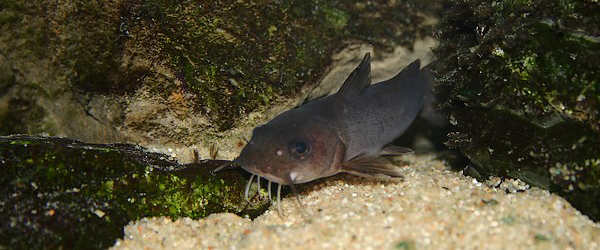
The subject of today's post is something that I'm sure that you've all encountered at one time or another. It's a group of animals that features highly in the world's food supply. Some of you may be grat fans of these animals and seek them out on a regular basis; others may not be so enthused. They go by many names: herring, sardines, sprats, shad... but all are members of the fish family Clupeidae.
For the most part, clupeids are a prime example of what I think of as 'fishy' fish: that is, fish that look exactly how the majority of people imagine a fish to look (as opposed, say, to some of those deep-sea jobs that are all teeth and poor muscle tone). They are most diverse in marine waters of the continental shelf though many spend part or all of their lives in fresh water. Most form schools, sometimes very large ones; it is this tendency to congregate that makes them such an important part of the food chain for humans and other predators. The clupeids themselves are mostly micro-predators, feeding on minute plankton. Most are medium-sized to small fish with large species getting up to a couple of feet in length*. Conversely, species of the south-east Asian freshwater genus Sundasalanx (on which more below) reach maturity at only 15 mm in length.
*Bond (1996) makes the remarkable statement that "Palonia castelnaudi, a freshwater herring of South America, reaches at least 1.5 m (Dr. Barry Chernoff, personal communication)". Not only have I been unable to find another reference to a clupeid of this size, I have been unable to confirm the existence of a species of this name. The same reference gives a maximum length for the Chirocentridae as 3.5 m; a quick search online suggests the correct figure is less than a third of that.

The exact circumscription of the Clupeidae has varied over time. It is the largest family in a clade called the Clupeoidei which is well defined by characters such as a reduction in the lateral line and the presence of the recessus lateralis, a channel running through the pterotic bone between the swim bladder and the inner ear. Other families within the Clupeoidei are the Engraulidae (anchovies), Pristigasteridae (ilishas) and Chirocentridae (wolf herrings). While each of the other families is fairly distinctive, the Clupeidae lack clear uniting features of their own and have tended to be defined as 'the rest'. Historically, some authors have united some or all of the other families within the Clupeidae, or recognised clupeid subgroups as their own additional families.
It therefore would not have come as too much of a surprise when a molecular phylogenetic analysis of the Clupeoidei by Lavoué et al. (2013) did not identify the Clupeidae as a monophyletic group. Instead, both the Pristigasteridae and Chirocentridae were nested within the Clupeidae. What is more, not one of the five subfamilies currently recognised within the clupeids was monophyletic either. Instead, Lavoué et al. found six distinct sublineages within the clupeids; each of these was individually well supported but the broader relationships between them were not. Four of these potentially formed a clade that may correspond to a restricted Clupeidae. However, members of the 'Dussumieriinae' (which differ from other clupeids in the shape of their pelvic scutes) formed two external lineages: one was potentially the sister group to all other clupeoids except the Engraulidae whereas the round herring genus Etrumeus was weakly placed as sister to the Chirocentridae. To the best of my knowledge, no-one has yet suggested a formal reclassification of the clupeoids as a result of such studies, but it seems likely that we will either see the Clupeidae expanded to include the chirocentrids and pristigasterids, or restricted to exclude the dussumieriines. Again, either one of these options would align with alternative classifications used in the past.

Also of note in recent studies on clupeid phylogeny is the position of the south-east Asian freshwater genus Sundasalanx. When first described in 1981, this genus was not recognised as a clupeid or even as a clupeoid. Instead, it was originally placed in the fish order Osmeriformes, the smelts, together with another fish genus Salanx. Members of these two genera are indeed similar in appearance: they are tiny and transparent, looking overall like whitebait but never growing into a larger adult. However, a study of the morphology of Sundasalanx in 1997 lead to the conclusion that the shared features of Salanx and Sundasalanx were actually convergences resulting from both exhibiting paedomorphy, becoming reproductively mature while still effectively in the larval stage. A relationship of Sundasalanx to the clupeoids was suggested instead and this was later corroborated by molecular analyses (Ishiguro et al. 2005). In fact, Sundasalanx is nested well within the Clupeidae, even in the family's restricted sense. Recent years have seen something of a surge in descriptions of paedomorphic fish (many of which were previously mistaken for juveniles of related taxa). Lavoué et al. (2008) recorded another paedomorphic clupeoid from marine waters of south-east Asia that the identified by molecular analysis as related to the dussumieriines, but to the best of my knowledge this species remains unnamed.
REFERENCES
Bond, C. E. 1996. Biology of Fishes 2nd ed. Saunders College Publishing.
Ishiguro, N. B., M. Miya, J. G. Inoue & M. Nishida. 2005. Sundasalanx (Sundasalangidae) is a progenetic clupeiform, not a closely-related group of salangids (Osmeriformes): mitogenomic evidence. Journal of Fish Biology 67: 561–569.
Lavoué, S., M. Miya, A. Kawaguchi, T. Yoshino & M. Nishida. 2008. The phylogenetic position of an undescribed paedomorphic clupeiform taxon: mitogenomic evidence. Ichthyol. Res. 55: 328–334.
Lavoué, S., M. Miya, P. Musikasinthorn, W.-J. Chen & M. Nishida. 2013. Mitogenomic evidence for an Indo-west Pacific origin of the Clupeoidei (Teleostei: Clupeiformes). PLoS ONE 8(2): e56485. doi:10.1371/journal.pone.0056485.