Field of Science

Showing posts with label Cephalopoda. Show all posts

Arranging Nautiloids

For years, the higher taxonomy of cephalopods was expressed as a division between three subclasses: the Nautiloidea, the Ammonoidea and the Coleoidea. Coleoids were the clade of cephalopods that had lost the external shell, ammonoids were a Mesozoic lineage with complex septa dividing the chambers of the shell, and nautiloids were... the rest. From the tiny, possibly benthic, curved cones of the Cambrian where the class began, to gigantic straight-shelled monsters of the later Palaeozoic, to the modern chambered nautilus, all were lumped together as 'nautiloids'. The nautiloid subclass was explicitly understood to include the ancestors of the others but recognition of more phylogenetically coherent subgroups has been hampered by poor understanding about how the various nautiloid lineages were interrelated. And part of the problem in this regard has been uncertainty about just what features of their fossils we should be paying attention to.

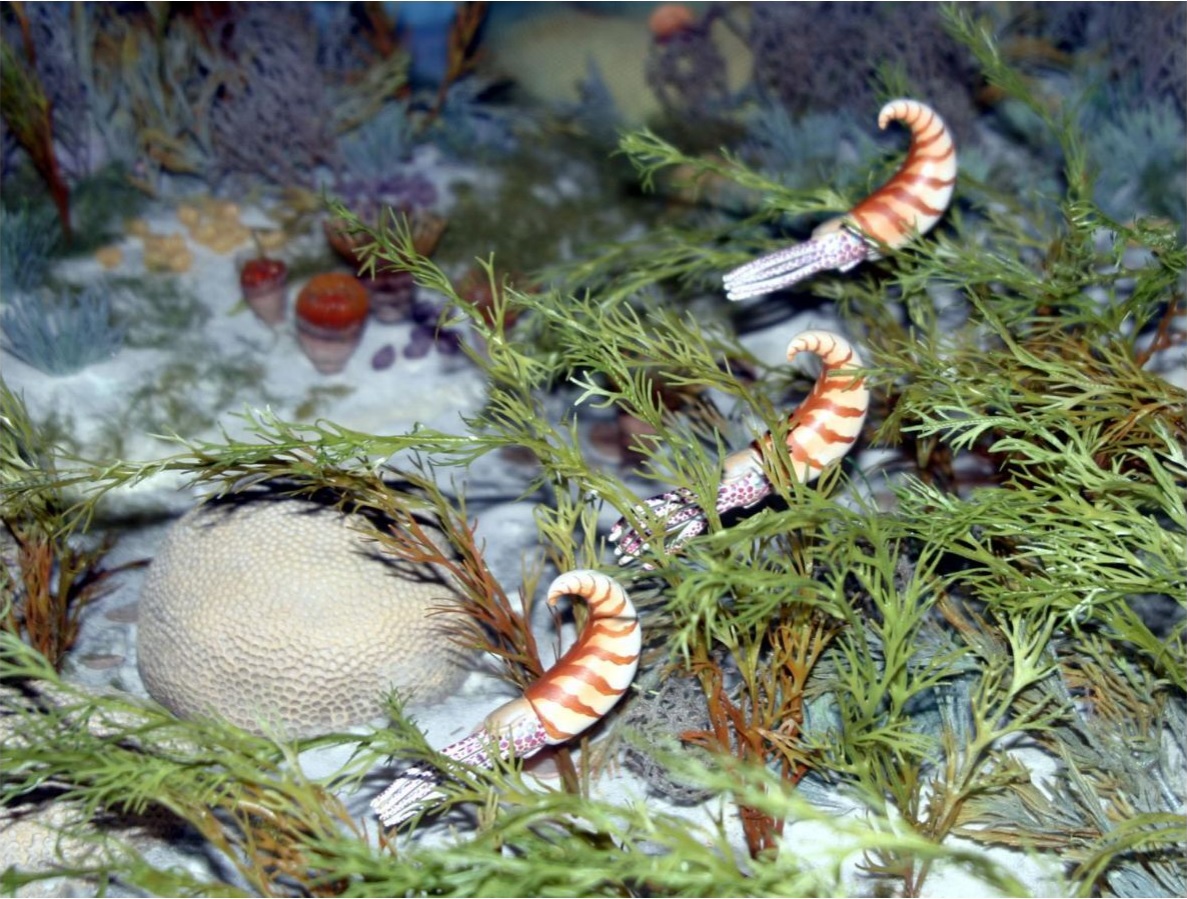
Diorama reconstruction of Beloitoceras oncocerids, from the Burpee Museum.


One factor that has drawn attention in recent years has been the arrangement of muscle scars on the shell. Large muscle attachment scars appear as raised annular elevations on the inside of the shell towards the rear end of the body chamber (in practice, they are more often observed in fossils as depressions on the internal mould). In the living nautilus, the muscles attached to these scars function in the retraction of the head (King & Evans 2019). Modern nautilus possess a pair of large lateral scars in an arrangement that has been labelled 'pleuromyarian'. However, many of the earliest cephalopods possessed a ring of numerous small scars, an arrangement referred to as 'oncomyarian'. Other cephalopods might have scars restricted to the dorsal ('dorsomyarian') or ventral ('ventromyarian') midline.

Primary types of muscle scar in nautiloids, from King & Evans (2019). 'D' and 'V' indicate dorsal and ventral, respectively, and arrows indicate direction of aperture.


Another feature that has been called out has been the structure of the connecting rings around the siphuncle. Shelled cephalopods, you will recall, have the shell divided into chambers separated by septa. Though the bulk of the animal is found in the final body chamber, a fleshy cord called the siphuncle runs back through the remaining chambers. In life, the siphuncle is used to control the levels of fluid in the chambers, which in turn controls the animal's buoyancy. The boundary between the siphuncle and the surrounding chamber is marked a toughened sheath, referred to as the connecting ring. In the modern nautilus, the connecting ring is comprised of two layers, an outer calcareous layer and an inner chitinous layer. In comparable fossils, the latter chitinous layer has decomposed after death so only the outer layer is preserved. However, some extinct cephalopod groups preserve evidence of calcification in the inner as well as the outer layer. Based on the distinction between these two siphuncle types, Mutvei (2015) supported dividing most of the nautiloids between two major lineages, the Nautilosiphonata (with a nautilus-type siphuncle) and the Calciosiphonata (with the internally calcified connecting rings).

A couple of years earlier, the same author (Mutvei 2013) had proposed recognition of a superorder Multiceratoidea for nautiloids that combined multiple muscle scars with a nautilus-type siphuncle. Examples of nautiloid orders with such a combination included the Ellesmeroceratida (small nautiloids with densely placed septa), the Oncoceratida (often short, squat nautiloids) and the Discosorida (similarly squat forms with complex bulging connecting rings). All of these were found in the earlier part of the Palaeozoic with the oncoceratids dieing off in the early Carboniferous. Mutvei (2013) also included the coiled Tarphyceratida and the egg-shaped Ascoceratida in this group. Later, King & Evans (2019) redefined this grouping as the Multiceratia, excluding the Tarphyceratida and Ascoceratida on the grounds that they had ventromyarian rather than oncomyarian muscle scars. Mutvei (2013) suggested that, rather than representing retractor muscles, these smaller repeated scars were associated with an outgrowth of the mantle, either as tentacles or a muscular 'skirt', that was used to capture micro-plankton.

Phylogeny of 'nautiloids' supported by King & Evans (2019). Though not shown on this diagram, the majority of authors have suggested that ammonoids and coleoids are descended from Orthoceratida.


King & Evans (2019) proposed a reclassification of the subclass Nautiloidea between five subclasses defined primarily by muscle structure. Apart from the earliest oncomyarian Plectronoceratia, most 'nautiloids' could be divided between two lineages. On one side were the dorsomyarian Orthoceratia (usually thought to include the ancestors of the ammonoids and coleoids). On the other, the oncomyarian Multiceratia would eventually give rise to the ventromyarian Tarphyceratia which in turn included the ancestors of the pleuromyarian Nautilida. Note that many of the reocognised subclasses (and orders) remain paraphyletic but we are at least approaching a more informative picture of cephalopod evolution than the earlier unceremonious dumping into 'Nautiloidea' (I should probably also remind you that, for various reasons, most invertebrate palaeontologists still don't regard strict monophyly as a taxonomic requirement in and of itself).

The usage of muscle scars and connecting rings as classificatory keys is handicapped by the difficulty of observing them. As internal structures, they each require careful preparation of a specimen to observe. And once you've gotten to a position where you can see them, it seems not to be particularly easy to tell just what you're looking at. As a result, muscle scarring and siphon structure remains undescribed for the majority of nautiloid species. Judging the structure of connecting rings seems to be particularly challenging and some have gone so far as to suggest that purported different structures may be the result of post-mortem taphonomic processes (King & Evans 2019). Nevertheless, what we do know suggests that such features remain reasonably consistent within each of the well-recognised nautiloid orders. And Mutvei's (2015) concept of Calciosiphonata vs Nautilosiphonata does largely line up with King & Evans' (2019) dorsomyarian vs oncomyarian-ventromyarian lineages. There are, of course, some notable exceptions. Whether these will cause the developing structure to collapse, or whether they indicate mistakes in interpretation, only continued research will tell.

REFERENCES

King, A. H., & D. H. Evans. 2019. High-level classification of the nautiloid cephalopods: a proposal for the revision of the Treatise Part K. Swiss Journal of Palaeontology 138: 65–85.

Mutvei, H. 2013. Characterization of nautiloid orders Ellesmerocerida, Oncocerida, Tarphycerida, Discosorida and Ascocerida: new superorder Multiceratoidea. GFF 135 (2): 171–183.

Mutvei, H. 2015. Characterization of two new superorders Nautilosiphonata and Calciosiphonata and a new order Cyrtocerinida of the subclass Nautiloidea; siphuncular structure in the Ordovician nautiloid Bathmoceras (Cephalopoda). GFF 137 (3): 164–174.

The Age of the Perisphinctoid

During the Mesozoic era, the world's oceans were dominated by the ammonites. The coiled shells of these extinct cephalopods can be found preserved in rocks of this era around the planet, encompassing a bewildering array of species. During the latter half of the Jurassic, the most diverse ammonites were members of the superfamily Perisphinctoidea.

Likely Perisphinctes, copyright Spacebirdy.


Perisphinctoids first appear around the mid-point of the Jurassic, during what is known as the Bajocian epoch (Énay & Howarth 2019). As with other major ammonite groups, perisphinctoids are characterised by features of the folding around the edges of the septa that separate chambers of the shell. Perisphinctoids have basally five-lobed septa that differ from their ancestors in the Stephanoceratoidea in the loss of the UII lobe towards the outer edge of the whorl. The earliest perisphinctoids had more or less evolute shells (that is, later whorls did not significantly overlap the predecessors) with a rounded venter. Some later lineages would become more involute, with older whorls becoming partially hidden, and the venter might get sharper or flatter. Others would pretty much retain the original conformation to the end. The majority of perisphinctoids exhibited strong ribs on the outside of the shell, these ribs usually branching towards the outer rim of the whorl. Some forms developed further elaborations of the shells such as prominent nodules or spines.

Dimorphism was widespread in the perisphinctoids, if not universal. As with other dimorphic ammonites, populations included distinct microconches and macroconches (the majority interpretation is that macroconches were female and microconches male, but of course this is speculative). Macroconches usually had simple peristomes whereas microconches commonly had the mature shell aperture flanked by elongate lappets. The early Late Jurassic (Bathonian and Callovian) Tulitidae had a tendency in macroconches for the shell coiling to become eccentric in the outermost whorls, the peristome being distinctly skewed from the main plane of the shell.

Aspidoceras hirsutum, copyright Daderot.


Perisphinctoid faunas were often markedly provincial with many lineages being restricted to particular regions (such as the bipolar Perisphinctes or the western Eurasian Parkinsoniinae). They were mostly animals of shallower waters, perhaps foraging close to the bottom. This may go some way to explaining their high diversity but it can provide a challenge to their use in stratigraphy. Ammonites of the 'perisphinctoid' type would survive the end of the Jurassic but would fade from the fossil record not too long afterwards. Nevertheless, that would not be the end of their lineage: at the beginning of the Cretaceous, they would also spawn two derived descendants (Besnosov & Michailova 1991), the largely smooth-shelled Desmoceratoidea and the Ancyloceratoidea with four-lobed septa, that would continue to dominate the Mesozoic seas.

And while I'm on the subject of ammonites, I have another correction to make to an earlier post. However, while I was able to shift some of the blame for the correction in my last post onto my original source, in this case the blame is entirely mine. In a prior discussion of the live anatomy of ammonites, I discussed the evidence that the aptychus (a pair of calcified plates that probably functioned as an operculum) originated as a modification of the lower jaw. As such, I criticised reconstructions of ammonites that showed the aptychus articulating with the shell in the manner of a nautilus' hood. Unfortunately, I had overlooked a significant difference between ammonites and nautiluses. The coiled shell of a nautilus is exogastric—that is, when they evolved from their straight-shelled ancestors, the shell coiled upwards so the original lower edge corresponded to the outside of the whorl. However, the shell of ammonites was endogastric, with the shell coiled downwards so the original venter was on the inside (in the absence of preserved soft anatomy, we can infer this from the position of the siphuncle within the shell). This means that, even though the lower ammonite aptychus was anatomically on the opposite side of the animal from the upper nautilus hood, functionally they would have appeared in life to occupy much the same position. Entirely my mistake, and a reminder to me that describing orientation in coiled animals can be confusing.

REFERENCES

Besnosov, N. V., & I. A. Michailova. 1991. Higher taxa of Jurassic and Cretaceous Ammonitida. Paleontological Journal 25 (4): 1–19.

Énay, R., & M. K. Howarth. 2019. Part L, revised, volume 3B, chapter 7: Systematic descriptions of the Perisphinctoidea. Treatise Online 120: 1–184.

The Age of Olcostephaninae

Ammonites are among the iconic fossils of the Mesozoic. These shelled cephalopods dominated the oceans during their heyday and diversified into a wide array of taxa. Many of these have become significant for recognising particular periods in the earth's history; among these are members of the Olcostephaninae of the Early Cretaceous.

Olcostephanus astierianus, copyright Hectonichus.


The Olcostephaninae, as recognised by Wright et al. (1996), are known from the Valanginian and Hauterivian epochs of the Early Cretaceous, disappearing from the fossil record some time during the earlier part of the latter. The Valanginian ran from about 140 to 133 million years ago; the Hauterivian lasted for about three and a half million years after that. A brief reminder here: the Cretaceous lasted for a bloody long time, with more time separating the beginning and end of the Cretaceous than separates the end of the Cretaceous and today. One genus described from Pakistan, Provalanginites, has been supposed to come from the latest Jurassic but, as this is at least five million years earlier than any known olcostephanine anywhere else, its age is regarded as questionable. Olcostephanines can be very abundant in formations of the right age. A mass occurrence in the latest Valanginian of northwestern Europe has long been recognised as a geological marker, dubbed the 'Astierien Schichten' (Astieria being a synonym of Olcostephanus; Lukeneder 2004).

Saynoceras verrucosum, from here.


Olcostephanines are small to moderate-sized ammonites. Lukeneder (2004) refers to macroconches* of Olcostephanus guebhardi up to about ten centimetres in diameter. The olcostephanines pictured in Wright et al. (1996) seem to indicate an average size smaller than this and the group also includes a number of dwarf genera that look to only be a bit over one centimetre in diameter. The shell of olcostephanines is usually characterised by a pattern of transverse ribs coalescing in bundles to meet tubercles on the inner margin of the whorl. One dwarf genus, Saynoceras, has a stronger ornamentation of two rows of tubercles near the midline and outer margins of the whorls.

*A common pattern in ammonoids is the co-occurrence within a formation of distinct forms, termed 'macroconches' and 'microconches', that are broadly similar except in size and the configuration of the aperture (generally simple in macroconches but with protruding lappets in microconches). The most popular interpretation of this phenomenon is that the forms represent sexual dimorphism. Obviously which sex is which can't be known at this time though comparison with living cephalopods suggests that the macroconches may be female.

Valanginites nucleus, from here.


Olcostephanines are very similar in external appearance to the earlier subfamily Spiticeratinae (known from the very earliest part of the Cretaceous) and are likely to be descended from among that group. Though the Olcostephaninae themselves as currently recognised disappeared during the Hauterivian epoch, this may not have been the actual end of the olcostephanine lineage. The slightly later Holcodiscidae are very similar to the olcostephanines and some have questioned whether they even warrant separation. There is also a strong similarity between early members of the superfamily Desmoceratoidea and species of Olcostephanus (Wright et al. 1996). If this similarity also indicates ancestry, then the family line of the olcostephanines would continue right until the final extinction of the ammonites at the end of the Cretaceous.

REFERENCES

Lukeneder, A. 2004. The Olcostephanus level: an Upper Valanginian ammonoid mass-occurrence (Lower Cretaceous, Northern Calcareous Alps, Austria). Acta Geologica Polonica 54 (1): 23–33.

Wright, C. W., J. H. Calloman & M. K. Howarth. 1996. Treatise on Invertebrate Paleontology pt L. Mollusca 4, revised vol. 4. Cretaceous Ammonoidea. The Geological Society of America, Inc.: Boulder (Colorado), and The University of Kansas: Lawrence (Kansas).

The Age of the Ceratites

The ammonites are unquestionably one of the most famous groups of fossil mollusks, indeed of fossil invertebrates in general. Even those who have little consciousness of the fossil world might be expected to have a vague mental picture of a coiled shell housing a squid-like beast. But ammonites are far from being the only group of shelled cephalopod known from the fossil record. And though ammonites may have dominated the marine environment during the Jurassic and Cretaceous periods, during the preceding Triassic period they were overshadowed by another such group, the ceratites.

Reconstruction of Ceratites spinosus, from Klug et al. (2007).


The ceratites of the order Ceratitida (or suborder Ceratitina, depending on how you've tuned your rank-o-meter today) were close relatives of the ammonites, each deriving separately from an earlier cephalopod group known as the prolecanitids. The earliest forms regarded as ceratites appeared during the mid-Permian, though the exact dividing line between prolecanitid and ceratite seems to be somewhat arbitrary (as, indeed, is only to be expected with a well-known historical lineage). During the remainder of the Permian their diversity remained fairly subdued. When marine life was hit with the cataclysmic upheaval that was the end-Permian extinction, two lineages of ceratites managed to squeak through, together with a single other prolecanitid lineage that would give rise to the ammonites during the ensuing Triassic. With most of their competitors thus eliminated, ceratite diversity expanded rapidly.

Externally, the shells of ceratites and ammonites were very similar, and without knowing their evolutionary context one would be hard-pressed to tell one from the other. Most ceratite shells formed the typical flat spiral one associates with ammonoids, with different species being variously evolute (with successive coils lying alongside the previous one) to involute (outer coils overlapping and concealing the inner ones), and cross-sections varying from narrow and lenticular to broad and low (Arkell et al. 1957). One later Triassic family, the Choristoceratidae, had shells that began as an evolute coil but became uncoiled or straightened in later stages. Another Upper Triassic group, the Cochloceratidae, had turreted shells that might externally be mistaken for those of a gastropod.

Ceratites dorsoplanus, showing ceratitic sutures, copyright Hectonichus.


Internally, ceratites and ammonites often differed in the structure sutures, the lines formed by the join between the outer shell and the septa dividing the internal chambers. In ammonoids as a whole, the sutures are variously curved back and forth on the inside of the shell, with those parts of the suture going forwards (towards the shell opening) forming what are called saddles and those going backwards (away from the opening) forming lobes. In most ceratites, the sutures more or less form a pattern that is known (appropriately enough) as ceratitic: the saddles are simple and not future divided, but the lobes have multiple smaller digitations. In some later taxa, the sutures became goniatitic (with both saddles and lobes simple, secondarily similar to those found in earlier ammonoids) or ammonitic (with both saddles and lobes subdivided, the pattern more commonly associated with ammonites).

Our knowledge of the soft anatomy of ceratites remains limited. We know that they possessed an anaptychus (a leathery plate at the front of the body that may have functioned as an operculum, as I described in an earlier post). Known radulae have fairly simple, slender, undifferentiated teeth (Kruta et al. 2015) so they were probably micro-predators or planktivores in the manner of most ammonites. A black, bituminous layer sometimes preserved against the inside of the shell in the body cavity may represent the remains of the dorsal mantle. Similarity between this layer and the dorsal mantle of nautilids lead Klug et al. (2007) to infer the presence of a non-mineralised hood in ceratites, though I wonder how the presence of a hood would relate to an anaptychus. Conversely, Doguzhaeva et al. (2007) interpreted the black layer as the remains of ink from a ruptured ink sac.

Assemblage of Arcestes leiostracus, copyright Lubomír Klátil.


Ceratites were to remain the ecological upper hand throughout the course of the Triassic. Though ammonites (represented by the phylloceratidans) were not uncommon during this period, their diversity remained consistently lower. However, the end of the Triassic was marked by a spike in global temperatures and ocean acidification, generally regarded as connected to the volcanic rifting activity that marked the beginning of formation of the Atlantic Ocean (Arkhipkin & Laptikhovsky 2012). Of the two ammonoid lineages, only the ammonites survived into the Jurassic; the ceratites were wiped out. Whether some aspect of ammonite biology made them better suited to survive the stresses of global climate change, or whether their survival was a question of simple dumb luck, seems to be an open question. Nevertheless, with the ceratites out of the picture, the way was open for the ammonites to become the lords of the Mesozoic ocean.

REFERENCES

Arkell, W. J., B. Kummel & C. W. Wright. 1957. Mesozoic Ammonoidea. In: Moore, R. C. (ed.) Treatise on Invertebrate Paleontology pt L. Mollusca 4. Cephalopoda: Ammonoidea pp. L80–L465. Geological Society of America, and University of Kansas Press.

Arkhipkin, A. I., & V. V. Laptikhovsky. 2012. Impact of ocean acidification on plankton larvae as a cause of mass extinctions in ammonites and belemnites. Neues Jahrbuch für Geologie und Paläontologie—Abhandlungen 266 (1): 39–50.

Doguzhaeva, L. A., R. H. Mapes, H. Summesberger & H. Mutvei. 2007. The preservation of body tissues, shell, and mandibles in the ceratitid ammonoid Austrotrachyceras (Late Triassic), Austria. In: Landman, N. H., R. A. Davis & R. H. Mapes (eds) Cephalopods Past and Present: New Insights and Fresh Perspectives pp. 221–238. Springer.

Klug, C., M. Montenari, H. Schulz & M. Urlichs. 2007. Soft-tissue attachment of Middle Triassic Ceratitida from Germany. In: Landman, N. H., R. A. Davis & R. H. Mapes (eds) Cephalopods Past and Present: New Insights and Fresh Perspectives pp. 205–220. Springer.

Kruta, I., N. H. Landman & K. Tanabe. 2015. Ammonoid radula. In: Klug, C., et al. (eds) Ammonoid Paleobiology: From Anatomy to Ecology pp. 485–505. Springer: Dordrecht.

Belemnitellidae: Reaching the End of an Era

Fossil cephalopods have featured on this site numerous times in the past. I've talked about nautiloids, I've talked about ammonoids. But one group of cephalopods that I haven't given that much time to to date is the group including the majority of living species: the coleoids. In coleoids, the ancestral cephalopod shell has become reduced and internalised (one group, the octopods, has lost the shell entirely) so it should not come as much of a surprise that their fossil record is more limited than that of other cephalopod groups. Nevertheless, the coleoid lineage does include at least one group known from an abundant fossil record: the Mesozoic belemnites.

Fossil guard of Belemnitella americana, from here, in ventral view with the ventral opening of the alveolus visible as a longitudinal fissure.


Belemnites were a significant part of the marine fauna during the Jurassic and Cretaceous. Externally, they were similar in overall appearance to modern squid, as demonstrated by rare finds of specimens with preserved soft body parts. However, whereas squid have the internal shell reduced to the thin, non-calcified pen, belemnites possessed a well-developed internal shell. The posterior end of the shell was a solid, bullet-shaped rostrum or guard, in front of which was a chambered section known as the phragmocone. Being completely calcified, the rostrum of a belemnite was readily preserved and isolated rostra make up the greater part of the belemnite fossil record (the more delicate phragmocone was less likely to survive the fossilisation process). Different belemnite taxa may be recognised by variations in rostral shape and structure and several families are recognised from various parts of the Mesozoic. The latest surviving belemnite family was the Belemnitellidae.

Reconstruction of a typical belemnite showing the life position of the shell (not actually visible externally), copyright Charlotte Miller.


Belemnitellids are characterised by rostra with an alveolus or pseudoalveolus (an anterior conical depression into which the phragmocone would have originally fit) that opens through a ventral fissure, and longitudinal dorsolateral impressions (Christensen 1997, 2002). The earliest belemnitellids appeared during the early part of the Cenomanian epoch of the Cretaceous period, about 98 million years ago (Christensen 1997). They reached their peak of diversity during the lower Santonian, about 86 million years ago, but they persisted in one form or another right up to the end of the Cretaceous, eventually disappearing in the giant colossal environmental clusterbump that brought that period to a close. Throughout their history, belemnitellids were restricted to the Northern Hemisphere, being known from what is now Europe and North America. By the late Cretaceous, of course, the modern continents were definitely approaching their modern forms and positions but were not quite there yet. For a large chunk of this period, sea levels were higher than they are now so much of modern Europe and the central part of North America were covered by shallow seas. The North Atlantic was still a developing prospect; it looks like there still would have been something of a continental shelf connection between what is now its two sides during the Santonian. This continental shelf and shallow seas was the habitat of the belemnitellids; it appears that they never made the shift to deeper waters. Hence their geographical restriction as the deeper Tethys Ocean still separated Eurasia from Africa and India. When the belemnitellids first appeared, these deeper Tethys waters were home to another belemnite family, the Belemnopseidae (the belemnitellids would make some inroads to the northern coast of the Tethys after the belemnopseids became extinct during the Cenomanian but never anything extensive). A third family, the Dimitobelidae, occupied the position of the belemnitellids in the Southern Hemisphere.

The earliest belemnitellids are known from northern Europe where they presumably evolved from belemnopseid ancestors (Christensen 1997). There do appear to be some questions about whether the belemnitellids as currently recognised represent a monophyletic group or whether the belemnopseid invasion happened more than once. However it be, northern Europe would remain the centre of diversity for the group. They reached North America during the Turonian, about ninety million years ago, but for whatever reason never quite diversified there as much as they did in their homeland. During the Campanian, from about 83 million years ago, there is a period of close to ten million years where belemnitellids disappeared from the North American fossil record entirely. Presumably this represents a local extinction followed by a later recolonisation from Europe.

North American belemnitellids also failed to quite make it to the end of the Cretaceous, dropping out about one or two million years earlier. In Europe, however, three species are known from the period's closing hours. Though not at their earlier levels of success, belemnitellids were diversifying right to the end: the distinctive Fusiteuthis polonica appears well within the last couple of million years. Nevertheless, there was precious little from that part of the world at that time in history that did not have the word DOOM stamped firmly on its forehead and belemnitellids were no exception. Their passing marked the final end of the belemnite hegemony and the stage was now completely clear for the more modern coleoids to rise.

REFERENCES

Christensen, W. K. 1997. The Late Cretaceous belemnite family Belemnitellidae: taxonomy and evolutionary history. Bulletin of the Geological Society of Denmark 44: 59–88.

Christensen, W. K. 2002. Fusiteuthis polonica, a rare and unusual belemnite from the Maastrichtian. Acta Palaeontologica Polonica 47 (4): 679-683.

A Mystery Ammonoid

Münster's (1834) figure of Goniatites hybridus.


Looks like I drew another dud. For today;s semi-random post, I ended up tasking myself to write something about the Devonian ammonoid genus Heminautilinus. But as it turns out, there simply isn't that much to say about this genus, and what there is isn't really worth saying.

Heminautilinus was established as a genus by A. Hyatt in 1884. He diagnosed it as including "species with whorls similar to those of Anarcestes, but with angular lateral lobes in the adults", and designated George de Münster's (1834) Goniatites hybridus as type species on the basis of that author's original figure. The problem is that Münster's figure is apparently not very reliable; the original specimen was only fragmentary and Münster himself expressed uncertainty as to just what section of the ammonoid conch he had on hand. So Hyatt's assumption that Münster's species retained some juvenile features to maturity should not be considered reliable.

As a result, Hyatt's genus seems to have been pretty roundly ignored. Those authors who have made some speculation as to its identity have suggested that it is probably synonymous with some better known genus such as Cheiloceras or Imitoceras. This might present something of an issue because either one of these genera was published more recently than 1884, meaning that Heminautilinus should be considered the senior name. Because there would be little to be gained from replacing a familiar name with one that is all but forgotten, it seems most likely that, even if Heminautilinus' identity could be reliably established, it would be somehow suppressed. As such, Heminautilinus seems doomed to remain in obscurity.

REFERENCES

Hyatt, A. 1883–1884. Genera of fossil cephalopods. Boston Soc. Nat. History, Proc. 22: 253–338.

Münster, G. de. 1834. Mémoire sur les clymènes et les goniatites du calcaire de transition du Fichtelgebirge Annales des Sciences Naturelles, seconde série, Zoologie 1: 65–99, pls 1–6.

The Arms of an Ammonite

The ammonoids are one of the most characteristic animal groups of the late Palaeozoic and Mesozoic. During their time on this earth, they were one of the most diverse and abundant groups of mollusks around. But as with other mollusks, their fossil record is overwhelmingly dominated by the hard shells, with little direct evidence of the softer parts of the animal. So what did the rest of an ammonoid look like?

A typical ammonite Asteroceras obtusum, copyright Dlloyd.


Ammonoids belong to the cephalopods, and hence to the same group of mollusks as modern octopods, squids and nautilus. Indeed, it is generally accepted that ammonoids were more closely related to octopods and squid than nautilus. As such, we can safely take as a starting assumption that those features shared by modern cephalopods were also present in ammonoids, such as a muscular siphon for propelling the animal, and an array of arms or tentacles surrounding a central mouth. But how many tentacles did ammonoids have? Squid and octopods have eight or ten arms, but nautilus have many more, about ninety. Because nautilus bear a superficial resemblance to early cephalopods in retaining an external shell, it has been tempting to assume that they are more primitive than octopods and squid, but there are good reasons to believe that the supernumerary tentacles of nautilus are a derived peculiarity of that group. Arm development in cephalopod embryos begins from ten original buds in both nautilus and squid, with these buds becoming divided in nautilus (Klug & Lehmann 2015), suggesting that the lower number could be the more primitive. With ammonoids on the squid line rather than the nautilus line as mentioned above, it seems likely that they retained the primitive arm number like their sister group. In their review of preserved ammonoid soft-tissue remains, Klug & Lehmann (2015) noted that there is only a single known fossil ammonoid (going by the memorable name of GSUB [Geosciences Collection, University of Bremen] C5836) that might include preserved arm tissue, but the area in question shows little more than a tarry smear. Trace fossils have been used to argue for a low tentacle number in orthocerids, a group of Palaeozoic cephalopods commonly believed to include the ancestors of both ammonoids and squid, but again the evidence is not enough to be conclusive.

If we do presume that ammonoids had a squid- or octopus-like number of tentacles, can we then interpret ammonoids as basically a squid in a coiled shell? This may be the most common representation of such animals:

Unfortunately for Akane's purposes, ammonites may not have provided much in the way of good eating. Whereas the fossil record of ammonoid tentacles themselves is next to nonexistent, we do have a bit more evidence about the arrangement of an ammonoid's mouthparts. Living cephalopods usually have a hardened beak at the opening of the mouth, with the ribbon-like radula sitting directly behind it. The majority of tearing and crushing of food is done by the beak; the radula mostly functions to pull food particles back into the gullet. In basal ammonoids, the beak was more or less similar to that of a recent cephalopod, but in the derived ammonites* it became quite modified. Ammonites possessed a broad structure near the opening of the body chamber that is called an anaptychus or aptychus according to its configuration (though just to confuse matters, the term 'aptychus' seems to sometimes be used to cover both types). An 'anaptychus' was a single chitinous, semi-circular plate; an 'aptychus' was a calcified, bivalved arrangement. The aptychi were not directly attached to the main shell and may commonly be found as isolated fossils. Examination of aptychi that have been preserved still in their original body chamber has lead to the widely held conclusion that they represent a modification of the original lower jaw of the beak. Meanwhile, the upper jaw became reduced and weakened in ammonites with aptychi (Tanabe et al. 2015).

*A quick explanation about 'ammonoid' versus 'ammonite': 'ammonoids' are a particular group of shelled cephalopods that first appeared during the Devonian. 'Ammonites' are a particular clade within the ammonoids including most of the Mesozoic species (a small number of non-ammonite ammonoids survived into the Triassic). So all ammonites are ammonoids, but not all ammonoids are ammonites.

Specimen of Neochetoceras with aptychus in place, from here.


Because they often have a similar configuration to the opening of the ammonite's shell, the aptychi have often been interpreted as functioning as an operculum for when the animal retracted itself into the body cavity, presenting a tough barrier to any would-be predator. Certainly the reduced upper jaw meant that they could not function as a beak to bite into food (though some Late Cretaceous ammonites did exhibit a re-enlargement of the upper jaw and may have regained their bite). However, if aptychi functioned as opercula then the tentacles of ammonites could not have sat in quite same arrangement as in modern cephalopods. They could not have completely surrounded the mouth because then they would have prevented the operculum from closing. Perhaps some of the lower tentacles were lost, or perhaps the base of the circle became divided. Some authors have argued that aptychi were jaw structures only, with no operculum function, but I confess I find it difficult to understand their purpose in that case.

That most ammonoids were not subjecting their food to strenuous chewing is also indicated by the structure of the radula: where known, the majority of ammonoids had radulae with high, slender teeth more suited to grasping than rasping (Keupp et al. 2016). The overall indication is that most ammonoids were probably micropredators, feeding on small plankton such as crustaceans; where possible stomach contents have been identified in ammonoid fossils, they have also supported this conclusion. The modern nautilus has a similar diet, and ammonoid arms possibly did resemble nautilus tentacles in being short and slender rather than long and muscular (though at least one author has discussed the possibility of ammonoid arms being expanded into broad fans for the capture of plankton). The Late Jurassic ammonite Aspidoceras had a much more robust, powerful radula than is known for other ammonoids but may provide something of an exception to prove the rule: its stomach contents are dominated by the pelagic crinoid Saccocoma, suggesting that it was still a planktivore even if it was tackling tougher prey than its relatives (Keupp et al. 2016).

A speculative reconstruction of an ammonite with filter-feeding arms, copyright sethd2725. Despite its highly conjectural elements, in some ways this is one of the better ammonite reconstructions I've seen. Most have too many arms, too robust arms, or (arguably worst of all) show the aptychus articulating dorsally in the manner of a nautilus' hood (Edit: Turns out I made an error here; see the bottom of this post for an explanation).


So to sum up, ammonoids probably had only a small number of tentacles, no more than ten at the most. They were probably slight affairs, suited for sweeping small or poorly motile food objects out of the water rather than grabbing and manipulating struggling prey. A planktivorous habit for ammonoids would also seem to fit with their predominance when they were around; after all, there's no shortage of plankton in the sea.

REFERENCES

Keupp, H., R. Hoffmann, K. Stevens & R. Albersdörfer. 2016. Key innovations in Mesozoic ammonoids: the multicuspidate radula and the calcified aptychus. Palaeontology 59 (6): 775–791.

Klug, C., & J. Lehmann. 2015. Soft part anatomy of ammonoids: reconstructing the animal based on exceptionally preserved specimens and actualistic comparisons. In: Klug, C., et al. (eds) Ammonoid Paleobiology: From Anatomy to Ecology pp. 507–529. Springer Science.

Tanabe, K., I. Kruta & N. H. Landman. 2015. Ammonoid buccal mass and jaw apparatus. In: Klug, C., et al. (eds) Ammonoid Paleobiology: From Anatomy to Ecology pp. 429–484. Springer Science.

The Perils of Lamellorthoceras in the Land of Taphonomy

Exfoliated specimen of Lamellorthoceras gracile, from Sweet (1964). The outer shell has been lost.


The title of today's post, offhand, is a hideously contrived allusion to something that I suspect many (most?) of you will not recognise. Those of you that do recognise it, possibly wish that you didn't. Nevertheless, I'll leave it to each of you to decide for yourself whether or not this post would have been improved by the inclusion of kabuki-inspired haute couture, or chariots pulled by topless busty Amazons in lieu of horses.

Lamellorthoceras, to introduce the star of today's post, is a genus of straight-shelled cephalopods from the Lower and Middle Devonian of northern Africa. It was not a large cephalopod. Like most straight-shelled Palaeozoic cephalopods, fossils of Lamellorthoceras represent pieces of the original shell rather than the entire thing (making judging its size when alive a bit tricky), but even with a generous estimate I don't think we're talking about anything more than a few centimetres long. Lamellorthoceras forms the core of a small, mostly Devonian family, the Lamellorthoceratidae, distinguished by a very interesting feature. Like other cephalopods, the shell of lamellorthoceratids was divided into a series of chambers, with a fleshy siphuncle presumably running the length of the shell. In most other cephalopods, the chambers around the siphuncle were more or less hollow, filled with gas to give the shell buoyancy. In fossils of lamellorthoceratids, however, the chambers are filled with thin lamellae arranged in a radial pattern between the shell and the siphuncle. This is so unusual compared to other cephalopods that the lamellorthoceratid Arthrophyllum was initially described as a type of coral! Genera of lamellorthoceratids have been distinguished based on the overall shape of the shell, and by the structure of the lamellae. Arthrophyllum, for instance, has simple straight lamellae in transverse section, while the lamellae of Lamellorthoceras are wavy and/or bifurcating.

Cross-section of Lamellorthoceras vermiculare, from Sweet (1964), showing the radiating lamellae.


In a previous post on this site, I discussed some of the implications of such structures, called cameral deposits, for the soft anatomy of fossil cephalopods. If we were to assume that all fossil cephalopods had much the same anatomy as our only real living model, the pearly nautiluses of the Nautilidae, then cameral deposits present us with a real problem. In Nautilus, the siphuncle is sealed away from each chamber by a structure called the connecting ring, and the walls of the chambers are devoid of living tissue. The siphuncle serves to control the buoyancy of the shell by controlling the ratio of fluid to gas in the chambers, but this fluid is only secreted or absorbed via pores in the connecting rings. The only part of the nautilus shell where mineral deposits are being actively laid down is in the anterior body chamber where the living animal is housed. For fossil cephalopods to have been laying down mineral deposits within the chambers behind the body chamber, there would have had to have been outgrowths of the mantle still present in the chambers. The siphuncle could not have been an isolated unit the way it is in Nautilus. Unfortunately, the connecting rings of nautilids are delicate structures that do not preserve easily as fossils, so seeing whether they were present in lamellorthoceratids is not as simple as just looking for them. Nevertheless, Kolebaba (1999) claimed after close examination of the Upper Silurian Nucleoceras that the connecting rings of lamellorthoceratids were at least open dorsally.

However, some researchers (e.g. Mutvei 2002) hold a quite different interpretation of what the cameral deposits meant for the living animal: absolutely nothing. Perhaps they were not a feature of the living cephalopod at all, but represent sediment build-up in empty shells after the animal's death. This would have interesting implications for the lamellorthoceratids, if their primary claim to fame was a taphonomic illusion! Evidence for the inorganic origin of the cameral deposits cited by Mutvei (2002) include their different chemical make-up from the main shell, often more similar to the surrounding matrix, and specimens preserved flattened in shales with no sign of cameral deposits. However, cameral deposits are not laid down haphazardly within a shell as one might expect if they were post-mortem artefacts, but more or less consistently between specimens. Deposits growing out from opposing chamber walls and septa do not merge seemlessly, but remain separated by breaks in the deposits ('pseudosepta') that may represent tissue membranes. Flattened shale specimens may indicate an original absence of cameral deposits, or they may represent preferential dissolution of the cameral deposits under those preservation conditions. It is also possible that cameral deposits present during life may have provided nuclei for further sediment deposition after death.

Reconstruction of a sectioned chamber of the lamellorthoceratid Esopoceras sinuosum, showing the internal arrangement of lamellae, from Stanley & Teichert (1976). Esopoceras had more strongly sinuous lamellae than Lamellorthoceras.


Needless to say, our views on the presence in life of cameral deposits could also have strong implications for our understanding of these animal's lifestyles. If the intra-cameral lamellae of Lamellorthoceras were present in life, the shell would have held little, if any, space for buoyant gas. As such, it probably would not have had the swimming abilities of modern cephalopods; instead, it may have had a more benthic lifestyle.

REFERENCES

Kolebaba, I. 1999. Sipho-cameral structures in some silurian cephalopods from the Barrandian area (Bohemia). Acta Musei Nationalis Pragae, Series B, Historia Naturalis 55 (1-2): 1-16.

Mutvei, H. 2002. Connecting ring structure and its significance for classification of the orthoceratid cephalopods. Acta Palaeontologica Polonica 47 (1): 157–168.

Stanley, G. D., Jr & C. Teichert. 1976. Lamellorthoceratids (Cephalopoda, Orthoceratoidea) from the Lower Devonian of New York. The University of Kansas Paleontological Contributions 86: 1-14, 2 pls.

Sweet, W. C. 1964. Nautiloidea – Orthocerida. In Treatise on Invertebrate Paleontology pt. K. Mollusca 3. Cephalopoda – General Features – Endoceratoidea – Actinoceratoidea – Nautiloidea – Bactritoidea (R. C. Moore, ed.) pp. K216-K261. The Geological Society of America and the University of Kansas Press.

The Horns of Ammon

Goniatite of the genus Girtyoceras, showing the relatively simple zig-zag sutures of this group, from here.


Ammonites are one of the few groups of fossil invertebrates that are known to the general public as animals with coiled shells, some of them reaching significant sizes. The name Ammonites means 'image of Ammon': Ammon was an Egyptian god whose sacred animal was the ram, the curled horns of which ammonites were supposed to resemble. Ammonites were Mesozoic representatives of a larger group of cephalopods, the Ammonoidea, which also included a number of Palaeozoic lineages.

Specimen of Ceratites, a Triassic ammonoid with a greater number of suture lobes than Girtyoceras, but with the lobes still relatively simple (if you look very closely, you may be able to see small crenulations in the lobes). From Drow male.


Among extant cephalopods, only extant members of the Nautilidae, the chambered nautiluses, have permanent external shells. Nautilus shells bear a general resemblance to those of ammonoids, and as a result ammonoids have often been assumed to have resembled nautiluses in life. However, there are numerous reasons to think that this may not have been the case. Ammonoids are more closely related to the other living cephalopods, the shell-less coleoids (octopods and squid). Study of the fossil record indicates that the coiled shells of ammonoids and nautiluses are due to convergence: both groups derived separately from straight-shelled ancestors. Soft-body remains of Michelinoceras, a straight-shelled cephalopod that was related to the ammonoid + coleoid clade, suggest that ammonoids probably possessed ten relatively large tentacles like modern squid, rather than the very numerous small tentacles of a nautilus (Jacobs & Landman 1993). Jacobs & Landman (1993) also argued that ammonoids are likely to have had an expansive mantle like that of coleoids, and could probably extend the body partially out of the shell. Many ammonoids had lateral extensions of the shell at the aperture that would have required some forward extension of the mantle to grow, and some even show evidence of external shell deposition. Palaeozoic ammonoids often have a sinus on the lower edge of the aperture like that of a nautilus: in the nautilus, this marks the position of the siphon used to propel the animal. Mesozoic ammonites, however, lack such a sinus, and may have had a more dorsally placed siphon, closer to the shell's centre of buoyancy. This would have allowed more direct, steady propulsion than that of a nautilus, but would have restricted the nautilus' ability to bend the siphon and use it to propel itself forwards as well as backwards.

The ammonite Phylloceras (Goretophylloceras) subalpinum, with greatly subdivided lobes, from here.


As generally presented, the story of ammonoid evolution is the story of sutures. The septa dividing the chambers within the shells of ammonoids had a tendency to become increasingly complex over time, and the form of the sutures between septa and shell are one of the main characteristics used in distinguishing ammonoids. In many species of goniatites, one of the more basal Palaeozoic ammonoid groups, the sutures had only a small number of simple lobes. In other ammonoids, the number of lobes increased, and the individual lobes tended to develop their own complications. By the appearance of the ammonites, the sutures had become massively complicated, with almost fractal-appearing folds and folds within folds. The reasons for this complexity are uncertain: one possibility is that, if the ammonoids were more mobile than the modern nautilus, the crenulated sutures may have helped the animal in withstanding the hydrodynamic pressures involved with faster movement, by breaking up the flow of water within the body chamber (Hewitt & Westermann 2003).

REFERENCES

Hewitt, R. A., & G. E. G. Westermann. 2003. Recurrences of hypotheses about ammonites and Argonauta. Journal of Paleontology 77 (4): 792-795.

Jacobs, D. K., & N. H. Landman. 1993. Nautilus-a poor model for the function and behavior of ammonoids? Lethaia 26: 101-111.

Ammonites of the Arctic (Taxon of the Week: Arctocephalitinae)

Ammonites are one of the classic animal groups of the Mesozoic. These coil-shelled cephalopods are guaranteed a mention in almost every popular book alluding to that time period. But what is often glossed over in popular accounts is that ammonites were an extremely speciose group, making them one of the best-studied groups in understanding marine fossil diversity.


Specimens of the arctocephalitine ammonite Arcticoceras harlandi. This species probably reached a diameter of around 10 cm though most preserved specimens are smaller as the large body chamber tends to break apart before preservation. Figures 5 and 6 show a microconch (see below). Figure from Rawson (1982).


Diagram showing the internal septa of a mature whorl from Arcticoceras harlandi. Figure from Poulton (1987).


Ammonite identification is, by all accounts, a tricky beast. Donovan et al. (1980) admitted that "Students tell us in their essays that one of the desirable attributes of a zonal fossil is that it should be easily recognizable. Most ammonites are not". Ammonites as a whole are readily distinguished from other shelled cephalopods by the ridiculously complex sutures separating chambers. However, lineages of ammonites in different periods and times often converged with each other in their morphology and successful identification often requires, in addition to simple morphology, consideration of such matters as geographical provenance and the nature of forms found in contiguous strata. And quite frankly, I'll be buggered if I've got the intellect to distinguish most of them.

That carping aside, the Arctocephalitinae were a subfamily of ammonites restricted to the region of the modern Arctic Ocean during the middle part of the Jurassic. Arctocephalitines are represented by an extensive fossil record found in localities such as Greenland, northern Canada and Siberia which have allowed a reasonable degree of success in tracing their lineages. The Arctocephalitinae are the basal radiation of the family Cardioceratidae, arising from early Sphaeroceratidae during the latter half of the Bajocian epoch; the subfamily Cadoceratinae was derived from within the Arctocephalitinae during the succeeding Bathonian and would itself give rise in turn to the Cardioceratinae (Donovan et al., 1980; ammonite researchers have so far been unimpressed by arguments for strict monophyly as a guiding principle in classification). The cadoceratines would outdo their arctocephalitine forebears by spreading beyond the Boreal region.


Specimen of 'Costacadoceras'; the asterisk indicates the start of the body chamber. This 'genus' includes the microconches of Arctocephalitinae. Microconches were much smaller, morphologically distinct forms of ammonite that were found alongside the usually more abundant and more characteristic larger forms (macroconches). It is now universally accepted that microconches and macroconches represent distinct sexes of a single species (with, by analogy to modern cephalopods, microconches probably being male and macroconches female) but matching a particular microconch with a particular macroconch is often not possible. Figure from Mitta (2005).


During the period of the earliest two genera of Arctocephalitinae, Cranocephalites and its descendant Arctocephalites, the subfamily had the Arctic to itself; no other ammonite families had reached the largely isolated ocean (Navarro et al., 2005). The arctocephalitines were largely laterally compressed with deep angular whorls (discocones). Things changed with the arrival of another family, the similarly discoconic Kosmoceratidae, in the Arctic Basin around the time of the origin of the third main arctocephalitine genus, Arcticoceras. The arrival of the kosmoceratids seems to have provided a competitive impetus to arctocephalitine evolution: the overall disparity in the family decreased and they were pushed out of the discocone niche. Instead, the succeeding cadoceratines were initially cadicones with broad shallow whorls though some cadoceratines returned to a discocone form after leaving the Arctic Basin.

REFERENCES

Donovan, D. T., J. H. Callomon & M. K. Howarth. 1980. Classification of the Jurassic Ammonitina. In: House, M. R., & J. R. Senior (eds) The Ammonoidea pp. 101-155. Academic Press: London & New York.

Mitta, V. V. 2005. Late Bathonian Cardioceratidae (Ammonoidea) from the middle reaches of the Volga River. Paleontological Journal 39 (Suppl. 5): S629-S644.

Navarro, N., P. Naige & D. Marchand. 2005. Faunal invasions as a source of morphological constraints and innovations? The diversification of the early Cardioceratidae (Ammonoidea; Middle Jurassic). Paleobiology 31 (1): 98-116.

Poulton, T. P. 1987. Zonation and correlation of Middle Boreal Bathonian to Lower Callovian (Jurassic) ammonites, Salmon Cache Canyon, Porcupine River, northern Yukon. Geological Survey of Canada Bulletin 358: 1-155.

Rawson, P. F. 1982. New Arctocephalitinae (Ammonoidea) from the Middle Jurassic of Kong Karls Land, Svalbard. Geological Magazine 119: 95-100.

Nectocaris: Largely Irrelevant to Cephalopods?


Nectocaris pteryx as reconstructed by Marianne Collins in Smith & Caron (2010).


Today's issue of Nature sees the publication of a paper presenting a radical reinterpretation of the Middle Cambrian nektonic animal Nectocaris pteryx (Smith & Caron, 2010). Previously only known from a single specimen, Smith & Caron increase the hypodigm of Nectocaris by a whopping 91 specimens, an absolutely mindblowing advance. Unfortunately (and, I'm sad to say, not uncommonly for a Nature paper), the authors then take this amazing discovery and use it to make some decidedly unwarranted inferences.

Smith & Caron reconstruct Nectocaris as a small squid-like animal with two anterior tentacles, broad lateral fins and a ventral cylindrical funnel close to the head. Based on the similarity of the funnel to the siphon of living cephalopods, the authors infer a relationship between Nectocaris and cephalopods and suggest that the former is representative of the ancestral morphology of the latter. One problem with that - Nectocaris doesn't have a shell and cephalopods have always been assumed to have evolved from shelled ancestors like other mollusc classes. Smith & Caron suggest that this assumption is incorrect and that each of the living mollusc classes acquired shells independently.

This is the representation given by Smith & Caron (2010) of molluscan evolution and the known fossil record of each of the classes:


Smith & Caron (2010): "Arrows indicate the crown groups of 1, molluscs; 2, conchifera; 3, cephalopods. Stars represent the earliest record of mineralization in each lineage (after ref. 23). Clade divergence times (dotted lines) are unconstrained. Early branches follow previous phylogeny (after ref. 20)."


Simple, straightforward and very misleading. The diagram only shows the living classes of mollusc but omits all lineages not directly relatable to one or another of the recent taxa - a category that includes most Cambrian molluscs, including many that are directly relevant to cephalopod ancestry. The phylogenetic positions of Tryblidiida (including modern 'monoplacophorans') and Polyplacophora (chitons) as sister group or serial* sister groups to other molluscs, together with features of putative stem molluscs such as Wiwaxia and their possible nearest living relatives the annelids, suggest that serially-repeated structures were part of the ancestral ground plan for molluscs. The absence of indications of serial structures in many Cambrian 'monoplacophorans' such as helcionelloids suggests that they were (at least) part of the clade including bivalves, gastropods and cephalopods, and the fossil record for helcionelloids extends back to the very earliest Cambrian (Runnegar & Jell, 1976). The supposed absence of an early fossil record for scaphopods overlooks good support for a derivation of scaphopods from the Rostroconchia, another Palaeozoic mollusc group (Peel, 2006) which may take the scaphopod lineage back to the early Cambrian. Smith & Caron dismiss the possibility that Nectocaris may have secondarily lost an ancestral shell by claiming that it is too early in the fossil record and lacks likely predecessors; however, shells have been lost on a large number of occasions in molluscan history; shelled molluscs appeared in the fossil record some twenty million years or so before the earliest known nectocarids; and the relative rarity and simplicity of early molluscan fossils (early molluscs were generally small and fairly delicate) means that it is quite possible that a direct nectocarid ancestor may not have been preserved, nor is there any guarantee that it would be recognised as such if it had.

*No pun intended.

As described in an earlier post, the earliest known stem cephalopods (from the Late Cambrian) possessed shells with large numbers of very tightly packed septa and were unlikely to have been very buoyant. Their generally short conical shape would have been ill-suited for jet-propelled swimming as in modern cephalopods and they were most likely benthic. As other molluscan classes were also ancestrally benthic, it seems unparsimonious that the actively swimming Nectocaris represents the ancestral cephalopod lifestyle.

If Nectocaris is a stem cephalopod (which essentially depends on how strong the siphon is as a supporting apomorphy), then the most likely scenario is that its shell loss and squid-like form is an independent convergence on modern shell-less cephalopods rather than representing the ancestral form for cephalopods as a whole. Nectocaris would not be an ancestor, but a highly specialised side branch of its own.

REFERENCES

Smith, M. R., & J.-B. Caron. 2010. Primitive soft-bodied cephalopods from the Cambrian. Nature 465: 469-472.

Peel, J. S. 2006. Scaphopodization in Palaeozoic molluscs. Palaeontology 49 (6): 1357-1364.

Runnegar, B., & P. A. Jell. 1976. Australian Middle Cambrian molluscs and their bearing on early molluscan evolution. Alcheringa 1 (2): 109-138.

How to be Straight


Before I leave the Palaeozoic cephalopods for a while, I have to sneak in this one last post. As I believe I've well and truly established by now (see earlier posts here, here and here), externally-shelled cephalopods in the Palaeozoic showed a far greater diversity of basic morphologies than their Mesozoic and Caenozoic successors - coiled gyrocones, long straight orthocones, short fat brevicones. By the beginning of the Mesozoic, almost all cephalopod shells were planar coils. A few orthoconic orthocerids lingered into the Triassic (and some ammonoid families did later experiment with different arrangements), but, overall, the coil was king.

I have also referred in association with the posts linked to above to why this was probably so - buoyancy management. The cephalopod shell, with its inbuilt flotation chambers, is a marvellous thing indeed, and was doubtless a crucial factor in allowing some cephalopods to become the biggest animals in the Palaeozoic. An exogastric (i.e. away from the venter) coil brings the centre of buoyancy more or less directly above the animal. Straight-shelled forms, of which there were many during the Palaeozoic, faced more of a challenge in this regard. Simply extending and enlarging the shell would have increased the potential buoyancy, but with the animal's buoyancy shifted towards the back end and its mass centred towards the living chamber at the front, orthoconic cephalopods with simple shells would have ended up floating permanently head-downwards with their arses sticking towards the sky - a rather inconvenient position for doing anything much. Some alternative approach was required to allow the shell to remain horizontal.


Diagram of cameral deposits from Kevin Bylund.


One approach that was used by a number of Palaeozoic cephalopods, such as orthocerids, was the formation of cameral deposits. Cameral deposits were mineralised layers coating the insides of the chambers (Teichert, 1964a). They became progressively thicker as they approached the apex of the shell, thus counter-balancing the weight of the living chamber at the front. They were also generally thicker ventrally than dorsally, to keep the animal upright.

If we were to assume that Palaeozoic cephalopod anatomy was just like that of a modern Nautilus (a completely unwarranted assumption, but one that has been made all too often), explaining cameral deposits poses a major dilemma. In Nautilus, the only part of the soft anatomy extending behind the living chamber is the siphuncle, a backward extension of the mantle. The siphuncle is a narrow cord running (more or less) through the centre of the chambers. Otherwise, the chambers are devoid of tissue, and the internal walls are bare (Stenzel, 1964). If orthocerids and such had the same arrangement, then the cameral deposits would have had to have been laid down in each successive living chamber before that chamber was closed off by the development of a new septa and forward contraction of the mantle. Though such an arrangement has indeed been suggested in the past, Teichert (1964a) pointed out that it was probably impossible. In many orthocones, the cameral deposits are so well-developed that the most apical chambers are entirely or nearly entirely filled by them. If they had been laid down before the formation of the next chamber, there would have been no room left in the shell for the animal itself! Also, when cameral deposits growing from opposing walls of the chamber meet in the middle, they are generally divided by a thin line, a pseudoseptum. It seems more likely that orthocerids and many other Palaeozoic cephalopods differed from modern Nautilus in possessing a "cameral mantle", a further extension of the mantle that lined the inner walls of the chambers*. While a cameral mantle may have been an ancestral feature for cephalopods (in light of the presence of cameral deposits in a number of phylogenetically disparate lineages, though some authors, e.g. Kolebaba, 2002, have recognised an order Pallioceratida defined by the presence of cameral mantle), it has not been preserved in any living cephalopod.

*A third alternative, suggested by some authors such as Mutvei (2002), is that the cameral deposits were not laid down during the lifetime of the animal at all, but instead represent post-mortem deposits formed by minerals precipitating from water penetrating the chambers. If so, they would be completely irrelevant to the animal's lifestyle. I agree with Teichert (1964a) that this seems unlikely considering the even, regular arrangement of the deposits.


Cross-section of the breviconic endocerid Cassinoceras, with the endocones visible in the lower part of the shell. Image from Palaeos.com.


An alternative solution to cameral deposits was employed by groups such as endocerids. Endocerids (which include the largest of all orthocones) had very large siphuncles, sometimes occupying nearly half the diameter of the shell (in another example of how Palaeozoic cephalopods may have differed in anatomy from modern cephalopods, Teichert [1964a] suggested that the siphuncular space in such forms may have been large enough that not only the mantle but also some of the visceral mass probably extended back past the living chamber). Instead of forming cameral deposits, endocerids weighted the apex of the shell by mineralising the siphuncle itself. The siphuncular space became filled with endocones, conical mineral layers stacked one into the next like a series of waffle cones (Teichert, 1964b). A hollow tube running through the centre of the endocones probably contained the living tissue. Because the siphuncle was such a sturdy structure, it is not uncommon for endocerids to be preserved as isolated pieces of siphuncle, with no trace of the more delicate external shell. Some structurally very distinctive groups, such as the Allotrioceratidae with two stacks of endocones pressed into the siphuncle alongside each other, are only known from such fragments of siphuncle (Teichert, 2004b), and what the remainder of the animal looked like is a complete mystery.

I do have to end this post on something of a complaint. The Endocerida, as recognised by Teichert (1964b), contains an assortment of families united primarily (as far as I can tell) by the presence of endocones. However, elsewhere in the same volume, Teichert (1964a) refers to the presence of endocones in some members of at least two other cephalopod orders, the Discosorida and Orthocerida. At least one of the families included by Teichert (1964b) in the Endocerida, the Narthecoceratidae (then known only from isolated siphuncles), has been transferred to the Orthocerida after the discovery of more complete specimens (Frey, 1981). So it would appear that all cephalopods with endocones are endocerids - except for when they are not. The stench of potential polyphyly hangs heavy in the air...

REFERENCES

Frey, R. C. 1981. Narthecoceras (Cephalopoda) from the Upper Ordovician (Richmondian) of southwest Ohio. Journal of Paleontology 55 (6): 1217-1224.

Kolebaba, I. 2002. A contribution to the theory of the cameral mantle in some Silurian Nautiloidea (Mollusca, Cephalopoda). Bulletin of the Czech Geological Survey 77 (3): 183-186.

Mutvei, H. 2002. Connecting ring structure and its significance for classification of the orthoceratid cephalopods. Acta Palaeontologica Polonica 47 (1): 157–168.

Stenzel, H. B. 1964. Living nautilus. In Treatise on Invertebrate Paleontology pt K. Mollusca 3 (R. C. Moore, ed.) pp. K59-K93. The Geological Society of America and The University of Kansas Press.

Teichert, C. 1964a. Morphology of hard parts. In Treatise on Invertebrate Paleontology pt K. Mollusca 3 (R. C. Moore, ed.) pp. K13-K53. The Geological Society of America and The University of Kansas Press.

Teichert, C. 1964b. Endoceratoidea. In Treatise on Invertebrate Paleontology pt K. Mollusca 3 (R. C. Moore, ed.) pp. K160-K189. The Geological Society of America and The University of Kansas Press.

When is a Cephalopod Like a Snake?


The tarphycerid Lituites lituus. Photo from here.


When its a snakestone.

Just a quick post on tarphycerids today - haven't much time. The Tarphycerida were the earliest group of cephalopods to develop a coiled shell, back in the lower Ordovician. Sweet et al. (1964) regarded tarphycerids as sharing a common ancestor in the lower Ordovician Bassleroceratidae with the Oncocerida, the lineage ancestral to modern nautilids. Though tarphycerids are therefore more closely related to nautilids than to coleoids (and therefore, unlike the other Palaeozoic cephalopods I've covered so far, have a case to actually be regarded as nautiloids), the fact that the earliest oncocerids were not coiled (Sweet, 1964a) indicates that the coiled form was independently derived in tarphycerids from nautilids. A few tarphycerid lineages later became more loosely coiled, or uncoiled.


Campbelloceras, a more typical tarphycerid. Note the significant size of the body chamber compared to earlier chambers. From Palaeos.com.


Most tarphycerids were more or less evolute. Closely coiled cephalopod shells can be described as evolute, involute or convolute, though these aren't distinct forms so much as lines on a spectrum. In involute forms, the successive whorls of the shell overlap and cover the earlier whorls to some degree. This is taken to the extreme in convolute forms such as modern Nautilus in which the later whorls entirely conceal the older whorls. In evolute forms, however, the successive whorls lie alongside each other and remain clearly visible. There seems to have been a repeated tendency for evolute forms to be replaced by involute forms - I'm guessing because the involute arrangement was more sturdy and robust. Evolute shells are described as 'serpenticone', which refers to an old English belief that such shells were the petrified remains of coiled snakes. Indeed, it was not uncommon for coiled cephalopod fossils to be sold as 'snakestones' (supposedly protecting against snakebite) with carved snake heads attached to them.


A specimen of the ammonite Dactylioceras commune, modified into a snakestone. Photo from here.


One tarphycerid genus, Lituites, was one of the earliest fossil cephalopods recognised, and though officially published by Bertrand in 1763, Bertrand was merely validating a name that pre-dated Linnaeus (Furnish & Glenister, 1964). Lituitidae started life as coiled shells, but soon changed their growth pattern and grew in a straight line, with the straight segment of shell far larger than the coiled section - lituitids might be up to a foot in length, with the coiled section less than an inch across. While most tarphycerid families were widespread (albeit uncommon), lituitids are only known from northern Europe (and mostly from erratic boulders, which are an absolute bugger to place stratigraphically).

Many tarphycerids showed changes in growth habit through their life. The siphuncle often changed in position - all tarphycerids had ventral siphuncles when young, but for many species they became dorsal with age. Juvenile tarphycerids had standard round apertures, but in many species the aperture changed significantly in form at maturity, becoming contracted by ingrowing lobes of the shell with deep hyponomic and ocular sinuses. Whether and how this change in aperture form was reflected by any change in soft-body morphology can, of course, only be speculated upon. It is worth noting, as well, that the mature body chamber was often spectacularly long - in the family Ophidioceratidae, it may occupy more than an entire whorl of the shell. Again, in the absence of soft-body fossils there is no way of knowing whether the adult body was similarly long, or whether the animal was shorter and able to retreat deep into its shell.

Tarphycerids survived into the mid-Devonian - Sweet (1964b) separated the lineage including all later forms as the order Barrandeocerida, but all more recent authors seem to include the barrandeocerids in the Tarphycerida* (e.g. Turek, 2008). A number of barranderocerids became non-planar coilers (torticones), adopting a more gastropod-like form. Because non-planar coils would not have had such a centred buoyancy distribution compared to planar forms, these species would have probably been benthic in their lifestyle. The tarphycerids disappeared at about the same time as the ecologically similar nautilids and ammonoids were diversifying.

*The concept of paraphyletic taxa in a phylogeny-based classification is a bit like the concept of God in a secular society. People may not actually have anything against the idea, they may argue vociferously for the retention of the idea, but as time goes by they just refer to the idea less and less, and eventually the realisation dawns that there's just no real practical point in hanging on to it.

REFERENCES

Furnish, W. M., & B. F. Glenister. 1964. Nautiloidea - Tarphycerida. In Treatise on Invertebrate Paleontology pt K. Mollusca 3 (R. C. Moore, ed.) pp. K343-K368. The Geological Society of America and The University of Kansas Press.

Sweet, W. C. 1964a. Nautiloidea - Oncocerida. In Treatise on Invertebrate Paleontology pt K. Mollusca 3 (R. C. Moore, ed.) pp. K277-K319. The Geological Society of America and The University of Kansas Press.

Sweet, W. C. 1964b. Nautiloidea - Barrandeocerida. In Treatise on Invertebrate Paleontology pt K. Mollusca 3 (R. C. Moore, ed.) pp. K368-K382. The Geological Society of America and The University of Kansas Press.

Sweet, W. C., C. Teichert & B. Kummel. 1964. Phylogeny and evolution. In Treatise on Invertebrate Paleontology pt K. Mollusca 3 (R. C. Moore, ed.) pp. K106-K114. The Geological Society of America and The University of Kansas Press.

Turek, V. 2008. Boionautilus gen. nov. from the Silurian of Europe and North Africa (Nautiloidea, Tarphycerida). Bulletin of Geosciences 83 (2): 141-152.