Field of Science

Showing posts with label Paraneoptera. Show all posts

Psalidothrips

Many of you may know thrips as small insects that infest buds and young shoots of garden plants, stymieing growth and causing malformed development. However, there is also a wide diversity of thrips species that feed on fungi, inhabiting leaf litter and other fallen vegetation. In tropical and subtropical regions of the world, one of the more numerous genera of such fungus-feeders is Psalidothrips.

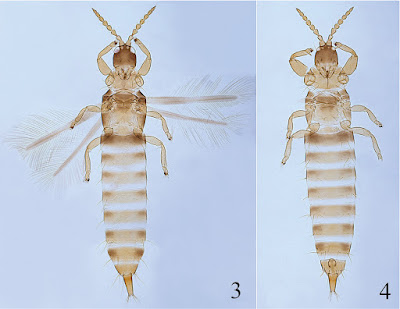
Winged female (left) and wingless male of Psalidothrips comosus, from Zhao et al. (2018).


Close to fifty species of Psalidothrips have been described from various locations around the world (Wang et al. 2019). They are most commonly found among leaf litter and are believed to feed on fungal hyphae. Most Psalidothrips are relatively small, pale thrips, yellowish or light brown in coloration. As members of the family Phlaeothripidae, the last segment of the abdomen is modified into a tube ending in a ring of setae; in Psalidothrips, this tube is commonly short and the terminal setae are often longer than the tube.

As is common among thrips, the recognition of Psalidothrips and its constituent species is often complicated by within-species variation. Many species are known as both winged and wingless forms (Wang et al., 2019, note that Australian species seem particularly prone to winglessness). Wingless forms often show reductions in the sclerotisation of the thorax. It is difficult to name a single feature of the genus that does not find exception in some species or other. Most species are weakly sculpted. For the most part, the maxillary stylets are short and sit low and far apart in the head when retracted. The mouth-cone is similarly short and rounded. The head is often fairly short with rounded cheeks that do not bear strong setae. Setae on the anterior margin of the pronotum are often reduced. The wings, if present, are often more or less constricted at about mid-length. Many phlaeothripids possess a series of large setae on the abdomen that hold the wings in place when folded back; in individuals of Psalidothrips with such setae (obviously, they tend to disappear in wingless individuals), they are often relatively few in number and simply curved.

Many of these features are related to the thrips' litter-dwelling habits. The short mouthparts, for instance, presumably reflect how these thrips are gleaning fungi from the surface of leaves without needing to pierce the leaf's cuticle. As such, it will be interesting to see how the genus holds out as our understanding of thrips phylogeny improves. Is this a true evolutionarily coherent assemblage, or disparate travellers who are following a fashion?

REFERENCE

Wang, J., L. A. Mound & D. J. Tree. 2019. Leaf-litter thrips of the genus Psalidothrips (Thysanoptera, Phlaeothripidae) from Australia, with fifteen new species. Zootaxa 4686 (1): 53–73.

Rasahus albomaculatus, the White-Spotted Corsair

Though the Hemiptera began their long evolutionary history as plant-feeders, many of their subgroups later switched to a predatory lifestyle, their suctorial mouthparts being just as suited for stabbing flesh as vegetation. Among the most successful of the predatory bugs where the assassin bugs of the family Reduviidae.

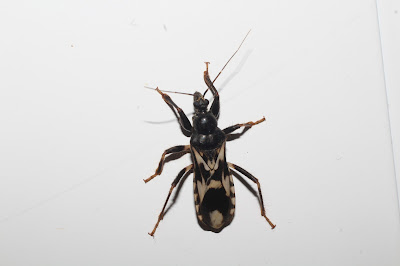
Image copyright Jacob Gorneau.


This is Rasahus albomaculatus, a widespread assassin of the Neotropical region, found from Mexico to Argentina (Coscaron 1983). Though not one of the largest members of its genus, R. albomaculatus is a decent-sized bug, growing close to an inch in length. Rasahus is a genus of the reduviid subfamily Peiratinae, commonly known as corsairs for their fearsome aspect. Features distinguishing Rasahus from other genera of corsairs include their large eyes, a deep grove across the head in front of the ocelli, long procoxae, and well-developed spongy pads on the fore- and mid-tibiae. Rasahus albomaculatus is distinguished from other species of the genus by its colour pattern. The body is mostly black with white patterning on the wings. Stripes along the top of the wing and across the mid-length form a crude H-shape when the wings are closed, with separate spots towards the base of the wing and towards the tip. Other noteworthy features include a lack of granulation on the pronotum, and a rounded apex to the scutellum (Swanson 2018).

Corsairs are mostly predators of other insects and not often dangerous to humans (though their bite is supposed to be very painful). Indeed, they may be beneficial to humans as among their prey are believed to be other reduviids of the subfamily Triatominae, the blood-sucking "kissing bugs" that spread Chagas disease (contrary to the Wikipedia page on the western corsair R. thoracicus, corsairs do not spread Chagas themselves). Rasahus albomaculatus may provide its vertebrate co-habitants with far more comfortable living conditions.

REFERENCES

Coscarón, M. del C. 1983. Revision del genero Rasahus (Insecta, Heteroptera, Reduviidae). Revista del Museo de La Plata (nueva serie) (Zoologia) 13: 75–138.

Swanson, D. R. 2018. Three new species of Rasahus, with clarification on the identities of three other Neotropical corsairs (Heteroptera: Reduviidae: Peiratinae). Zootaxa 4471 (3): 446–472.

Booklice: The Cutest of Pests

Humans have a tendency to think of 'nature' and the 'environment' as something distinct from our own society. Environments unmodified by humans are seen as 'natural' whereas structures created by human activity, such as buildings, are not 'natural' and thought to be somehow outside the 'environment'. As such, people often react strongly to the idea of things associated with the 'environment', such as non-human wildlife, encroaching on their homes. But of course, human houses are as much an environment of their own as any other of the world's habitats, and many animals find them to be places where they can thrive. Among the animals that most regularly share our houses with us are booklice of the genus Liposcelis.

Liposcelis bostrychophila, copyright Andreas Eichler.


Representatives of Liposcelis can be found almost anywhere in the world except in the coldest of regions. About 130 species have been described in the genus to date (Yoshizawa & Lienhard 2010) with doubtless more yet to be discovered (by comparison, Broadhead's review of the genus in 1950 recognised only 22 species, with a six-fold increase since then). The family Liposcelididae, to which Liposcelis belongs, differ from other free-living members of the Psocodea (or 'Psocoptera') in their flattened body form, as well as being smaller than most other examples (Liposcelis grow little more than a millimetre in length). In the flattened habitus, they resemble the parasitic true lice of the Phthiraptera, and recent studies have agreed that the liposcelidids represent the closest relatives of true lice (Yoshizawa & Lienhard 2010). Liposcelis species are readily distinguished from other liposcelidids by the shape of the hind legs: an obtuse tubercle on the outer margin of the hind femur gives it a distinctly broad appearance* (indeed, the genus name Liposcelis translates into English as 'fat thigh'). Liposcelis are also distinctive in being invariably wingless; other liposcelidid species typically come in both winged and wingless forms. Though the genus as a whole is easily recognised, distinguishing individual species is often a far more challenging prospect requiring microscopic examination of fine features of the chaetotaxy (arrangement of bristles on the body) and cuticular sculpture. Authors have divided Liposcelis species between a number of diagnostic sections and subgroups based on these and other features but the monophyly or otherwise of these subdivisions is largely unstudied.

*This feature is also shared with a cave-dwelling species from Ascension Island currently placed in its own genus, Troglotroctes ashmoleorum, but it seems more than likely that this species is itself a derived offshoot of Liposcelis.

Liposcelis species can feed on a wide range of organic matter but, like other 'Psocoptera', their primary source of food is probably yeasts and fungal spores (their vernacular name has been attributed to their feeding on yeasts growing on the glue binding books, though I would note that they are also probably more likely to be seen crawling on the light background of a book's page than in other, less closely examined corners of the house). Turner (1994) provided a detailed review of the natural history of one of the most widespread domestic pest species in the genus, L. bostrychophila, and reports that he was able to maintain cultures on "'Weetabix'™, 'Shreddies'™, baby rice, soya granules, sage and onion stuffing mix, skimmed milk powder, 'Oat Krunchies'™, red lentils, and yellow split peas". Other stored foods from which complaints had been received of booklice included "sugar, bread, salt, bay leaves, gelatine powder, poppadoms, custard powder, dried yeast, instant potato, nuts, dried fruit, baby food, sauce mix, dried mushrooms, pasta, coconut, cocoa, milk powder, spices, glace cherries, garlic, baking powder, icecream mix, dried soup, cracked wheat, carob powder, maize meal, wheat germ, jellied sweets and bread crumbs". They have also been found on cured meat and may damage curated insect specimens. As well as obtaining moisture from their food, Liposcelis are also able to extract water directly from the atmosphere owing to the hygroscopic properties of their saliva. A booklouse will hold a drop of saliva inside its mouth, then swallow it when the ball has absorved enough water from the air.

Liposcelis sp. (possibly L. meridionalis?) from southern France, copyright Jessica Joachim.


Female Liposcelis bostrychophila generally reach maturity and begin producing eggs about two weeks after hatching and may produce two or three eggs a day. As each egg is about one-third the size of the adult, this means that a female at peak fecundity is producing her own body mass in eggs in a single day. Most Liposcelis species reproduce sexually but some are parthenogenetic. Domestic L. bostrychophila, for instance, seem to be entirely parthenogenetic with males of the species only known from isolated collections in Hawaii, Arizona and Senegal (Georgiev et al. 2020). Studies on an unnamed species of Liposcelis from Arizona found that sex determination seemed to be facultative, determined by the mother, with no evidence for differentiated sex chromosomes (Hodson et al. 2017). Females seemed to produce more males early in life and more females later. The same studies also established the occurrence of paternal genome elimination in this species, where chromosomes inherited from the father were inactivated in the offspring and not passed on to their own progeny (which raises the question that, if males are effectively a genetic dead end, why would a female produce male offspring at all?) Paternal genome elimination has also been found in the human louse Pediculus humanus, and may be characteristic of the broader clade encompassing these species, but other species remain unstudied. Liposcelis genomes are also remarkable in the occurrence of fragmentation of the mitochondrial genome. Whereas some Liposcelis species have only a single mitochondrial chromosome, as is standard for most other animals, some species have the mitochondrial genome divided between two, three, five or seven chromosomes (Feng et al. 2019). The functional significance, if any, of this feature remains unknown.

Though booklice may be found in houses and stores on the regular, they are mostly only minor pests, only causing distress when reaching large numbers (an exceptional case quoted by Turner, 1994, involved a house in New Jersey at the beginning of the 1900s that became so infested "'that a pinpoint could not have been put down without touching one or more of these bugs"). They are not believed to transmit pathogens, except perhaps incidentally by carrying microbes from one store to another. For the most part, these little beasties are just another part of the wildlife that shares our homes with us, whether we are aware of them or not.

REFERENCES

Feng, S., H. Li, F. Song, Y. Wang, V. Stejskal, W. Cai & Z. Li. 2019. A novel mitochondrial genome fragmentation pattern in Liposcelis brunnea, the type species of the genus Liposcelis (Psocodea: Liposcelididae). International Journal of Biological Macromolecules 132: 1296–1303.

Georgiev, D., A. Ostrovsky & C. Lienhard. 2020. A new species of Liposcelis (Insecta: Psocoptera: Liposcelididae) from Belarus. Ecologica Montenegrina 29: 41–46.

Hodson, C. N., P. T. Hamilton, D. Dilworth, C. J. Nelson, C. I. Curtis & S. J. Perlman. 2017. Paternal genome elimination in Liposcelis booklice (Insecta: Psocodea). Genetics 206: 1091–1100.

Turner, B. D. 1994. Liposcelis bostrychophila (Psocoptera: Liposcelididae), a stored food pest in the UK. International Journal of Pest Management 40 (2): 179–190.

Yoshizawa, K., & C. Lienhard. 2010. In search of the sister group of the true lice: a systematic review of booklice and their relatives, with an updated checklist of Liposcelididae (Insecta: Psocodea). Arthropod Systematics and Phylogeny 68 (2): 181–195.

The Mirines

Every profession has its quirks, tricks of the trade that are difficult to learn and appreciate except through direct experience. One quirk of entomology is that specimens of each distinct type of insect will have their own nuances for the best method to preserve and present them. And there are some particular types of insect that can be particularly challenging in that regard. Which is a roundabout way of saying: I am not a great fan of mirids.

Green mirid Creontiades dilutus, copyright CSIRO.


Mirids are the largest recognised family of the true bugs in the Heteroptera, with over 11,000 species known worldwide and presumably many more remaining undescribed. They can be distinguished from most (though not, it should be stressed, all) other bug families by the presence of the cuneus, a distinct cross-fold near the outer tip of the hemelytron (the toughened basal part of the fore wing). Most mirids can be further recognised by the absence of ocelli. They are mostly smaller bugs, generally somewhat soft-bodied, and mostly plant feeders though there are some notable exceptions. They also (and this is the reason why they have sometimes been the object of my animus in the past) have a tendency to be what I can only describe as weirdly flimsy. Most insect specimens, at least while stil fresh and relaxed, hold together reasonably well when subject to basic handling. Mirids, on the other hand, will throw off legs if you so much as look at them too hard.

An ant-mimicking mirid, Dacerla inflata, copyright Judy Gallagher.


Mirids are divided between several subfamilies, with the type subfamily Mirinae including well over 4000 species (Kim & Jung 2019). Mirines tend to be relatively large compared to other mirids (up to a bit over half a centimetre in length) and are characterised by features of the genitalia, together with a pair of lamellate, divergent parempodia (fleshy structures that may help in gripping onto things) at the end of the legs between the claws. Other notable features (shared with the closely related Deraeocorinae) include a deeply punctate pronotum, and a relatively long beak that extends beyond the mid coxae at rest. Several species of Mirinae are notable pests. The green mirid Creontiades dilutus is one of the more significant bug pests of crops in Australia, attacking a wide range of hosts including cotton, stone fruit, potatoes, legumes and many more (Malipatil & Cassis 1997). It generally feeds from growing points, killing new buds and inhibiting the production of flowers and new growth. Other polyphagous pests causing similar damage include the tarnished plant bugs of the genus Lygus, whose vernacular name is somewhat self-explanatory, and the alfalfa bug Adelphocoris lineolatus.

Tarnished plant bug Lygus pratensis, copyright Hectonichus.


Six tribes have been recognised within the Mirinae, distinguished by their overall habitus. The Mirini, the largest tribe, have a more or less ovoid body shape with a distinct, raised pronotal collar and opaque hemelytra. The Hyalopeplini have a similar body shape to Mirini but transparent hemelytra. The Restheniini have a reduced evaporative area on the abdomen. The Stenodemini and Mecistoscelini are long and slender with long appendages, with the head directed forward in the Stenodemini. The Herdoniini are ant mimics, presumably for defence from predators. The appearance of an ant waist is achieved by a narrowing of the mirid's own body and wings, and/or an appropriately placed white triangular marking across the hemelytron. Despite the superficial distinctiveness of the tribes, however, a phylogenetic study of the Mirinae by Kim & Jung (2019) found at least two of them to be paraphyletic, with Mecistoscelini being nested within Stenodemini, and Hyalopeplini and Restheniini within Mirini. The affinities of the Herdoniini, unsampled by Kim & Jung, remain to be established.

REFERENCES

Kim, J., & S. Jung. 2019. Phylogeny of the plant bug subfamily Mirinae (Hemiptera: Heteroptera: Cimicomorpha: Miridae) based on total evidence analysis. Systematic Entomology 44: 686–698.

Malipatil, M. B., & G. Cassis. 1997. Taxonomic review of Creontiades Distant in Australia (Hemiptera: Miridae: Mirinae). Australian Journal of Entomology 36: 1–13.

Mesopsocus unipunctatus: an Intriguing Barklouse

I've maintained before that barklice or Psocoptera/Psocodea are the cutest of all insects, an opinion that I still stand by. Nevertheless, their small size and inoffensive habits mean that they don't get the attention that they deserve.

Female Mesopsocus unipunctatus, copyright Tom Murray.


Mesopsocus unipunctatus is a widespread barklouse species in Europe and North America (and possibly in Asia as well where a lack of records may reflect a lack of people looking). It is a relatively large species as barklice go, growing up to about half a centimetre in length. Mature males are fully winged but females have the wings reduced to rudiments and are flightless. Mesopsocus unipunctatus are found living on the bark of trees, primarily on branches rather than on the trunk, and their diet is predominantly made up of the micro-alga Pleurococcus and fungal spores. They are active in early summer: populations in Yorkshire had the first nymphs hatching during April and numbers of individuals reached a peak in late June to early July. The population survived over winter as eggs, laid in clusters of five to eight and covered with a protective layer of hard faecal matter (Broadhead & Wapshere 1966).

Mesopsocus unipunctatus shares much of its range with a closely related species, M. immunis, and the two are often found in association (Broadhead & Wapshere 1966). Differences between the two are slight: M. immunis tends to be paler in coloration but the two species are best distinguished by features of their terminalia. They both feed on the same diet and are active around the same time of year (conversely, other ecologically similar barklice species found in Yorkshire by Broadhead & Wapshere, 1966, were active later in the summer). So how do the two manage to persist without one excluding the other? As it turns out, they differ in oviposition behaviour. Mesopsocus unipunctatus prefers to lay its eggs right at the tips of tree branches whereas M. immunis mostly lays about 25 to 50 cm back from the tip. Mesopsocus immunis also covers its egg masses with a layer of silk in addition to the layer of faecal matter used by both species. These behaviours mean that M. immunis egg masses are better protected from one of their major threats, a mymarid wasp that parasitises them. However, M. unipunctatus compensates for its higher vulnerability to parasitoids through a greater resistance to cold, meaning that a higher proportion of its unparasitised eggs survive the winter. The greater cold resistance of M. unipunctatus means that it may also be found at altitudes and latitudes beyond the range of M. immunis.

Male Mesopsocus unipunctatus, copyright Ken Schneider.


Another feature of M. unipunctatus worth mentioning is that it shows variation in coloration attributed to industrial melanism. This phenomenon is better known in Lepidoptera: you may have heard of one of the most famous animals supposed to exhibit it, the peppered moth Biston betularia. Individuals of M. unipunctatus in England vary in the degree of dark markings on the abdomen, from some that are almost entirely dark through those with a mottled pattern of dark patches and stripes to some in which the dark markings are restricted to the primary transverse stripe on the fourth abdominal segment. The head and thorax are also darker in some individuals than others though it is notable that not all individuals with darkened abdomens also have darkened heads and thoraces (Popescu et al. 1978). Industrial melanism is so-called because this variation in colour pattern is supposed to be related to industrial pollution. It is supposed that the original paler, broken coloration provided camouflage on lichen-covered bark but selection came to favour darker color patterns as trees became blackened with soot. Studies on melanism in M. unipunctatus did indeed find a correlation between the number of dark individuals in a population and the degree of pollution in the environment (Popescu 1979). However, aviary studies of predation rates on M. unipunctatus individuals released into simulated habitats were a bit more equivocable: survival rates of light-coloured individuals were better among branches taken from rural locations but neither morph was definitely favoured among branches from urban environments. Also, darker individuals exhibited faster growth rates in polluted environments than lighter individuals, perhaps due to better absorption of heat despite sunlight being blocked by smog. Are there more dark-coloured individuals in industrial locations because they die less, or because they live more? Another question I don't know the answer to: has M. unipunctatus also reflected Biston betularia in seeing a drop in melanistic individuals with the reduction of smog levels in England in recent decades?

REFERENCES

Broadhead, E., & A. J. Wapshere. 1966. Mesopsocus population on larch in England—the distribution and dynamics of two closely-related coexisting species of Psocoptera sharing the same food resource. Ecological Monographs 36 (4): 327–388.

Popescu, C. 1979. Natural selection in the industrial melanic psocid Mesopsocus unipunctatus (Müll.) (Insecta: Psocoptera) in northern England. Heredity 42 (2): 133–142.

Popescu, C., E. Broadhead & B. Shorrocks. 1978. Industrial melanism in Mesopsocus unipunctatus (Müll.) (Psocoptera) in northern England. Ecological Entomology 3: 209–219.

The Stilt Bug Neides tipularius

Image copyright Janet Graham.


This is Neides tipularius, a widespread bug in the western part of the Palaearctic region. It feeds on a wide range of plants: I've seen references to it on grasses, on composites, or on chickweeds. It prefers drier regions such as coastal dunes or heaths.

Neides tipularius is a fairly typical member of the stilt bug family Berytidae. Berytids are more or less slender bugs in general but Neides is one of the more slender and long-legged ones. There are few other bugs with which a berytid could be confused; not only is there the wispy legginess to mark them, but berytids have distinctive long antennae with a short, spindle-shaped terminal segment forming a dark bobble at the end. Latreille (1802) did place N. tipularius in the genus Ploiaria, but that is now used for a group of small, long-legged assassin bugs with raptorial forelegs for catching prey.

Image copyright Sanja565658.


As with many other bugs, Neides tipularius exhibits polymorphism in wing development with flightless brachypters having narrower wings that only just reach the tip of the abdomen. Whether a given individual grows into a flying or flightless adult appears to be connected to the conditions under which they develop. Hot springs and summers have been noted to lead to increased numbers of macropterous adults.

REFERENCE

Latreille, P. A. 1802. Histoire Naturelle, générale et particulière des crustacés et des insectes vol. 3. Familles naturelles des genres. F. Dufart: Paris.

Cicadomorpha

Textbooks will tell you that the term 'bug' should be restricted to insects of the order Hemiptera though, as I've noted before, I don't know if I've ever met anyone who actually used the word that way. For many people, one of the groups of actual bugs that they are most likely to be aware of are members of the Cicadomorpha.

Tasmanian hairy cicada Tettigarcta tomentosa, copyright Simon Grove.


Cicadomorphs include the cicadas (Cicadoidea), leafhoppers (Membracoidea) and spittlebugs (Cercopoidea). As a group, they are distinguished by an enlarged postclypeus (the upper part of the front of the head below the antennae), simple antennae with a whip-like flagellum, and small and narrowly placed mid-coxae (Dietrich 2005). The enlarged postclypeus is associated with adaptations for feeding on xylem, deeper in the plant stem than many other plant-sucking bugs prefer, though derived subgroups of the leafhoppers have changed back to phloem or parenchyma. Well over 30,000 species of cicadomorph are known from around the world. Cicadas can be readily distinguished from other cicadomorphs by their possession of three ocelli in a triangle on the top of the head whereas leafhoppers and spittlebugs have only two or no ocelli.

Male bladder cicada Cystosoma saundersii, one of the world's more ridiculous animals, from Brisbane Insects.


Cicadas are best known, of course, for their singing. The songs are produced by a pair of membranous 'drums', the tymbals, at the base of the abdomen; muscular vibration of the membranes produces the sound. In most cicadas, only the male possesses these tymbals. However, both sexes possess tymbals in the hairy cicadas Tettigarcta, two species found in alpine regions in south-eastern Australia. Hairy cicadas also differ from the remaining cicadas in other ways, most notably in lacking the well-developed tympana on the underside of the abdomen that typical cicadas hear with (hairy cicadas have simpler hearing organs in their place). As a result, Tettigarcta is placed in its own distinct family, sister group to the remaining cicadas in the Cicadidae. Though now restricted to Australia, fossil species from the Mesozoic and Palaeogene of other parts of the world have also been placed in the Tettigarctidae (Shcherbakov 2008); however, they are mostly so placed on the basis of shared primitive rather than derived features and may well represent stem taxa for Cicadoidea as a whole. Other derived features of the cicadas proper in the Cicadidae include gas-filled chambers in the abdomen that resonate the calls produced by the tymbals. In males of another Australian species, the bladder cicada Cystosoma saundersii, these resonating chambers reach a remarkable size and the entire abdomen looks to have been blown up like a beach ball.

Froghopper Cercopis vulnerata, copyright Richard Bartz.


The spittlebugs or froghoppers of the Cercopoidea are smaller cicadomorphs, distinguished from species of the Membracoidea by their short and cylindrical (rather than long and quadrate) hind tibiae. The name 'spittlebug' refers to the nymphs of these bugs living covered with a protective covering of foam. In one family, the Machaerotidae, the nymph produces a calcareous tube around itself that it fills with fluid. The foam or fluid used for protection by cercopoids is primarily composed of the nymph's own excrement: the xylem fluids that they feed on are mostly water, after all, so they produce a large quantity of watery excreta.

Mango leafhopper Idioscopus nagpurensis, one of the world's many, many species of Cicadellidae, copyright Arian Suresh.


The third main subgroup of the cicadomorphs, the Membracoidea, is by far the most diverse, particularly the largest family Cicadellidae (leafhoppers). My own impression from my experience of collecting insects in various locations is that cicadellids are just everywhere. Over 20,000 species of this family have been described to date, and it has been estimated that the true number may be much higher. For instance, at one location in North America close to 100 species of a single genus Erythroneura have been recorded from a single plant (Dietrich 2002). Just how such a high diversity of closely related species can live in such close proximity remains a largely unanswered question, though some studies have apparently suggested the possibility of very fine micro-habitat partitions (making sense of the great mass of cicadellid diversity is not helped by many species exhibiting dimorphism between flying and flightless forms, similar to that I recently described for delphacids). Another notable feature of cicadellids is the protection of brochosomes, tiny, hollow, soccerball-like granules constructed of protein nets with which the leafhopper coats itself after moulting. The hydrophobic brochosomes help to keep the hopper free of water droplets and its own wet, sticky excreta. They may also serve other protective functions: females will coat newly laid eggs with a layer of brochosomes that may serve to prevent egg parasitoids such as micro-wasps from attacking the eggs.

Membracid leafhopper Cladonota benitzei, copyright P. Lahmann.


The membracoids also include the Membracidae, renowned for the remarkable appearance of the pronotal shield (the top and front of the thorax) in many species. In more humble membracids, the pronotum may form a high mound or pillar, but in others it may extend into bizarre arrangements of globules and branched spines hanging above the leafhopper like a baroque chandelier. Again, just what the purpose of this extravagant morphology is remains unknown but many authors have proposed some sort of protective function. It has been suggested that pronotal projections may help membracids mimic part of their host plant, or potential predators such as parasitic wasps. Alternatively, they mean that potential predators such as birds find the hopper just too hard to swallow.

REFERENCES

Dietrich, C. H. 2002. Evolution of Cicadomorpha (Insecta, Hemiptera). Denisia, Neue Folge 4 (176): 155–170.

Dietrich, C. H. 2005. Keys to the families of Cicadomorpha and subfamilies and tribes of Cicadellidae (Hemiptera: Auchenorrhyncha). Florida Entomologist 88 (4): 502–517.

Shcherbakov, D. E. 2008. Review of the fossil and extant genera of the cicada family Tettigarctidae (Hemiptera: Cicadoidea). Russian Entomological Journal 17 (4): 343–348.

Hoppers

The world is home to a wide variety of leafhoppers, both in terms of number of species and range of morphological disparity. One of the more diverse leafhopper families is the Delphacidae, including over two thousand species from around the globe. Delphacids are relatively small leafhoppers that are easily distinguished from other families by the possession of a large movable spur at the end of the tibia of the hind leg. I can't say as I know what the function of this spur is, but similar structures in other insect groups may be used for grooming.

Brown leafhoppers Nilaparvata lugens, from ICAR. The individual on the right is a long-winged disperser, the one on the left is a flightless brachypter.


Delphacids feed on the phloem of their host plants; the greater number of species are associated with monocots such as grasses. A number of species are significant economic pests; perhaps the most infamous are the brown leafhopper Nilaparvata lugens and white-backed leafhopper Sogatella furcifera which attack rice. They feed at the base of rice plants, causing the formation of round, yellow patches that soon dry up and turn brown, a condition known as 'hopper burn'. Death of the entire plant will often follow. As well as the direct damage from feeding, these leafhopper species also transmit viruses that further impact yields. Historically, numerous famines have been blamed on leafhopper outbreaks, such as the Kyoho famine of 1732 that saw rice production reduced to only 10% of its previous level. Estimates of the number of people affected by the famine seem to vary widely—according to Wikipedia, the official death toll was a bit more than twelve thousand people, but estimates of the actual number of fatalities range well in excess of 150,000. In more recent years, leafhopper outbreaks may be exacerbated by indiscriminate fertiliser and pesticide use, with the latter reducing competition for the hoppers from other insects or predators.

Delphacids (and many other leafhoppers) commonly exhibit polymorphism in wing development with both flying macropterous and flightless brachypterous forms occuring in a single population. The question of macroptery vs brachyptery is an environmental one. If a developing delphacid receives sufficient nitrogen then it will develop into a flightless adult, remaining in the place of its birth to continue to benefit from the good feeding conditions there. But if feeding conditions become degraded and the developing nymph is deprived of nitrogen then it will develop into a fully-winged adult that can leave its home in search of more favourable conditions elsewhere. Because of their small size, migrating delphacids may be carried long distances by the winds. In the case of pest species, this phenomenon of migration further exacerbates the problem of control as hopper populations from different countries are regularly mixed, increasing genetic diversity and resistance to varying control methods.

REFERENCE

Urban, J. M., C. R. Bartlett & J. R. Cryan. 2010. Evolution of Delphacidae (Hemiptera: Fulgoroidea): combined-evidence phylogenetics reveals importance of grass host shifts. Systematic Entomology 35: 678–691.

Edible Stinkbugs

In recent years, there has been some discussion in certain circles about whether people in western cultures should become more accepting of the practice of entomophagy: that is, eating bugs. For the most part, insects do not play a big part in diets in the English-speaking world except indirectly. In other parts of the world, however, certain insects may be eaten with relish. One such insect is the edible stinkbug Encosternum delegorguei of southern Africa.

Edible stinkbug Encosternum delegorguei, from Dzerefos et al. (2013).


The edible stinkbug is a member of the family Tessaratomidae, one of a number of families in the stinkbug superfamily Pentatomoidea. Tessaratomids are mostly relatively large, flat-bodied stinkbugs, often with shining metallic coloration, found in warmer parts of the world. They are all plant-suckers; one species, the lychee stinkbug Tessaratoma javanica, is a significant pest of lychee crops while the bronze orange bug Musgraveia sulciventris is a pest of citrus trees in Australia. The edible stinkbug feeds on a range of tree species, belonging to a number of different flowering plant families such as Combretaceae, Fabaceae and Ebenaceae. Though widespread in southern Africa, their distribution seems to be patchy; only certain ethnicities have a tradition of stinkbug harvesting (Dzerefos et al. 2013).

Harvester collecting stinkbugs, copyright Cathy Dzerefos.


Edible stinkbugs are collected during winter (the dry season) when they aggregate in large protective clusters (up to football-sized) on particular trees. Like other stinkbugs, Encosternum delegorguei produce a foul-smelling defensive chemical from glands on the thorax. As well as smelling bad, this chemical can stain skin and may cause temporary blindness if it gets into eyes. Dzerefos et al. (2013) note that stinkbug harvesters informed them that exposure to the defensive chemical over several years could cause fingernail loss and wart growth. The chemical needs to be removed from the bugs before they are cooked for consumption because, as one harvester explained, "if you eat the unprepared one it will kill taste for a month".

Clusters of stinkbugs are collected live into bags which are then shaken to encourage the bugs to discharge their chemicals. Further processing could be done by two methods. Perhaps the more common method is to pinch off the head of each bug then squeeze out the contents of the thorax, after which the bugs are cooked immediately. However, the Bolobedu people (who collect stinkbugs more for commercial sale than for their own consumption) place the bugs into a bucket with a perforated base, then pour hot water over them and stir vigorously. The bugs discharge their glands into the water as the heat kills them. They are then rinsed off in cold water, then returned to hot water for about eight minutes, then spread out on bags on the ground to dry. Any bugs that had not fully discharged their glands before dying can be recognised by dark marks on the thorax and are discarded. Though slightly more involved than the waterless method, this process of preparation has the advantage that bugs can be stored for some time rather than having to be cooked immediately. Stinkbugs are usually cooked by braising in a frying pan with salt; they are supposed to have a spicy taste, like chili.

Basket of prepared stinkbugs, from here.


According to Dzerefos et al. (2013), many of the stinkbug harvesters they spoke to reported a decline in populations of the bugs in recent years. Potential reasons for the decline included drought and/or the felling of trees that would otherwise be used by the bugs as roosts. Could edible stinkbugs be more widely used commercially? Perhaps, but it should be noted that while some groups relish the bugs, their neighbours disdain the delicacy. Mind you, Bolobedu people apparently didn't eat the bugs themselves before the 1980s, only taking up harvesting them when co-workers in tea plantations taught them what a resource they had on their hands!

REFERENCE

Dzerefos, C. M., E. T. F. Witkowski & R. Toms. 2013. Comparative ethnoentomology of edible stinkbugs in southern Africa and sustainable management considerations. Journal of Ethnobiology and Ethnomedicine 9: 20.

Hairy-Winged Barklice

Forewing and fore tibia of Siniamphipsocus fusconervosus, from Mockford (2003). Scale bar for the femur = 0.1 mm.


For my next semi-random post, I drew Siniamphipsocus, a genus of more than twenty species of barklice known from eastern Asia. Most of these species were described by China by the almost ludicrously prolific psocopterologist Li Fasheng who over the course of his career has described close to 1000 psocopteran species—nearly a fifth of the world's barklouse fauna. It should be noted, though, that this productivity has not entirely come without criticism: for instance, in the case of the Siniamphipsocus species, most if not all are known from a single sex with some described from males and others from females (Li 2002).

Siniamphipsocus is a genus of the Amphipsocidae, a family of barklice most easily recognised by their wings which have a double row of setae along each of the veins. Amphipsocids can be relatively large as barklice go: the largest Siniamphipsocus species, S. aureus, has a body length of four millimetres, with the forewings being up to 6.75 millimetres long. Features distinguishing Siniamphipsocus from other amphipsocids include the absence of the brush of hairs present at the base of the hind wing in many other species, the absence of a spur vein in the rear of the forewing pterostigma, and the presence of a row of minute spines along the fore femur (Li 2002). Distinguishing the individual species of the genus requires fine attention to details such the patterns of markings on the face, the proportions of the wing veins, and details of the genitalia.

REFERENCES

Li F. 2002. Psocoptera of China (2 vols). Science Press: Beijing.

Mockford, E. L. 2003. New species and records of Psocoptera from the Kuril Islands. Deutsche Entomologische Zeitschrift 50 (2): 191–230.

The Polyctenidae: Blood-sucking Bugs on Bats

Dorsal, ventral and lateral views of Eoctenes spasmae, from Marshall (1982).


If you ever feel inclined to scan through host records for ectoparasites (and really, why wouldn't you?), you may be struck by the impression that bats seem to be peculiarly lousy animals. There seems to be an unexpected number of groups of ectoparasites that have their highest number of species on bats. One possible reason for this is that, with over 900 potential host species, bat-parasite diversity is high simply because bat diversity is high. Nevertheless, there are other features peculiar to bats that make them excellent parasite hosts. The modification of their fore-legs into wings means that their ability to groom themselves is curtailed. Because many bat species roost in dense colonies, transmission of parasites from one bat to another may happen freely. And because most bats will consistently return to the same roost, speciation is promoted by each colony becoming like an isolated island.

At the same time, referring to bats as 'lousy' is misleading because one ectoparasite group that is curiously absent from bats is the true lice (why this should be I have no idea). Instead, bats are often host to a number of parasite groups all of their own. One such group is the Polyctenidae, flightless true bugs that are found only on bats in tropical and subtropical parts of the world. Polyctenids are closely related to the bed bugs of the Cimicidae and are not dissimilar in appearance. Noticeable differences are their relatively shorter antennae and absence of eyes. They also possess a number of bristle combs at various places on the body, roughly similar in appearance to those on fleas. Their front legs are short and have sucker-like structures on the tarsi instead of claws; the hind two pairs of legs are longer and clawed. The manner of movement of the legs is specialised for crawling among the hair of their host; if removed from the host, the bug is unable to move on a flat surface. Transmission of bugs from one host to another presumably happens only through direct physical contact. Polyctenids share with bed bugs the notorious practice of traumatic insemination with each male injecting sperm directly into the female's body cavity via sharpened genitalia. However, unlike bed bugs they are viviparous, producing live nymphs instead of eggs. The developing embryos are nourished by a 'pseudoplacenta' with a single female potentially containing several developing embryos in a conveyor arrangement at different stages of development. The most mature of these embryos protrudes from the female's genital opening for some time prior to birth and may be a third of its mother's size when born (Marshall 1982).

Type specimen of Hesperoctenes giganteus, from here.


Five genera of polyctenids are generally recognised, with four genera found in the Old World and only a single genus, Hesperoctenes, in the New World (Maa 1964; Ueshima 1972). A second New World genus, Parahesperoctenes, was described in 1947 from a single female, but as the features supposedly distinguishing it from Hesperoctenes related to the consistent duplication of combs, etc., it is thought likely that this was an ordinary individual of Hesperoctenes on the cusp of moulting from a nymph to an adult (so the features of the adult cuticle were visible through the translucent nymphal cuticle). Most of the polyctenid species have a restricted host range, being found on only a single bat species or a small number of closely related species. Some species of Hesperoctenes are more flexible, being found on a range of host species. Hesperoctenes and the Old World genus Hypoctenes are found on free-tailed bats of the Molossidae. Of the other Old World genera, Adroctenes is found on horseshoe bats and leaf-nosed bats of the Rhinolophidae and Hipposideridae, Polyctenes is found on ghost bats of the Megadermatidae, and Eoctenes is found on Megadermatidae, Nycterididae and Emballonuridae. Records of polyctenids from other bat families are currently regarded as suspicious, due to either mislabelling or cross-contamination. Ueshima (1972) suggested that records of Hesperoctenes fumarius from the bulldog bat Noctilio labialis might result from bugs being transferred while the bulldog bats were sharing a roost with their more usual molossid hosts.

Relationships between the genera were discussed by Maa (1964) who divided the family between two subfamilies on the basis of comparative features; a formal phylogenetic analysis of the family appears to still be wanting. On the basis of Hesperoctenes being the 'most specialised' genus and its shared host family with Adroctenes, Maa suggested an Old World origin for Polyctenidae. Eoctenes, with its broad host family range, was regarded as 'least specialised' and likely to be evolutionarily older than other genera. Many of the features distinguishing the polyctenid genera relate to the arrangement of combs: which combs are present where and how they are developed. Prior to Maa's revision, Hesperoctenes had been regarded as likely to be primitive within the Polyctenidae due to its relatively low number of combs. The mid- and hind legs of Adroctenes are fairly short compared to those of other genera.

REFERENCES

Maa, T. C. 1964. A review of the Old World Polyctenidae (Hemiptera: Cimicoidea). Pacific Insects 6 (3): 494–516.

Marshall, A. G. 1982. The ecology of the bat ectoparasite Eoctenes spasmae (Hemiptera: Polyctenidae) in Malaysia. Biotropica 14 (1): 50–55.

Ueshima, N. 1972. New World Polyctenidae (Hemiptera), with special reference to Venezuelan species. Brigham Young University Science Bulletin, Biological Series 17 (1): 13–21.

Thrips Wars!

Two males of Elaphrothrips tuberculatus fight it out on the left, while the object of their desire guards her egg-mass on the right. Figure from Crespi (1986).


All around, little dramas are taking place every day, conflicts as intense as the plot of any daytime soap opera. And like most daytime soap operas, the main focus of these dramas often comes down to who is shagging whom. Most people only known thrips as small annoying insects that damage garden plants and crops, but some thrips may engage in remarkable behaviours.

Elaphrothrips is a genus of thrips found almost throughout the tropics (though it is absent from Australasia). They are found on dead leaves, where they feed on fungal spores. Well over a hundred species have been named in Elaphrothrips, though Mound & Palmer (1983) pointed out that many of these may be turn out to be synonymous as individual species can vary significantly in appearance. Males may have thick forelegs with strong tubercles on the femora, while the forelegs of females are usually slender and lack tubercles. Indeed, the sexes are different enough that at one point they have been mistaken for separate genera. The males themselves may vary significantly in size, with larger males having correspondingly larger legs and spines.

A lot of these differences are related to the Elaphrothrips' mating behaviour. The best-studied of the Elaphrothrips species is E. tuberculatus, a widespread species in eastern North America and the largest North American thrips species. Elaphrothrips tuberculatus prefer dead oak leaves that are still hanging in clusters from the tree, where females lay eggs in clusters on the leaves and then stand guard over them. The females are themselves guarded by males, but the males may be challenged by others who want to take the female for themselves. Battles between male Elaphrothrips most commonly take the form of the two males lining up alongside each other, as in the drawing at the top of this post, and then one or each begins batting at the other with his elongate abdomen. Alternatively, one male may attempt to reach under his opponent's abdomen with his own, and then try to flip his opponent over. Crespi (1986) noted that challenging males were more likely to try to flip their opponent than defending males, perhaps because the success rate of flipping attempts was very low, making this tactic more of a gamble. Flipping could also act as a defense against a third attack strategy, in which one male would climb up onto the back of his opponent and use the tubercles on his forelegs to stab at his opponent's thorax. Larger males were more likely to stab their opponents than smaller males, which of course have less developed leg spines. However, a smaller male may also get around larger male through sneaking behaviour, mating with the female before her guarding male realises he is there.

Whichever male mates with the female, one thing is certain: he will only have daughters. Thrips have a haplodiploid sex determination system like that of ants and bees, with males developing from unfertilised ova and females from fertilised ones. Elaphrothrips tuberculatus adds another wrinkle to the system that only females hatch from eggs. Male offspring, on the other hand, develop inside their mother and are born live (Crespi 1989). Nevertheless, an individual female may have both male and female offspring, as she may change her reproductive mode between broods to be a live-bearer or an egg-layer!

REFERENCES

Crespi, B. J. 1986. Size assessment and alternative fighting tactics in Elaphrothrips tuberculatus (Insecta: Thysanoptera). Animal Behaviour 34: 1324-1335.

Crespi, B. J. 1989. Facultative viviparity in a thrips. Nature 337: 357-358.

Mound, L. A., & J. M. Palmer. 1983. The generic and tribal classification of spore-feeding Thysanoptera (Phlaeothripidae: Idolothripinae). Bulletin of the British Museum (Natural History): Entomology 46 (1): 1-174.

Barrow's Scaly Bark-louse

Male of Lithoseopsis humphreysi, from Taylor (2013). As this specimen has been preserved in ethanol, most of the wings' scales have been washed off.


In yesterday's post, I told you about our project's new book on the terrestrial invertebrates of Barrow Island. In this post, I want to tell you about my own main contribution: a description of Barrow Island's resident species of Amphientomidae.

Amphientomidae is a family of the bark-lice, the Psocodea (or Psocoptera, perhaps). They differ from most other bark-lice in having the wings densely covered in scales, like the wings of a moth; someone on BugGuide once referred to an amphientomid as a "moth-hopper-louse-bug thingy". These scales are often arranged into striking patterns of contrasting colours (take a look at the individual below). When the late Courtenay Smithers initially identified our collections of bark-lice from Barrow Island (which we briefly reviewed last year, though most are still not identified to formal species), he highlighted the presence of an amphientomid in the collection as particularly interesting. Amphientomids are incredibly little known in Australia. Only three Australian species had previously been described, and all three were only known from a single specimen. The description in my paper is drawn from six specimens, so it represents a tripling of Australia's published tally!

A North American species of Lithoseopsis, L. hellmani, photographed by Diane Young.


With this in mind, a description of the Barrow Island amphientomid seemed in order. This, of course, required comparing it to the already-described Australian species, which had thankfully been given detailed descriptions (Smithers 1989; New 1994). Two of these were from Western Australia: one from the Kimberley region in the far north, the other from the Cape Range which is on the mainland close to Barrow Island. Both of these had been placed in the genus Seopsis, which is otherwise known from Africa and Asia. However, when I compared the Barrow Island specimens to descriptions of Seopsis and other Asian genera, things didn't quite add up. For instance, take a look at the face of the Barrow Island species:
In particular, note the position of the ocelli (the three simple eyespots) at the front of the face. In all the Australian species, these are widely spaced, and the two lateral ocelli are right alongside the compound eyes. In contrast, here is the face of a Japanese amphientomid:
The individual in this photo, from here, isn't identified but may belong to Paramphientomum yumyum (yes, really, that's its name). Note how in this species, all three ocelli form a close triangle in the centre of the face; Seopsis also has this arrangement of ocelli. Other features such as genital morphology were also inconsistent between the Western Australian species and Seopsis.

Instead, the Western Australian species are better placed in a genus called Lithoseopsis*. The Barrow Island specimens I assigned to the same species that had earlier been described from the Cape Range, Lithoseopsis humphreysi. There are some minor differences between the Barrow specimens and the Cape Range holotype, but with only one specimen available from the latter locality I couldn't really assess whether these were indicative of more than one species. The recognition of this species as Lithoseopsis is interesting, as this genus is otherwise known only from southern North America. How such an oddly disjunct distribution may have come about I have no idea; my first guess would be that it's somehow relictual. However, it's also worth pointing out that there are three other genera very similar to Lithoseopsis that share its broadly-spaced ocelli: the African genus Hemiseopsis and the circum-Mediterranean genera Marcenendius and Nephax. The relationship between these genera really deserves a proper study.

*And here's a bit of a cautionary tale for you all. When I initially submitted the manuscript of this paper for review, one of the reviewers pointed out that the Western Australian species shouldn't be placed in Lithoseopsis due to the absence of one of that genus' primary features, a sclerotised plate on the back of the abdomen. Therefore, the manuscript was revised and accepted to establish the WA species as a new genus. At this point, I should note, the only amphientomids that had been available from Barrow Island were males. However, shortly before the book was due to be published, I finally received a female specimen. This specimen possessed the sclerotised plate that had been absent in the males! The paper was quickly revised at the last minute to return the WA species to Lithoseopsis. The ability to examine a female from Barrow also lead me to change my mind about whether the Barrow species was distinct from the Cape Range species, represented only by a female holotype. Unfortunately, once the book had been published and I could see the final product, I found that I had missed correcting the genus and species name in the figure captions! Much wailing and gnashing of teeth immediately commenced, I can bloody well tell you. After the whole pureora/pureroa thing, 2013 has not made me look good as a proof-reader.

The Barrow Island specimens also tell us something interesting about intra-specific variation in amphientomids. A common feature of bark-lice is variation within species of wing development: individuals of a single species may have the wings fully developed, reduced or absent. In amphientomids, however, such variation has been rarely recorded. A couple of species are known in which males and females differed in wing development, but so far as was known all males and all females had wings the same size. In the Barrow Island specimens, however, some males had both pairs of wings large and fully developed, but others had the forewings slightly shortened and the hind wings reduced to minute flaps. As the reduced-wing specimens were otherwise little different from the fully-winged specimens, they seem unlikely to represent different species. Instead, Lithoseopsis humphreysi is the first recorded example for amphientomids of wing polymorphism within a single sex.

REFERENCES

New, T. R. 1994. A second species of Amphientomidae (Insecta: Psocoptera) from Western Australia. Proceedings of the Linnean Society of New South Wales 114 (4): 233–236.

Smithers, C. N. 1989. Two new species of Amphientomidae (Insecta: Psocoptera), the first record of the family for Australia. Proceedings of the Linnean Society of New South Wales 111 (1): 31–35.

Taylor, C. K. 2013. The genus Lithoseopsis (Psocodea: Amphientomidae) in the Western Australian fauna, with description of the male of Lithoseopsis humphreysi from Barrow Island. Records of the Western Australian Museum Supplement 83: 245-252.

Holometabolous When?

A few days ago, I asked you to guess the problem with this T-shirt (from here):
'Holometaboly' refers to the life-cycle found in insects belonging to the clade Holometabola (i.e. flies, moths, wasps, beetles, etc.), where the larval stage is significantly different in appearance to the adult stage, and the body undergoes significant reconstruction during an intervening, quiescent pupal stage. Some of you may be aware that thrips are not members of the clade Holometabola, being instead more closely related to the Hemiptera, the sucking bugs. Nevertheless, thrips can indeed be described as holometabolous, as they have evolved a pupal stage in their life cycle independently of the holometabolans. So my problem with the slogan 'Holometabolous before it was cool' is not with the use of the word 'holometabolous'.

It's with the word 'before'. The earliest known crown-group thrips, and thus the earliest known thrips that we can be reasonably certain was holometabolous (absent actual fossilised thrips pupae) is Liassothrips crassipes from the Late Jurassic (Shmakov 2008). In contrast, the earliest known crown-group holometabolans are stem-beetles and stem-neuropterans from the Early Permian, a good hundred million years or so before (Grimaldi & Engel 2005). Even if we open the gates to potential stem-group thrips (which may or may not have been holometabolous), that doesn't take us back any further than a potential tie with the Holometabola.

Liassothrips crassipes, from Schmakov (2008). Scale bar equals 1 mm.


So while thrips may be holometabolous, the possibility that they were so 'before it was cool' is fairly remote. Thrips are much more likely to have been late-comers to the holometaboly game.

REFERENCES

Grimaldi, D., & M. S. Engel. 2005. Evolution of the Insects. Cambridge University Press.

Shmakov, A. S. 2008. The Jurassic thrips Liassothrips crassipes (Martynov, 1927) and its taxonomic position in the order Thysanoptera (Insecta). Paleontological Journal 42 (1): 47-52.

Quick Quiz

Recently, this has been seen doing the rounds on the interweb:
My first thought: clever. My second thought: hang on, there's something wrong here. Anyone care to guess what it was?

Trichadenotecnum: Six Spots and Spiny Terminalia

Trichadenotecnum sexpunctatum, photographed by Brian Valentine.


The animal in the photo above is a typical representative of Trichadenotecnum, a diverse genus of the barklice. About 200 species have been assigned to this genus from almost all the major biogeographic regions of the world except Australia (Yoshizawa et al. 2007); of the two species recorded from Australia and assigned to this genus, one (Ptycta enderleini) has recently been excluded from Trichadenotecnum, and the other (Trichadenotecnum circularoides) is probably a recent introduction from the Americas (Yoshizawa & Smithers 2006). Though long regarded as suspectly heterogenous, the genus has been extensively reviewed in recent years, particularly by Kazunori Yoshizawa of Hokkaido University and associates (Yoshizawa 2001, 2004; Yoshizawa et al. 2008). Members of Trichadenotecnum are characterised by a distinctive array of wing markings, visible in the above photo. Note, in particular, the series of six submarginal spots forming a U-shape towards the end of each wing (though, confusingly, these characteristic markings can become difficult to distinguish in species in which the wings are more heavily spotted overall). The genus is also distinguished by certain features of the male terminalia (or, in layman's terms, the bum) with a number of processes developed on the hypandrium, the posteriormost segment of the underside of the abdomen that covers the phallosome, the intromittent organ in Psocoptera. These processes vary in development between species, and often themselves bear arrays of small spines or teeth. A number of species of Trichadenotecnum also have the terminalia assymmetrically developed, with the left and right lobes of the hypandrium (for instance) differently sized and/or shaped, though the functional significance of this arrangement (if any) remains unknown.

Various views of the terminalia of Trichadenotecnum alexanderae, from Yoshizawa (2001). In life, the phallosome is contained within the underside of the terminalia.


The variability of the terminalia between species of Trichadenotecnum makes them a rich source of characters for use in taxonomy. The problem with this, of course, is that you need adult males, and that isn't always easy. Particularly in a group like Psocoptera, which seem to show a particular tendency for parthenogenesis. A number of Trichadenotecnum species are not, as yet, known to produce males, including the aforementioned T. circularoides, necessitating identifiers to fall back largely on wing markings. Trichadenotecnum circularoides has been recorded from Angola, east Asia, Australia, North America and Brazil; the distribution of closely related species suggests that the last locality represents its original homeland with human dispersal carrying it elsewhere (Yoshizawa et al. 2008). The New World species of Trichadenotecnum appear to fall within a small number of clades: one including T. circularoides is the sister group to other members of the genus, while the T. alexanderae species group is Holarctic in distribution. The majority of New World species, however, form a single lineage referred to as the 'bulky clade' by Yoshizawa et al. (2008). Members of the bulky clade have a movable median tongue on the hypandrium that bears a dorsal covering of denticles or spines. Yoshizawa et al. (2008) suggested that, as the bulky clade was nested amongst a number of Old World lineages, this group may represent a relatively recent invasion of the Americas, probably by way of the Bering Strait.

Nymphs of Trichadenotecnum possess glandular hairs to which frass and pieces of lichen become attached, providing them with camouflage. This individual was photographed by Charley Eiseman.

REFERENCES

Yoshizawa, K. 2001. A systematic revision of Japanese Trichadenotecnum Enderlein (Psocodea: ‘Psocoptera’: Psocidae: Ptyctini), with redefinition and subdivision of the genus. Invertebrate Taxonomy 15: 159-204.

Yoshizawa, K. 2004. Molecular phylogeny of major lineages of Trichadenotecnum and a review of diagnostic morphological characters (Psocoptera: Psocidae). Systematic Entomology 29: 383-394.

Yoshizawa, K., A. N. García Aldrete & E. L. Mockford. 2008. Systematics and biogeography of the New World species of Trichadenotecnum Enderlein (Insecta: Psocodea: ‘Psocoptera’: Psocidae). Zoological Journal of the Linnean Society 153: 651-723.

Yoshizawa, K., C. Lienhard & V. K. Thapa. 2007. Systematic study of the genus Trichadenotecnum in Nepal. Insecta Matsumurana, new series 63: 1-33.

Yoshizawa, K., & C. N. Smithers. 2006. Systematic position of Trichadenotecnum enderleini (Roesler) (Psocodea: “Psocoptera”: Psocidae). Records of the Australian Museum 58: 411-415.

The Psocoptera of Barrow Island

Courtenay Smithers, courtesy of the Sydney Morning Herald.


Gunawardene, N. R., C. K. Taylor & J. D. Majer. 2012. Revisiting the Psocoptera (Insecta) of Barrow Island, Western Australia. Australian Entomologist 39 (4): 253-260.


Our lab has just recently added to its publication list with the above title, which is part of a special issue of the Australian Entomologist printed in memory of the late Courtenay Smithers, who passed away last year. For many years, Courtenay was one of Australia's leading entomologists, particularly for those unfairly overlooked animals the bark-lice (non-parasitic Psocodea). An obituary for him can be found here.

We wanted to include this paper as a tribute to Courtenay, as it basically presents some identification work that he had done for us in the last few years. As some of you already know, we've been working for the last few years on surveying the terrestrial invertebrates of Barrow Island, off the north-west coast of Australia. Courtenay had first surveyed the bark-lice of Barrow back in 1982, when he collected only five species of Psocodea all up, including the cosmopolitan synanthrope Liposcelis entomophila (Smithers 1984). Because Barrow Island is a very arid habitat, with little to no standing fresh water, Courtenay felt that "The small size of the fauna is probably a reality not an illusion".

A cute litte critter from our collection that still only goes by the name of 'Pteroxanium sp. A'.


As it turns out, he was wrong. At least 26 species of Psocodea have been found on Barrow so far (the paper says 25, but we've had at least one more turn up since it was accepted for publication). Most of these have currently only been identified as morphospecies: identification of bark-lice is often a difficult task, and many Australian species probably remain undescribed (as an example, Courtenay's 1996 tally of the total described Australian Psocodea for the Zoological Catalogue of Australia includes less species of Liposcelididae than have been collected on Barrow Island alone). Three of the recorded species are synanthropes collected in buildings on the island; as far as we know, these species are not found in unmodified habitat. One of these, Dorypteryx domestica, was particularly interesting to me as it had not been recorded previously from Australia (and was my first real success at identifying a psocodean right down to species level, hurrah!), though Tim New (Australia's remaining bark-louse expert) informed us that its presence has always been expected. I have to say, while bark-lice in general are among the cutest of all insects, but the little jumping Dorypteryx really amps the cuteness right up there.

And here it is! (Photo from Gunawardene er al. 2012.) Dorypteryx domestica is probably found worldwide, but records are scattered because of its unassuming nature.


Unfortunately, Courtenay's passing highlights that a large proportion of taxonomic expertise currently resides in the minds of retired individuals (of the experts who have made identifications of material from the Barrow Island project, nearly a third were either retired or amateur taxonomists working in their spare time). There is no shortage of material out there, but we still need the people to tell us what it is.

Suspiciously posed-looking photo, used in Gunawardene et al. (2012), of yours truly supposedly demonstrating an insect collection method.


REFERENCES

Smithers, C. N. 1984. The Psocoptera of Barrow and Boodie Islands, Western Australia. Entomologica Scandinavica 15: 215-226.

Smithers, C. N. 1996. Psocoptera. In: Wells, A. (ed.) Zoological Catalogue of Australia. Psocoptera, Phthiraptera, Thysanoptera pp. 1–79. CSIRO Publishing: Melbourne.