Field of Science

Showing posts with label Myrtales. Show all posts

Leandra

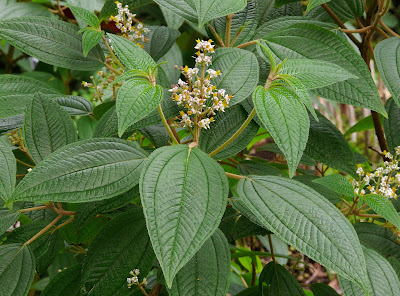
I'm sure I've noted before that there are a number of plant families that form significant components of the world's flora but tend to glide under the radar of popular representation owing to their largely tropical distributions. One of the prime examples is the Melastomataceae, an assemblage of over 5000 known species that represents one of the ten largest recognised plant families. Melastomes often stand out from other tropical plants by their distinctive leaves, which are opposite with acrodromous venation (several strong longitudinal veins arch outwards from the base to converge near the tip) and flowers that often bear large, colourful anthers (New York Botanical Garden). They are most diverse in the Neotropics with one of the significant genera found in this region being Leandra.

Leandra subseriata, copyright James Gaither.


As currently recognised, Leandra includes over two hundred species with the highest diversity centred in southeastern Brazil. Leandra forms part of the tribe Miconieae, distinguished by flowers with more or less inferior ovaries and fleshy berry fruits. Genera within the Miconieae have historically been difficult to define; as early as 1891, the Belgian botanist Alfred Cogniaux declared that they were essentially arbitrary. Leandra was supposed to be defined by its acute petals and terminal inflorescences but it has not always been clear whether a given species can be said to possess these features or not. It should therefore come as no surprise that the genus Leandra proved to be polyphyletic with the advent of molecular analysis (Martin et al. 2008). Nevertheless, a large clade centered on southern Brazil has continued to be referred to as Leandra sensu stricto.

There appear to be few if any direct observations of pollination in Leandra but flower morphology and comparison with related genera suggests that they are buzz-pollinated with pollinators taking pollen as a reward (Reginato & Michelangeli 2016b; buzz-pollination referring to pollination by bees where the bee's buzzing induces the flower to release pollen). Apomixis, with seeds being produced directly from ovule tissue without pollination, is not uncommon and may even be the majority condition (Reginato & Michelangeli 2016a). Seeds are dispersed by birds feeding on the berries. Many Leandra species appear very localised in distribution and they are particularly diverse in a number of high altitude areas. Species vary in their preferred habitat from disturbed to undisturbed; those species found in undisturbed locations are rare components of the understory, but those found in disturbed habitats may be among the most abundant shrubs in the area.

REFERENCES

Martin, C. V., D. P. Little, R. Goldenberg & F. A. Michelangeli. 2008. A phylogenetic evaluation of Leandra (Miconieae, Melastomataceae): a polyphyletic genus where the seeds tell the story, not the petals. Cladistics 24: 315–327.

Reginato, M., & F. A. Michelangeli. 2016. Diversity and constraints in the floral morphological evolution of Leandra s.str. (Melastomataceae). Annals of Botany 118: 445–458.

Reginato, M., & F. A. Michelangeli. 2016. Untangling the phylogeny of Leandra s.str. (Melastomataceae, Miconieae). Molecular Phylogenetics and Evolution 96: 17–32.

White by Evening in the American Southwest

Though various species of it may be found around the world, the evening primrose family Onagraceae reaches its highest diversity in the south-west of North America. For this post, I'm looking at a genus endemic to this region, Eremothera.

Eremothera boothii, copyright Kerry Woods.


Eremothera is one of several genera of evening primroses newly recognised by Wagner et al. (2007). The species included in this genus had previously been included in the broader genera Oenothera or Camissonia, but these genera were progressively broken down owing to polyphyly and poor definitions. Eremothera species are annual herbs with more or less erect stems. Leaves are arranged on the stem alternately; those near the base are carried on a long petiole of up to six centimetres. The genus is distinguished from its close relatives by having mostly white flowers that open in the evening (in rare cases they my be pink or red, fading as they age). Pollination is by moths when the flowers first open, with small bees visiting the flowers the following morning. The fruit is a long capsule that arises directly from the main stem without a subtending stalk.

Eremothera refracta with flowers and green fruits, copyright Stan Shebs.


Seven species of Eremothera were recognised by Wagner et al. (2007). Eremothera nevadensis is a specialist of clay soil that occupies a relatively small range in Nevada, around Reno. Eremothera refracta is a widespread species in the south-west United States with fruit that are of an even diameter along their length (Hickman 1993). Eremothera chamaenerioides is a self-pollinating derivative of E. refracta with smaller flowers in which the stigma is surrounded and overtopped by the anthers. Eremothera boothii and E. minor (both also widespread) have fruits that are wider at the base than at the tip. In E. minor the inflorescence is held erect; in E. boothii the flowers nod. Two localised species, E. gouldii and E. pygmaea, are self-pollinating derivatives of E. boothii. Eremothera minor is also self-pollinating, and may in some cases even be cleistogamous with pollen being transferred to the stigma without the flower even opening.

REFERENCES

Hickman, J. C. (ed.) 1993. The Jepson Manual: Higher Plants of California. University of California Press: Berkeley (California).

Wagner, W. L., P. C. Hoch & P. H. Raven. 2007. Revised classification of the Onagraceae. Systematic Botany Monographs 83: 1–240.