Field of Science

Showing posts with label Neogastropoda. Show all posts

Colus and Co.

The neogastropods have long been a challenge taxonomically. They are extremely diverse, encompassing a large number of species with a wide range of lifestyles, but they also exhibit exhibit regular patterns of convergence and/or conservatism between different lineages. Perhaps the most challenging group of all has been the whelks, commonly recognised as the superfamily Buccinoidea, a massive radiation of over 3300 known species. Whelks are particularly diverse in colder regions of the world's oceans, including amongst their number there the members of the family Colidae.

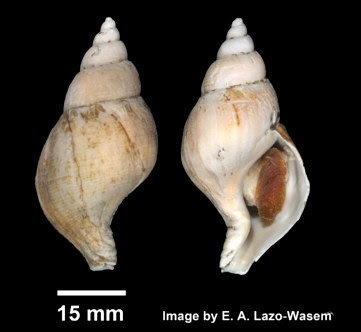
Hairy colus Colus pubescens, copyright E. A. Lazo-Wasem.

Colus has been used as the basis of a family group name at many levels of whelk classification, whether it be Colidae, Colinae or Colini. The gastropod classification laid out by Bouchet et al. (2017) recognised 'Colini' as a diverse tribe within the main whelk family Buccinidae, including a range of cold-water taxa. However, a more recent phylogenetic analysis of the buccinoids by Kantor et al. (2021) found Bouchet et al.'s concept of Colini to be polyphyletic, placing the type genus Colus outside what the called the 'core Buccinoidea'. As such, they raised Colidae to the status of a separate family and restricted it to just two genera, Colus and Turrisipho.

In this restricted form, the Colidae are thin-shelled, medium-sized to large whelks with the largest having shells up to twenty centimetres in length. The shells are fusiform to ovate in shape with a more or less elongate siphonal canal and covered by a brown periostracum. Axial sculpture is absent; spiral sculpture is expressed as more or less prominent cords. The aperture is closed with a operculum bearing a terminal nucleus. The animal has a more or less long proboscis. The radula bears three teeth per row; the middle tooth has a more or less square base and one to three cusps, with the middle cusp the largest, whereas the lateral teeth bear three hooked cusps with the outermost cusp significantly larger than the other two. None of these features, it should be noted, is entirely unique to the Colidae (Kantor et al. 2021).
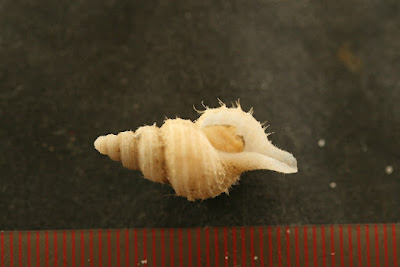
Turrisipho dalli, from BoldSystems.


Members of the Colidae are found in the Arctic and northern Atlantic Oceans, from subtidal to bathyal depths. Because they are not targeted commercially, the life habits of colids have not been well studied. However, what we do know indicates that they are likely predators on other invertebrates (Kosyan 2007). The long proboscis of most species is probably used to pull infaunal animals such as amphipods and bivalves out of their burrows. Colids have well-developed salivary glands and it is possible that these may produce toxins as found in other neogastropods. They do not have anything like the elaborate venom delivery setups like those found in the conoids, but even a little dose of toxic saliva helps to subdue a struggling crustacean.

REFERENCES

Bouchet, P., J.-P. Rocroi, B. Hausdorf, A. Kaim, Y. Kano, A. Nützel, P. Parkhaev, M. Schrödl & E. E. Strong. 2017. Revised classification, nomenclator and typification of gastropod and monoplacophoran families. Malacologia 61 (1–2): 1–526.

Kantor, Y. I., A. E. Fedosov, A. R. Kosyan, N. Puillandre, P. A. Sorokin, Y. Kano, R. Clark & P. Bouchet. In press 2021. Molecular phylogeny and revised classification of the Buccinoidea (Neogastropoda). Zoological Journal of the Linnean Society.

Kosyan, A. R. 2007. Morphological features, ecology, and distribution of poorly studied molluscan genera of the Colinae subfamily (Gastropoda, Buccinidae) from the far eastern seas of Russia. Oceanology 47 (4): 531–536.

Crossing the Busycon

I must admit that when I think about the biodiversity hotspots of the world, the eastern seabord of the United States would not be among the first regions to come to mind. But for this post, I'm looking at a dramatic and eye-catching radiation of molluscs for which this is their centre of distribution. I speak of the giant whelks of the Busyconidae.

Left-handed whelk or lightning whelk Sinistrofulgur sinistrum, copyright Andrea Westmoreland.


Busyconid whelks first appeared in the waters of eastern North America during the early Oligocene, about 32 million years ago, in what was then the Mississippi Sea and is now the Mississippi River Basin. As the oceans receded from the Mississippi, they spread into the Gulf of Mexico and are now found between Massachusetts in the north and the Yucatan Peninsula in the south. Except for an introduced population of the channeled whelk Busycotypus canaliculatus that has become established in San Francisco Bay in California since the 1930s, the family has never been found elsewhere. These are remarkably large snails: smaller examples are still more than five centimetres in length, and the largest of all get close to a foot (Petuch et al. 2015). Mature shells have a large body whorl, generally higher than the visible spire, with a long siphonal canal. SCulpture of the shell, if present, is dominated by spiral elements, and the shoulder of the whorls may be marked by prominent carinae and/or spines. As is standard for neogastropods, the classification of this group has shifted around a bit over the years, whether treated as their own family or as a subfamily Busyconinae of the related families Buccinidae or Melongenidae. In a recent review of the busyconids, Petuch et al. (2015) recognised fifteen living species in six genera. The number of fossil species that has been described is significantly larger (over one hundred); not surprisingly, these large solid shells have an excellent fossil record. However, it is worth noting that some of the living species may be remarkably variable in shell morphology and I don't know whether fossil representatives have been subject to the same systematic scrutiny.

Knobbed whelk Busycon carica, copyright Matt Tillett.


All busyconids are predators on bivalves, particularly on burrowing clams. In general, the whelk envelops its victim in its muscular foot and then uses the edge of the shell lip to open the clam's shell, allowing the whelk to insert its radula and rasp out the clam's flesh. The preferred method of opening the shell depends on the species of whelk and may be classed as 'wedging' and 'chipping'. 'Wedging' is the most straightforward method and believed to be the more primitive; wedgers insert the shell lip into the gap between valves and directly force them apart and/or prevent the clam shell from closing. 'Chipping' is more involved and performed by members of the genera Busycon and Sinistrofulgur. In this method, the edge of the whelk shell is rhythmically pounded against the commissure between the clam shell valves, progressively wearing at the valve margins until enough of an opening has been made to insert the radula. The process may take multiple hours of patient hammering. Chipping requires more power and a heavier shell than wedging (chipping whelks may damage their own shell as well as the prey's) but also allows the whelk to attack thicker-shelled clams.

Though each species of busyconid will generally use one or the other method of opening prey, there are borderline examples. Larger individuals of Busycotypus canaliculatus, usually a wedger, may adopt a process like chipping though their attacks on the prey shell are usually less systematic than true chippers. And while I haven't found anywhere that says as much, I suspect that young chippers may spend the earlier parts of their life as wedgers untill they have developed the shell strength for chipping. Dietl (2004) suggested that chipping behaviour may have originated twice among busyconids, based on the fossil evidence of its traces left on clam shells. The modern chippers appear to derive from a single origin in the later Pliocene. However, evidence of an earlier and now seemingly extinct chipping lineage was also found in shells from the late Miocene. These earlier chippers seemingly did not belong to any of the modern chipping genera which are not known from the Miocene deposits in which chipped clams were found. Instead, Dietl proposed that the culprit was a large Busycotypus.

Channeled whelk Busycotypus canaliculatus laying a string of egg cases, copyright Eric Heupel.


Busyconid whelks have long been of significance to people living in areas where they are found. Not only are the shells eye-catching and ornamental objects in themselves, the animals are also harvested for food (though their meat is often sold under misleading names such as 'conch' or 'clam strips'). Archaeological examples have been found of busycon shells being used for tools; Petuch et al. (2015) illustrate an example of a left-handed whelk Sinistrofulgur sinistrum shell with holes drilled into it that would have allowed it to be attached to a stick and used as a shovel. These animals are truly an icon of North America's eastern seaboard.

REFERENCES

Dietl, G. P. 2004. Origins and circumstances of adaptive divergence in whelk feeding behavior. Palaeogeography, Palaeoclimatology, Palaeoecology 208: 279–291.

Petuch, E. J., R. F. Myers & D. P. Berschauer. 2015. The Living and Fossil Busycon Whelks: Iconic Mollusks of Eastern North America. San Diego Shell Club, Inc.

Murderous Cones

The cone shells of the family Conidae have long been the subject of extreme interest from collectors. Their architectural form, polished surface and intricate patterning make it hard to argue that they are things of beauty, indeed. Not surprisingly, this long-standing aesthetic interest has also made them the subject of much taxonomic interest—some for the better, some arguably for the worse. For today's post, I've selected a particular subgroup of the cone shells: the species of the subgenus Textilia.

Bubble cone Conus bullatus, copyright H. Zell.


To describe the generic taxonomy of cone shells as 'messy' is something of an understatement. Part of the problem is that cone shells are another one of those groups in which a high level of species diversity contrasts with a low level of morphological disparity. Though species are readily distinguishable on the basis of superficial features such as colour patterning, they generally hew pretty closely to a particular overall morphotype. This can make it difficult to associate particular species into evolutionary groups. For many authors, the problem has been solved (or at least satisfyingly swept under the rug) by treating all cone shells as belonging to a single genus Conus. But with over 800 known species of conid, many showing intriguing variations in biology and natural history, many have yearned for a more informative system. Those who would divide, however, have disagreed significantly on how many divisions there should be. At the most disassociative end on the scale, one recent system divided the cone shells between no less than 113 genera, separated into five families. A more conservative approach was taken by Puillandre et al. (2014) who recognised four genera of cone shells (in a single family) with the larger genera encompassing multiple subgenera. Textilia was treated by PUillandre et al. as a subgenus within Conus, which remains the largest genus in the family by a considerable margin.

Pallisade cone Conus cervus, copyright James St. John.


Ten species of cone shell were included in Textilia by Puillandre et al. (2014). The species are found in the Indo-west Pacific, between south-east Africa and Hawaii. They are medium- to large-sized cone shells with the largest species, the pallisade cone Conus cervus reaching close to 12 cm in length. The smallest, the Timor cone C. timorensis, is at least 13 mm long. Textilia species have smooth, inflated shells and flared lips on the aperture (Old 1973). Only one species of Textilia, the bubble cone C. bullatus, can be considered well known. Not only is it found over almost the subgenus' entire range (other species are more localised), it is the only species found in shallower waters, being most common from slightly subtidally to 50 m (Hu et al. 2011). All other Textilia species are restricted to deeper waters. Just to confuse matters slightly, the textile cone C. textile is not a member of subgenus Textilia but another subgenus Cylinder.

Video of cone shells capturing fish, from here. The first individual is a striated cone Conus striatus (subgenus Pionoconus), the second is a bubble cone Conus bullatus.


Textilia forms part of a clade of cone shells with a diet composed primarily of fish. A slow-moving gastropod is obviously ill-suited to taking down a fast-moving fish by brute strength alone so cone shells make use of a quite different tactic: lethal poisons. The venom of a cone shell can be exceedingly powerful, enough so that multiple species have been known to cause severe injury or fatality to humans unwise enough to handle them live (cone shells may use their venom for defense as well as for attack). The teeth of the cone shell's radula have been modified into elongate, hollow needles. While most of the teeth are retained in a sac at the rear of the buccal cavity, only a single tooth is in use at any one time. When a suitable prey animal comes within reach, the snail's proboscis is stealthily extended towards it. The active tooth is then fired along the proboscis into the target, injecting a complete payload of toxins. Among Textilia, Conus bullatus is the only species whose toxic characteristics and capabilities have been studied as yet, but it is probably representative of the subgenus as a whole. As with other fish-hunting cone shells, the injected venom carries a mixture of toxic peptides that can be divided between two functional groups (Hu et al. 2011). These have been referred to as the "lightning-strike cabal" and the "motor cabal". The peptides of the lightning-strike cabal are the first to take effect, causing a rapid (almost instantaneous) tetanic immobilisation of the prey. After this, the motor cabal of peptides act to block neuromuscular transmission, preventing the prey from recovering from its freeze. And all this in a matter of milliseconds: as of 2011, at least, C. bullatus had the fastest immobilisation capacities of any fish-hunting cone shell. As beautiful as they are, cone shells are a force to be feared.

REFERENCES

Hu, H., P. K. Bandyopadhyay, B. M. Olivera & M. Yandell. 2011. Characterization of the Conus bullatus genome and its venom-duct transcriptome. BMC Genomics 12: 60.

Old, W. E., Jr. 1973. A new species of Conus from Indonesian waters. Veliger 16 (1): 58–60.

Puillandre, N., T. F. Duda, C. Meyer, B. M. Olivera & P. Bouchet. 2014. One, four or 100 genera? A new classification of the cone snails. Journal of Molluscan Studies 81: 1–23.