Field of Science

Showing posts with label Apocrita. Show all posts

Williamsita

A while back, I wrote a post about the crabronid wasp genus Podagritus. This time, I'm going to cover another crabronid genus found here in Australia: Williamsita.

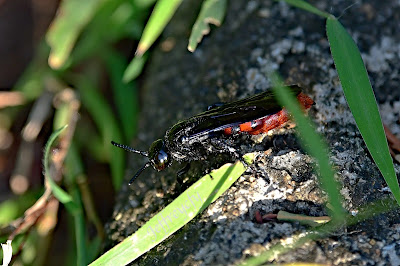
Williamsita sp., copyright David Francis.


Like Podagritus, Williamsita species are boldly coloured wasps, typically mostly black with contrasting yellow or orange markings. They differ from Podagritus species in being more robust with the base of the gaster not notably pedunculate. Other distinguishing features include the presence of distinct foveae (pits) against the margins of the eyes (occasionally less distinct in males), thirteen-segmented antennae in males, and a pygidial plate in both sexes that is narrowed and concave in females, quadrate in males. Williamsita species also do not have the palps reduced as in Podagritus, instead having the more typical arrangement of six segments in the maxillary palps and four segments in the labial palps (Bohart & Menke 1976).

To date, eleven species have been recognised in the genus Williamsita (Leclercq 2006). Most are found in Australia with a single species each known from New Caledonia and Vanuatu. Leclercq (1950) suggested dividing the genus between two subgenera with all species except the New Caledonian type species W. novocaledonica forming a subgenus Androcrabro. Features supporting the latter taxon included the presence of ventral notches on one or more segments of the antennae in males. However, Leclercq later suggested abandoning such a formal division, questioning its significance (Leclercq 2006). The Australian species of Williamsita are, nevertheless, distinct from the two insular species in being marked with much stronger punctation over the body.

Most Williamsita species remain little seen and poorly known. However, breeding habits have been recorded for two Australian species, W. bivittata and W. tasmanica (Maynard & Fearn 2021; McCorquodale et al. 1989). Both these species nest in branching holes in rotting wood, either commandeering burrows left by wood-boring insects or excavating their own. Prey consists of larger flies such as blow flies or soldier flies which were carried back to the nest by the wasp running with the fly carried below the body. Up to six paralysed flies might be placed lying on their backs in a nest cell with an egg laid across the 'throat' (i.e. at the joint between head and thorax) of one of the flies. The cell would then be closed with a plug of woody frass. McCorquodale et al. (1989) recorded W. bivittata constructing several such cells in a series along a single tunnel, whereas Maynard & Fearn (2021) found W. tasmanica more likely to place a single cell in a side-branch. As both observations were limited to a single location in a single season, though, one might reasonably question whether these represent true differences in species behaviour or were determined by available conditions. There's a limit to how deep a Williamsita can burrow.

REFERENCES

Bohart, R. M., & A. S. Menke. 1976. Sphecid Wasps of the World. University of California Press: Berkeley.

Leclercq, J. 1950. Sur les crabroniens orientaux et australiens rangés par R. E. Turner (1912–1915) dans le genre Crabro (subgenus Solenius). Bulletin et Annales de la Société Entomologique de Belgique 86 (7–8): 191–198.

Leclercq, J. 2006. Hyménoptères crabroniens d'Australie du genre Williamsita Pate, 1947 (Hymenoptera: Crabronidae). Notes Fauniques de Gembloux 59 (2): 115–119.

Maynard, D., & S. Fearn. 2021. Ecological and behavioural observations of a nesting aggregation of the endemic Tasmanian digger wasp Williamsita tasmanica (Smith, 1856) (Hymenoptera: Crabronidae: Crabroninae). Papers and Proceedings of the Royal Society of Tasmania 155 (1): 43–50.

McCorquodale, D. B., C. E. Thomson & V. Elder. 1989. Nest and prey of Williamsita bivittata (Turner) (Hymenoptera: Sphecidae: Crabroninae). Australian Entomological Magazine 16 (1): 5–8.
Velvet Photomorphs

The velvet ants of the family Mutillidae are a diverse but relatively little-studied group of insects. As well as their often retiring habits, studies of this family are hindered by the difficulty of associating sexes. Females are wingless and superficially resemble hairy ants. Males are usually winged and resemble more typical wasps (there is a small handful of species in which both sexes are flightless). What we do know of velvet ant diversity suggests a high level of endemicity with different regions each having their own distinct assemblages of genera and species. In North America, one of the most diverse recognised genera is Photomorphus.

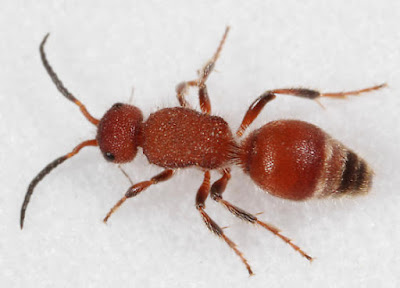
Female Photomorphus banksi, copyright Cotinis.


Species of Photomorphus are found across much of the United States and Mexico, being most diverse in the arid regions of the south-west (Brabant et al. 2010). The genus is currently divided between three subgenera, each originally described from males. Males have round, slightly protruding eyes, a more or less petiolate metasoma with a distinct constriction between the first and second segments, and a pair of ridges on the mesosternum behind the procoxae. The genus is currently divided between three subgenera: Photomorphus, Photomorphina and Xenomorphus. Males of subgenus Photomorphus have a distinct space between the mesocoxae and bidentate mandibles whereas Photomorphina males have the mesocoxae closely placed and tridentate mandibles (Manley & Pitts 2002). Females of Photomorphus have dense, silver setae on the mesosoma whereas females of Photomorphina have a less hairy mesosoma and typically have a band of plumose setae along the dorsal hind margin of the second metasomal segment (Brabant et al. 2010). The third subgenus, Xenomorphus, is known from a single Mexican species only and its female remains unidentified.

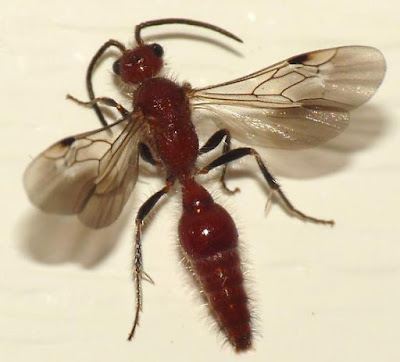
Male Photomorphus paulus, copyright J. C. Jones.


Photomorphus is part of a lineage of nocturnal mutillids common in arid regions of North America. Velvet ants develop as nest parasites of other wasps and bees; Photomorphus species are presumably no exception but their hosts are as yet unknown. A phylogenetic analysis of the North American nocturnal mutillids by Pitts et al. (2010) supported recognition of the group as a single clade but identified Photomorphus itself as polyphyletic. A clade corresponding to the subgenus Photomorphus was recovered but Photomorphina species were divided between multiple separate clades. This included the species P. myrmicoides which Brabant et al. (2010) had suggested should be moved from Photomorphina to subgenus Photomorphus. Females of P. myrmicoides have hair like that of subgenus Photomorphus but differs in the structure of the pygidial plate, a hairless area at the end of the metasoma. In the strict subgenus Photomorphus, this plate is completely smooth and shiny; in Photomorphina and P. myrmicoides, it is rough or marked by ridges. Clearly a reclassification of Photomorphus is on the cards but we are yet to see when we have the confidence to enact it.

REFERENCES

Brabant, C. M., K. A. Williams & J. P. Pitts. 2010. True females of the subgenus Photomorphina Schuster (Hymenoptera: Mutillidae). Zootaxa 2559: 58–68.

Manley, D. G., & J. P. Pitts. 2002. A key to genera and subgenera of Mutillidae (Hymenoptera) in America north of Mexico with description of a new genus. Journal of Hymenoptera Research 11 (1): 72–100.

Pitts, J. P., J. S. Wilson & C. D. von Dohlen. 2010. Evolution of the nocturnal Nearctic Sphaerophthalminae velvet ants (Hymenoptera: Mutillidae) driven by Neogene orogeny and Pleistocene glaciation. Molecular Phylogenetics and Evolution 56: 134–145.

The Hairy Digger Wasps of Hong Kong

Taylor, C., & C. Barthélémy. 2021. A review of the digger wasps (Insecta: Hymenoptera: Scoliidae) of Hong Kong, with description of one new species and a key to known species. European Journal of Taxonomy 786: 1–92.

On Christmas Eve, I received an e-mail from Christophe Barthélémy in Hong Kong to tell me that we'd gotten a Christmas present. Our big paper on the scoliid wasps of Hong Kong was now freely, publicly available! In this paper, we reviewed all sixteen species of Scoliidae known from the Hong Kong SAR to date, providing detailed descriptions and photographs of each. Nine of these had not previously been recorded from the region; one represented an entirely novel species. We also provided a detailed identification key and clarified some of the often convoluted taxonomy of this family.

Liacos erythrosoma, one of the larger scoliid species found in Hong Kong, copyright Jeffrey Cfy.


The Scoliidae, sometimes referred to as the hairy digger wasps or hairy flower wasps, are often large, striking wasps (the largest species found in Hong Kong get close to an inch in length) that are most often seen by observers when they visit flowers for food. They differ from other wasps in the structure of the wings which are shaped into radiating folds (often referred to as 'pseudoveins') towards the outer margins. In life, the wings have an iridescent appearance. Female scoliids are robust insects with powerful legs. This is so they can burrow into the ground in search of hosts for their larvae which develop as parasitoids on the larvae of scarabaeid beetles. Male scoliids are generally smaller and more slender than females. In some species (particularly members of the tribe Campsomerini), males can look very different from females, to the extent that it can be all but impossible to link one with the other in isolation. Males of some species can sometimes be found in large numbers as they form swarms in search of females.

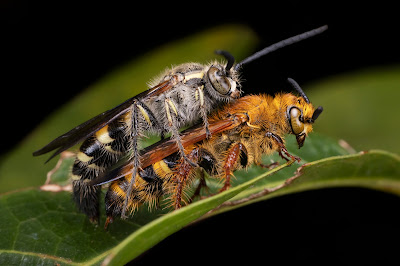
Mating pair of Phalerimeris phalerata (male on top), perhaps Hong Kong's commonest scoliid species. Copyright Daphne Wong.


Christophe and I had lit upon the idea of producing a review of the family as I was attempting to identify specimens collected as part of the Hong Kong mangrove survey. Christophe already had an extensive number of scoliids as part of his own amateur collection; these formed the greater part of the material we used. One of our primary challenges was making sense of the group's taxonomy. As well as the aforementioned difficulties in matching males to females, scoliid taxonomy has its own individual tangles. The system has historically been beset with confusion, questionable decisions, and disregard for priority. Species have often been subdivided into a bewildering array of subspecies, varieties and formae, often on the basis of quite superficial differences and often with little apparent consideration as to whether they represented distinct populations (individuals of different 'subspecies' may often be found at the same location). As a result, I had to spend a lot of time digging into archaic publications to make sure they had been correctly quoted by their successors. Fortunately (as long time readers of this site will probably know), this is exactly the sort of thing that I love doing*.

*With a shout-out here to the Biodiversity Heritage Library. An absolutely brilliant resource that has just revolutionised the way we do literature research.

While I mostly took care of the taxonomy, key, and the first drafts of the descriptions, Christophe produced the photos, distribution maps, and revisions of the descriptions after I returned to Australia (including male genital dissections of all the species we had on hand). The end result is a paper I feel very proud of. Thank you to Benoit Guénard and the Entomology lab of Hong Kong University for providing access to resources, and if you have any interest in the wonderful world of Hong Kong hairy flower wasps, you can check out the final product here.

Pompilus: Spider Wasps of the Dunes

I've commented before on the difficulties that can be attendent on identifying spider wasps (Pompilidae), one of those groups that combine a high species diversity with a tendency to be morphologically conservative. As a result, the taxonomic history of this group has been one of shifting generic concepts and ill-defined wastebaskets. Not surprisingly, one of the main victims of this uncertainty has been the type genus Pompilus. Historically used to cover a significant percentage of all spider wasps, the name Pompilus is now restricted to a small cluster of species inhabiting the Old World.

Pompilus cinereus, copyright Martin Grimm.


The genus Pompilus and its history were last revised in detail by Day (1981) who recognised seven species associated with more or less open, sandy habitats. The most widespread and best-known of these is Pompilus cinereus, found over wide parts of Eurasia, Africa and Australia, often alongside bodies of water. This species shows a wide range of morphological variation across its range but Day (1981) declared himself unable to sensibly correlate this variation with discrete populations. The possibility remains that further studies may identify P. cinereus as a species complex. The other species in the genus, P. mirandus of India and south-east Asia and five African species, are more restricted in range and little studied. Pompilus mirandus is more tolerant of vegetated habitats than P. cinereus. Conversely, P. niveus of northern Africa is a specialist of the sand dunes of the Sahara Desert. Species of Pompilus all have a black cuticle with a covering of short grey pubescence. The most distinctive feature of the genus is the possession by females of long, weakly curved mandibles with a single inner tooth (other spider wasps have shorter, thicker mandibles with more teeth). These modified mandibles are related to their distinctive manner of handling prey. Whereas other spider wasps will drag their spider victims backwards to their nest, females of Pompilus will lift the spider off the ground and run forward while carrying it.

Nesting behaviour has only been described for P. cinereus. Targeted prey comprises ground-running spiders such as wolf spiders or clubionids. After a spider has been captured, paralysed and carried near the intended nest site, it is temporarily buried in the sand while the female constructs a burrow (Day suggested that this preliminary burial was to prevent the spider being stolen). The simple burrow leads to a single nest cell a few inches deep. The female exhumes the spider, transports it into the burrow and then lays an egg on its abdomen near the front of the side. She then closes the entrance to the burrow with sand, tamping it down securely with the end of her metasoma.

Within the burrow, the spider begins to wake from its paralysis after a few hours. However, it remains in poor shape: its movements are slow and it begins to continuously exude silk from its spinnerets. By wandering about the cell in this distressed state, the spider ends up producing a silken purse that serves as extra protection for the nest's contents. This, of course, includes the wasp larva that within a couple of days will have begun to feed on the trapped spider.

Though details of breeding behaviour have not been observed for other Pompilus species, they might be expected to resemble P. cinereus. It might be noted, however, that the female of P. cinereus has a patch of flattened scales at the end of the metasoma that is less developed in P. mirandus. Is this an indication that P. mirandus is somehow less conscientious in sealing the nest burrow than P. cinereus? If you keep an eye out in the wastelands of India, you might just learn the answer.

REFERENCE

Day, M. C. 1981. A revision of Pompilus Fabricius (Hymenoptera: Pompilidae), with further nomenclatural and biological considerations. Bulletin of the British Museum (Natural History): Entomology 42 (1): 1–42.

The Stizus Sand Wasps

Some years ago, I presented a post on the sand wasps of the tribe Bembicini. Bembicini are just part of the broader range of sand wasps that have been variously classified as the Bembicidae, Bembicinae or Nyssoninae (Bohart & Menke 1976; Sann et al. 2018). Another diverse subgroup of the bembicids is the genus Stizus, of which more than 120 species are found in Eurasia, Africa and North America (but not in Australia or South America). Stizus species are relatively large wasps, getting up to 3.5 cm in length. Like Bembicini, they are often brightly coloured, black banded with yellow and/or red. They are otherwise fairly generalised in appearance: the labrum is exserted but is not remarkably long like that of bembicins, and the ocelli are not reduced (Bohart & Menke 1976).

Stizus pulcherrimus, copyright Phonon B.


The nesting behaviour of Stizus species was reviewed by Evans & O'Neill (2007). All known Stizus nests are constructed in soil and sand, sometimes in relatively damp locations such as salt marshes or near water bodies. Burrows of nests may be a foot or more deep and contain multiple cells; acessory burrows are common. Though females construct their burrows strictly single-handedly, they will often nest in clusters with other females. Polidori et al. (2008) found that this clustering behaviour in the European Stizus continuus was due to females being actively attracted to nests of other females, rather than just a side effect of limited nest sites. The most commonly used prey are various Orthoptera (grasshoppers or katydids); a handful of species instead prey on mantids. Prey are paralysed by repeated stinging before being flown back to the nest carried under the female. After the prey insect has been placed in a nest cell, the female lays an egg on its thorax. In most cases, cells are fully stocked with prey before laying, but females of S. continuus have been observed carrying fresh prey back to nests in which larvae have already hatched and begun eating.

Stizus perrisi female constructing nest, copyright David Genoud.


Mating between males and females generally occurs as the newly matured females emerge from the parent nest. Males often emerge before females and begin patrolling the nesting area, searching for females and chasing away other males. In some cases, they may begin actively digging for females emerging from burrows, and a newly emerged female may find herself surrounded by a pack of competing males. In their eagerness, males may become rather hasty: males of the Japanese S. pulcherrimus have been observed attempting to force themselves on females of the related genus Bembix!

REFERENCES

Bohart, R. M., & A. S. Menke. 1976. Sphecid Wasps of the World. University of California Press: Berkeley.

Evans, H. E., & K. M. O'Neill. 2007. The Sand Wasps: Natural History and Behavior. Harvard University Press.

Polidori, C., P. Mendiola, J. D. Asís, J. Tormos, J. Selfa & F. Andrietti. 2008. Female-female attraction influences nest establishment in the digger wasp Stizus continuus (Hymenoptera: Crabronidae). Animal Behaviour 75: 1651–1661.

Sann, M., O. Niehuis, R. S. Peters, C. Mayer, A. Kozlov, L. Podsiadlowski, S. Bank, K. Meusemann, B. Misof, C. Bleidorn & M. Ohl. 2018. Phylogenomic analysis of Apoidea sheds new light on the sister group of bees. BMC Evolutionary Biology 18: 71.

Podagritus in Australia

The digger wasps of the tribe Crabronini are a widespread group distinguished by a boxy head shape and relatively stout mesosoma. They are not dissimilar to hairless bees and indeed are close relatives of that group. There is a wide diversity of crabronins around the world; among their representatives here in Australia are members of the genus Podagritus.

Podagritus cf. tricolor, from Insects of Australia.


Podagritus species are medium-sized, elongate crabronins, generally in the region of a centimetre in length (give or take a few millimetres). The gaster is pedunculate (that is, the first segment of the metasoma is drawn into an elongate peduncle). Other, finer features distinguishing them from related genera of crabronins include a palpal formula of 5-3 (referring to the number of segments in the maxillary and labial palps, respectively; 5-3 indicates that both palps are slightly reduced from the ancestral count for crabronins) and often the presence of a sharp subvertical ridge, the omaulus, near the front of the mesopleuron (the median plate on the side of the mesosoma). If the omaulus is not present as such, there is still a distinct curve where it would have been so the planes of the mesopleuron on either side are more or less perpendicular. Females have a well defined triangular, flat pygidial plate and males often have one as well (Bohart & Menke 1976).

Thirty species of Podagritus were recognised from Australia by Leclercq (1998). Other species of the genus are known from New Zealand and South America. Historically, the Australian species have been treated as a distinct subgenus Echuca from Podagritus elsewhere, based on features such as a well defined, flat prepectus and a weakly sculpted metapleuron. Leclercq, however, questioned the value of this distinction, noting the existence of a couple of Australian species sharing notable features in common with species found elsewhere, and suggested abandoning subgenera until the genus could be revised as a whole.

The natural history of Podagritus species in Australia remains poorly known. One species found in the east of the continent, P. leptospermi, has been found nesting in a sloping gravel bank (Bohart & Menke 1976). Burrows were near vertical and close to a foot deep, and contained two or three cells placed at the ends of lateral galleries (one cell per gallery). Entrances were surrounded by flat mounds of sand six to ten centimetres wide and were not closed while the female was out hunting. Cells were stocked with flies (Tachinidae and Therevidae, so presumably reasonably large) that were initially stored at the bottom of the burrow before being placed in the cell head inwards and belly up, in lots of four to six. The egg was attached to a fly between the head and thorax, so when the larva hatched it would find itself already in place on a welcoming bed of food.

REFERENCES

Bohart, R. M., & A. S. Menke. 1976. Sphecid Wasps of the World. University of California Press: Berkeley.

Leclercq, J. 1998. Hyménoptères sphécides crabroniens d'Australie du genre Podagritus Spinola, 1851 (Hymenoptera, Sphecidae). Entomofauna 19 (18): 285–308.

Small Carpenters

It's time for another dip into the wide diversity of bees. The small carpenter bees of the tribe Ceratinini are small (often less than a centimetre in length), slender bees found on all continents except Antarctica, though their toehold in Australia is a very tenuous one indeed with only a single known species there. Though diverse, with hundreds of known species, the difficulty of breaking the tribe into clearly defined, monophyletic groups has lead recent authors to recognise a single genus Ceratina (Michener 2007). Distinctive subgroups previously treated as separate genera, such as the relatively large Megaceratina and the heavily punctate Ctenoceratina of Africa, and the both bright metallic and heavily punctate Pithitis of Africa and southern and eastern Asia, are now treated as subgenera. There are a lot of recognised subgenera, over twenty at last count, but there are also a lot of species not yet assigned to subgenus. Phylogenetic analysis of the ceratinins supports monophyly of most subgenera and a likely African origin for the clade as a whole, with multiple dispersals into Eurasia followed by a single dispersal to the Americas (Rehan & Schwarz 2015).

Ceratina sp., possibly C. smaragdula, copyright Vengolis.


Distinctive features of Ceratina compared to other bees include the absence of a pygidial plate, a flattened and hardened patch on the tip of the abdomen in females. As members of the family Apidae, Ceratina are long-tongued bees with a scopa (cluster of pollen-carrying hairs) on the hind legs, though the scopa does not enclose a bare patch for carrying a shaped pollen ball as in some other apids (for instance, the familiar honey bees). The scopa is less extensive in small carpenter bees than it is in other apids and the hairs on the body as a whole are rather short, so Ceratina look much shinier and less fuzzy than other bees. Ceratina are black or metallic green in colour (on rare occasions, the metasoma is red) and usually have yellow patches, particularly on the face.

Ceratina nest in a fennel stem, copyright Gideon Pisanty.


The name 'carpenter bee' refers to their practice of nesting in hollow stems or twigs, entered at broken ends. The absence of the pygidial plate is probably related to this manner of nesting: it is normally used by ground-nesting bees to tamp down soil when closing the nest. Most of the time, Ceratina are solitary nesters but two or more females may sometimes work on a nest together. In these cases, they adopt a proto-eusocial division of labour with one female laying eggs while the others act as 'workers' (I have no idea how they decide who gets to do what). Though a reduction in hairiness in bees is often associated with kleptoparasitism, no Ceratina species are known to behave in that manner (though some kleptoparasites are known among the members of the closely related and very similar tribe Allodapini). The reduction of the scopa may instead be associated with the bees carrying food supplies for the nest in their crop as well as on the legs. Cells are lined up in the nest stem with only simple partitions between them. These partitions are made from loose particles, mostly the pith of the stem, with no obvious adhesive holding them together. In at least some species, females will return to the nest after completion, dissembling and reassembling cell walls in order to clean out dead larvae and faeces that are then incorporated into the partitions. As such, while small carpenter bees are not directly on the evolutionary line leading to the more integrated colonies of the social bees, they do provide us with a model of what one stage in their evolution may have looked like.

REFERENCES

Michener, C. D. 2007. The Bees of the World 2nd ed. John Hopkins University Press: Baltimore.

Rehan, S., & M. Schwarz. 2015. A few steps forward and no steps back: long-distance dispersal patterns in small carpenter bees suggest major barriers to back-dispersal. Journal of Biogeography 42: 485–494.

Mooching Off the Relatives

Something I've referred to before but only (I think) in passing is that, among the enormous diversity of bees that inhabit this world, there are a large number of species that act as cleptoparasites*. That is, instead of constructing and provisioning their own nests, they lay their eggs in the nests of other bee species. When the eggs hatch, the emerging larvae feed on the provisions that the constructing bee intended for her own offspring. One lineage of these cleptoparasites is the megachilid genus Coelioxys.

*Depending on the source, you may see this term spelt as either 'cleptoparasite' or 'kleptoparasite'. Personally, I've never been able to decide just which I should be using.

Coelioxys sodalis, copyright jgibbs.


Coelioxys is a diverse, cosmopolitan genus with nearly 500 known species, closely related to the even more diverse leafcutter bees and resin bees of the genus Megachile. Species vary in size from half a centimetre to nearly an inch in length. They are fairly similar to species of Megachile in overall appearance, the most obvious difference being that (as with most cleptoparasitic bees) their covering of hair is greatly reduced. In particular, the dense scopa of hairs that covers the underside of the metasoma in female Megachile is absent. The primary function of the hairs in bees is to carry pollen; with no nest of their own to worry about, cleptoparasitic bees have no need for such dense hairs. Coelioxys females also differ from Megachile in the shape of the metasoma which is tapering and ends in a narrow tip. More on that in a moment.

As might be expected for such a large genus, Coelioxys has been divided between a number of subgenera. Until recently, the definitions of a number of these subgenera was somewhat uncertain. The biggest problem was that most revisions of the genus had been done on a regional level so (for instance) North American taxa were more finely subdivided than in the Old World. However, a recent phylogenetic analysis of the genus by da Rocha Filho & Packer (2017) redefined a number of subgenera and adjusted their definitions. For instance, the type subgenus Coelioxys, recognised as subcosmopolitan by Michener (2007), became restricted to just two species, the European C. quadridentata and the North American C. sodalis. Whereas Michener's concept of Coelioxys was essentially recognised by lacking the specialised features of other subgenera, the restricted Coelioxys sensu stricto can be recognised by having the outer margin of the pronotal lobe conspicuously rounded, as well as having the pilosity on the mesosoma suberect, long and thin, without spots of appressed hairs (da Rocha Filho & Packer 2017).

For the most part, Coelioxys species are cleptoparasites of Megachile though some have also been found mooching off Apidae species. Coelioxys quadridentata, for instance, has been found in association with nests of both Megachile and Anthophora. In most cases, a female Coelioxys will lay into a host nest before it is closed, while the constructor is away foraging for supplies. The narrow metasoma allows the Coelioxys to reach into the cavity containing the nest and insert her eggs into the nest wall where the host will not notice it. Often, multiple eggs will be laid in a single nest. After the nest is closed, the eggs hatch into larvae that look fairly unremarkable for their first one or two instars: like other bee larvae, not doing much more than sit there and eat. But upon reaching the second or third instar, the Coelioxys larva develops greatly enlarged mandibles that it uses to stir through the nest's food mass and execute any other larvae and eggs contained therein. Both the original host larva and any other Coelioxys larvae the nest may contain are dealt with in this manner (presumably the process of finding an appropriate host nest is difficult enough that the waste of eggs is still worth it for the parent Coelioxys to increase the chance that at least one reaches maturity). Its competitors thus removed, the larva them moults back to a more average form with nothing more agin to do but eat until the time to mature is reached.

REFERENCES

Michener, C. D. 2007. The Bees of the World 2nd ed. John Hopkins University Press: Baltimore.

Rocha Filho, L. C. da, & L. Packer. 2017. Phylogeny of the cleptoparasitic Megachilini genera Coelioxys and Radoszkowskiana, with the description of six new subgenera in Coelioxys (Hymenoptera: Megachilidae). Zoological Journal of the Linnean Society 180: 354–413.

Camponotus: A Sugary High

I think I may have said before that Australia is the land of ants. When travelling in Australia's arid regions (i.e. most of the continent), ants are often the most visible animals about. Perhaps the most visible of all Australia's ants are the meat ants (Iridomyrmex), but not too far behind them are the sugar ants of the genus Camponotus.

Workers and emerging queens of banded sugar ants Camponotus consobrinus around the nest opening, copyright Steve Shattuck.


Camponotus is a genus of the ant subfamily Formicinae found pretty much everywhere around the world that ants are to be found. It is massively diverse: well over 1000 species have been assigned to this genus over the years, with probably more to be described. They are correspondingly diverse in habits and appearance. Some are among the giants of the ant world, others are much smaller. Some form massive colonies that are difficult to miss and forage during the day, others are more retiring and emerge only at night. Some construct their nests in holes under the grounds, others hollow out wood or use the holes left by other wood-boring insects. Most (but not all) Camponotus species exhibit some form of worker polymorphism: rather than having just a single worker caste, a colony will often include large major workers and much smaller minor workers, with the two forms superficially looking quite different. Sometimes the distinction between majors and minors will be quite clear, other times there will also be workers of intermediate sizes. In some Australian species, known as honeypot ants, there are specialised workers called 'repletes' who spend their lives hanging in one spot inside the nest, being fed by the other active workers until their gasters swell into engorged round balls. These repletes serve the colony as a living larder, able to regurgitate their stored excess of food when needed by their nestmates. Despite all this diversity, most Camponotus species are readily recognisable as Camponotus: they usually lack spines on the mesosoma (the 'thorax'), the back end of which is narrow and often arched. This smoothness and slimness gives Camponotus a distinctive look that kind of puts me in mind of the ant version of a greyhound. The majority of Camponotus species also differ from other ants in lacking the metapleural gland, a gland producing an antibiotic chemical whose opening is usually visible near the rear of the mesosoma.

Camponotus aurocinctus, copyright Steve Shattuck.


Camponotus species have been referred to in Australia as 'sugar ants' in reference to their diet, which is commonly dominated by the sugary excretions of plant-sucking bugs that they attend. In other parts of the world, they have sometimes been referred to as 'carpenter ants' in reference to the wood-tunneling habits of their most notorious representatives. Bug-derived honeydew is high in sugar but low in other essential nutrients, so the ants also feed on things such as the scavenged bodies of the bugs themselves after death. They are also probably assisted in meeting their nutritive needs by Blochmannia, an endosymbiotic bacterium that infests specialised cells in the gut of Camponotus and closely related genera (Wernegreen et al. 2009). Genetic data from the endosymbiont indicates that it probably synthesises nutrients the ant does not otherwise ingest. It may also play some role in compensating for an absence of metapleural gland secretions. As well as the gut, Blochmannia infest the ovaries of reproductive females and are passed to the next generation via the developing oocytes. Phylogenetic analysis of Blochmannia indicates that it is closely related to other endosymbiotic bacteria found in mealybugs, and it is possible that the ancestors of Camponotus picked it up in the course of feeding on honeydew.

Honeypot ant Camponotus inflatus repletes hanging in the nest, copyright Mike Gillam.


The sheer size of Camponotus as a genus has been a challenge to understanding relationships within the genus. Over thirty subgenera have been proposed at one time or another, but many of these are poorly defined and many authors eschew using them in favour of informal species groups. It does not help matters that, since the early 20th century, most reviews of Camponotus have been conducted at a local rather than a global level. Those studies that have touched on Camponotus phylogeny in recent years suggest the need for a large-scale revision, with few of the subgenera supported as monophyletic.

REFERENCES

Wernegreen, J. J., S. N. Kauppinen, S. G. Brady & P. S. Ward. 2009. One nutritional symbiosis begat another: phylogenetic evidence that the ant tribe Camponotini acquired Blochmannia by tending sap-feeding insects. BMC Evolutionary Biology 9: 292. doi:10.1186/1471-2148-9-292.

Perilampella acaciaediscoloris: An Australian Gall Wasp

The small but incredibly diverse chalcidoid wasps are mostly known as parasitoids, their larvae attacking the eggs and young of others insects. Some, however, have chosen the vegetarian option, inserting their eggs into plant rather than animal tissue. As the larva develops, it induces the host plant to develop an often bizarre-looking growth around it that provides both shelter and food; this growth is known as a gall.

Antenna, forewing venation and dorsum of Perilampella acaciaediscoloris, from Bouček (1988).


Perilampella acaciaediscoloris is an gall-forming wasp that was first described by Froggatt in 1892 from galls that he collected on the wattle Acacia discolor, a species now regarded as a synonym of the sunshine wattle A. terminalis of south-eastern Australia. Froggatt placed his species in the genus Cynips (which is not part of the Chalcidoidea but belongs to a different micro-wasp superfamily, the Cynipoidea) but it is now placed in the chalcid subfamily Ormocerinae in the (polyphyletic) Pteromalidae. Ormocerinae are fairly generalised 'pteromalids' that are non-metallic in colour and often finely sculpted. So far as is known, ormocerines are all associated with galls in one way or another, either as gall-causers themselves or as inquilines (species that lay their eggs in the galls caused by other insects). Another ormocerine species, Trichilogaster acaciaelongifoliae, has been introduced from Australia to South Africa to help control the Sydney golden wattle Acacia longifolia.

The related ormocerine Trichilogaster acaciaelongifoliae, copyright Simon van Noort. Perilampella acaciaediscoloris most obviously differs from this species in its hairier and darker wings, and more shiny mesosoma.


The genus Perilampella differs from other ormocerines in being particularly shiny, with little clear setation. Bouček (1988) listed four Australian species in the genus, noting that P. acaciaediscoloris could be recognised by its very dark, long wings and shiny orange-yellow mesosoma. Froggatt (1892) described the galls of P. acaciaediscoloris as formed at the inception of a leaf bud or new shoot. Sometimes, they would be little more than swellings at the base of the shoot. More often, they would be oval with three irregular horns formed from aborted leaf buds. Sometimes, P. acaciaediscoloris galls would be the target of inquilines of their own that caused the gall to degrade to a shapeless mass.

REFERENCES

Bouček, Z. 1988. Australian Chalcidoidea (Hymenoptera): A biosystematic revision of genera of fourteen families, with a reclassification of species. CAB International.

Froggatt, W. W. 1892. Notes on Australian Cynipidae, with descriptions of several new species. Proceedings of the Linnean Society of New South Wales, second series 7: 152–156.

Delta Wasp

Thanks to your support, I am 30% of the way towards success at my crowdfunding drive. But with only a week left on the clock, I'm going to need everyone's help if I'm to be succesful. Please visit my page at Experiment.com and consider offering your support!

Two views of the potter wasp Delta unguiculata, copyright Entomart.


Not so long ago, I found myself struggling with the challenge of identifying potter wasps. Potter wasps are close relatives of the social wasps, close enough that they are usually classified in the same family Vespidae, but they belong to a distinct lineage (the subfamily Eumeninae) of a more solitary bent, each female constructing its own individual nests in which to lay its eggs. The 'potter' part of their name refers to their preferred material for said nests which are sculpted from mud. Though they do not form the vexatious swarms that social wasps can, potter wasps still tend to be relatively large and impressive wasps, and like social wasps they are usually strikingly patterned in bold colours to give fair warning of their potentially painful stings.

Nevertheless, despite being the sort of thing that would be likely to attract interest, identifying potter wasps can be a definite challenge. For a large part of the twentieth century, eumenine genera were mostly divided very finely, with the features separating related genera often difficult to distinguish. Here in Australia, I found an approachable identification guide for most eumenines to be nigh on nonexistent. One potter wasp genus that I did successfully pull out, however, was Delta.

Female Delta campaniforme constructing a nest, from Brisbane Insects.


Delta is a genus of about fifty species of potter wasp found in warm regions of the Old World. At least one member of the genus, D. campaniforme rendalli, has become established in Florida after being introduced there from southern Africa (Menke & Stange 1986). Delta belongs to the Eumenes group of genera, in which the first segment of the metasoma (the petiole) is very long and slender. Distinctive features of Delta within this group include the second segment of the metasoma being relatively short with the associated tergum bell-shaped, and the males having the last segment of the antenna bent backwards to form a hook (Nguyen 2015). Females build their mud nests, which they stock with moth caterpillars, cemented to flattened surfaces such as the sides of buildings or along branches. The species introduced to North America possibly arrived in the form of a nest glued to some easily transportable substrate such as a shipment of lumber.

The names of Delta and many other Eumenes-group genera derive from the work of Henri de Saussure, who recognised a single genus Eumenes corresponding to this group but divided it into a number of sections that he labelled Alpha, Beta and so forth. Later authors raised these sections to the status of separate genera though some expressed the objection that Saussure may have never intended these alphabetical designations to be formal names at all. The validity of Saussure's 'genus-group names' was eventually settled by a decision of the International Commission on Zoological Nomenclature but authors such as Menke & Stange (1986) have continued to criticise the recognition of these difficult segregate genera, especially as, whereas the Eumenes group as a whole is probably monophyletic, many of its component genera may not be. Future classifications may yet see Eumenes gathering its prodigals back into the fold.

REFERENCES

Menke, A. S., & L. A. Stange. 1986. Delta campaniforme rendalli (Bingham) and Zeta argillaceum (Linnaeus) established in southern Florida, and comments on generic discretion in Eumenes s. l. (Hymenoptera: Vespidae: Eumeninae). Florida Entomologist 69 (4): 697–702.

Nguyen, L. T. P. 2015. Taxonomic notes on the genus Delta de Saussure (Hymenoptera: Vespidae: Eumeninae) from Vietnam. Animal Systematics, Evolution and Diversity 31 (2): 95–100.

Trap-jaw Ants of Australia (and a couple from Africa)

Foraging worker of Epopostruma frosti, copyright Alex Wild.


Anyone who finds themselves travelling through regional Australia will soon find themselves convinced that this is a continent ruled by ants. During the course of the day, while the hot Australian sun drives other animals to seek shelter and seclusion, ants are often the only living things (other than plants) to be seen. To match this abundance, Australia's ants also come in a variety of distinctive forms, many of them unique to this country.

One distinctively Australian group of ants are the 'epopostrumiforms'. This is a small group of genera belonging to the tribe Dacetonini of the subfamily Myrmicinae (in the past the epopostrumiforms have been formally recognised as the subtribe Epopostrumiti, though Bolton eschewed the use of formal subtribes in his 1999 review of the Dacetonini). The Dacetonini are all predatory ants, with a distinctive large process inside the base of the mandibles that helps to lock them closed when holding struggling prey. The mandibles may be particularly long and slender, sometimes with only a few teeth present at the end. Where their habits are known, epopostrumiforms are predators of springtails; these are the most typical prey for the Dacetonini as a whole though some species of the tribe are more catholic in their tastes. Dacetonins live in small colonies, commonly in secluded habitats such as leaf litter; the epopostrumiforms include species that nest and forage either above or below ground (Brown & Wilson 1959). Dacetonins hunt their prey by stealthily sneaking up to it with the mandibles held open, followed by a quick lunge combined with snapping the mandibles shut. Once the prey has been successfully grabbed, those dacetonins with shorter mandibles rapidly bring the sting forward to quell it. Even after using the sting, however, hunters of springtails may find themselves flung into the air by flicks of the springtail's furca a couple of times before the venom takes full effect (hence the need for a firm mandibular lock). Dacetonins with longer mandibles may also deploy their sting or they may simply lift the prey above their heads until it gives up the ghost.

The African Microdaceton tanyspinosum, copyright April Nobile.


As already indicated, the majority of epopostrumiforms are endemic to Australia (one genus, Colobostruma, includes a few species found in New Guinea and the Solomon Islands). The only non-Australasian taxon to be assigned to the Epopostrumiti is an African long-mandibulate genus Microdaceton. Features uniting Microdaceton with the Australasian epopostrumiforms include the presence of lateral outgrowths on the petiole and postpetiole (the first two nodular segments of the metasoma) and the position of the petiolar spiracle (Bolton 1999) but some authors have suggested a closer relationship of Microdaceton to other dacetonin genera. Even if correctly positioned, Microdaceton is at most the sister taxon to the Australasian clade, members of which are united by features such as reduced antennae and an enlarged labrum.

Face of Colobostruma alinodis, copyright Estella Ortega.


Bolton (1999) divided the Australasian epopostrumiforms between three genera: Colobostruma, Mesostruma and Epopostruma. Less than fifty species of this clade have been described to date though others probably remain to be named. Even among the known species, many are rare and/or cryptic and some are known from only a very few specimens. Epopostruma resembles Microdaceton in having elongate mandibles with only a small number of interlocking teeth at the end (two in Epopostruma, three in Microdaceton). When hunting, Epopostruma may open their mandibles to a full 170°. Colobostruma has much shorter, triangular mandibles with numerous teeth; Mesostruma has triangular mandibles somewhat intermediate between the other two genera. The mandibles of both Colobostruma and Mesostruma cannot be opened to the same degree as those of Epopostruma; rather, species of these two genera will open their mandibles to a maximum angle of 90° when hunting. Whether the Dacetonini involved long mandibles on a single occasion, with a number of sub-lineages reverting to shorter mandibles afterwards, or whether the short-mandibled Dacetonini retain the ancestral morphology and long mandibles evolved on multiple occasions within the tribe, remains a question occasioning some debate.

REFERENCES

Bolton, B. 1999. Ant genera of the tribe Dacetonini (Hymenoptera: Formicidae). Journal of Natural History 33: 1639–1689.

Brown, W. L., Jr & E. O. Wilson. 1959. The evolution of the dacetine ants. Quarterly Review of Biology 34 (4): 278–294.

Tachytes: Crickets Face Death from Above

A Tachytes species feeding, copyright Stephen Cresswell.


Most people who are not entomologists assume that 'ants', 'bees' and 'wasps' are all mutually exclusive groups of animals. But while bees and ants are distinct from each other, they are both really distinctive subgroups of wasps. It is not difficult to find guides on the interwebs purporting to tell you the differences between a bee and a 'wasp', but many of the points usually cited will not apply to all wasps (usually what is intended is the differences between a bee and a social wasp, which is the type of non-bee, non-ant wasp most likely to make itself known to humans). Some wasps can look very similar to bees indeed.

Diagram of Tachytes ocelli, from here.


Tachytes is a large, cosmopolitan genus of not-quite-bees, including more than 250 species found on all continents except Antarctica. Its members are robust and hairy, and one would have to look very closely to spot the features marking it as a non-bee (such as the point that its hairs, though numerous, are not branched in the manner of a true bee). Tachytes is classified in the Crabronidae, the family of wasps believed to be most closely related to true bees (other crabronids have been featured in earlier posts: here, here and here). Like other crabronids, adult Tachytes are pollinators, feeding on nectar from flowers. Tachytes species can be separated from most other crabronids by the shape of the ocelli. As well as the two large compound eyes with their multiple lenses on either side of the head, many insects have three small single-lens eyes, called the ocelli, on the top of the head (some insects have fewer or no ocelli). When all three ocelli are present, they are arranged in a triangle with one at the front and two at the rear. In Tachytes, the rear ocelli are present but deformed (I presume non-functional, though I don't actually know). They are reduced to a pair of scar-lines shaped roughly like a comma, or the upper part of a question mark without the dot.

Female Tachytes sinensis sinensis with katydid prey, from here.


Like many other wasps, female Tachytes dig burrows in which they they sequester other insects in a paralysed state to provide food for their young (the big change between bees and other wasps was the provision of their larvae with a plant-derived food source such as honey or pollen instead of animal matter). The size of the burrow varies from species to species, but some are quite extensive: the North American species T. praedator digs a burrow with a centimetre-wide entrance about a metre long, with a 70 cm down-shaft followed by a horizontal run of about a foot (Lin 1967). This species digs at night, thus presumably both avoiding the heat of the day and reducing the risk of detection by predators or parasites. The top of the burrow is usually marked by a heap comprised of the removed soil from its digging; in some species, the female will close over the top of the burrow when not actively digging. A series of cells are constructed branching from the end section of the burrow; each of these cells is filled with enough prey to feed one larva, then an egg is laid in the cell and its entrance sealed. Most Tachytes species feed their larvae with Orthoptera such as crickets, grasshoppers or katydids; the exact type preferred differs between species, though I get the impression of a general correlation between the size of the Tachytes species and the size of its preferred prey. At least two exceptional Tachytes species from central Asia (T. ambidens and T. bidens) are known to supply their larvae with small caterpillars rather than orthopterans. The prey is carried by the female held by her legs, with the antennae clasped by the mandibles. Hunting behaviour has been described for two species from North America, T. intermedius and T. mergus, that stock their nest with pygmy mole crickets (Tridactylidae). Females of these species walk along the ground tapping at it with their antennae. When one locates a cricket in its underground burrow, she quickly digs downwards in an attempt to grab the cricket by its head with her mandibles and haul it out. Even if the cricket hears her coming and attempts to flee from its burrow, it may not escape. The wasp moves so quickly that she is often able to grab the cricket in mid-air as it leaps for freedom. These two Tachytes species also differ from others in the genus in that the crickets are sequestered in the nest not fully paralysed: it has been noted that mole crickets recovered from their nests are still quite mobile and even able to jump.

REFERENCES

Bohart, R. M., & A. S. Menke. 1976. Sphecid Wasps of the World: A generic revision. University of California Press.

Lin, C. S. 1967. Nesting behavior of Tachytes (Tachyplena) praedator Fox, with a review of the biology of the genus (Hymenoptera: Sphecidae: Larrinae). American Midland Naturalist 77 (1): 241–245.

These Ants Must Be Crazy

Black or longhorn crazy ant Paratrechina longicornis, copyright Efram Goldberg.


I have to admit that my ant-identifying skills are fairly rudimentary. I can recognise some of the more distinctive and/or common varieties—meat ants, bull ants, strobe ants, maybe even green-headed ants—but that's about as far as it goes. One ant species that I would have a decent chance of recognising right off the bat, however, is the black crazy ant Paratrechina longicornis.

Black crazy ants are an excellent example of what ant experts refer to as 'tramp species'—generalist species that have spread over a wide range in association with humans. Indeed, the black crazy ant is believed to be the most widespread of all ant species (Wetterer 2008): in tropical regions, it is nigh-on ubiquitous, and in cooler regions it lives within buildings and other warm structures built by humans. So widespread is it, and so readily does it spread, that we can't say for absolute certain where it originally came from: most likely it originated somewhere in south-east Asia, but other possibilities have been considered over the years.

Black crazy ants belong to the ant subfamily Formicinae; as such, they lack the sting carried by ants of other subfamilies and instead have a nozzle-like pore in its place that they use to spray formic acid at perceived threats. They are distinguished from other ants by their slender appearance, with numerous upright bristles on the body, and long legs and antennae. The antennae are most distinctive, with a particularly long scape (the first antennal segment, before the sharp 'elbow'). Paratrechina longicornis are known as 'crazy' ants because of their erratic mode of foraging, wandering about seemingly aimlessly and not following clear trails. Other ants with similar modes of behaviour have also been dubbed crazy ants, such as the yellow crazy ant Anoplolepis gracilipes, but they are not close relatives.

Effectiveness in numbers: black crazy ants bring down a Florida carpenter ant Camponotus floridanus, from AntWeb.


Black crazy ants may form large or small colonies as circumstances allow; part of the secret of their success is that these colonies can be found in man-made marginal habitats such as on ships at sea. Crazy ant colonies may reach plague proportions; this website relates an account of students at a Florida primary school being so beset by crazy ants that food and other possessions had to be kept in sealed bags on tables at all times with the table legs set in bowls of water to prevent the ants crawling up them. Black crazy ants produced winged reproductives like other ants, but the new queens remove their wings before they expand and emerge from the nest already wingless. While at first glance this seems counter-productive, I can see this behaviour being another factor in their success as a tramp. Colonies living in isolated habitatssuch as the aforementioned ships and buildings in cold climates will tend to persist in that location, rather than losing all their reproductive potential in fruitless exploratory nuptial flights.

In recent times, P. longicornis has been recognised as one of a number of species in the genus Paratrechina (of which it is the effective type). However, a phylogenetic study by LaPolla et al. (2010) of the group of genera to which Paratrechina belongs has found that the genus as then recognised was polyphyletic. Rather than being directly related to other 'Paratrechnina', P. longicornis was most closely related to two south-east Asian genera Euprenolepis and Pseudolasius. This lead to the resurrection of two older generic names, Nylanderia and the cringe-inducingly named Paraparatrechina, into which all Paratrechina species other than P. longicornis were transferred.

REFERENCES

LaPolla, J. S., S. G. Brady & S. O. Shattuck. 2010. Phylogeny and taxonomy of the Prenolepis genus-group of ants (Hymenoptera: Formicidae). Systematic Entomology 35: 118–131.

Wetterer, J. K. 2008. Worldwide spread of the longhorn crazy ant, Paratrechina longicornis (Hymenoptera: Formicidae). Myrmecological News 11: 137–149.

The Chromeurytominae: Australo-Asian Mystery Wasps

One of the most diverse groups of micro-wasps is the Chalcidoidea, a bewildering array of intricate little jewels. A number of chalcidoid taxa have been extensively studied due to their roles as parasitoids of insect pests, but there are also many groups of chalcidoids that remain little known. One such group is the Chromeurytominae.

Male Chromeurytoma sp., copyright John Heraty.


The Chromeurytominae are a small group of chalcidoids primarily known from Australia, where they are represented by two genera, fourteen species of Chromeurytoma and the monotypic Asaphoideus niger (Bouček 1988). A single species, Pitayana coccorum, has also been described from Bangladesh (Bouček & Bhuiya 1990). Characteristic features include a relatively large subrectangular pronotum (the first segment of the thorax) and an antenna with six segments between the pedicel and the clava (the club). They are more or less shiny, often with a blue or green metallic gloss, and the gaster is fairly robust and does not collapse in preserved specimens. The affinities of the Chromeurytominae have been rather uncertain and the subfamily was only established by Bouček in 1988. Chromeurytoma itself was originally described in the family Eurytomidae, with which it shares the large pronotum. Other features suggest a relationship with the family Torymidae, such as an occipital carina (a ridge around the back of the head) and prominent cerci. Currently the Chromeurytominae are treated as part of the family Pteromalidae, which is not really saying too much. As our understanding of chalcidoid phylogeny has improved in recent years, it has largely confirmed what many workers had long suspected: that once you account for the other families, the Pteromalidae is pretty much just what's left over. Nevertheless, the broad-scale analysis of chalcidoids by Heraty et al. (2013) places the Chromeurytominae within a cluster of 'pteromalid' subfamilies, closer to the type subfamily Pteromalinae than to either the Eurytomidae or Torymidae.

The chromeurytomines are a bit of a mixed bag in terms of host species, but there is the common thread that their hosts are immobile or semi-sedentary plant-feeding insects. Pitayana coccorum attacks mealybugs and other soft scales, with multiple larvae potentially developing on a single host. Asaphoideus niger attacks the citrus leaf-miner Phyllocnistis citrella. The Chromeurytoma species are associated with galls on trees such as Eucalyptus; presumably they are parasites of the insects forming the galls.

REFERENCES

Bouček, Z. 1988. Australasian Chalcidoidea (Hymenoptera): A biosystematic revision of genera of fourteen families, with a reclassification of species. CAB International: Wallingford (UK).

Bouček, Z., & B. A. Bhuiya. 1990. A new genus and species of Pteromalidae (Hym.) attacking mealybugs and soft scales (Hom., Coccoidea) on guava in Bangladesh. Entomologist's Monthly Magazine 126: 231–235.

Heraty, J. M., R. A. Burks, A. Cruaud, G. A. P. Gibson, J. Liljeblad, J. Munro, J.-Y. Rasplus, G. Delvare, P. Janšta, A. Gumovsky, J. Huber, J. B. Woolley, L. Krogmann, S. Heydon, A. Polaszek, S. Schmidt, D. C. Darling, M. W. Gates, J. Mottern, E. Murray, A. D. Molin, S. Triapitsyn, H. Baur, J. D. Pinto, S. van Noort, J. George & M. Yoder. 2013. A phylogenetic analysis of the megadiverse Chalcidoidea (Hymenoptera). Cladistics 29: 466–542.

More on Spider-Hawks

A couple of years ago, I presented a bit of an abortive post on wasps of the family Pompilidae, the spider-hawks. Despite their striking appearance and relatively high visibility, I noted, it was nigh on impossible to find reliable taxonomic information on them.

Diagram of the forewings of Cryptocheilus australis (above) vs Heterodontonyx bicolor (below) from Wahis (2008), showing the differences in the shape of the marginal cell (the large cell along the top margin of the wing).


This question came back to the fore for me recently when I had to attempt to identify a number of spider-hawks for work. With no recent key available for Australian pompilids, I had to try and piece together clues. As it turns out, a large part of the difficulty in identifying spider-hawks is that they are, overall, a conservative bunch. Though coming in a range of sizes and colours, they tend to be structurally uniform. This makes it difficult to find reliably key-able characters, and means that evolutionarily quite distinct species can look superficially quite similar. Take, for example, one of the most 'familiar' of the Australian pompilids, the black-and-orange Cryptocheilus bicolor. Recently, Wahis (2008) established that this was not a true species of Cryptocheilus, but belonged to a distinct (albeit related) genus as Heterodontonyx bicolor. The two genera can be distinguished by the shape of the marginal cell in the forewing, which is distally pointed in Heterodontonyx but rounded in Cryptocheilus. The thing is, many of the photos one may find online labelled as 'Cryptocheilus bicolor' are true Cryptocheilus, not Heterodontonyx. Those on Wikipedia may be correctly identified, but these here are not. Not every large orange-and-black spider-hawk in Australia is Heterodontonyx bicolor.

Specimen of Telostegus inermis, copyright Josef Dvořák.


So what of Telostegus, the genus that I was complaining about being unable to find the diagnostic characters for in my earlier post? Evans (1972) describes it as having bifid tarsal claws, and a vena spuria in the forewing. A vena spuria ('spurious vein') is a fold in the wing that might be mistaken at first glance for a wing vein. In the images above, it can be seen as a dark line along the middle of the wing in the dorsal view. Evans (1972) separated two genera of spider-hawks, Telostegus and Elaphrosyron, on the basis of the number of submarginal cells in the forewing (two in Telostegus, three in Elaphrosyron) but more recent authors have not regarded this distinction as valid.

REFERENCES

Evans, H. E. 1972. A review of the Australian species of Elaphrosyron and Telostegus, with notes on other genera (Hymenoptera: Pompilidae). Breviora 386: 1–18.

Wahis, R. 2008. Contribution à la connaissance des Pompilides d’Australie (Hymenoptera : Pompilidae). 2. Sur quelques spécimens récoltés par G. Else (Natural History Museum, London) avec descriptions de deux espèces nouvelles des genres Auplopus et Ctenostegus. Faunistic Entomology 61 (1–2): 23–31.

The Phaeogenini: Widdle Icky Newmans

Female Diadromus collaris on a pupa of a diamondback moth Plutella xylostella, from here.


The ichneumons are perhaps the best-known family of parasitic wasps. Most people will have come across a description of the classic ichneumon lifestyle at at least some point: a female lays an egg in the larva of another insect, which then hatches into a wasp larva that eats out its hosts insides before emerging at maturity, leaving an empty husk behind. It is easy to see why ichneumons have become the poster children for parasitoid wasps everywhere: not only are they one of the most diverse wasp families, they can often be dramatic in appearance, growing to remarkable sizes. However, not all ichneumons are giants.

Female Eparces quadriceps, copyright Tom Murray.


The tribe Phaeogenini includes some of the smallest ichneumons, with some species being only a few millimetres long (Rousse et al. 2013). They belong the the subfamily Ichneumoninae, within which they are distinguished from most other tribes by their possession of round rather than elongate spiracles on the petiole. They are otherwise quite diverse in appearance, and Gauld (1984) suggested that they may be a polyphyletic assemblage of species that had convergently evolved their common features as a result of their small size. However, molecular phylogenetic analyses have largely supported the monophyly of the Phaeogenini (e.g. Quicke et al. 2009). One genus, Lusius, tends to be placed elsewhere among the ichneumons, but this is probably due to its having an anomalous 28S rDNA sequence with a number of deletions; Quicke et al. (2009) implied that they thought it more likely to still be a true phaeogenin. Some authors have suggested a relationship between phaeogenins and another unsual small ichneumon genus Alomya (in which case, due to the vagaries of priority, the name of this tribe becomes the Alomyini), but molecular analysis does not support this association.

Dirophanes fulvitarsis encounters a smaller wasp (perhaps a figitid?). Copyright J. K. Lindsey.


Like other members of the Ichneumoninae, the Phaeogenini are parasitoids of Lepidoptera: specifically, in accord with their small size, micro-lepidoptera. However, identification of the hosts of phaeogenins can be difficult, as they tend not to attack them until after the host has formed a cocoon (Diller & Shaw 2014). Where hosts are known, they are often borers in plant stems or leaves. The phaeogenin Diadromus collaris attacks the diamondback moth Plutella xylostella, a significant pest on brassicas and related plants. As such, it has been widely introduced around the world to help in the control of this pest.

REFERENCES

Diller, E., & M. R. Shaw. 2014. Western Palaearctic Oedicephalini and Phaeogenini (Hymenoptera: Ichneumonidae, Ichneumoninae) in the National Museums of Scotland, with distributional data including 28 species new to Britain, rearing records, and descriptions of two new species of Aethecerus Wesmael and one of Diadromus Wesmael. Entomologist's Gazette 65: 109–129.

Gauld, I. D. 1984. An Introduction to the Ichneumonidae of Australia. British Museum (Natural History).

Quicke, D. L. J., N. M. Laurenne, M. G. Fitton & G. R. Broad. 2009. A thousand and one wasps: a 28S rDNA and morphological phylogeny of the Ichneumonidae (Insecta: Hymenoptera) with an investigation into alignment parameter space and elision. Journal of Natural History 43 (23–24): 1305–1421.

Rousse, P., S. van Noort & E. Diller. 2013. Revision of the Afrotropical Phaeogenini (Ichneumonidae, Ichneumoninae), with description of a new genus and twelve new species. ZooKeys 354: 1–85.

Sympiesis

Female Sympiesis, copyright Lyle J. Buss.


We often imagine that parasites select their hosts largely on the basis of type: one parasite prefers caterpillars, for instance, while another prefers flies. However, sometimes what is important is not so much what type of host a parasite attacks, as where they find it. The wasp in the photo above represents Sympiesis, a sizeable genus (the Universal Chalcidoidea Database lists over 130 species) of microscopic parasitoid wasps found worldwide. The majority of Sympiesis larvae attack the larvae of Lepidoptera, but others feed on the larvae of Diptera. A few have been recorded as hyperparasitoids, attacking the larvae of other parasitic wasps. The main thing that all hosts of Sympiesis have in common, though, is that they are all found in secluded, vegetative habitats: either mining in leaves, or in retreats formed by rolling or tying leaves (sometimes boring in stems). Depending on species, Sympiesis larvae may be either ectoparasites or endoparasites: those species feeding on leaf-rolling hosts tend to be ectoparasites, while those targeting leaf-miners are endoparasites (Miller 1970).

Sympiesis is a genus of the chalcid family Eulophidae. Eulophids used to be the subject of some disagreement between myself and a colleague of mine about their ease of recognition. Eulophids are a diverse group in appearance, coming in a bewildering array of shapes and colours. However, I have always maintained that they are nevertheless readily recognisable. Whatever their appearance, eulophids seem to always a distinctive stamp of 'eulophid-ness'. They tend to be slender, relatively soft-bodied wasps, often with a flat top to the gaster. Most identification guides will tell you to look out for their four-segmented tarsi (as opposed to the five-segmented tarsi of most other chalcid wasps); eulophid tarsi are rendered even more recognisable by the point that, though they have less segments than the tarsi of other chalcids, they are not any shorter so the individual tarsal segments are all relatively long. The features distinguishing Sympiesis from other eulophid genera are, of course, finer and require fairly close examination: notably, they have relatively few dorsal setae (only four on the scutellum) (Bouček 1988). As far as I know, they are mostly metallic green in coloration.

Male Sympiesis, showing branched antennae, from here.


As with many eulophids, males of Sympiesis usually differ from females in having long branches on the antennae. However, the first species of the genus to be described, the European Sympiesis sericeicornis, is distinctive in that these antennal branches are much reduced so that the males' antennae look little different from the females' (if you look very closely, they still have just a bit of a finger on each of the middle antennal segments). This led historically to a fair bit of confusion in the recognition of Sympiesis, with many species originally being placed in segregate genera (often with tongue-twistery compound names such as Asympiesiella or Sympiesonecremnus; thank you again, Alexandre Girault). Even now, the status of Sympiesis with regard to some related smaller genera could do with further investigation; we may yet see it grow again.

REFERENCES

Bouček, Z. 1988. Australasian Chalcidoidea (Hymenoptera): A biosystematic revision of genera of fourteen families, with a reclassification of species. CAB International: Wallingford (UK).

Miller, C. D. 1970. The Nearctic species of Pnigalio and Sympiesis (Hymenoptera: Eulophidae). Memoirs of the Entomological Society of Canada 102 (Suppl. S68): 5–121.