Field of Science

Showing posts with label Teleocephala. Show all posts

Protacanthopterygii: A Brief History of a Vague Idea

There are some taxon names whose concepts are rock-solid, that have been universally recognised since their inception almost without variation. There are some taxon names that are coined, potentially linger through one or two subsequent uses, then disappear into the mists of history never to be used again. And then there are some taxon names that are used regularly but whose actual concept shifts wildly over time: names that seem to be used not so much for their own sake as because authors seem to think they need to be in there somewhere. Witness today's subject, the Protacanthopterygii.

Brown salmon Salmo trutta, photographed by Eric Engbretson, about as close to a definitive 'protacanthopterygian' as you're going to get.


The Protacanthopterygii has widely been recognised as a major group of ray-finned fishes since the name was established by Greenwood et al. (1966). Using the modern parlance, Greenwood et al.'s Protacanthopterygii was an explicitly paraphyletic group of euteleost fishes that could be recognised as branching off the lineage leading to the Acanthopterygii and Paracanthopterygii but lacked the full suite of characteristics of the latter group. As such, many of the characters listed by Greenwood et al. as diagnostic of the Protacanthopterygii were expressed in the form of trends: "widespread trend toward the development of premaxillary processes", for instance, or "hyoid and branchiostegal skeleton approaching paracanthopterygian and acanthopterygian form". We also get a number of references to majority rather than universal features: "glossohyal teeth usually prominent", or "few species with opercular spines or serrations". Greenwood et al. included the bulk of their Protacanthopterygii in the order Salmoniformes, but recognised this order in a much broader sense than modern authors. As well as the Salmonidae itself, their Salmoniformes included taxa that would now be placed in the orders Galaxiiformes, Esociformes, Myctophiformes, Aulopiformes and Stomiiformes, among others. Greenwood et al.'s Protacanthopterygii was also supposed to include the orders Cetomimiformes, Gonorynchiformes and Ctenothrissiformes. Their concept of Cetomimiformes is now recognised as polyphyletic and neither Cetomimiformes and Gonorynchiformes include any taxa closely related to Salmonidae; the case of Ctenothrissiformes has been discussed on this site previously.

Northern pike Esox lucius, copyright Jik jik.


In the intervening years, of course, the philosophy of systematics has shifted to prioritising the recognition of monophyletic taxa, requiring the dissolution of the original Protacanthopterygii. Unfortunately, calculating basal euteleost relationships has not proven an easy task. As a result, authors have differed considerably on exactly which fishes should be regarded as 'protacanthopterygians'. About the only constant factor in all circumscriptions of the taxon has been the inclusion of the Salmonidae, the salmons, trouts and the like. Indeed, the most extreme restriction of the Protacanthopterygii would treat it as including this family alone.

Recent molecular studies have agreed on the recognition of a clade uniting the Salmonidae with the Esociformes. The Esociformes is a small order of a bit over a dozen species of freshwater fish found in the Holarctic region, uniting the pikes of the genus Esox with the mudminnows of the Umbridae. Betancur-R et al. (2017) recognised Protacanthopterygii as the name for a clade uniting the Salmonidae, Esociformes, Argentiniformes (a marine order including herring smelts, barreleyes and the like) and Galaxiidae (whitebaits). However, other studies have not supported this clade.

Spotted galaxias Galaxias truttaceus, copyright Nathan Litjens, an Australian member of the whitebait family. Though galaxiids are rather salmon-like in overall appearance, it remains an open question whether this resemblance indicates any sort of direct relationship or just a shared hold-over from some ancestral neoteleost.


Considering the difficulty in defining it, one might question why the concept of a 'Protacanthopterygii' persists at all. Really, there doesn't seem to be much reason for it other than that the Greenwood et al. (1966) classification was long the base standard for teleost classifications, leaving subsequent authors loathe to discard any taxon recognised therein lightly. It might, in theory, be possible to rescue the Protacanthopterygii concept by phylogenetic definition: for instance, as those species more closely related to Salmo than Perca (indeed, I would not be surprised to learn this has already been done). But considering that the uncertain composition of the resulting clade would reduce the practicality of its recognition, I don't think I would be weeping too much if someone would just take the Protacanthopterygii concept out the back and shoot it.

REFERENCES

Betancur-R., R., E. O. Wiley, G. Arratia, A. Acero, N. Bailly, M. Miya, G. Lecointre & G. Ortí. 2017. Phylogenetic classification of bony fishes. BMC Evolutionary Biology 17: 162.

Greenwood, P. H., D. E. Rosen, S. H. Weitzman & G. S. Myers. 1966. Phyletic studies of teleostean fishes, with a provisional classification of living forms. Bulletin of the American Museum of Natural History 131 (4): 339–456.

A Parasitic Eel?

The following post was inspired by an e-mail that I was sent recently by Sebastian Marquez. He told me about a friend of his catching a trevally when fishing, then cutting it open to find a snake eel inside the body cavity (but outside the stomach), wrapped around the trevally's internal organs. According to Sebastian, the lead suspicion for what had happened was that the eel had somehow burst out of the trevally's stomach before it was caught, and he wanted to know if I'd ever heard of anything similar. I didn't have an explanation for him, but his story did get me thinking about the snub-nosed eel.

Snub-nosed eel Simenchelys parasitica, from Jordan (1907).


The snub-nose eel Simenchelys parasitica is a small deep-sea eel, about 20 to 35 centimetres long. It has attracted note by being found a number of times burrowed into the body cavity of larger fishes with perhaps the most renowned case being two juveniles that were found nested inside the heart of a mako shark. This lead to the description of S. parasitica as an endoparasite (hence the species name). However, acceptance of this tag has been far from universal. The snub-nosed eel has been caught free-living more regularly than it has been found in other fish and because of its deep-sea habitat it has never been observed in life. An alternative suggestion has been that Simenchelys is normally a scavenger; because many of its recorded 'hosts' have been collected through non-targeted methods such as trawls, it is not impossible that the snub-nosed eels may have burrowed into their body cavity after they were already deceased.

It was with this conundrum in mind that the cranial anatomy of the snub-nosed eel was described by Eagderi et al. (2016). The jaws of Simenchelys are relatively short and muscular (hence its 'snub nose'). It also has teeth arranged in such a way that they form an even cutting edge (in contrast to the more spaced and uneven teeth of other eels). Eadgeri et al. came to the conclusion that the snub-nosed eel probably feeds by biting out plugs of flesh, in a similar manner to a cookie-cutter shark. Simenchelys also resembles a cookie-cutter in having large, fleshy lips that are probably used to form a seal between jaws and food source. A large hyoid ('tongue') apparatus probably works to provide suction to maintain the seal. The snub-nosed eel may also rotate while biting, a behaviour known from both cookie-cutters and other eels.

So is Simenchelys a parasite? It is probably not a habitual endoparasite, lacking as it does any clear adaptations to the endoparasitic lifestyle. There are fish that could be described as ectoparasites, in that they habitually feed on live animals larger than themselves in a manner that does not normally lead to the host's death. The cookie-cutter is one such fish; another is the candiru Vandellia cirrhosa, a small freshwater catfish from the Amazon basin that feeds on blood from the gills of other fish. It is possible that the snub-nosed eel could have a similar lifestyle to one of these. However, recorded evidence of its habits is even more consistent with scavengers such as hagfish and the candiru-açu Cetopsis candiru (another South American catfish) that tear flesh from the submerged bodies of dead animals, and may often burrow their way into the corpse's body cavity as they do so.

Of course, the two modes of feeding are not mutually exclusive. The only difference between predator and parasite in this scenario is whether the attacked animal is alive or dead, and the thing about flesh-feeders is that they're not always picky. A habitual scavenger may easily choose the opportunity to take a nibble from a still-living host, especially is said host is in some way incapacited (as a result of being swept up by a trawl, for instance). The snub-nosed eel may not be a habitual parasite, but it may be an opportunistic one.

REFERENCE

Eagderi, S., J. Christiaens, M. Boone, P. Jacobs & D. Adriaens. 2016. Functional morphology of the feeding apparatus in Simenchelys parasitica (Simenchelyinae: Synaphobranchidae), an alleged parasitic eel. Copeia 104 (2): 421–439.

Many Kinds of Herring

The original herring: Baltic herrings Clupea harengus membras, copyright Riku Lumiaro.


The subject of today's post is something that I'm sure that you've all encountered at one time or another. It's a group of animals that features highly in the world's food supply. Some of you may be grat fans of these animals and seek them out on a regular basis; others may not be so enthused. They go by many names: herring, sardines, sprats, shad... but all are members of the fish family Clupeidae.

For the most part, clupeids are a prime example of what I think of as 'fishy' fish: that is, fish that look exactly how the majority of people imagine a fish to look (as opposed, say, to some of those deep-sea jobs that are all teeth and poor muscle tone). They are most diverse in marine waters of the continental shelf though many spend part or all of their lives in fresh water. Most form schools, sometimes very large ones; it is this tendency to congregate that makes them such an important part of the food chain for humans and other predators. The clupeids themselves are mostly micro-predators, feeding on minute plankton. Most are medium-sized to small fish with large species getting up to a couple of feet in length*. Conversely, species of the south-east Asian freshwater genus Sundasalanx (on which more below) reach maturity at only 15 mm in length.

*Bond (1996) makes the remarkable statement that "Palonia castelnaudi, a freshwater herring of South America, reaches at least 1.5 m (Dr. Barry Chernoff, personal communication)". Not only have I been unable to find another reference to a clupeid of this size, I have been unable to confirm the existence of a species of this name. The same reference gives a maximum length for the Chirocentridae as 3.5 m; a quick search online suggests the correct figure is less than a third of that.

Another commercially significant species: sardines Sardina pilchardus, photographed by Alessandro Duci.


The exact circumscription of the Clupeidae has varied over time. It is the largest family in a clade called the Clupeoidei which is well defined by characters such as a reduction in the lateral line and the presence of the recessus lateralis, a channel running through the pterotic bone between the swim bladder and the inner ear. Other families within the Clupeoidei are the Engraulidae (anchovies), Pristigasteridae (ilishas) and Chirocentridae (wolf herrings). While each of the other families is fairly distinctive, the Clupeidae lack clear uniting features of their own and have tended to be defined as 'the rest'. Historically, some authors have united some or all of the other families within the Clupeidae, or recognised clupeid subgroups as their own additional families.

It therefore would not have come as too much of a surprise when a molecular phylogenetic analysis of the Clupeoidei by Lavoué et al. (2013) did not identify the Clupeidae as a monophyletic group. Instead, both the Pristigasteridae and Chirocentridae were nested within the Clupeidae. What is more, not one of the five subfamilies currently recognised within the clupeids was monophyletic either. Instead, Lavoué et al. found six distinct sublineages within the clupeids; each of these was individually well supported but the broader relationships between them were not. Four of these potentially formed a clade that may correspond to a restricted Clupeidae. However, members of the 'Dussumieriinae' (which differ from other clupeids in the shape of their pelvic scutes) formed two external lineages: one was potentially the sister group to all other clupeoids except the Engraulidae whereas the round herring genus Etrumeus was weakly placed as sister to the Chirocentridae. To the best of my knowledge, no-one has yet suggested a formal reclassification of the clupeoids as a result of such studies, but it seems likely that we will either see the Clupeidae expanded to include the chirocentrids and pristigasterids, or restricted to exclude the dussumieriines. Again, either one of these options would align with alternative classifications used in the past.

The paedomorphic Sundasalanx microps, copyright Michael Lo.


Also of note in recent studies on clupeid phylogeny is the position of the south-east Asian freshwater genus Sundasalanx. When first described in 1981, this genus was not recognised as a clupeid or even as a clupeoid. Instead, it was originally placed in the fish order Osmeriformes, the smelts, together with another fish genus Salanx. Members of these two genera are indeed similar in appearance: they are tiny and transparent, looking overall like whitebait but never growing into a larger adult. However, a study of the morphology of Sundasalanx in 1997 lead to the conclusion that the shared features of Salanx and Sundasalanx were actually convergences resulting from both exhibiting paedomorphy, becoming reproductively mature while still effectively in the larval stage. A relationship of Sundasalanx to the clupeoids was suggested instead and this was later corroborated by molecular analyses (Ishiguro et al. 2005). In fact, Sundasalanx is nested well within the Clupeidae, even in the family's restricted sense. Recent years have seen something of a surge in descriptions of paedomorphic fish (many of which were previously mistaken for juveniles of related taxa). Lavoué et al. (2008) recorded another paedomorphic clupeoid from marine waters of south-east Asia that the identified by molecular analysis as related to the dussumieriines, but to the best of my knowledge this species remains unnamed.

REFERENCES

Bond, C. E. 1996. Biology of Fishes 2nd ed. Saunders College Publishing.

Ishiguro, N. B., M. Miya, J. G. Inoue & M. Nishida. 2005. Sundasalanx (Sundasalangidae) is a progenetic clupeiform, not a closely-related group of salangids (Osmeriformes): mitogenomic evidence. Journal of Fish Biology 67: 561–569.

Lavoué, S., M. Miya, A. Kawaguchi, T. Yoshino & M. Nishida. 2008. The phylogenetic position of an undescribed paedomorphic clupeiform taxon: mitogenomic evidence. Ichthyol. Res. 55: 328–334.

Lavoué, S., M. Miya, P. Musikasinthorn, W.-J. Chen & M. Nishida. 2013. Mitogenomic evidence for an Indo-west Pacific origin of the Clupeoidei (Teleostei: Clupeiformes). PLoS ONE 8(2): e56485. doi:10.1371/journal.pone.0056485.

Cichlids are Not the Only Radiation

The Congo River catfish Chrysichthys brevibarbis, copyright John P. Sullivan.


With their long barbels around the mouth and lack of scales, the catfish of the Siluriformes are one of most instantly recognisable groups of fishes. They are also one of the more diverse, with close to 3000 species and including a third of the world's freshwater fishes (Diogo & Peng 2010). Within the catfish, the Claroteidae are a distinctly African group of thirteen genera divided between two subfamilies, the Claroteinae and Auchenoglanididae. They are characterised by a moderately elongate body with a distinct adipose fin, and strong spines in the dorsal and pectoral fins (Geerinckx et al. 2003). Distinctive features of the Claroteinae include the presence of a toothplate on the palate. The Auchenoglanidinae have a rounded caudal fin and the anterior nostrils moved to the anteroventral side of the upper lip (Geerinckx et al. 2004). For a long time, the claroteids were included in the catfish family Bagridae before being raised to the level of their own family in 1991. A molecular phylogenetic analysis of the Siluriformes by Sullivan et al. (2006) placed the claroteids within a clade of African catfish that they somewhat whimsically labelled as 'Big Africa'. The Bagridae, meanwhile, were placed within 'Big Asia' (though one true bagrid genus, Bagrus, does occur in Africa). Sullivan et al. (2006) questioned claroteid monophyly, finding Auchenoglanidinae to be sister to a clade grouping the Claroteinae with the family Schilbidae, but other morphological studies have found claroteids as a monophyletic unit (Diogo & Peng 2010).

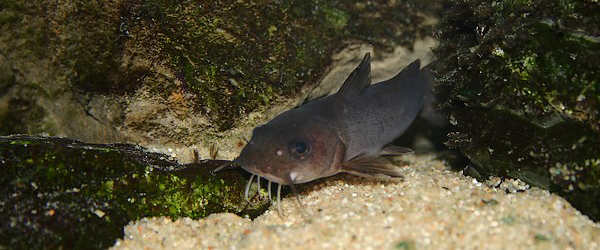
Lake Tanganyika catfish Lophiobagrus brevispinis, from tanganyikacichlide.nl.


The Claroteinae are notable for having undergone something of an adaptive radiation in one of African Great Lakes, Tanganyika. Though not as dramatic as the famous radiation of cichlids in the same lake, the Tanganyikan claroteines comprise over a dozen species divided between four genera (Bailey & Stewart 1984; Hardman 2008). Seven of these are placed in the genus Chrysichthys which has a wide distribution around Africa; the other three genera are unique to the lake. Molecular phylogeny indicates that the majority of Tanganyikan claroteines represent a single colonisation of the lake; only Chrysichthys brachynema has colonised Lake Tanganyika independently (Peart et al 2014). This indicates that the genus Chrysichthys as currently defined is non-monophyletic (something that had previously been suggested on morphological grounds) but any consequent reclassification is yet to occur. The species of Chrysichthys are mostly larger than the endemic Tanganyikan genera, ranging from 19 to 77 cm within Tanganyika (species elsewhere in Africa may reach up to 1.5 m). Of the endemic genera, the monotypic Bathybagrus tetranema is about 15 cm in length but the other two genera Phyllonemus and Lophiobagrus are even smaller, less than 10 cm in length. Bathybagrus and Lophiobagrus also both have reduced subcutaneous eyes. In Bathybagrus, this possibly reflects their occurrence at greater depths than other Tanganyika fish, occurring down to 80 m (nowhere near the depths reached by Lake Baikal sculpins but still impressive enough in the low-oxygen depths of a tropical lake). Lophiobagrus species are specialised to live in the gaps between rocky rubble on the lake bottom. The species of this genus have also been observed secreting a toxic mucus that can be fatal to other fish; this mucus is believed to be secreted from enlarged glands behind the pectoral fins.

Subcutaneous eyes are also found in two claroteines outside Tanganyika: the species Amarginops platus and Rheoglanis dendrophorus, both found in the Upper Congo (Hardman 2008). These two species are specialised for life in river rapids.

REFERENCES

Bailey, R. M., & D. J. Stewart. 1984. Bagrid catfishes from Lake Tanganyika, with a key and descriptions of new taxa. Miscellaneous Publication, Museum of Zoology, University of Michigan 168: 1–41.

Diogo, R., & Z. Peng. 2009. State of the art of siluriform higher-level phylogeny. In: Grande, T., F. Poyato-Ariza & R. Diogo (eds) Gonorynchiformes and Ostariophysan Relationships: A Comprehensive Review pp. 465–515. Science Publishers.

Geerinckx, T., D. Adriaens, G. G. Teugels & W. Verraes. 2003. Taxonomic evaluation and redescription of Anaspidoglanis akiri (Risch, 1987) (Siluriformes: Claroteidae). Cybium 27 (1): 17–25.

Geerinckx, T., D. Adriaens, G. G. Teugels & W. Verraes. 2004. A systematic revision of the African catfish genus Parauchenoglanis (Siluriformes: Claroteidae). Journal of Natural History 38: 775–803.

Hardman, M. 2008. New species of catfish genus Chrysichthys from Lake Tanganyika (Siluriformes: Claroteidae). Copeia 2008 (1): 43–56.

Peart, C. R., R. Bills, M. Wilkinson & J. J. Day. 2014. Nocturnal claroteine catfishes reveal dual colonisation but a single radiation in Lake Tanganyika. Molecular Phylogenetics and Evolution 73: 119–128.

Sullivan, J. P., J. G. Lundberg & M. Hardman. 2006. A phylogenetic analysis of the major groups of catfishes (Teleostei: Siluriformes) using rag1 and rag2 nuclear gene sequences. Molecular Phylogenetics and Evolution 41: 636–662.

Shock Me like an Electric Eel

Electric eel Electrophorus electricus, photographed by Stefan Köder.


The electric eel Electrophorus electricus is one of those animals that seem to border on the mythical. Most people will have come across some sort of reference to their existence, and may even have seen some sort of intended depiction of one in cartoon form. However, said depiction will probably bear little if any resemblance to a real-life electric eel. Most commonly, it will look more like a standard Anguilla eel, to which true electric eels are not close relatives. Instead, electric eels belong to a uniquely South and Central American group of fish, the Gymnotiformes.

The Gymnotiformes, commonly known as the Neotropical knife-fishes, are more closely related to catfish than they are to anguillid eels. They are characterised by an elongate body form, lacking the dorsal fin of other fish. The anus has been moved forward relative to other fish: in some gymnotiforms, the anus is actually in front of the pectoral fins, just behind the head. The anal fin that runs behind the anus has become greatly elongated, and instead of swimming by undulating the body from side to side like other fish, gymnotiforms swim by undulating the anal fin alone while the main body remains more or less rigid. This unusual swimming style is directly related to another distinctive feature of the gymnotiforms: their production of an electrical field. Many fish are able to passively sense electrical fields in the water: gymnotiforms take the next step and generate their own electrical field, which they use to sense their surrounding environment (Albert & Crampton 2005). As a result, they can live and hunt effectively at night and in turbid waters with poor visibility. They can also use their electrical fields for communication, signalling their moods and identities to other fish. The connection between electricity generation and swimming style is that, if gymnotiforms swam in the manner of other fish, their changes in body aspect would create changes in the shape of their electrical field. Holding the body more or less rigid means that the electrical field also remains constant, and any distortions must be caused by something external. Another group of fishes found in Africa and Asia that also navigates by electricity, the Notopteridae, has evolved a very similar appearance and swimming style to the gymnotiforms (and are also known as knife-fishes), but are entirely unrelated phylogenetically.

Tiger knife-fish Gymnotus tigre, from Trix.


The electric eel is something of an outlier among gymnotiforms. For a start, it's a monster: electric eels can be over two metres in length, while other gymnotiforms are all much smaller. The electric eel has also had a Susan Storm-style upgrade, and weaponised its electrosensory system. Electric eels can produce up to 600 volts of electricity, allowing them to stun reasonably large prey. The closest relatives of the electric eel are the banded knife-fishes of the genus Gymnotus; both are predators of fish and other aquatic animals. Males of at least some Gymnotus species and the electric eel build nests that the females lay their eggs into; males of Gymnotus carapo have been recorded to mouth-brood larvae.

The apteronotid Sternarchorhynchus mesensis, from here.


The remaining gymnotiforms were placed by Albert (2001) in a clade called the Sternopygoidei; these taxa have a smaller gape and feed on correspondingly smaller prey (some are planktivores). Two families, the Hypopomidae and Rhamphichthyidae, are united by the lack of teeth in the oral jaws; rhamphichthyids also have a very long and tubular snout. The other sternopygoids are placed in the families Sternopygidae and Apteronotidae; a distinctive feature uniting these two families is that they produce a wave- or tone-type electrical field instead of the pulse-type electrical field of other gymnotiforms. Pulse-type species produce discrete pulses of electricity at a lower frequency, while wave-type species produce a continuous series of electrical discharges at a much higher frequency (Albert 2001). While Albert (2001) regarded the pulse-type electrical field as ancestral for the gymnotiforms and the wave-type field as derived, other authors have preferred the opposite scenario. Sternopygids retain well developed eyes, in contrast to the reduced eyes of other gymnotiforms, while apteronotids are the only gymnotiforms to retain a caudal (tail) fin. If the wave-type families form a derived clade, then either these features were lost independently in the other families, or they represent reversals to an ancestral type.

One final thing to note is that the gymnotiforms have been going through something of a taxonomic boom, with many new species described in recent years. Albert & Crampton (2005) estimated that the total number of species out there could be nearly twice the 135 that had been named so far. In South America, it turns out, the streams are alive with the buzz of electricity.

REFERENCES

Albert, J. S. 2001. Species diversity and phylogenetic systematics of American knifefishes (Gymnotiformes, Teleostei). Miscellaneous Publications, Museum of Zoology, University of Michigan 190: 1-129.

Albert, J. S., & W. G. R. Crampton. 2005. Diversity and phylogeny of Neotropical electric fishes (Gymnotiformes). In: Bullock, T. H., C. D. Hopkins, A. N. Popper & R. R. Fay (eds) Electroreception, pp. 360-409. Springer: New York.