Field of Science

Showing posts with label Percomorpharia. Show all posts

By the Light of the Pony

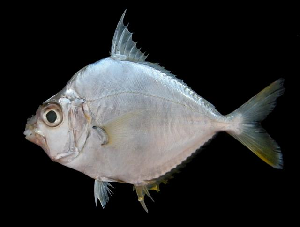
Light-emitting organs have evolved in many different species of marine fish. For the greater part, they are associated with inhabitants of the deep sea, the twilight and midnight zones beyond the reach of celestial light. Light production by species found in shallow waters is much less common. Nevertheless, one particularly notable radiation of near-surface glowers is the ponyfishes of the family Leiognathidae.

Leiognathus equulus, copyright Sahat Ratmuangkhwang.


Ponyfishes are small, mostly silvery fishes found in coastal and brackish waters in tropical regions of the Indo-West Pacific. The largest ponyfishes grow to about 25 cm in length but most species are much smaller (Woodland et al. 2002). They live in large schools that forage near the surface at night, descending close to the bottom sediment during the day. Why these animals are referred to as 'ponyfishes', I have no idea (perhaps the head is meant to look a bit pony-like?) An alternative vernacular name of 'slipmouth' makes a lot more sense as these fish have highly extensible jaws that can be used to snipe prey out of the water. A groove along the top of the skull allows for reception of a long, mobile premaxilla, supporting the mouth as an elongate tube when extended. Most ponyfishes are planktivores with simple, minute teeth in the jaw and the mouth extending horizontally. Species of the genus Deveximentum have the mouth tilted obliquely at rest so that it stretches upwards when extended. Members of the genus Gazza are piscivores when mature, feeding on other fish, and possess a pair of large caniniform teeth in each of the upper and lower jaws to hold their prey (James 1975).

Ponyishes are also notable for their elaborate light-producing organs. In most bioluminescent fishes, the photophores sit on or close to the skin surface but in leiognathids it is an internal outgrowth of the gut. A cavity around the end of the oesophagus houses colonies of bioluminescent bacteria, usually the species Photobacterium leiognathi. This light organ sits alongside or projects into the gas bladder which has a reflective internal coating. In many species, patches of scale-less, translucent skin allow the transmitted light to shine forth brightly. Muscular 'shutters' associated with the light organ allow the fish to control light transmission more directly (Woodland et al. 2002).
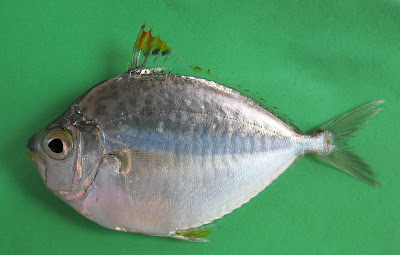
Photopectoralis bindus, copyright D. G. R. Wiadnya.


In a review of ponyfish taxonomy by James (1975), no mention was made of the light-emitting organ or many of its associated structures (though reference was made to the absence of scales on certain parts of the body). With the exceptions of the distinctive genera Gazza and Deveximentum, ponyfishes were assigned to a broad genus Leiognathus. Since then, variations in the structure of the light organ have been recognised as taxonomically significant, allowing the recognition of several genera divided between two subfamilies Leiognathinae and Gazzinae (Chakrabarty et al. 2011). Leiognathinae is defined by plesiomorphic characters and is likely to be paraphyletic to Gazzinae (Sparks & Chakrabarty 2015).

Because of the nocturnal habits of ponyfish and the delicacy of the light-emitting structures, our understanding of how light production functions in Leiognathidae remains somewhat limited. In Leiognathinae and females of Gazzinae, the light organ is relatively small and the external body surface lacks translucent patches. For the most part, light is expressed in these individuals as a uniform ventral glow that probably functions as counter-illumination (the light from the venter prevents the fish from appearing as a silhouette against light from the water surface to predators swimming below). Alternatively, light may be flashed to warn school-mates of danger. In males of Gazzinae, conversely, the light organ is enlarged relative to females and associated with translucent 'windows'. The shape of the organ and the arrangement of the 'windows' is a primary factor in distinguishing genera. Rhythmic flashing of light has been observed in males of many gazzine species and is probably characteristic of the group as a whole. Woodland et al. (2002) observed a school of several hundred Eubleekeria splendens flashing their lights synchronously shortly after nightfall. The exact function of such displays is uncertain, whether in courtship displays, co-ordinating school movements, attracting prey or dissuading predators. The sexually dimorphic nature of the light organ system, together with its species-specific expression, might seem to favour the first of these options but it should be noted that they are not all mutually exclusive.

Despite their small size, ponyfishes are often significant food fish for people living in areas where they are found. Thanks to their schooling behaviour, they are often a major component of dredge catches. In the Philippines, they are used for making bagoong, a fermented fish paste. In other places, they may be cooked whole after cleaning. The glow, sadly, does not survive the process.

REFERENCES

Chakrabarty, P., M. P. Davis, W. L. Smith, R. Berquist, K. M. Gledhill, L. R. Frank & J. S. Sparks. 2011. Evolution of the light organ system in ponyfishes (Teleostei: Leiognathidae). Journal of Morphology 272: 704–721.

James, P. S. B. R. 1975. A systematic review of the fishes of the family Leiognathidae. J. Mar. Biol. Ass. India 17 (1): 138–172.

Sparks, J. S., & P. Chakrabarty. 2015. Description of a new genus of ponyfishes (Teleostei: Leiognathidae), with a review of the current generic-level composition of the family. Zootaxa 3947 (2): 181–190.

Woodland, D. J., A. S. Cabanban, V. M. Taylor & R. J. Taylor. 2002. A synchronized rhythmic flashing light display by schooling Leiognathus splendens (Leiognathidae: Perciformes). Marine and Freshwater Research 53: 159–162.

Of Hawks and Marble

The acanthomorph fishes (a major clade of fishes mostly characterised by the presence of spines at the front of the dorsal fin) have long been recognised as a particularly thorny problem for higher-level systematics. Morphological relationships between many of the large number of families recognised in this clade have been almost impossible to unravel, and it is only in recent years that molecular analyses have been able to start making sense of the rapid divergences. Nevertheless, there are some subgroups of the acanthomorphs that have been recognised for a long time and which recent analyses have continued to support. One such group is the cirrhitoids.

Spottedtail morwong Goniistius zonatus, copyright Joi Ito.


Variously referred to in recent sources as the Cirrhitoidea, the Cirrhitoidei, or the Cirrhitiformes, the cirrhitoids include about eighty known species usually divided between five families. These are the hawkfishes of the Cirrhitidae, the trumpeters and morwongs of the Latridae, the Cheilodactylus fingerfins, the Chironemus kelpfishes and the Aplodactylus marblefishes (the morwongs were historically placed with the fingerfins in the Cheilodactylidae but have recently been transferred based on molecular data—Ludt et al. 2019). The largest cirrhitoid is the dusky morwong Dactylophora nigricans of western and southern Australia, growing to 1.2 metres in length, but most species are only a fraction of this size. Some of the largest species are of note to fisheries. Cirrhitoids are generally inhabitants of reefs, mostly feeding on benthic invertebrates such as crustaceans. They have long been recognised as a coherent group owing to their distinctive fin structure. The lower rays of the pectoral fins are not branched, and in a number of species they are thickened and protrude past the fin membrane (observant readers of this post may have already noticed a theme in many of the genus names given to cirrhitoids, relating to this feature). The pelvic fins are set well behind the pectoral fins. Other notable features of the clade include a relatively high number of vertebrae, a relatively low number of rays in the caudal fin, and the presence in juveniles of a fatty sac running along the fish's underside (Greenwood 1995).

Coral hawkfish Cirrhitichthys oxycephalus, copyright Aquaimages.


Both morphological and molecular studies have agreed that the hawkfishes of the Cirrhitidae represent the sister clade to the remaining cirrhitoids. Hawkfishes are brightly coloured inhabitants of the tropics, usually well under a foot in length. They are distinguished by bundles of trailing filaments emerging from the ends of the spines on the dorsal fin. Perhaps the most familiar member of the group is the longnose hawkfish Oxycirrhites typus, a regular in marine aquaria. However, this is also perhaps the most atypical member of the family as other species do not have the elongate snout. Hawkfishes commonly perch atop corals on the uppermost part of the reef, protected by the coral's sting and able to maintain a clear view of their surrounds. Wikipedia suggests that this behaviour is the inspiration for the name of 'hawkfish', but I'm not sure I buy this. I mean, it sounds plausible, but it also sounds like the sort of thing you would have to be diving below the reef to see. Vernacular names for fish tend to more often refer to things you might observe while hauling them onto a boat.

Marblefish Aplodactylus arctidens, copyright Peter Southwood.


The remaining cirrhitoids are all found in cooler waters, mostly in the Southern Hemisphere. Two species of Latridae, the redlip morwong Goniistius zebra and the spottedtail morwing G. zonatus, are found in the northern Pacific off the coast of eastern Asia (the kind of distribution shown by the genus Goniistius, where species are found in northern and southern temperate waters but not in the intervening tropics, is known as 'anti-tropical' and it's an interesting question how such a distribution would come to be). They are mostly found among rocky reefs, with the kelpfishes Chironemus and marblefishes Aplodactylus being particularly associated with patches of seaweed. The marblefishes feed on algae (particularly reds) as well as on some invertebrates and are characterised by a transverse mouth that is little or not protractible (Regan 1911). As noted above, the family Latridae has been inflated recently by the inclusion of most of the species previously included in the Cheilodactylidae. Cheilodactylus itself is now restricted to two species found around southern Africa. They differ from the remaining species in the latrids by the absence of a gas bladder as well as by elements of the skeleton. Many of the latrids are favourites of anglers, being well regarded as eating fish. By contrast, the herbivorous marblefishes are maligned as very poor fare and avoided. There's something to be said for eating your greens.

REFERENCES

Greenwood, P. H. 1995. A revised familial classification for certain cirrhitoid genera (Teleostei, Percoidei Cirrhitoidea), with comments on the group's monophyly and taxonomic ranking. Bulletin of the Natural History Museum of London (Zoology) 61 (1): 1–10.

Ludt, W. B., C. P. Burridge & P. Chakrabarty. 2019. A taxonomic revision of Cheilodactylidae and Latridae (Centrarchiformes: Cirrhitoidei) using morphological and genomic characters. Zootaxa 4585 (1): 121–141.

Nelson, J. S., T. C. Grande & M. V. H. Wilson. 2016. Fishes of the World 5th ed. Wiley.

Regan, C. T. 1911. On the cirrhitiform percoids. Journal of Natural History, series 8, 7: 259–262.

Tuskfish

The reefs of the Indo-west Pacific Oceans are one of the most species-rich regions of the entire marine environment. A complex geological history and high geographical complexity have contributed to drive speciation, resulting in a number of local radiations. One such radiation is the tuskfishes of the genus Choerodon.

Orange-dotted tuskfish Choerodon anchorago, copyright Bernard Dupont.


Choerodon is a genus of the wrasse family Labridae, most diverse around the islands of south-east Asia and northern Australasia where they inhabit coastal reefs or sea-grass beds. A revision of the genus by Gomon (2017) recognised 27 species, varying in size from a little over ten centimetres in length to half a metre or more. LIke other members of the wrasse family, they are often brightly coloured, with juveniles in particular of a number of species being patterned with bold vertical stripes. The vernacular name of 'tuskfish', as well as the zoological name of the genus (which translates as 'pig-tooth'), refers to the possesion of a pair of prominent, protruding incisors at the front of each of the upper and lower jaws. Other characteristic features of Choerodon include a dorsal fin with twelve spiny rays and eight soft rays, or thirteen spines and seven soft rays, and a lack of scales on the lower part of the cheek and lower jaw. Choerodon species, like most other wrasses, are protogynous hermaphrodites, starting their lives as females before eventually transforming into males.

Baldchin groper Choerodon rubescens, copyright Katherine Cure.


Diet-wise, tuskfishes are predators, feeding on animals such as crustaceans or mollusks. Larger species may even take other vertebrates. A kind of tool use has been observed for the genus, with difficult prey such as clams (Jones et al. 2011) or young turtles (Harborne & Tholan 2016) being grasped in the mouth and hammered against rocks to subdue them and/or break open shells. Multiple species of tuskfish may be found in close proximity though they will often differ in their preferred habitat. A study of five Choerodon species found around Shark Bay in Western Australia by Fairclough et al. (2008) found that the baldchin groper C. rubescens was found only on exposed marine reefs whereas the other four species preferred more sheltered habitats further inside the bay. The blue tuskfish C. cyanodus and blackspot tuskfish C. schoenleinii were both found in a range of habitats in this region but C. cyanodus was most abundant along rocky shores whereas C. schoenleinii preferred coral reefs (C. schoenleinii also differed from other species in the region in constructing burrows at the base of reefs that it used as a retreat). The purple tuskfish C. cephalotes was almost exclusively found among seagrass meadows. Finally, the bluespotted tuskfish C. cauteroma spent the early part of its life among seagrasses but moved onto reefs as it matured to adulthood.

Tuskfish and other wrasses are highly prized as eating fishes. However, it would be remiss to refer to the reefs of the Indo-west Pacific without mentioning that many of them are highly endangered. Heavy fishing, often using destructive methods, have combined with the effects of changing climate to cause a dramatic reduction in reef cover in recent decades. Should the decline continue at current rates, the lives of millions of people stand to be dangerously impacted.

REFERENCES

Fairclough, D. V., K. R. Clarke, F. J. Valesini & I. C. Potter. 2008. Habitat partitioning by five congeneric and abundant Choerodon species (Labridae) in a large subtropical marine embayment. Estuarine, Coastal and Shelf Science 77: 446–456.

Gomon, M. F. 2017. A review of the tuskfishes, genus Choerodon (Labridae, Perciformes), with descriptions of three new species. Memoirs of Museum Victoria 76: 1–111.

Harborne, A. R., & B. A. Tholan. 2016. Tool use by Choerodon cyanodus when handling vertebrate prey. Coral Reefs 35: 1069.

Jones, A. M., C. Brown & S. Gardner. 2011. Tool use in the tuskfish Choerodon schoenleinii? Coral Reefs 30 (3): 865.

Strike up the Bandfish

The diversity of fishes can be absolutely overwhelming and, as a result, there a some distinctive groups that fail to get their time in the spotlight. For this post, I'm briefly highlighting one of the lesser-known fish families, the bandfishes of the Cepolidae.

Australian bandfish Cepola australis at home in its burrow, copyright Rudie H. Kuiter.


Cepolids are small fish (growing to about 40 cm at most with many species much smaller) that are widespread in the eastern Atlantic and the Indo-Pacific but nowhere common. They have a laterally compressed, tapering body and a lanceolate caudal (tail) fin. They have an angled mouth that is relatively large compared to their size and pelvic fins with a single spine and five segmented rays, four of which are branched (Smith-Vaniz 2001). Two subfamilies are recognised, the Cepolinae and Owstoniinae. The Cepolinae are particularly elongate in body form and have the dorsal and anal fins connected by membranes to the caudal fin; these three fins are all distinctly separate in the Owstoniinae. Cepolines are divided between two genera: Acanthocepola species have scaly cheeks and spines on the preopercular margin whereas Cepola have naked cheeks and no such spines. Classification of Owstoniinae has been a bit less settled. A recent revision of the subfamily recognised only a single genus Owstonia (Smith-Vaniz & Johnson 2016), synonymising the genus Sphenanthias previously distinguished by features of the lateral line. As an indication of how little-known cepolids are, Smith-Vaniz & Johnson's revision more than doubled the number of known species of owstoniine from fifteen to 36 .

Male Owstonia hawaiiensis, from Smith-Vaniz & Johnson (2016).


Cepolids are most commonly found in relatively deep water, up to about 475 m. They are not targeted by any significant fisheries though Wikipedia claims that the oldest known recipe from a named author is for the cooking of bandfish. Cepolinae live on sandy or muddy bottoms on continental shelves where they excavate burrows in which they insert themselves with the head protruding above the substrate. Owstonia species are free-swimming, more commonly found near rocky bottoms on upper slopes or around atolls. The diet, where known, appears to be composed of zooplankton though Smith-Vaniz & Johnson (2016) suggested on the basis of tooth morphology that Owstonia were detritivores for at least part of their life cycle.

REFERENCES

Smith-Vaniz, W. F. 2001. Cepolidae. Bandfishes. In: Carpenter, K. E., & V. H. Niem (eds) FAO Species Identification Guide for Fishery Purposes. The Living Marine Resources of the Western Central Pacific vol. 5. Bony fishes part 3 (Menidae to Pomacentridae) pp. 3331–3332. Food and Agriculture Organization of the United Nations: Rome.

Smith-Vaniz, W. F., & G. D. Johnson. 2016. Hidden diversity in deep-water bandfishes: review of Owstonia with descriptions of twenty-one new species (Teleostei: Cepolidae: Owstoniinae). Zootaxa 4187 (1): 1–103.

Sweepers

It's time to meet the sweepers.

Smallscale bullseyes Pempheris compressa, copyright John Turnbull.


Sweepers, Pempheridae, are a group of moderately sized marine fish (usually about fifteen to twenty centimetres in length) found around tropical reefs in the Indo-Pacific and western Atlantic. I don't know why they're called sweepers, but in some areas they may be among the most abundant fish on the reef. Distinctive features of the group include a short, high dorsal fin and a long anal fin. The lateral line is also distinctively long, extending past the end of the tail right onto the caudal fin. Perhaps the feature that most stands out about sweepers is their large eyes. The eyes are so big because sweepers are nocturnal; during the day they retreat into protected crevices and caves, emerging at night to feed on minute crustaceans and other small animals (Mooi 2001).

Pygmy sweeper Parapriacanthus ransonneti, from here.


Sweepers are divided between two quite distinct genera. Members of the genus Parapriacanthus have a more 'average fish-like' elongate profile with the body less deep than the head is long. The other genus, Pempheris, has a distinctively deep profile, deeper than the head is long. The exact number of species of pempherid appears to still be uncertain. Pempherids lack the striking markings of other tropical fish and species can appear very similar to each other. What is more, they have two layers of scales on the body, with the outer scales being larger than the inner and deciduous (easily shed), and loss of the outer scales has the potential to change an individual's superficial appearance. Early descriptions of pempherid species are often inadequate for their reliable identification, and new species continue to be described at a quite rapid pace. A recent publication by Randall & Victor (2015), for instance, described no less than thirty-four new species of Pempheris from various locations in the Indian Ocean, close to doubling the number of species in the genus at a stroke. The genus Parapriacanthus is much less diverse, with only about five recognised species.

Orange-striped bullseyes Pempheris ornata in hiding during the day, copyright Peter Southwood.


Because of their relatively small size and retiring habits, sweepers are mostly not that significant economically. At least one species, Pempheris xanthoptera, is fished off the coast of Japan and mostly eaten as fish paste; it is supposed to be quite tasty. Some have appeared in aquaria.

When foraging at night, sweepers communicate with each other by producing popping noises through muscular flexing of the swim bladder wall. Noise production increases in the presence of potential threats, perhaps to warn other members of the school. At least some pempherid species also have bioluminescent glands associated with the posterior part of the gut. The bioluminescent compound is not directly produced by the fish itself but obtained by consuming bioluminescent ostracods. I haven't found whether the function of this bioluminescence is specifically known for pempherids, but similar ventral glows in other fish provide camouflage by breaking up the fish's silhouette when seen from below.

REFERENCES

Mooi, R. D. 2001. Pempheridae. Sweepers (bullseyes). FAO Species Identification Guide for Fishery Purposes. The Living Resources of the Western Central Pacific vol. 5. Bony fishes part 3 (Menidae to Pomacentridae) pp. 3201–3204. Food and Agriculture Organization of the United Nations: Rome.

Randall, J. E., & B. C. Victor. 2015. Descriptions of thirty-four new species of the fish genus Pempheris (Perciformes: Pempheridae), with a key to the species of the western Indian Ocean. Journal of the Ocean Science Foundation 18: 77 pp.

Sea Bass, Mutant or Otherwise

...though to the best of my knowledge, none of them have fricking lasers on their heads.

Painted comber Serranus scriba, copyright Roberto Pillon.


The Serranidae are a group of marine fish that go by vernacular names such as sea bass, rock bass or rock cod. They are carnivores, and are found mostly around reefs in tropical and subtropical waters around the world. In appearance, they are fairly generalised (these are fish that look like fish) with a body shape that is longer than high, but not too long, and relatively big jaws with the lower jaw often jutting forward a bit beyond the upper. Some of them are quite colourful (as befits a tropical reef fish) and some of the smaller ones turn up in marine aquaria as a result. As used in the past, the Serranidae has been quite a broad grouping of fish united by having three spines on the margin of the opercle (the gill cover) and the maxilla in the upper jaw not hidden by the cheekbone when the mouth is closed. Members of this broad Serranidae were commonly divided between three subfamilies: the Serraninae (including the sea basses), Epinephelinae (including the groupers) and Anthiinae (basslets and goldies), though some authors further subdivided the Epinephelinae. However, recent molecular studies have indicated the polyphyly of this grouping, with the Serraninae and Epinephelinae occupying distinct positions within the clade known as the Serraniformes or Perciformes sensu stricto (see this old post), and so have cut the latter out of the Serranidae. As for the Anthiinae, their position remains uncertain, with some analyses placing them with the Serraninae and others with the Epinephelinae (Lautredou et al. 2013). As a result, a monophyletic Serranidae is probably to be restricted to the old 'Serraninae'.

Shy hamlet Hypoplectrus guttavarius, copyright Florent Charpin.


There are over eighty species listed for this restricted Serranidae on FishBase, but new ones continue to be described. As is common among reef fishes, it can be hard to determine exactly what counts as a species (whatever your preferred definition). A prime example of this is the genus Hypoplectrus, small serranids known as hamlets (no, I don't know why either) found in the Caribbean and the Gulf of Mexico. Hamlets come in a range of different colours and patterns, but structurally speaking the various forms are otherwise indistinguishable. As a result, some authors have regarded them as all colour morphs of a single species. Others have recognised close to twenty different species. Domeier (1994), conducting field observations on hamlets together with breeding experiments in the laboratory, found that different colour morphs would usually only mate with partners sharing their own colour pattern, though hybrid matings could be produced if no more suitable mate was provided. These hybrid matings produced offspring bearing intermediate colour patterns, and the rarity of such intermediates in the field led Domeier to infer that the different morphs were mostly acting as good species.

Kelp bass Paralabrax clathratus, photographed by Steve Lonhart.


Most sea basses are simultaneous hermaphrodites: they have both male and female reproductive organs functional at the same time. Though they are capable of fertilising their own eggs, they still usually breed in pairs with each individual alternating the release of male and female gametes. Not all serranids follow this reproductive template: members of the genera Chelidoperca and Centropristis are protogynous, starting their mature lives as females before switching over to males. Two species of Serranus, the lantern bass Serranus baldwini and the barred serrano S. psittacinus, are mostly simultaneous hermaphrodites like other species in the genus, but the largest individuals resorb their female organs and become exclusively males. Finally, many species of the genus Paralabrax have entirely separate males and females. Phylogenetic analysis suggests that protogyny may be the original mode of sexual development in the serranids, with separate sublineages developing simultaneous hermaphroditism vs separate sexes (Erisman & Hastings 2011). In correlation with this, individuals of Paralabrax that are functionally single-sexed have been found to retain non-functional remnants of the other sex's organs.

REFERENCES

Domeier, M. L. 1994. Speciation in the serranid fish Hypoplectrus. Bulletin of Marine Science 54 (1): 103–141.

Erisman, B. E., & P. A. Hastings. 2011. Evolutionary transitions in the sexual patterns of fishes: insights from a phylogenetic analysis of the seabasses (Teleostei: Serranidae). Copeia 2011 (3): 357-364.

Lautredou, A.-C., H. Motomura, C. Gallut, C. Ozouf-Costaz, C. Cruaud, G. Lecointre & A. Dettai. 2013. New nuclear markers and exploration of the relationships among Serraniformes (Acanthomorpha, Teleostei): the importance of working at multiple scales. Molecular Phylogenetics and Evolution 67: 140–155.

The Sculpins of Baikal

Drawing of Leocottus kesslerii, one of the more plesiomorphic of Baikal's sculpins, from here.


In a post that appeared on this site some seven years ago, I briefly introduced you to the sculpins of Lake Baikal. Sculpins, to quickly recap, are a group of bottom-dwelling fish found in Eurasia and North America, both in marine and freshwater habitats. At some point, a representative of the freshwater sculpins entered the massive Siberian lake known as Baikal, where it gave rise to one of the world's classic adaptive radiations.

To date, about thirty species of sculpin have been described from Lake Baikal. The level of morphological divergence between these species is such that they have been classified in the past into three separate families: while some were placed in the widespread family Cottidae, others were placed in two families endemic to Baikal, the Abyssocottidae and Comephoridae. However, phylogenetic analyses indicate that all the Baikalian sculpins originated from a single ancestor, and the entire clade is nested not only within the Cottidae but also within the genus Cottus (Kontula et al. 2003). Some of the Baikalian sculpins, such as the relatively basal Leocottus kessleri, retain a habitus and lifestyle similar to those of other sculpins elsewhere. Others, such as the golomyankas of the genus Comephorus, have become remarkably modified.

Specimens of Abyssocottus korotneffi, copyright Muséum National d'Histoire Naturelle.


The greatest diversity of Baikalian sculpins has resulted from their radiation into the lake's deep waters, which reach over 1600 metres (Sideleva 1996). This is a habitat unparalleled in any other freshwater lake. The only other great lakes reaching even comparable depths are the rift lakes Malawi and Tanganyika in Africa (the great lakes of North America, in contrast, are reasonably shallow). In the African lakes, the water quickly becomes anoxic below a fairly shallow top layer, and so the depths are devoid of multicellular life. Baikal, in contrast, is oxygenated all the way down (in this post, I speculated that this was due to Baikal's hydrothermal vents; it seems I was wrong. Baikal is oxygenated because the change in surface water temperature between summer and winter results in water circulating between layers and drawing oxygen down; in the tropical great lakes, where surface temperature remains fairly constant all year round, this circulation doesn't happen). The bulk of Baikal's deep-water sculpins make up the prior family Abyssocottidae, and exhibit adaptations similar to those seen in many marine deep-water fish. Their retinal structure has become simplified as a result of low light conditions. Their scales are reduced, and the lateral line system is composed of neuromasts exposed directly on the surface of the skin rather than contained in sub-surface canals and exposed to the outside environment via pores. The convergences between 'abyssocottids' and marine deep-sea fishes are so marked that some authors previously used them to argue for a direct marine ancestry of the Baikal fish (perhaps through a direct connection between Baikal and the sea that was once thought to have existed in the past), but this has been firmly quashed by the more recent molecular analyses. Instead, the majority of Baikal's deep-waters sculpins form a single clade that originated from shallower-water ancestors; the only exception is the genus Procottus, which includes both shallow-water and deep-water species (Kontula et al. 2003).

Golomyanka Comephorus dybowskii, from here.


Possibly sister to this deep-water clade are the aforementioned two species of golomyanka in the genus Comephorus. The golomyankas are without question the most bizarre members of the Baikalian sculpin radiation. They have become adapted to a pelagic mode of life, swimming in the open water column and feeding on Baikal's similarly remarkable pelagic amphipod Macrohectopus branickii (and as remarkable as Lake Baikal's sculpins are, they are nothing compared to its amphipods). It is not a simple matter for a sculpin to swim freely: they lost their swim bladders at an earlier stage in their evolution, so their native position is quite closely associated to the water's bed. To correct for this ancestral lack of buoyancy, golomyankas have lost their covering of scales and developed a low-density body structure that contains a high proportion of oil, about one-third of their total mass. Their pectoral fins have become greatly enlarged, covering about twice the area of the remainder of the body. The end result is that golomyankas are close to neutral buoyancy, and able to simply float in water column, waiting to ambush passing prey.

Golomyankas are also distinctive in their reproductive biology. Other sculpins lay their eggs in nests among stones, where they are tended by the male until they hatch. This includes the Baikalian genus Cottocomephorus, which has adopted a partially pelagic life comparable to that of Comephorus, but not to the same extent (Cottocomephorus species resemble Comephorus in having enlarged pectoral fins, but are otherwise more typically sculpin-like). Golomyankas, in contrast, are viviparous, releasing active larvae directly into the water column. Golomyankas are by far the most abundant fish in Lake Baikal, and a major component in the diet of other fish species (including, when young, other golomyankas). They are one of the key components in making Lake Baikal what it is, the world's only freshwater sea.

REFERENCES

Kontula, T., S. V. Kirilchik & R. Väinölä. 2003. Endemic diversification of the monophyletic cottoid fish species flock in Lake Baikal explored with mtDNA sequencing. Molecular Phylogenetics and Evolution 27 (1): 143–155.

Sideleva, V. G. 1996. Comparative character of the deep-water and inshore cottoid fishes endemic to Lake Baikal. Journal of Fish Biology 49 (Suppl. A): 192–206.

In a Pufferfish's Garden

Bullseye puffer Sphoeroides annulatus, copyright Geoffrey W. Schultz.


I don't know if it applies in other parts of the world, but one animal that you are guaranteed to see in the estuary here in Perth is pufferfish. One of the most instantly recognisable fish families, pufferfish (Tetraodontidae) are of course famed for their high toxicity, the determination of some people to eat them despite aforementioned toxicity, and their habit of swallowing air or water when threatened to inflate their distendible bellies. That last feature makes them a favourite of children (or at least of yours truly as a child), because their slow swimming style makes them one of the few fish that can be easily captured by hand (you just have to make sure you don't allow the fish to give you a nasty bite with their beak). The first feature makes them a lot less popular with fishermen who have to experience the frustration of reeling in a line to find that the bait has been taken by a puffer, then trying to remove the puffer from the hook while avoiding the aforementioned beak.

Oceanic puffer Lagocephalus lagocephalus, from Baino96.


There are a little under 200 known pufferfish species worldwide. Most of them are found in coastal marine and brackish waters, but there are also several species found in fresh water in South America, Africa and southeast Asia. Some marine species are also resistant to fresh water and may spend extended periods away from the sea. Some southeast Asian brackish-water Tetraodon species even make regular appearances in the the aquarium trade labelled as 'freshwater' puffers (Yamanoue et al. 2011), though their long-term survival requires more appropriate water conditions. The toxin associated with pufferfishes is not produced by the fish itself, but accumulated through its diet. As such, the exact level of toxicity of a pufferfish may vary according to season.

Grass puffer Takifugu niphobles, copyright OpenCage.


A molecular phylogenetic analysis of pufferfish by Yamanoue et al. (2011) identified four main clades in the family. These clades were also supported by a subsequent analysis by Santini et al. (2013), though the deeper relationships between the clades differed between the analyses. Yamanoue et al. (2011) identified a small number of freshwater clades (only one for each continent with freshwater taxa) and inferred that the transition from marine to fresh water had happened only rarely. Santini et al. (2013), in contrast, supported a higher number of transitions in tetraodontid history, though at least some of the difference between the two studies can be explained by differing definitions of 'freshwater'. For instance, some species of Takifugu usually live in brackish water but spawn in fresh water; Santini et al. counted these as freshwater species, but Yamanoue et al. did not.

Papuan toby Canthigaster papua, photographed by Dwayne Meadows.


One of the major clades identified within the Tetraodontidae includes the genus Lagocephalus, a group of relatively long-bodied puffers including some of the few pelagic puffer species. This genus may be the sister taxon of the remaining puffers (as found by Yamanoue et al.), or it may have a more nested position as sister to a clade including the mostly West Atlantic-East Pacific genera Sphoeroides and Colomesus (as found by Santini et al.). This latter clade includes South America's only freshwater puffer, the Amazon species Colomesus asellus. Santini et al. identified the basalmost tetraodontid clade as an Indo-West Pacific assemblage including the genus Takifugu and related taxa, which Yamanoue et al. had found as sister to the final clade including taxa related to the genus Tetraodon. This last clade includes the African and southeast Asian freshwater puffers (except for a few members of the Takifugu clade that cross into fresh water at times). It also includes the genus Canthigaster, the sharpnose pufferfish. In contrast to the more or less globular form of all other puffers, sharpnose puffers have a laterally compressed body form that superficially looks a bit more like a triggerfish than a puffer. Most Canthigaster species are reef-dwellers, a somewhat unusual habitat for a puffer (the other main group of reef-dwelling puffers being the genus Arothron, also in the Tetraodon clade).

Circular underwater 'nest' constructed by a pufferfish, from Spoon & Tamago.


One of the most remarkable characteristics of any puffer, though, was not discovered until quite recently. In 2012, it was announced that large structures observed off the coast of Japan by underwater photographer Yoji Ookata were in fact the work of pufferfish. These structures, circular and regular geometric patterns in the sea bed about 1.5 metres in diameter, were made by male puffers swimming against the sand. The structures are believed to function in attracting females, and also function as nests in which the females lay their eggs. Rather frustratingly, I haven't found any indication exactly which species of puffer is involved!

Puffer in the process of building a nest, also from Spoon & Tamago.


REFERENCES

Santini, F., M. T. T. Nguyen, L. Sorenson, T. B. Waltzek, J. W. Lynch Alfaro, J. M. Eastman & M. E. Alfaro. 2013. Do habitat shifts drive diversification in teleost fishes? An example from the pufferfishes (Tetraodontidae). Journal of Evolutionary Biology. doi: 10.1111/jeb.12112.

Yamanoue, Y., M. Miya, H. Doi, K. Mabuchi, H. Sakai & M. Nishida. 2011. Multiple invasions into freshwater by pufferfishes (Teleostei: Tetraodontidae): a mitogenomic perspective. PLoS ONE 6 (2): e17410. doi:10.1371/journal.pone.0017410.