Field of Science

Showing posts with label Globothalamea. Show all posts

Lifestyles of the Rosalinidae

Among the modern foraminiferans, one of the most prominent radiations is among members of the Rotaliida, characterised by globose chambers and calcareous, hyaline test walls. Among the numerous families making up the Rotaliida are members of the Rosalinidae.

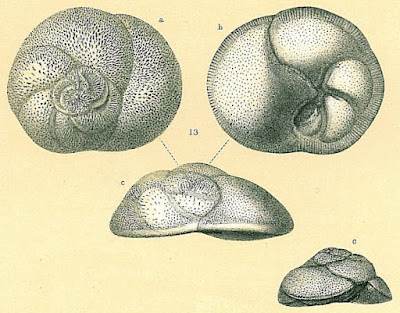
Benthic form of Rosalina globularis, from Brady (1884).


Rosalinids may be regarded as fairly typical-looking marine rotaliids with the test growing freely as a low trochospire (so a flattened cone or dish shape). The aperture of the test is a low slit on the interior margin along the umbilicus (Hansen & Revets 1992). Rosalinids have a complex life cycle involving both benthic and planktonic stages (Sliter 1965). The asexually reproducing diploid stage is benthic. Depending on conditions, diploid individuals may divide to produce other diploid individuals, resulting in several asexual generations. Eventually, however, the diploid generation will undergo meiosis to produce the haploid sexual generation (in the common species Rosalina globularis, this is induced by exposure to warmer water). In the sexual generation, a large globular chamber forms at maturity that covers the umbilical side of the test. This float chamber becomes filled with gas, allowing the foram to disperse planktonically before releasing gametes to produce the next diploid generation. Planktonic individuals are distinct enough in appearance from their benthic counterparts that they were long mistaken for distinct taxa before their identity was revealed by lab cultures.
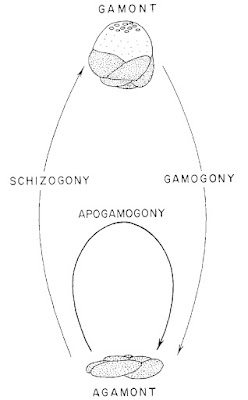
Life cycle of Rosalina globularis, from Sliter (1965).


The majority of forams are particulate feeders. A network of filamentous pseudopodia radiating outwards from the cell body captures micro-organisms and other organic particles. However, one genus of rosalinids, Hyrrokkin, lives as parasites on sessile invertebrates (Cedhagen 1994). Species of this genus have variously been found on sponges, corals and bivalves. On sponges, they settle on the inhalent surface of the sponge and dissolve the underlying tissues. On bivalves, they form pits on the shell surface from which they bore holes through to the body cavity. Pseudopodia extended through this hole allow the foram to feed on host tissue. Infested hosts may bear multiple scars from the foram moving about on the outer surface. The forams may also feed on other animals such as polychaete worms or bryozoans attached to the surface of their primary host. In such cases, Hyrrokkin remains in its original pit but develops an irregularly shaped chamber with its aperture directed towards the alternate prey. Hyrrokkin species evidently do well from their rapacious lifestyle: whereas other rosalinids are only a fraction of a millimetre in diameter, Hyrrokkin sarcophaga is an absolute giant reaching around six millimetres across and with protoplasm containing thousands of nuclei. Proving once again that one may make a great deal of profit from the labour of others.
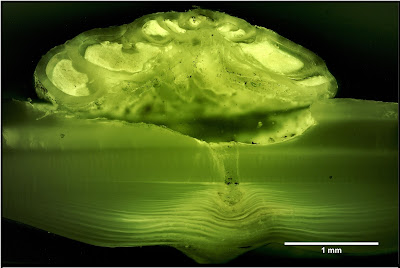
Cross-section of Hyrrokkin sarcophaga boring into shell of file clam Acesta excavata, from Schleinkofer et al. (2021).


REFERENCES

Cedhagen, T. 1994. Taxonomy and biology of Hyrrokkin sarcophaga gen. et sp. n., a parasitic foraminiferan (Rosalinidae). Sarsia 79: 65–82.

Hansen, H. J., & S. A. Revets. 1992. A revision and reclassification of the Discorbidae, Rosalinidae, and Rotaliidae. Journal of Foraminiferal Research 22 (2): 166–180.

Sliter, W. V. 1965. Laboratory experiments on the life cycle and ecologic controls of Rosalina globularis d'Orbigny. Journal of Protozoology 12 (2): 210–215.

The Bolivinitids

The Cretaceous was a period of significant innovation in the evolution of Foraminifera with a number of distinct new lineages making their appearance during this period. Among those, appearing in the latter part of the Cretaceous, were the first members of the modern family Bolivinitidae.

Bolivinita costifera, from the Smithsonian National Museum of Natural History.


The Bolivinitidae are free-living benthic forams with a calcareous, hyaline (glassy) test. The overall shape of the test is elongate with chambers arranged in biserial coils (that is, there are two chambers per loop). The terminal aperture is usually loop-shaped with a surrounding lip. Inside the chamber, a tooth plate (an inner protrusion of the test) runs from the aperture to the opening of the previous chamber and may protrude through the aperture (Revets 1996).

Representatives of the Bolivinitidae are found in a wide range of depths, from the shallow waters of the ocean to the bathyal zone. They may be among the most abundant forams in areas of low oxygen concentrations and are commonly associated with sustained organic matter input (Erdem & Schönfeld 2017). In other words, these are muck-lovers. Individuals growing in low oxygen conditions tend to show less pronounced surface sculpture on the test than those where the oxygen levels are higher. Conversely, individuals at deeper levels tend to be larger overall than those in shallower waters (Brun et al. 1984). As such, bolivinitids have received their fair share of attention as potential indicators of changes in environmental condition over time.

REFERENCES

Brun, L., M. A. Chierici & M. Meijer. 1984. Evolution and morphological variations of the principal species of Bolivinitidae in the Tertiary of the Gulf of Guinea. Géologie Méditerranéenne 11 (1): 13–57.

Erdem, Z., & J. Schönfeld. 2017. Pleistocene to Holocene benthic foraminiferal assemblages from the Peruvian continental margin. Palaeontologica Electronica 20.2.35A: 1–32.

Revets, S. A. 1996. The generic revision of the Bolivinitidae Cushman, 1927. Cushman Foundation for Foraminiferal Research Special Publication 34: 1–55.

Chilostomellidae: Deep Forams

Holotype of Chilostomella serrata, from the Smithsonian National Museum of Natural History.


The specimen in the figure above is a fairly typical representative of the Chilostomellidae, a cosmopolitan family of forams known from the Jurassic to the present day. Members of this family have a translucent calcareous test with chambers arranged in a trochospiral (broad conical) or planispiral (flat spiral) pattern. The chambers of each spiral are expanded to cover over the prior spirals so only the outermost spiral is generally visible. The aperture of the test in the final chamber is a narrow slit along the margin with the underlying chamber (Loeblich & Tappan 1964).

Despite their long history and wide distribution, I get the general impression that chilostomellids are not usually abundant. They are generally restricted to deeper waters, more than 100 m below the surface (Cushman et al. 1954). Members of the genus Chilostomella, at least, have commonly been regarded as associated with low-oxygen environments. However, it has also been suggested that their favoured conditions are not so much a question of low oxygen as high organic flux (Jorissen 2002). Perhaps the best location to find chilostomellids would be around sites where dead animals and seaweeds have fallen to the deeper waters below.

REFERENCES

Cushman, J. A., R. Todd & R. J. Post. 1954. Recent Foraminifera of the Marshall Islands. Bikini and nearby atolls, part 2, oceanography (biologic). Geological Survey Professional Paper 260-H: 319–384, pls 82–93.

Jorissen, F. J. 2002. Benthic foraminiferal microhabitats below the sediment-water interface. In: Sen Gupta, B. K. (ed.) Modern Foraminifera pp. 161–179. Kluwer Academic Publishers: Dordrecht.

Loeblich, A. R., Jr & H. Tappan. 1964. Treatise on Invertebrate Paleontology pt C. Protista 2. Sarcodina: chiefly "thecamoebians" and Foraminiferida vol. 2. The Geological Society of America, and The University of Kansas Press.

Holding Forams Together

Nouria polymorphinoides, from Foraminifera.eu.


In past posts relating to the Foraminifera, I've made reference to the changes in classification undergone by this group over the years. Forams are unusual among unicellular organisms in producing a hard, often complex test that means they have both left an extensive fossil record and provided a number of characters on which to base a classification. However, there has been much disagreement over the relative attention due to particular features of the test. The classification used for forams in the Treatise on Invertebrate Paleontology by Loeblich & Tappan (1964), one of most influential sources in recent decades, made its primary divisions on the basis of the structure and chemistry of the test itself. Forams that produce a test by gluing together (agglutinating) sand particles and other foreign objects were treated as fundamentally distinct from those that secreted calcareous tests. Because the foram cell itself is amoeboid, there was an underlying assumption that the test architecture was too mutable to indicate anything more than low-level relationships.

However, there were some prominent inconsistencies with this assumption (Mikhalevich 2013). One is that the division between agglutinated and calcareous tests is not always perfect. Agglutinated forams might not secrete the bulk of the test themselves but they do secrete the cement used to hold the sand grains together, and there is a definite spectrum in the proportion of sand to cement used by a given foram. In some agglutinated forms, a distinct calcareous layer may underlie the agglutinated section of the test, and it is easy to envision how a progressive reduction in the proportion of agglutinated material could lead to the evolution of an entirely secreted test. This was not in itself fatal to the earlier system as it had generally been assumed that agglutinated forams were likely to represent a paraphyletic group. More problematic was the common appearance of foram species that were extremely similar in test architecture with the only really significant difference being that one was agglutinated and the other calcareous. This lead some authors to argue that whereas a small number of such cases might be accepted as the result of convergence, the abundance of such cases suggested that changes in test composition were more common than previously recognised. Molecular studies of forams are still in their infancy but have offered some support for the significance of test architecture, such as the division between globular and tubular forams (Pawlowski et al. 2013) that I referred to in an earlier post.

Liebusella goesi, from Foram Barcoding.


One effect of this change in focus is that the Mikhalevich (2013) classification divides the agglutinated forams between a number of groups that are not recognised in alternative systems. One such group is the Nouriida, known from the Cretaceous to the present day. Mikhalevich included the Nouriida in a larger group called the Hormosinana; at least one hormosinanan was placed by Pawlowski et al. (2013) at the base of the globular foram lineage. In contrast, Loeblich & Tappan (1964) included most of the nouriidans in the family Ataxophragmiidae, other members of which belong to the tubular forams. Nouriida and other Hormosinana are united by having the aperture of the test in a terminal position; in some nouriidans, it may be raised on a short neck. Nouriida differ from other hormosinanans in the arrangement of chambers in the test. In early stages they tend to be more or less trochospiral; with maturity, the number of chambers to a whorl decreases and the test may become biserial or uniserial. The two subfamilies recognised within the Nouriida by Mikhalevich differ in the internal structure of their chambers: Nourioidea have internally simple chambers but Liebuselloidea have the lumen of the chambers complexly subdivided.

I haven't found much about their ecological role; at least one modern species, Nouria polymorphinoides, seems to be not uncommon in shallower continental shelf waters worldwide. My general impression (just confirmed by asking a colleague who actually works on forams) is that agglutinated forams receive far less attention than calcareous ones. A big part of this is simply that they're harder to find: it takes a lot of practice to be able to pick out an actual agglutinated foram test from any other conglomeration of sand, and if they break apart during sample prep (which they often do) then there is little sign they were ever there to begin with.

REFERENCES

Loeblich, A. R., Jr, & H. Tappan. 1964. Treatise on Invertebrate Paleontology pt C. Protista 2. Sarcodina: chiefly "thecamoebians" and Foraminiferida vol. 1. The Geological Society of America, and The University of Kansas Press.

Mikhalevich, V. I. 2013. New insight into the systematics and evolution of the Foraminifera. Micropaleontology 59 (6): 493–527.

Pawlowski, J., M. Holzmann & J. Tyszka. 2013. New supraordinal classification of Foraminifera: molecules meet morphology. Marine Micropalaeontology 100: 1–10.

The Forams that Bind

Cross-section of Fabiania cassis, from BouDagher-Fadel (2008).


Here we see an example of Fabiania. Fabiania is a genus of foraminiferan known from the Eocene epoch that could reach a relatively large size as forams go, up to several millimetres across (nowhere near as large as some that I've covered on this site, maybe, but still respectable). It had a conical test with a rounded apex and a deeply excavated centre; depending on growing conditions, individual Fabiania might be a regular or a flattened cone. In its early stage, Fabiania had two globose thick-walled and perforate chambers; later chambers were cyclical and divided by horizontal and vertical partitions. The aperture of the test was a single row of pores opening into the large umbilicus. The wall of the test was thick and calcareous, and covered with coarse perforations on the upper side of the cone (BouDagher-Fadel 2008; Loeblich & Tappan 1964).

Fabiania lived in association with coral reefs, often preferring the undersides of corals and other sheltered locations. It was primarily found around the mid-depths, not too close to the water's surface but also not too deep (Bosellini & Papazzoni 2003). I've referred in an earlier post to another group of coral-encrusting forams, the acervulinids. Because reef forams tend to be cryptic (in more exposed parts of the reef they tend to get out-competed by coralline algae), and are often variable in morphology making them taxonomically difficult, they tend to be less studied than the reef's more prominent components. However, forams may play a not so insignificant role in developing the reef's structure, helping to bind the reef in place.

REFERENCES

Bosellini, F. R., & C. A. Papazzoni. 2003. Palaeoecological significance of coral-encrusting foraminiferan associations: a case-study from the Upper Eocene of northern Italy. Acta Palaeontologica Polonica 48 (2): 279–292.

BouDagher-Fadel, M. K. 2008. The Cenozoic larger benthic foraminifera: the Palaeogene. Developments in Palaeontology and Stratigraphy 21: 297–418.

Loeblich, A. R., Jr & H. Tappan. 1964. Treatise on Invertebrate Paleontology pt C. Protista 2. Sarcodina, chiefly "thecamoebians" and Foraminiferida vol. 1. The Geological Society of America and The University of Kansas Press.

Forams with Teeth

Time for another foram post. The above image (copyright Robert P. Speijer, scale bar = 100 µm) shows Turrilina brevispira, a typical Eocene representative of the foram subfamily Turrilininae.

The Turrilininae are a group of calcareous forams that first appeared in Middle Jurassic (Loeblich & Tappan 1964). In most species, the test is what is called a 'high trochospiral' form: that is, it coils in a similar manner to, and overall looks rather like, a high-shelled snail. Each of these whorls is divided into at least three successive chambers, sometimes more. At the end of the test is a loop-shaped aperture. At least one species of turrilinine, Floresina amphiphaga, is a predator/parasite of other forams, drilling into their test to extract their protoplasm.

The turrilinines are most commonly classified in a broader foram superfamily known as the Buliminoidea or Bulimnacea. Other buliminoids commonly resemble turrilinines in their overall form. The group has commonly been defined, however, on the basis of what is called a 'tooth-plate'. This is an outgrowth of the internal wall of the test that runs between the apertures of each chamber. The exact appearance of the tooth-plate differs between taxa; in Turrilina, for instance, it is a trough-shaped pillar that is usually serrated along one end (Revets 1987). I have no idea what the function of the tooth-plate is, if indeed any is known, whether it provides an anchor for some cytoplasmic structure or anything else. However, in more recent decades a number of authors have questioned whether the tooth-plate is as significant a taxonomic feature as previously thought. For instance, Tosaia is a Recent genus of foram whose overall morphology and chamber arrangement is fairly typical for the Turrilininae but which lacks any sign of a tooth-plate (Nomura 1985). Excluding Tosaia from the buliminoids on this basis alone would imply a remarkably strong evolutionary convergence of every other feature of this genus.

REFERENCES

Loeblich, A. R., Jr & H. Tappan. 1964. Treatise on Invertebrate Paleontology pt C. Protista 2. Sarcodina, chiefly "thecamoebians" and Foraminiferida vol. 2. The Geological Society of America and the University of Kansas Press.

Nomura, R. 1985. On the genus Tosaia (Foraminiferida) and its suprageneric classification. Journal of Paleontology 59 (1): 222–225.

Revets, S. A. 1987. A revision of the genus Turrilina Andreae, 1884. Journal of Foraminiferal Research 17 (4): 321–332.