Field of Science

Showing posts with label Tetrapulmonata. Show all posts

A Spider for Christmas

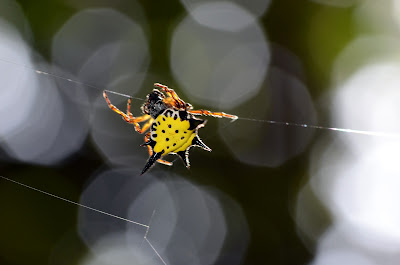
Hasselt's spiny spider Macracantha hasselti, copyright Patrick Randall.


In many warmer parts of the Old World, the spiny orb-weavers of the subfamily Gasteracanthinae are among the most eye-catching of all spiders. As well as constructing complex, easily seen webs in the manner of other orb-weavers, these spiders draw attention by their bright colours and ornate structure, often with prominent arrangements of spines on the abdomen. Here in Australia, their dramatic appearance has lead to their often being referred to as "Christmas spiders". The exact reason for this drama is uncertain. The spines are generally presumed to be for defence but the coloration has been subject to multiple proposals from an aposematic warning to functioning as a lure for flying insects.

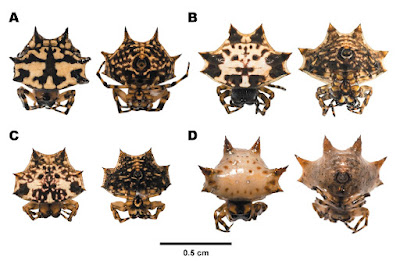
Variants of Gasteracantha kuhli, from Macharoenboon et al. (2021).


The taxonomic history of the Christmas spiders is a complicated one, going back to the early years of arachnology. Not surprisingly for such distinctive animals, a large number of species were described by early authors. However, species of spiny orb-weavers are often very variable, leading to a significant number being described as new on more than one occasion. As with other orb-weavers, males are much smaller than females, and the spines on the abdomen tend to be more poorly developed. Coloration within a species can vary considerably in brightness, tone, and patterning. Structural features such as the arrangement of spines and the development of sigilla (impressions on the dorsal surface of the abdomen that mark the placement of internal muscles) can still provide reliable indicators of species identity, as (of course) can features of the genitalia. You have to learn to look past the superficial daubings and focus on the underlying form.

Where There's a Whip, There's a Scorpion

As our understanding of the higher relationships between organisms has improved vastly in recent decades, the arachnids have remained an intransigent bunch. Proposed connections between the various historically recognised orders have remained poorly supported and, even now, there are few that do not continue to jump about with gleeful abandon with each successive analysis. One small bastion of reliable support, however, has been been the tropical clade known as the Pedipalpi.

Whip spider Phrynus exsul, copyright Michel Candel.


Members of the Pedipalpi have traditionally been divided between two or three distinct orders: the whip spiders or tailless whip scorpions of the Amblypygi, the whip scorpions of the Uropygi, and the micro-whip scorpions of the Schizomida (alternative classifications have combined the last two in a single order Uropygi or Thelyphonida). All have a broad distribution in tropical and subtropical regions of the world. Representatives of the Pedipalpi are active hunters, united by the possession of large, raptorial pedipalps used in the capture of prey. All three groups also have the first pair of legs modified to become elongate and whip-like (Shultz 2007). These legs are not used in walking but are held forwards to function like antennae. The Uropygi and Schizomida are further united by the possession of a terminal appendage on the body, the 'whip' of a 'whip scorpion'. There is also a general agreement in recent years that the Pedipalpi are in turn the sister lineage to the spiders. Some researchers have argued for a closer relationship of the Amblypygi to the spiders rather than the whip scorpions, reflecting their (among other things) similar habitus, but this remains a minority view.

Syntype (one of the original described specimens) of Paracaron caecus, from Garwood et al. (2017). Scale bar = 5 mm.


Globally, the Pedipalpi are not a hugely diverse lineage, with a bit more than 600 known species overall. About 190 species belong to the Amblypygi, the whip spiders. As noted above, these arachnids are quite spider-like in appearance owing the lack of a terminal flagellum and the presence of a well-defined waist between cephalothorax and abdomen, but they lack the poison fangs and spinnerets of a spider. Most whip spiders have a distinctly flattened habitus, allowing them to enter narrow spaces under bark or between rocks. They also have the most remarkably elongate first legs among the Pedipalpi. Living whip spiders can be divided between two lineages, referred to as the Paleoamblypygi and Euamblypygi (Garwood et al. 2017). The Paleoamblypygi are represented in the modern fauna by only a single known (but little known) species, Paracharon caecus, a blind inhabitant of termite nests in western Africa. Paracharon caecus differs from other living whip spiders in retaining a vertical plane of motion of the pedipalps, like those of whip scorpions. In the Euamblypygi, the orientation of the pedipalps has shifted so they move in a horizontal plane only. In some whip spiders, the pedipalps have become remarkably long, perfect for clasping prey in a fatal hug.

Giant whip scorpion Mastigoproctus giganteus, copyright David Bygott.


The whip scorpions of the Uropygi are the least diverse of the three lineages of Pedipalpi, with about 110 known species. They are large, robust arachnids characterised by their long, filamentous terminal flagellum. Glands at the base of the flagellum produce noxious chemicals used in defense, giving some species the alternative name of 'vinegaroons'. The Schizomida are the most diverse subgroup of the Pedipalpi, including about half the known species. Some species have become widespread as a result of human transportation in association with greenhouses whereas others have even been collected among ice and snow in California (Harvey 2003). Schizomids are smaller and softer-bodied than the Uropygi and the terminal flagellum is shorter (as in Uropygi, the flagellum is flanked by repugnatorial glands). In male schizomids, the flagellum is often distinct in shape from that of the females, becoming bulbous. Schizomids also differ from most other arachnids in the presence of visible dorsal divisions between the segments of the cephalothorax.

Female schizomid Hubbardia briggsi, copyright Marshal Hedin.


In all subgroups of the Pedipalpi, reproduction involves mating displays in which the male deposits a spermatophore on the ground and then guides the female over it (Harvey 2003). The exact manner in which the male guides the female differs between subgroups. In schizomids, the female grasps onto the male's flagellum and he leads her. In Uropygi, the male grasps the female's fore legs with his pedipalps before turning to face the same direction as her with himself in front, and pulls her over the spermatophore. He then turns, embraces her abdomen with his pedipalps, and manually inserts the spermatophore into her genital operculum. Amblypygi have perhaps the most graceful option of the three: the male stands facing the female then gently beckons her forward, allowing her to approach and collect the spermatophore of her own volition.

REFERENCES

Garwood, R. J., J. A. Dunlop, B. J. Knecht & T. A. Hegna. 2017. The phylogeny of fossil whip spiders. BMC Evolutionary Biology 17: 105.

Harvey, M. S. 2003. Catalogue of the Smaller Arachnid Orders of the World: Amblypygi, Uropygi, Schizomida, Palpigradi, Ricinulei and Solifugae. CSIRO Publishing.

Shultz, J. W. 2007. A phylogenetic analysis of the arachnid orders based on morphological characters. Zoological Journal of the Linnean Society 150 (2): 221–265.

The Running of the Crabs

There are many varieties of spider in the world that, while not necessarily uncommon, tend to be little known to the general public owing to their cryptic and retiring nature. As an example, meet the genus Philodromus.

Philodromus cespitum, copyright R. Altenkamp.


Philodromus is the largest genus recognised in the family Philodromidae, commonly referred to as the running crab spiders or small huntsman spiders. About 250 species have been assigned to this genus from various parts of the world (Muster 2009), mostly in the Holarctic region. Like the huntsman spiders of the Sparassidae and the crab spiders of the Thomisidae, philodromids are an example of what old publications often referred to as 'laterigrade' spiders, in which the legs are arranged to extend sideways from the body more than forwards and backwards. They have eight eyes arranged in two recurved rows of four. Philodromids differ from crab spiders in having scopulae (clusters of hairs that can look a bit like little booties) on the leg tarsi, and having secondary eyes that lack a tapetum (reflective layer). They differ from huntsmen in that the junction between the tarsi and metatarsi is restricted to movement in a single plane, rather than the tarsus being able to move freely (Jocqué & Dippenaar-Schoeman 2007). Philodromids do not build a web to capture prey but instead seize prey directly.

The distinction between Philodromus and other genera in the family has historically been imprecise (Muster 2009) which goes some way to explaining the large number of species it has encompassed. In general, though, the eye rows of Philodromus are relatively weakly recurved, and its body form is less slender than that of the genera Tibellus and Thanatus. These may well be primitive features for the family, and a phylogenetic analysis of philodromids by Muster (2009) indicated that at least one group of species historically included in Philodromus (the P. histrio group) may be more closely related to the slender-bodied genera. The great French arachnologist Eugene Simon recognised several species groups in Philodromus, distinguished by features such as eye arrangement and leg spination, but recent authors feel that the status of these groups requires further investigation before we could consider treat?ing them as distinct genera.

Philodromus dispar, copyright Judy Gallagher.


Most species of Philodromus live on vegetation, flattening themselves against stems and foliage to avoid detection. As with other laterigrade spiders, the arrangement of their legs allows for rapid sideways movement, perfect for avoiding predators or turning up where prey do not expect them. At least one species group found in the Mediterranean region (including P. pulchellus and its relatives) differs in being ground-living, with a predilection for salt flats (Muster et al. 2007). Bites to humans from Philodromus appear to be vanishingly rare: a report on such a bite by Coetzee et al. (2017) appears to be the first record of one (the bite was painful, causing swelling and some ulceration, but without long-term effects following treatment). Philodromus species are much more likely to have a net positive value to humans, as they may act as control agents for insect pests among crops and orchards.

REFERENCES

Coetzee, M., A. Dippenaar, J. Frean & R. H. Hunt. 2017. First report of clinical presentation of a bite by a running spider, Philodromus sp. (Araneae: Philodromidae), with recommendations for spider bite management. South African Medical Journal 107 (7): 576–577.

Jocqué, R., & A. S. Dippenaar-Schoeman. 2007. Spider Families of the World. Royal Museum for Central Africa: Tervuren (Belgium).

Muster, C. 2009. Phylogenetic relationships within Philodromidae, with a taxonomic revision of Philodromus subgenus Artanes in the western Palearctic (Arachnida: Araneae). Invertebrate Systematics 23: 135–169.

Muster, C., R. Bosmans & K. Thaler. 2007. The Philodromus pulchellus-group in the Mediterranean: taxonomic revision, phylogenetic analysis and biogeography (Araneae: Philodromidae). Invertebrate Systematics 21: 39–72.

The Monkey Orb of Asia

Just a quick entry for this week. And for the second week in a row, today's post will somehow involve monkeys.

Female monkey orb-weaving spider Neoscona punctigera, copyright Akio Tanikawa.


The orb-weavers of the family Araneidae are a highly diverse group of spiders, with well over 3000 known species. They are also one of the most familiar spider groups, often being relatively large as well as visible due to their construction of exposed and characteristic webs. The lady in the picture above represents one of the more moderately sized species, being about a centimetre in length (Tikader & Bal 1981). Neoscona punctigera is a widespread species in Asia, with a range extending from Madagascar and surrounding islands to Japan, as well as south into New Guinea and northernmost Australia. Vernacular names for the species include ghost spider or monkey orb-weaver. Like many other orb-weavers, N. punctigera only puts up its web at night; it sits in the web head downwards. When morning comes, the spider consumes the previous night's web and finds a concealed spot to hide until evening. On the underside of the body, N. punctigera has one or two pairs of bright white spots. When the spider is hunkered down for the day, these spots are concealed but when the spider is out on its web at night they are very visible; Chuang et al. (2008) found that these bright spots appear to attract prey, as spiders who had had their spots painted over caught less moths than usual.

Male Neoscona punctigera, copyright Suresh Kumar.


The name 'monkey orb-weaver' refers to the appearance of the male, which like the males of other orb-weavers is quite a bit smaller than the female (I have no idea where the name 'ghost spider' comes from; perhaps something to do with the spider's appearance on a web?) Resting males tend to adopt a pose with the front legs bent close together and the rear legs crossed behind the abdomen (as in the photo just above). Combined with eye-like spots on the abdomen, the overall effect has been compared to a monkey lying back with its legs crossed and its hands behind its head.

Orb-weaver taxonomy can often be confusing. Early authors tended to dump a large number of orb-weavers in a broad genus Araneus; though this genus is now used in a much narrower sense, many orb-weaver genera are difficult to distinguish without examining the genitalia. Individual species can also be quite variable in superficial appearance with a lot of variation in colour pattern, so many species were initially described under a number of names. Female Neoscona differ from Araneus in the presence of a longitudinal groove on the cephalothorax, as well as the presence of one or two lateral lobes at the base of the scape (a projecting process over the epigyne, the sclerotised structure around the female genital openings). Distingushing N. punctigera from other species of Neoscona requires even closer inspection of the genitalia. In a number of older sources the species now generally referred to as Neoscona punctigera (including in the World Spider Catalog) is commonly referred to as 'Araneus lugubris'. Confusingly enough, the latter name actually has priority (it dates to 1841 whereas the name pectinigera was only published in 1857) but has fallen out of disuse since Grasshoff (1986) stated that it was preoccupied in a review of African Neoscona. I'm not sure if he was correct—I suspect that he thought it was antedated by Aranea lugubris, published in 1802 for what is now a species of wolf spider, but as the 1841 species was originally placed in the now-obsolete genus Epeira I don't think they actually conflict. Nevertheless, the rules governing how preoccupation affects the use of older names can be complicated and if N. pectinigera has been settled as standard then it may be best to let it be.

REFERENCES

Grasshoff, M. 1986. Die Radnetzspinnen-Gattung Neoscona in Afrika (Arachnida: Araneae). Annalen Zoologische Wetenschappen 250: 1–123.

Chuang, C-Y., E.-C. Yang & I.-M. Tso. 2008. Deceptive color signaling in the night: a nocturnal predator attracts prey with visual lures. Behavioral Ecology 19 (2): 237–244.

Tikader, B. K., & A. Bal. 1981. Studies on some orb-weaving spiders of the genera Neoscona Simon and Araneus Clerck of the family Araneidae (=Argiopidae) from India. Records of the Zoological Survey of India, Occasional Paper 24: 1–60.