Field of Science

Showing posts with label Angiospermae. Show all posts

Eriogonum spergulinum, the Spurry Buckwheat

Wandering around sandy highlands of the southwest United States, you may encounter a sparse, wiry weed growing between five and forty centimetres in height. This is the spurry buckwheat Eriogonum spergulinum.

Spurry buckwheat Eriogonum spergulinum, copyright Dcrjsr.


Members of the buckwheat family Polygonaceae are found worldwide but tend to be easily overlooked as low, scrubby weeds. In North America, one of the most diverse genera is Eriogonum, known from about 250 species though many are difficult to readily distinguish (Hickman 1993). Eriogonum spergulinum is one of the more recognisable species in the genus. As mentioned above, it grows in sandy soils, particularly those dominated by worn-down granite, and is found at altitudes between 1200 and 3500 metres. It is an annual herb with basal leaves of a linear shape, less than two millimetres wide but up to thirty millimetres long. The greater part of the plant's height is made up by the slender, cyme-like inflorescence bearing unribbed, four-toothed involucres on slender stalks. The flowers are up to three millimetres in diameter with a white perianth marked by darker stripes. Overall, E. spergulinum in flower resembles a drifting cloud of small white stars.

Close-up on Eriogonum spergulinum flowers, copyright Tom Hilton.


Three varieties of Eriogonum spergulinum have been recognised though they are not always distinct and tend to intergrade with each other. In most parts of the species' range, plants belong to the variety E. spergulinum var. reddingianum. This variety is characterised by erect inflorescences with glandular axes and flowers about two millimetres in diameter. The other two varieties are both restricted to the Sierra Nevada mountains of California. Eriogonum spergulinum var spergulinum resembles var. reddingianum but produces larger flowers, about three millimetres in diameter. Eriogonum spergulinum var. pratense is more distinctive. Inflorescences are prostrate to ascending, only about two to five millimetres in height, and lack glands on the axes. Flowers are only 1.5 millimetres across. Pratense is also a higher-altitude variety, found at heights above 2500 metres. The Sierra Nevada varieties are both uncommon; if any variety is likely to be found, it is the widespread reddingianum.

REFERENCE

Hickman, J. C. (ed.) 1993. The Jepson Manual: Higher Plants of California. University of California Press: Berkeley (California).

Succulent Orchids

With over 1200 known species found in Asia and Australasia, Dendrobium is one of the largest currently recognised genera of orchids. As with other examples of such 'super-genera', the question of how to best handle such a monster has been fiercely debated. In 2003, Australian botanist M. Clements proposed dividing Dendrobium between numerous segregate genera, noting (among other reasons) that the genus as previously recognised was not monophyletic. However, Clements' system does not seem to have garnered widespread usage with other orchid systematists preferring to retain a broad concept of Dendrobium (excluding some of the more egregious outliers) that largely corresponds with its established usage (e.g. Schuiteman 2011). Nevertheless, many of the subdivisions promoted by Clements remain recognised as well delimited groups. One such cluster is the assemblage of species recognised as Dendrobium section Aporum.

Growth habit of Dendrobium sect. Aporum, copyright Tony Rodd.


Species of section Aporum are epiphytes found in lowland forests of south-east Asia, extending eastwards to New Guinea and the Solomon Islands. Members of this section have thin stems that are erect at first but tend to become pendulous as they lengthen. Leaves are fleshy and equitant: that is, they are folded longitudinally with what would otherwise be the two sides of the dorsal surface fused, except at the base where they overlap with opposing leaves. The stem may be more or less completely concealed by the leaf bases. Tips of the leaves end in a point. Flowers are borne singly or in clusters, arising laterally on the stem between leaf nodes or at the tip of the stem alongside a terminal scale. The flowers may be subtended by persistent chaffy bracts. They are generally small and fleshy and tend to be short-lived, wilting after just a few days.

Flowers of Dendrobium anceps, copyright Aqiao HQ.


The functional significance of the Aporum section's distinctive leaves remains uncertain. As noted by Carlsward et al. (1997), the fleshy leaves might be taken as an adaptation to water retention. However, though access to water is a consistent concern for epiphytes, the humid rainforests in which Aporum species are found hardly seem the driest of places. Conversely, the effective even distribution of stomata on both sides of leaf resulting from their equitant condition may make it easier for excess water to be released from the plant.

Dendrobium distichum, photographed by Ronny Boos.


Orchids in general are, of course, most often considered by people as ornamental plants. My impression is that the various Aporum species tend not to be among the most widely grown of species though their unusual growth habit might attract interest. This may be due to them not being the easiest of orchids to maintain; they appear to require high humidity and warm temperatures to thrive with a cooler, drier period in the non-growing season. Among the more popular species are Dendrobium anceps and D. keithii, both of which produce small greenish flowers. Those of D. anceps have been described as having a distinct "apple pie" fragrance. Of course, if you happen to be wandering through the jungles of south-east Asia, you might well discover these plants growing of their own accord.

REFERENCES

Carlsward, B. S., W. L. Stern, W. S. Judd & T. W. Lucansky. 1997. Comparative leaf anatomy and systematics in Dendrobium, sections Aporum and Rhizobium (Orchidaceae). International Journal of Plant Sciences 158 (3): 332–342.

Clements, M. A. 2003. Molecular phylogenetic systematics in the Dendrobiinae (Orchidaceae), with emphasis on Dendrobium section Pedilonum. Telopea 10 (1): 247–298.

Schuiteman, A. 2011. Dendrobium (Orchidaceae): to split or not to split? Gardens' Bulletin Singapore 63 (1–2): 245–257.

Leandra

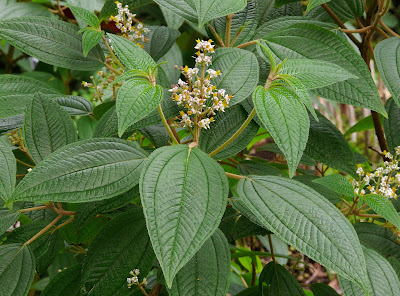
I'm sure I've noted before that there are a number of plant families that form significant components of the world's flora but tend to glide under the radar of popular representation owing to their largely tropical distributions. One of the prime examples is the Melastomataceae, an assemblage of over 5000 known species that represents one of the ten largest recognised plant families. Melastomes often stand out from other tropical plants by their distinctive leaves, which are opposite with acrodromous venation (several strong longitudinal veins arch outwards from the base to converge near the tip) and flowers that often bear large, colourful anthers (New York Botanical Garden). They are most diverse in the Neotropics with one of the significant genera found in this region being Leandra.

Leandra subseriata, copyright James Gaither.


As currently recognised, Leandra includes over two hundred species with the highest diversity centred in southeastern Brazil. Leandra forms part of the tribe Miconieae, distinguished by flowers with more or less inferior ovaries and fleshy berry fruits. Genera within the Miconieae have historically been difficult to define; as early as 1891, the Belgian botanist Alfred Cogniaux declared that they were essentially arbitrary. Leandra was supposed to be defined by its acute petals and terminal inflorescences but it has not always been clear whether a given species can be said to possess these features or not. It should therefore come as no surprise that the genus Leandra proved to be polyphyletic with the advent of molecular analysis (Martin et al. 2008). Nevertheless, a large clade centered on southern Brazil has continued to be referred to as Leandra sensu stricto.

There appear to be few if any direct observations of pollination in Leandra but flower morphology and comparison with related genera suggests that they are buzz-pollinated with pollinators taking pollen as a reward (Reginato & Michelangeli 2016b; buzz-pollination referring to pollination by bees where the bee's buzzing induces the flower to release pollen). Apomixis, with seeds being produced directly from ovule tissue without pollination, is not uncommon and may even be the majority condition (Reginato & Michelangeli 2016a). Seeds are dispersed by birds feeding on the berries. Many Leandra species appear very localised in distribution and they are particularly diverse in a number of high altitude areas. Species vary in their preferred habitat from disturbed to undisturbed; those species found in undisturbed locations are rare components of the understory, but those found in disturbed habitats may be among the most abundant shrubs in the area.

REFERENCES

Martin, C. V., D. P. Little, R. Goldenberg & F. A. Michelangeli. 2008. A phylogenetic evaluation of Leandra (Miconieae, Melastomataceae): a polyphyletic genus where the seeds tell the story, not the petals. Cladistics 24: 315–327.

Reginato, M., & F. A. Michelangeli. 2016. Diversity and constraints in the floral morphological evolution of Leandra s.str. (Melastomataceae). Annals of Botany 118: 445–458.

Reginato, M., & F. A. Michelangeli. 2016. Untangling the phylogeny of Leandra s.str. (Melastomataceae, Miconieae). Molecular Phylogenetics and Evolution 96: 17–32.

Lilies of Blood

The flora of southern Africa is renowned for being remarkably diverse and, in many cases, remarkably eye-catching. The region is home to more than its fair share of ornamental plants, many of which have become popular garden subjects. Among the remarkable members of the southern African flora are the blood lilies of the genus Haemanthus.

Haemanthus coccineus, copyright Peter Coxhead.


Haemanthus is a genus of 22 known species found in the very southern part of the continent, in the countries of South Africa and Namibia (species from further north that have historically been included in Haemanthus are now treated as a separate genus Scadoxus). It is a member of the belladonna family Amaryllidaceae and, like many other members of that family, grows as a herb from a fleshy bulb that is partially or entirely concealed underground. The plant above ground may be annual or persistent, depending on species. Each individual Haemanthus plant produces very few leaves at a time: two is the most common number (Van Jaarsveld 2020). The leaves are more or less fleshy, often hairy, and may be directed upwards or spread outwards.

In those species that shed their leaves, flower stalks are produced before the next season's leaves appear, in a similar matter to the related naked ladies Amaryllis belladonna. Flowers are produced in dense umbels, subtended by bracts that are often brightly coloured, so at a glance the inflorescence of some species might be taken for a single large flower up to ten centimetres in diameter. Depending on the species, the supporting stalk may vary from over a foot in height to only a few centimetres. The first species to be described bear flowers of a bright red colour, explaining both the genus and vernacular names, but flowers may also be pale pink or white. Species that lack the red colour may be referred to as 'paintbrush lilies' rather than 'blood lilies'. Fruits are soft fleshy berries.

Haemanthus albiflos, copyright Krzysztof Ziarnek, Kenraiz.


Phylogenetic analyses of the genus have identified two major clades, a mostly eastern clade found in regions with summer rainfall and a mostly western clade associated with winter rainfall. A notable outlier is the eastern summer-rainfall species H. montanus which is the sister taxon to the winter rainfall clade. Members of the summer-rainfall clade have white or pale pink flowers; members of the winter-rainfall clade have pale pink to dark red flowers. Members of both clades have been grown as pot plants for their unusual appearance though the scent of the flowers is not regarded as pleasant. Perhaps the most widely grown species is H. albiflos, a species native to both the western and eastern parts of South Africa that bears flowers in umbels up to seven centimetres wide. This species is evergreen, carrying its leaves year-round.

REFERENCE

Van Jaarsveld, E. 2020. Haemanthus. In: Eggli, U., & R. Nyffeler (eds) Illustrated Handbook of Succulent Plants: Monocotyledons 2nd ed. pp. 441–443. Springer.

Woolly Orchids

The orchids of the Orchidaceae are widely recognised as one of the most diverse families of plants in the modern world, both in number of species and morphologically. They are readily distinguished from other flowering plants by a unique combination of features including the fusion of the male and female organs of the flower into a central column. Rather than being released as individual grains, pollen is aggregated into compact masses called pollinia that are attached to pollinators as whole units. Most orchid species also have the lower of the flower's three petals enlarged and differentiated into a distinctive lip that may present a bewildering array of shapes and colours. Because of their striking and colourful appearance, many orchids have long attracted attention from humans and many are popular ornamentals. But there are also some major groups of orchids that have been more neglected and one such group is members of the subtribe Eriinae.

Dendrolirium tomentosum, copyright Orchi.


The Eriinae comprise about a thousand known species of orchid found mostly in the tropics of Asia and the west Pacific, with a handful of species described from Africa. Most are epiphytes and lithophytes (growing on rocks); a smaller number are terrestrial. Because the flowers of eriines tend to be fairly small and simple, they have attracted less notice than other members of the family, but in some parts of their range they are among the most abundant epiphytic orchids (Ng et al. 2018). Within the Orchidaceae, eriines are a subgroup of the subfamily Epidendroideae, characterised by compact, laterally compressed pollinia, and the tribe Podochileae, with duplicate leaves, a short and massive column, and often spherical silica cells in the stems (Szlachetko 1995). The features distinguishing Eriinae from other subtribes of Podochileae are more vague and there are reasons to believe the Eriinae ultimately represent the paraphyletic residue of the tribe once the more specialised subgroups are removed (Ng et al. 2018). One recent classification of the orchids recommended abandoning subtribes within the Podochileae altogether (Chase et al. 2015). Nevertheless, features characteristic of most eriines include a terminal or upper lateral inflorescence, eight pollinia per flower, and sticky caudicles on the pollinia composed of apical pollen grains. The lip is commonly divided into three lobes. Another common feature of the group (and the inspiration for the name of the type genus Eria, meaning 'woolly') is a covering of hairs on the flower and sometimes the inflorescence. In one genus, Trichotosia, the leaves are also hairy.

Ascidieria grandis, copyright Dick Culbert.


Historically, the majority of eriines have been included in a broad genus Eria. However, as with the subtribe as a whole, recent studies have indicated that this sense of Eria is not monophyletic and hence its species should probably be divided between several genera. Ng et al. (2018) recognised 21 genera among the eriines. The African species, previously placed in their own genus Stolzia, were united with the closely related Asian genus Porpax.

The pollination biology of eriines is, for the most part, not well known. Some have speculated that they were pollinated by beetles; one website I found showed pollinia attached to a gnat. The two species of the genus Callostylis have flowers whose appearance suggests pollination by pseudocopulation (tricking male insects into attempting to mate with them by mimicking females) but such flowers are unique within the Podochileae (Ng et al. 2018). At least some eriines have flowers producing 'pseudopollen' from broken-off hairs (Pansarin & Maciel 2017). This pseudopollen is collected and eaten by pollinators. Thus, though the most common means of attracting pollinators among orchids is via deception, at least some eriines are willing to pay their way in life.

REFERENCES

Ng, Y. P., A. Schuiteman, H. A. Pedersen, G. Petersen, S. Watthana, O. Seberg, A. M. Pridgeon, P. J. Cribb & M. W. Chase. 2018. Phylogenetics and systematics of Eria and related genera (Orchidaceae: Podochileae). Botanical Journal of the Linnean Society 186: 179–201.

Pansarin, E. R., & A. A. Maciel. 2017. Evolution of pollination systems involving edible trichomes in orchids. AoB Plants 9: plx033.

Szlachetko, D. L. 1995. Systema Orchidalium. Fragmenta Floristica et Geobotanica Supplementum 3: 1–152.

Tears of a Baby

For many people, the most familiar members of the plant family Urticaceae are the stinging nettles. However, the nettles make up only one part of this cosmopolitan family and there are many representatives that do not sting. One such plant is Soleirolia soleirolii, commonly referred to by the vernacular name of baby's tears.

Baby's tears Soleirolia soleirolii growing around dwarf horsetail Equisetum scirpoides, copyright Carnat Joel.


The only species of its genus, Soleirolia soleirolii is a small creeping herb with more or less succulent stems and subcircular leaves half a centimetre or less in diameter (Harden 1990). It grows in damp habitats and may even grow submerged in water. Baby's tears form a dense flat mat with stems rooted at the nodes. The tiny white flowers reach only a millimetre in size. Wikipedia lists a number of vernacular names for this plants, such as baby's tears, angel's tears, Corsican creeper, or mind-your-own-business (I have no idea what this last name refers to).

In its native range, Soleirolia soleirolii is mostly restricted to islands of the western Mediterranean, including Corsica, Sardinia and Majorca, with a localised mainland population near Rome in Italy (Schüßler et al. 2019). A population was also recently discovered near the coast of Algeria (Hamel & Boulemtafes 2017). On the basis of molecular phylogenetic dating, Schüßler et al. (2019) suggested that its current range may be relictual, having gone extinct over most of mainland Europe as the climate changed. However, as those who glanced at the references for this post may have already guessed, Soleirolia has now become established in many parts of the world outside its native range. It has often been grown as a ground cover or houseplant. If it finds itself somewhere it likes, it may become invasive; though easily uprooted, its proclivity for vegetative reproduction means that it can easily return if not thoroughly cleared. And so we have a paradox, where what is regarded as a valuable relict in one location may be considered a vexatious weed in another.

REFERENCES

Hamel, T., & A. Boulemtafes. 2017. Découverte d'une endémique tyrrhénienne Soleirolia soleirolii (Urticaceae) en Algérie (Afrique du Nord). Flora Mediterranea 27: 185–193.

Harden, G. J. (ed.) 1990. Flora of New South Wales vol. 1. New South Wales University Press.

Schüßler, C., C. Bräuchler, J. A. Reyes-Betancort, M. A. Koch & M. Thiv. 2019. Island biogeography of the Macaronesian Gesnouinia and Mediterranean Soleirolia (Parietarieae, Urticaceae) with implications for the evolution of insular woodiness. Taxon 68 (3): 537–556.

The Spread of Carrots

Carrots are one of the staple vegetables in this part of the world as well as in a great many others. Indeed, Wikipedia informs us that about forty million tonnes of carrots and turnips were produced worldwide in 2018, and I would have to think that carrots accounted for the greater part of that number. Wild carrots are also a widespread weed that can commonly be seen growing in disturbed, open habitats such as roadside verges. This post is about the group of plants that carrots typify, the subtribe Daucinae.

Wild carrot Daucus carota in flower, copyright Cwmhiraeth.


Daucinae is a subgroup of the plant family Apiaceae, historically known as the Umbelliferae. The latter name refers to the characteristic production of flowers in dense, flat-topped inflorescences known as umbels. Anyone who is familiar with the appearance of carrot flower-heads is familiar with the form of an umbel; the wild form of carrot is often known as "Queen Anne's lace" in reference to said appearance. The fruit of Apiaceae species is a schizocarp, a dry fruit that splits at maturity into segments (called mericarps), each containing a single seed, that are dispersed independently. In Daucinae and related group of umbellifers, the mericarps carry longitudinal ribs, both primary ribs containing a vascular bundle and secondary ribs without. The secondary ribs of Daucinae are often modified to form broad wings or curved spines that function in the mericarp's dispersal.

Broad-leafed sermountain Laserpitium latifolium seedheads, showing wings, copyright Krzysztof Ziarnek, Kenraiz.


Historically, these differences in mericarp morphology have been used to assign the species bearing them to different tribes. However, more recent phylogenetic analyses have indicated that changes between wings and spines have occurred on multiple occasions due to changes in mode of dispersal (Wojewódzka et al. 2019). Mericarps bearing wings are generally anemochorous (dispersed by wind) whereas those bearing spines are epizoochorous (carried by animals, such as stuck to a mammal's fur). The distinction is not 100% immutable: winged seeds may sometimes get caught in fur, spined seeds may be carried slightly further by wind than smooth ones. Phylogenies indicate that anemochory was the ancestral condition for Daucinae, retained in genera such as Laserpitium and Thapsia. Epizoochorous species do not form a single clade within the Daucinae (indeed, the genus Daucus includes both anemochorous and epizoochorous species) but it is unclear to what degree epizoochory arose on multiple occasions versus reversions to anemochory from epizoochorous ancestors. Two species of Daucinae, Daucus dellacellae from the Cyrenaica region of northern Africa and Cryptotaenia elegans from the Canary Islands, have neither spines nor wings on their mericarps which are therefore dispersed by gravity alone. In the case of C. elegans, at least, it has been suggested that it evolved from epizoochorous ancestors that lost the spines because of the absence of suitable dispersing animals on the islands (Banasiak et al. 2016).

Though the carrot Daucus carota is perhaps the most widely grown daucine umbellifer, it is not the only economically significant member of the group. Cumin Cuminum cyminum, whose seeds are widely used as a spice, is either a daucine or a close relative of daucines (Banasiak et al. 2016). Cuminum does differ from other daucine genera in that its mericarps lack appendages on the secondary keels, however. Gladich Laser trilobum is a perennial found growing in Europe and western Asia whose seeds are used as a condiment. Certain species of the deadly carrot genus Thapsia have a history of medicinal usage though, as their vernacular name suggests, their use does require caution. One species, T. garganica, is among the suggested candidates for the identity of the mysterious silphium of the Romans (used, among other things, as an abortifacient) though perhaps not the most likely contender. That, perhaps, is a story for another time.

REFERENCES

Banasiak, Ł., A. Wojewódzka, J. Baczyński, J.-P. Reduron, M. Piwczyński, R. Kurzyna-Młynik, R. Gutaker, A. Czarnocka-Ciecura, S. Kosmala-Grzechnik & K. Spalik. 2016. Phylogeny of Apiaceae subtribe Daucinae and the taxonomic delineation of its genera. Taxon 65 (3): 563–585.

Wojewódzka, A., J. Baczyński, Ł. Banasiak, S. R. Downie, A. Czarnocka-Ciecura, M. Gierek, K. Frankiewicz & K. Spalik. 2019. Evolutionary shifts in fruit dispersal syndromes in Apiaceae tribe Scandiceae. Plant Systematics and Evolution 305: 401–414.

Australasian Mistletoes

Australia is home to a fair diversity of parasitic mistletoes, nearly ninety species in all. In a previous post, I described one of our most remarkable species, the terrestrial Nuytsia floribunda. But, of course, the remaining species occupy the more typical aerial mistletoe habitat, growing directly attached to the branches and trunk of their host. And within Australia, the most diverse mistletoe genus is Amyema.

Amyema pendula growing on Acacia, copyright Groogle.


Species of Amyema are found in southeast Asia, Australia, and islands of the Pacific as far east as Samoa. A revision of the genus by Barlow (1992) recognised 92 species with the greatest diversity in the Philippines, Australia and New Guinea. They are found in a range of habitats, from wet rainforests to arid woodlands. Some species (particularly in arid habitats) grow from a single central haustorium (the structure by which a parasitic plant attaches to and draws nutrients from its host); others (particularly rainforest species) produce numerous haustoria from runners stretching along the outside of the host. Most rainforest species tend to have low host specificity but those growin in arid habitats may be more likely to restrict themselves to a small number of host species. Those species which restrict themselves to a single host may have leaves closely resembling that host, making them difficult to spot within the host canopy.

Amyema species are mostly characterised by their flowers which are typical borne in triads with the triads often then being clustered in loose umbels. In some species, the triads are reduced to pairs or single flowers. The flowers themselves are bird-pollinated and have four to six long petals that are generally separated right to the base, at most forming only a very short tube at the base of the flower. The flowers are hermaphroditic though a study of some Australian species by Bernhardt et al. (1980) found a tendency for anthers to mature before the stigma, presumably to prevent self-pollination.

Flowers of Amyema miquelii, copyright Kevin Thiele.


Not surprisingly, attention on mistletoes in Australia has commonly been focused on their effect on host trees. Mistletoe infestations may be heavy and have commonly been blamed for tree mortalities. However, one might legitimately question whether mistletoes themselves cause fatalities: does mistletoe infestation cause a host tree to become unhealthy, or are unhealthy trees more vulnerable to infestation by mistletoes? A study by Reid et al. (1992) on Amyema preissii infesting Acacia victoriae found that, though there was a relationship between mistletoe volume and host mortality, they were unable to demonstrate that mistletoe removal improved host survival. Conversely, such a positive effect was found by Reid et al. (1994) for removal of Amyema miquelii growing on two Eucalyptus species (the methods of this latter study also include the great line, "the highest mistletoes had to be shot down with a .22 rifle"). However, the authors remained conservative when it came to advocating mistletoe removal. Not only do a number of native birds and other animals depend on mistletoes for food and nesting sites, mistletoe removal can be an expensive process and may not itself be devoid of adverse effects on the host tree. Where rates of infestation are not extreme, it may still be better to just live and let live.

REFERENCES

Barlow, B. A. 1992. Conspectus of the genus Amyema Tieghem (Loranthaceae). Blumea 36: 293–381.

Bernhardt, P., R. B. Knox & D. M. Calder. 1980. Floral biology and self-incompatibility in some Australian mistletoes of the genus Amyema (Loranthaceae). Australian Journal of Botany 28: 437–451.

Reid, N., D. M. Stafford Smith & W. N. Venables. 1992. Effect of mistletoes (Amyema preissii) on host (Acacia victoriae) survival. Australian Journal of Ecology 17: 219–222.

Reid, N., Z. Yan & J. Fittler. 1994. Impact of mistletoes (Amyema miquelii) on host (Eucalyptus blakelyi and Eucalyptus melliodora) survival and growth in temperate Australia. Forest Ecology and Management 70: 55–65.

White by Evening in the American Southwest

Though various species of it may be found around the world, the evening primrose family Onagraceae reaches its highest diversity in the south-west of North America. For this post, I'm looking at a genus endemic to this region, Eremothera.

Eremothera boothii, copyright Kerry Woods.


Eremothera is one of several genera of evening primroses newly recognised by Wagner et al. (2007). The species included in this genus had previously been included in the broader genera Oenothera or Camissonia, but these genera were progressively broken down owing to polyphyly and poor definitions. Eremothera species are annual herbs with more or less erect stems. Leaves are arranged on the stem alternately; those near the base are carried on a long petiole of up to six centimetres. The genus is distinguished from its close relatives by having mostly white flowers that open in the evening (in rare cases they my be pink or red, fading as they age). Pollination is by moths when the flowers first open, with small bees visiting the flowers the following morning. The fruit is a long capsule that arises directly from the main stem without a subtending stalk.

Eremothera refracta with flowers and green fruits, copyright Stan Shebs.


Seven species of Eremothera were recognised by Wagner et al. (2007). Eremothera nevadensis is a specialist of clay soil that occupies a relatively small range in Nevada, around Reno. Eremothera refracta is a widespread species in the south-west United States with fruit that are of an even diameter along their length (Hickman 1993). Eremothera chamaenerioides is a self-pollinating derivative of E. refracta with smaller flowers in which the stigma is surrounded and overtopped by the anthers. Eremothera boothii and E. minor (both also widespread) have fruits that are wider at the base than at the tip. In E. minor the inflorescence is held erect; in E. boothii the flowers nod. Two localised species, E. gouldii and E. pygmaea, are self-pollinating derivatives of E. boothii. Eremothera minor is also self-pollinating, and may in some cases even be cleistogamous with pollen being transferred to the stigma without the flower even opening.

REFERENCES

Hickman, J. C. (ed.) 1993. The Jepson Manual: Higher Plants of California. University of California Press: Berkeley (California).

Wagner, W. L., P. C. Hoch & P. H. Raven. 2007. Revised classification of the Onagraceae. Systematic Botany Monographs 83: 1–240.

A Slipper of the Lip

The world of flowering plants includes many unusual and eye-catching examples but even among all this variety the orchids often stand out. Their remarkable array of colours and forms have long fascinated people around the world. One of the more distinctive of orchid subgroups is the Cypripedioideae, commonly known as the slipper orchids.

Pink slipper orchids Cypripedium acaule, copyright Sasata.


Slipper orchids get their name from their most easily recognisable feature, a flower with a deeply saccate labellum or lip (the lower of the three petals) that is supposed to resemble a slipper (an analogy presumably settled on because the alternative of 'scrotum orchid' doesn't have the same ring to it). Like many other orchids, slipper orchids attract pollinators through deception rather than offering a genuine reward. Pollinators are enticed into entering the lip through its large central opening but find themselves unable to exit the same way (presumably because of the way that the rim of the opening curls inwards). Instead, they are forced to make their exit through one of two smaller openings at the base of the lip where it joins the flower's central column. As the pollinator exits this way, it must crawl past the stigma and stamens, removing any pollen it might already be carrying and depositing a new load.

Dwarf slipper orchid Cypripedium fargesii, copyright Steve Garvie.


The exact manner in which the pollinator is lured in varies by species and target (Pemberton 2013). Many produce odours that mimic legitimate nectar-producing flowers or potential food sources such as carrion. A group of species in the genus Cypripedium that are pollinated by bumble bees have low-growing flowers with a purple lip whose main opening appears black. They therefore resemble the opening of a mouse-hole of the type bumble bees use as nest sites. The North American Cypripedium fasciculatum produces a mushroom-like smell that attracts diapriid wasps that parasitise fungus gnats. Some species of the genus Paphiopedilum have light-coloured spots or warts on the flower that are mistaken for a colony of fat, healthy aphids by egg-laying hover flies seeking a food source for their larvae. Perhaps one of the oddest known set-ups is found in the species Cypripedium fargesii whose hover fly pollinator normally feeds on fungal spores. The orchid lures the fly in with patches of hairs on its leave that resemble a fungal infection. A few slipper orchid species are known to be habitually self-pollinating without the intervention of a pollinator; one such species, the South American Phragmipedium lindenii, has lost the slipper-shaped labellum and instead has a lip resembling the other petals.

Selenipedium dodsonii, a species only described as recently as 2015, copyright Andreas Kay.


Slipper orchids have been recognised as a distinct group from other orchids since at least 1840. A number of features isolate them from other orchids, such as their possession of two functional stamens (most other orchids have flowers with only a single stamen). More recent phylogenetic studies have corroborated their position as one of the earliest-diverging orchid lineages. Over 170 species of slipper orchid are currently known, divided by most authors between five genera; most of these genera have widely separated geographic ranges. The genera Selenipedium and Cypripedium have plicate leaves (that is, leaves that are folded within the bud several times longitudinally, in the manner of a fan) that are widely spaced along a well-developed stem, and a prominent rhizome (Rosso 1966). Selenipedium is a small genus found in northern South America that may reach heights of five metres. It differs from the more diverse Cypripedium in having trilocular ovaries and a commonly branching stem; Cypripedium, with over fifty species found across the Holarctic region, has unilocular ovaries and never branches. Cypripedium is the most widely distributed of the slipper orchid genera; the North American C. passerinum may even be found growing in tundra.

Paphiopedilum Leeanum, a cultivated hybrid originally developed in Britain in the 1880s, copyright David Eickhoff.


Phylogenetic analysis of the slipper orchids places Selenipedium as the sister group of the other genera with Cypripedium the next to diverge (Cox et al. 1997). The remaining three genera likely form a single clade united by the possession of a condensed rhizome and conduplicate leaves (folded once in the bud along the midline) arranged in a basal rosette. Paphiopedilum is the most speciose genus of slipper orchids with over ninety species found in India and southeastern Asia; it is also the genus most commonly found in cultivation. Phragmipedium includes over 25 species found in Central and South America; one of these, the Peruvian P. kovachii, has the largest known flowers of any slipper orchid, reaching twelve centimetres in diameter. The third genus Mexipedium, includes a single species M. xerophyticum found in Oaxaca state in Mexico. The three conduplicate-leaved genera are less distinct than the other two genera (one notable distinction is that Phragmipedium has trilocular ovaries whereas those of Paphiopedilum and Mexipedium are unilocular) and it has been suggested that they should be merged into a single genus. Nevertheless, not only are they all geographically distinct, they are supported as monophyletic by molecular analysis (Cox et al. 1997).

Phragmipedium caudatum, copyright Eric Hunt.


Their dramatic appearance has made slipper orchids highly prized in cultivation or by flower collectors. Unfortunately, many species have been subject to over-collection as a result. Many of the temperate Cypripedium species now require intensive conservation management, and populations of some Paphiopedilum species have been driven close to extinction. Once again, it would be a tragedy if such a fascinating group of plants was to vanish from the world.

REFERENCES

Cox, A. V., A. M. Pridgeon, V. A. Albert & M. W. Chase. 1997. Phylogenetics of the slipper orchids (Cypripedioideae, Orchidaceae): nuclear rDNA ITS sequences. Plant Systematics and Evolution 208: 197–223.

Pemberton, R. W. 2013. Pollination of slipper orchids (Cypripedioideae): a review. Lankesteriana 13 (1–2): 65–73.

Rosso, S. W. 1966. The vegetative anatomy of the Cypripedioideae (Orchidaceae). Journal of the Linnean Society, Botany 59: 309–341.

Oily and Salty Trees

The Annonaceae is another one of those plant families like Acanthaceae that, despite containing a high diversity of speceis, tend to be overlooked because that diversity is mostly tropical. A number of species in the type genus Annona produce commercially significant fruits: custard apples, cherimoyas, soursops and the like. However, these are just a few of the 2400+ species of trees and lianes assigned to this family.

Ylang-ylang flowers Cananga odorata, from here.


Taxonomically, the Annonaceae is well established as distinct, readily recognised by a number of distinctive features. Among these is a characteristic 'cobweb' appearance to the wood structure when seen in cross-section, resulting from prominent rays of xylem connected by narrow cross-bands of parenchyma (Chatrou et al. 2012). Relationships within the family have been much harder to work out, not becoming well established until the advent of the molecular era. Recently, Chatrou et al. (2012) have recognised four subfamilies within the Annonaceae. The majority of species are placed in the subfamilies Annonoideae and Malmeoideae (which together form a clade), but a handful of species are placed in two basal subfamilies: one for the single genus Anaxagorea, and the Ambavioideae. Anaxagorea and the ambavioids differ from the annonoid-malmeoid clade in the structure of their seeds. Seeds of Annonaceae have what is called ruminate endosperm: that is, the surface of the endosperm is not smooth, but divided by wrinkles and grooves (the term 'ruminate' literally means 'chewed'). In Annonoideae and Malmeoideae, the ruminations of the endosperm are shaped like spines or lamellae. In Anaxagorea and the Ambavioideae, the ruminations are irregular in appearance. Molecular analyses place Anaxagorea as the sister taxon to all other Annonaceae.

View into the canopy of a salt-and-oil tree Cleistopholis patens, copyright Marco Schmidt.>


The Ambavioideae, despite not being very diverse, are widespread, with species found in the tropics of Africa, Asia and the Americas. Perhaps the best known ambavioid is the ylang-ylang tree Cananga odorata, native to south-east Asia, whose flowers are used as a source of perfume. Other south-east Asian ambavioids belong to the genera Cyathocalyx, Drepananthus and Mezzettia. The type genus, Ambavia, is native to Madagascar; other ambavioids in the genera Meiocarpidium, Cleistopholis and Lettowianthus are found in continental Africa. Finally, a single genus Tetrameranthus is found in South America. Most species of ambavioid are not systematically economically exploited but a number are locally used as sources of wood. The wood is light and not suitable for structural uses, but can be shaped and finished for utensils and other small items. The West African species Cleistopholis patens, whose Ghanaian name has been translated as 'salt and oil tree' (in reference to the taste of the bark when chewed), provides a fibrous bark that is readily stripped from the tree and is used for such purposes as matting and carrying straps (see here).

REFERENCES

Chatrou, L W., M. D. Pirie, R. H. J. Erkens, T. L. P. Couvreur, K. M. Neubig, J. R. Abbott, J. B. Mols, J. W. Maas, R. M. K. Saunders & M. W. Chase. 2012. A new subfamilial and tribal classification of the pantropical flowering plant family Annonaceae informed by molecular phylogenetics. Botanical Journal of the Linnean Society 169: 5–40.

Scurvy and Cress

Without the subject of today's post, it's just possible that my home country of New Zealand could have had quite a different history. Sometimes, one shouldn't overlook the importance of cress.

Pepperwort Lepidium heterophyllum, copyright Anne Burgess.


Lepidium is a genus of herbs and subshrubs belonging to the Brassicaceae, the same family as cabbages, radishes and cauliflowers. The genus is found worldwide, and more than 150 species have been recognised to date. The fruit is a type of dry capsule called a silicle which is usually dehiscent (one subgroup of Lepidium, previously separated as the genus Cardaria, has indehiscent fruit), with strongly keeled or winged valves, and contains a single pendulous seed in each locule. The seeds are usually copiously covered in mucilage (Mummenhoff et al. 2001). Like other members of the Brassicaceae, Lepidium has not been overlooked for culinary uses. Leaves and stems of number of species in the genus, such as garden cress Lepidium sativum and dittander Lepidium latifolium, are used as pot or salad herbs. A South American species, maca Lepidium meyenii, is grown as a root vegetable.

Because of its wide distribution, some early authors suggested that Lepidium was a very ancient genus whose members had diverged with the break-up of the Mesozoic supercontinents. However, more recent phylogenetic analyses (Mummenhoff et al. 2001) have suggested just the opposite: the crown group of Lepidium may have originated in the Mediterranean-Central Asian region little more than two million years ago. The mucilaginous seeds of many species become sticky when damp, and can easily be carried long distances adhered to birds' feet and other such dispersal agents. Perhaps the most dramatic suggestion of intercontinental dispersal in the genus involves a clade of species found in Australia and New Zealand that phylogenetic analysis suggests originated via hybridisation between two divergent species—with one parent being native to South Africa and the other to California (Mummenhoff et al. 2004).

Cook's scurvy grass Lepidium oleraceum, copyright Andrea Brandon.


It was one of the members of the latter clade that played a small but significant role in New Zealand history. Lepidium oleraceum is an endemic New Zealand species that was once found growing over much of the country. It is commonly known as 'Cook's scurvy grass', because Captain James Cook was able to collect it while surveying New Zealand to provide vitamin C to stave off the scurvy that could have otherwise devastated his crew. Sadly, this once common plant is now extremely rare: the disappearance of mainland-nesting seabirds means that they are no longer around to provide the guano-enriched soils on which this plant thrived. It also proved extremely palatable to introduced herbivores. As a result, Cook's scurvy grass is now almost exclusively found on small offshore islets.

REFERENCES

Mummenhoff, K., H. Brüggemann & J. L. Bowman. 2001. Chloroplast DNA phylogeny and biogeography of Lepidium (Brassicaceae). American Journal of Botany 88 (11): 2051–2063.

Mummenhoff, K., P. Linder, N. Friesen, J. L. Bowman, J.-Y. Lee & A. Franzke. 2004. Molecular evidence for bicontinental hybridogenous genomic constitution in Lepidium sensu stricto (Brassicaceae) species from Australia and New Zealand. American Journal of Botany 91 (2): 254–261.

The Mancos Saltbush: Life in the Badlands

Thanks to your support, I am nearly 40% of the way towards success at my crowdfunding drive. But with only two days left on the clock, I'm going to need everyone's help if I'm to be succesful. Please visit my page at Experiment.com and consider offering your support!

Mancos saltbush Proatriplex pleiantha, from here.


Proatriplex pleiantha, the Mancos saltbush, is arguably not much to look at. It never grows very large (only about half a foot in height) and though a single plant may produce a lot of flowers, they are not very showy. Nevertheless, this little fleshy-leaved annual is something of a survivor. It grows on badlands in only a few localities in northern New Mexico and southern Colorado, and may be the only vegetation to be found on the eroded clays that it calls home. It persists in this hostile environment by not persisting; instead, each individual plant will produce hundreds, if not thousands, of seeds during its short life that may lie dormant in the soil for several years, waiting for the flash of rain that will allow it to emerge.

The Mancos saltbush was first described in 1950; its vernacular name refers to the original collection locality near the Mancos River. It was originally described in the genus Atriplex, a diverse cosmopolitan assemblage of herbs and shrubs in the family Chenopodiaceae commonly known as saltbushes and oraches (the garden orache or mountain spinach A. hortensis has long been grown as a vegetable in Europe). However, right from the start it was considered distinctive enough to be placed in its own subgenus, later raised to the status of a distinct genus by Stutz et al. (1990). A molecular phylogenetic analysis by Kadereit et al. (2010) later confirmed that Proatriplex pleiantha is not a direct relative of Atriplex, instead being associated with other small North American Chenopodiaceae genera Grayia and Stutzia. Features distinguishing Proatriplex from true Atriplex include the succulent leaves, the flowers being borne in groups of three to seven in the axil of a single bract, and the presence of a five-segmented perianth around female flowers (Atriplex flowers are borne singly to a bract, and lack a perianth).

Because of its restricted range, the Mancos saltbush may be vulnerable to disturbances in its habitat; for instance, one of its main population centres in New Mexico is in close proximity to the Navajo coal mine. Nevertheless, this species is not currently listed by the US Fish & Wildlife service as being of concern, due to its being locally abundant in the areas where it does occur. Surveys of this species have been complicated by the dependence of its germination on suitable weather conditions: in years with little rainfall, it may appear to be almost absent, but the advent of a wetter year may prove otherwise. All it takes is a decent drop of rain, and you may see the badlands bloom.

REFERENCES

Kadereit, G., E. V. Mavrodiev, E. H. Zacharias & A. P. Sukhorukov. 2010. Molecular phylogeny of Atripliceae (Chenopodioideae, Chenopodiaceae): implications for systematics, biogeography, flower and fruit evolution, and the origin of C4 photosynthesis. American Journal of Botany 97 (10): 1664–1687.

Stutz, H. C., G.-L. Chu & S. C. Sanderson. 1990. Evolutionary studies of Atriplex: phylogenetic relationships of Atriplex pleiantha. American Journal of Botany 77 (3): 364–369.

Checker Mallows

The crowdfunding campaign for my research on New Zealand harvestmen is still active. So far we're about 25% of the way towards the goal! Please click on the link above, and do your part to support your favourite arachnologist.

Flowering spike of Sidalcea nelsoniana, copyright Rhiannon Thomas.


Regular readers may have noticed that it's been a bit quiet around here lately. The last few weeks at chez Christopher have been... hectic. I have been writing posts but not had the time to publish them. So over the next few days, you'll be seeing a bit of a run of short posts in quick succession. Keep your eyes out.

The handsome plant you see above is a representative of Sidalcea, a genus of about thirty species found in the north of Mexico and the western United States. Members of this genus are commonly known as checker mallows (apparently because of the pattern of veins on the petals of some species); in the British gardening trade, they are also known as prairie mallows. As indicated by their vernacular names, Sidalcea species belong to the mallow family Malvaceae, and are hence related to other flowering plants such as cotton or hibiscus. These affinities are also reflected by their genus name, which is a portmanteau of the names of two other genera of Malvaceae, Sida and Althaea. Checker mallows differ from other members of the Malvaceae in having flowers with stamens that separate from the stamineal column in two tiers, an inner and an outer ring.

Most species of checker mallow are herbs; a few may develop into subshrubs. The genus includes both perennial and annual species. Stems of checker mallows are mostly more or less erect though they are often basally reclining or decumbent towards the base;it is not uncommon for decumbent stems to become secondarily rooted into the ground and develop into spreading stolons (or 'rhizomes'). Flowers of checker mallows are usually various shades of purple; a small number of species have white flowers (or white forms may occur in usually purple species). Many species of this genus are supposed to be difficult to identify: hybridisation is not uncommon, and some species are quite plastic in their own right. Young plants may also have a quite different appearance, including differently shaped leaves, from mature plants.

Sidalcea campestris, photographed by Amy Bartow.


The primary monograph of Sidalcea was published by E. M. F. Roush in 1931. She divided the genus between three subgenera, two of which contained only a single species each with all the remainder placed in her subgenus Eusidalcea (since the publication of Roush's monograph, a third non-Eusidalcea species has been recognised). These species are all perennials that, among other features, lack the variation in leaf shape with growth seen in Eusidalcea. More recent molecular analyses have supported Roush's arrangement arangement (Andreasen & Baldwin 2003). However, they have not supported Roush's division of Eusidalcea into separate sections for the annual and perennial species; instead, it appears that one or the other habit (it is unclear which) has arisen multiple times.

Like other diverse plant genera found in the California region, Sidalcea has attracted a certain degree of research into its evolutionary dynamics. Comparison of evolutionary rates between species has found that, as might be expected, annual lineages evolve faster than perennial ones (Andreasen & Baldwin 2001). Most species within each life-history class appeared to evolve at similar rates to each other, except for three perennial species: the three non-Eusidalcea species referred to above. One of these species, Sidalcea stipularis (the only one not known to Roush in 1931) showed evidence of an unusually high evolutionary rate for a perennial; this species is restricted to a very small population (only a few hundred plants may exist in the wild) and may have been subject to a higher rate of effective genetic drift. In contrast, the other two species have diverged more slowly than expected. One of these species, S. malachroides, is a presumably slow-lived subshrub; the other, S. hickmanii, commonly germinates after fires from seeds that may have remained in the ground for a number of years. In both cases, the overall result is that particular genotypes may persist in the population longer than in species with a more rapid turnover.

Oregon checkerbloom Sidalcea oregana ssp. spicata, copyright Dcrjsr.


Another feature of Sidalcea population dynamics to have attracted interest is the occurrence in several species of gynodioecy, a phenomenon where some individuals of a population have flowers with both male and female organs whereas other individuals have female organs only. The persistence of such an arrangement raises questions: because hermaphroditic individuals have the potential to contribute to more reproductive pairings than female-only individuals, shouldn't the former end up out-competing the latter and eliminating them from the population? This has lead to the inference that some factor(s) must give the female-only individuals an advantage that allows them to persist. Ashman (1992) found in germination tests of Sidalcea oregana spp. spicata that seeds that came from female-only plants tended to germinate into healthier, more vigorous offspring than those from hermaphrodites. It may be that plants that can only produce seed by outcrossing are less vulnerable to the effects of inbreeding, or perhaps not having to invest energy in making pollen means that the parent can put more energy into producing seeds.

REFERENCES

Andreasen, K., & B. G. Baldwin. 2001. Unequal evolutionary rates between annual and perennial lineages of checker mallows (Sidalcea, Malvaceae): evidence from 18S–26S rDNA internal and external transcribed spacers. Mol. Biol. Evol. 936–944.

Andreasen, K., & B. G. Baldwin. 2003. Reexamination of relationships, habital evolution, and phylogeography of checker mallows (Sidalcea; Malvaceae) based on molecular phylogenetic data. American Journal of Botany 90 (3): 436–444.

Ashman, T.-L. 1992. The relative importance of inbreeding and maternal sex in determining progeny fitness in Sidalcea oregana ssp. spicata, a gynodioecious plant. Evolution 46 (6): 1862–1874.

Roush, E. M. F. 1931. A monograph of the genus Sidalcea. Annals of the Missouri Botanical Garden 18 (2): 117–244.

Why is an Oak like a Cassowary?

Beach casuarina Casuarina equisetifolia bearing flowers and cones, copyright Atamari.


When one thinks of the Australian vegetation, one might think of towering eucalypts or hardy acacias. One might contemplate unwelcoming spinifex or vibrant grevilleas. But perhaps few groups of plants are so distinctively Australian as the Casuarinaceae, the casuarinas or she-oaks. Members of this family are also found in south-east Asia and the Pacific Islands, but it is in Australia that they reach their highest diversity.

Casuarinas are also unmistakable. They are flowering plants, but they are wind-pollinated and the flowers are highly reduced, being borne in small clusters or spikes. The clusters of fruits, when mature, look more like a miniature pine cone than anything else. The trees that bear these cones also look a bit like pines themselves, with their narrow photosynthetic branches (cladodes) bearing a superficial resemblance to pine needles. The leaves proper are reduced to tiny teeth arranged around nodes or joints on the branches. The outer layer of the cladodes is composed of a thick cortex which together with the needle-like morphology helps resist desiccation. The name of the family refers to the resemblance of their branches to the hair-like feathers of a cassowary Casuarius. Casuarinas are so distinct from other flowering plants that their affinities were long uncertain, though more recent studies have suggested a relationship to other wind-pollinated trees in families such as the Betulaceae (Steane et al. 2003).

In line with their drought-resistant mien, casuarinas are most often found growing in arid and/or coastal regions. The most widespread species, the beach she-oak Casuarina equisetifolia, is found along coastlines from the Bay of Bengal to Polynesia. Their persistance in harsh conditions is also assisted by the presence of nodules on their roots containing bacteria of the genus Frankia, that function like the Rhizobium in root nodules on legumes to fix nitrogen from the atmosphere. Casuarinas also resemble pine trees in forming a mat around their base of fallen cladodes that restricts the growth of competing vegetation.

Desert oaks Allocasuarina decaisneana, copyright Cgoodwin.


Until relatively recently, casuarinas were all classed in a single genus but most authors now recognise four genera in the family. The most distinctive, whose position as sister to the remaining genera is confirmed by molecular analyses (Steane et al. 2003), is Gymnostoma, which contains eighteen species found from south-east Asia to Queensland and Fiji. Whereas other genera of Casuarinaceae have the stomata on the cladodes hidden within deep longitudinal grooves, Gymnostoma has much shallower grooves on the cladodes and the stomata more or less exposed. As such, it is less resistant to desiccation than the other genera. Gymnostoma has four of these grooves on each cladode, corresponding to four leaf-teeth around each node, so the cladodes also tend to have a squarish cross-section.

The second-most divergent genus, Ceuthostoma, contains just two species found from Palawan and Borneo to New Guinea. Ceuthostoma resembles Gymnostoma in having four teeth around each node, but resembles the remaining two genera, Casuarina and Allocasuarina, in having the stomata hidden within deep grooves. In Casuarina and Allocasuarina, the number of teeth around each node is generally increased (up to twenty in Casuarina), meaning that the cladodes are more rounded than square. As noted by Steane et al. (2003), rounder cladodes with more grooves mean that the opening of each groove is narrower, further improving desiccation resistance. Casuarina and Allocasuarina are most readily distinguished by the appearance of their seeds, which are paler and dull in Casuarina but dark brown or black and shiny in Allocasuarina. Allocasuarina is the most diverse genus of the family, with over fifty species endemic to Australia. Casuarina contains fewer species but is more widespread. Steane et al.'s molecular analysis suggested a division within Casuarina between two main clades, one of which was restricted to Australia while the other was primarily composed of Indomalesian species (as well as C. equisetifolia which, as noted above, is found damn near everywhere).

Borneo ru Gymnostoma nobile, from natureloveyou.sg.


Fossils of Casuarinaceae date back to the Palaeocene epoch, and indicate that the family was more widespread in the past with species known from the Eocene of South America and the Miocene of New Zealand. Casuarinaceae-like pollen is also known from the Palaeogene of southern Africa and Antarctica. The South American species have been assigned to the living genus Gymnostoma; the New Zealand species, though originally assigned to Casuarina, is probably also more closely related to Gymnostoma (Zamaloa et al. 2006). Though dominant in the modern flora, the drought-resistant clade of the other three genera is probably of more recent origin, and has probably only ever been unique to the Australasian region.

And I've just realised that I haven't answered the question in the title to this post. As I noted above, an alternate vernacular name for these trees to 'casuarina' is 'she-oak'. I used to wonder why this should be, seeing as casuarinas look about as unlike oaks as you might care to imagine. A good summary of the solution can be found in this newspaper column from the Western Mail of 1914. Though some have suggested that 'she-oak' may be a corruption of an Aboriginal word (despite no such word having been put on record), the more simple explanation is that even if the tree itself doesn't look like an oak, the wood that comes out of it does.

REFERENCES

Steane, D. A., K. L. Wilson & R. S. Hill. 2003. Using matK sequence data to unravel the phylogeny of Casuarinaceae. Molecular Phylogenetics and Evolution 28: 47–59.

Zamaloa, M. del C., M. A. Gandolfo, C. C. González, E. J. Romero, N. R. Cúneo & Peter Wilf. 2006. Casuarinaceae from the Eocene of Patagonia, Argentina. International Journal of Plant Sciences 167 (6): 1279–1289.

A Spoonful of Lemba

Lemba or hill coconut Curculigo latifolia, from here.


The south-east Asian plant known as lemba has been referred to briefly on this site before, as a member of the family Hypoxidaceae. As noted in that post, it has been through a couple of names over the years: some sources will refer to it as Molineria latifolia, while others will call it Curculigo latifolia. The genera Molineria and Curculigo have been distinguished based on the presence of beaked (Curculigo) or unbeaked (Molineria) fruits and seeds, but the phylogenetic analysis of Hypoxidaceae by Kocyan et al. (2011) did not find this character to correlate with phylogeny. They therefore proposed to stop recognising the two genera as distinct, merging all species under Curculigo.

Curculigo latifolia is one of the largest species in the Hypoxidaceae. It is mostly found growing in damp, shaded locations, and the long-petioled leaves coming from an erect central rhizome can be a metre in length. Its small yellow flowers are placed at the base of the plant, at ground level; this distinguishes this species from various large orchid species found in the same region that may also be referred to as 'lemba' (or 'lumbah', or some other spelling/linguistic variant). The flowers give rise to small white berries, about an inch in size, with a distinct beak.

Fruit cluster of Curculigo latifolia, from DQ Farm.


Uses of this plant were recently reviewed by Lim (2012). The leaves provide a strong, lightweight fibre that is used to make nets, rope and cloth. The roots are brewed to treat various illnesses. However, the feature of this plant that has received the most attention in recent years is the fruit. These are edible, and are said to taste a bit like a sweet cucumber. The reason they have aroused interest, though, is that after eating one, anything else eaten within the next ten minutes or so will also taste sweet. This effect has been traced to a protein in the fruit, variously called neoculin or curculin, that has been reported to have several hundreds times the sweetness relative to weight of sucrose. Curculin has consequently been proposed as a potential low-calorie sweetener (to which I say, I'm sure it can't possibly taste worse than stevia), though one limitation is that the protein becomes denatured at temperatures above fifty degrees and loses its sweetening properties. As yet, though, it doesn't look like lemba sweetener has made it onto the commercial market.

REFERENCES

Kocyan, A., D. A. Snijman, F. Forest, D. S. Devey, J. V. Freudenstein, J. Wiland-Szymańska, M. W. Chase & P. J. Rudall. 2011. Molecular phylogenetics of Hypoxidaceae—evidence from plastid DNA data and inferences on morphology and biogeography. Molecular Phylogenetics and Evolution 60 (1): 122-136.

Lim, T. K. 2012. Edible Medicinal and Non-Medicinal Plants, vol. 4. Fruits. Springer.

Lachenalia

Back in 2011, I presented you with a post on the southern African flowering bulb genus Ledebouria. In that post, I mentioned that Ledebouria was just one of a wide diversity of ornamental plants found in that part of the world.

Lachenalia elegans var. flava, from the Pacific Bulb Society.


Lachenalia, sometimes known as Cape cowslips, is a genus of over 100 species found in Namibia and South Africa. Most Lachenalia species sprout and flower in the winter. Lachenalia is not too distant a relative of Ledebouria—both are classified in the squill tribe Massonieae—and bears a distinct resemblance to the latter with its fleshy leaves that are often blotched with purple. Some species of Lachenalia share the geophyllous habit I described in the earlier post for some Ledebouria, with the leaves growing pressed closely to the ground. However, Lachenalia differs from Ledebouria in having flowers with well-developed bracts, and anthers arranged in two series. Also, while the scales of Ledebouria bulbs are often loose, though of Lachenalia bulbs are always tightly packed (Manning et al. 2004).

Lachenalia zebrina f. zebrina, photographed by Alan Horstmann.


Lachenalia species include some popular garden plants, to the extent that some are known as invasive weeds here in the Perth region. Nevertheless, a simple image search immediately shows why they are so popular. Varieties of this genus are available in reds, pinks, yellows, purples... One species, L. viridiflora, has flowers of a quite remarkable turqouise colour. Though revered in cultivation, L. viridiflora is critically endangered in the wild, with a range of only 19 km2 in which it is threatened by grazing, housing development and (almost ironically) the collection of specimens for horticulture.

Lachenalia viridiflora, photographed by A. Harrower.


REFERENCE

Manning, J. C., P. Goldblatt & M. F. Fay. 2004. A revised generic synopsis of Hyacinthaceae in sub-Saharan Africa, based on molecular evidence, including new combinations and the new tribe Pseudoprospereae. Edinburgh Journal of Botany 60 (3): 533-568.