Field of Science

Showing posts with label Panhexapoda. Show all posts

Psalidothrips

Many of you may know thrips as small insects that infest buds and young shoots of garden plants, stymieing growth and causing malformed development. However, there is also a wide diversity of thrips species that feed on fungi, inhabiting leaf litter and other fallen vegetation. In tropical and subtropical regions of the world, one of the more numerous genera of such fungus-feeders is Psalidothrips.

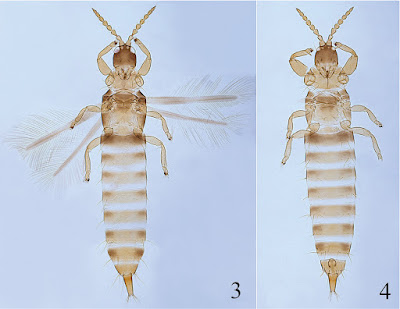
Winged female (left) and wingless male of Psalidothrips comosus, from Zhao et al. (2018).


Close to fifty species of Psalidothrips have been described from various locations around the world (Wang et al. 2019). They are most commonly found among leaf litter and are believed to feed on fungal hyphae. Most Psalidothrips are relatively small, pale thrips, yellowish or light brown in coloration. As members of the family Phlaeothripidae, the last segment of the abdomen is modified into a tube ending in a ring of setae; in Psalidothrips, this tube is commonly short and the terminal setae are often longer than the tube.

As is common among thrips, the recognition of Psalidothrips and its constituent species is often complicated by within-species variation. Many species are known as both winged and wingless forms (Wang et al., 2019, note that Australian species seem particularly prone to winglessness). Wingless forms often show reductions in the sclerotisation of the thorax. It is difficult to name a single feature of the genus that does not find exception in some species or other. Most species are weakly sculpted. For the most part, the maxillary stylets are short and sit low and far apart in the head when retracted. The mouth-cone is similarly short and rounded. The head is often fairly short with rounded cheeks that do not bear strong setae. Setae on the anterior margin of the pronotum are often reduced. The wings, if present, are often more or less constricted at about mid-length. Many phlaeothripids possess a series of large setae on the abdomen that hold the wings in place when folded back; in individuals of Psalidothrips with such setae (obviously, they tend to disappear in wingless individuals), they are often relatively few in number and simply curved.

Many of these features are related to the thrips' litter-dwelling habits. The short mouthparts, for instance, presumably reflect how these thrips are gleaning fungi from the surface of leaves without needing to pierce the leaf's cuticle. As such, it will be interesting to see how the genus holds out as our understanding of thrips phylogeny improves. Is this a true evolutionarily coherent assemblage, or disparate travellers who are following a fashion?

REFERENCE

Wang, J., L. A. Mound & D. J. Tree. 2019. Leaf-litter thrips of the genus Psalidothrips (Thysanoptera, Phlaeothripidae) from Australia, with fifteen new species. Zootaxa 4686 (1): 53–73.

Lichen Darklings

The beetles of the family Tenebrionidae, often referred to as the darkling beetles, are a diverse bunch. Members of this family have adapted to a wide range of lifestyles, coming in a variety of body types. Among the more obscure representatives of the tenebrionids are the members of the Southern Hemisphere tribe Titaenini.

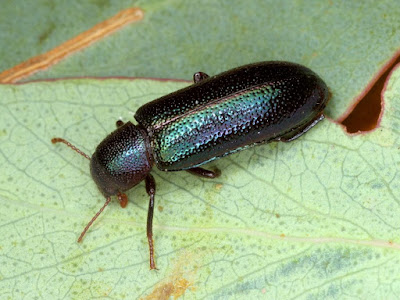
Titaena sp., copyright Martin Lagerwey.


Members of the Titaenini have a typical Gondwanan distribution, being known from southern and eastern Australia, New Zealand, New Caledonia and southern South America (Matthews & Bouchard 2008). They grow up to about a centimetre and a half in length with an elongate, parallel-sided body shape that is more or less cylindrical. The prothorax is relatively short, allowing the head to be held vertically in the Australian genus Titaena. Antennae are short with fairly simple segments not forming a club at the end. Legs have similarly simple tarsi. The tribe is distinguished from other, similar darkling beetles by the epipleura (the flattened underside of the elytral margins) which are shortened, not reaching the elytral apex. Members of the Titaenini have large repugnatorial glands opening near the end of the abdomen. In the Australian genus Titaena, at least, species are usually metallic blue or green in coloration.

The habits of the Titaenini are poorly known. As far as we do know, their larvae are specialised feeders on lichen. Adults probably pursue a similar diet. This is an exposed lifestyle, one in which you could easily come to the attention of predators, and the bright coloration of Titaena probably functions to warn off any such unwelcome interest.

REFERENCE

Matthews, E. G., & P. Bouchard. 2008. Tenebrionid Beetles of Australia: Descriptions of tribes, keys to genera, catalogue of species. Australian Biological Resources Study: Canberra.

Rasahus albomaculatus, the White-Spotted Corsair

Though the Hemiptera began their long evolutionary history as plant-feeders, many of their subgroups later switched to a predatory lifestyle, their suctorial mouthparts being just as suited for stabbing flesh as vegetation. Among the most successful of the predatory bugs where the assassin bugs of the family Reduviidae.

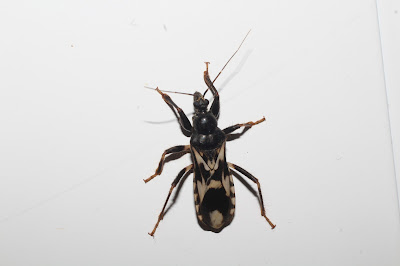
Image copyright Jacob Gorneau.


This is Rasahus albomaculatus, a widespread assassin of the Neotropical region, found from Mexico to Argentina (Coscaron 1983). Though not one of the largest members of its genus, R. albomaculatus is a decent-sized bug, growing close to an inch in length. Rasahus is a genus of the reduviid subfamily Peiratinae, commonly known as corsairs for their fearsome aspect. Features distinguishing Rasahus from other genera of corsairs include their large eyes, a deep grove across the head in front of the ocelli, long procoxae, and well-developed spongy pads on the fore- and mid-tibiae. Rasahus albomaculatus is distinguished from other species of the genus by its colour pattern. The body is mostly black with white patterning on the wings. Stripes along the top of the wing and across the mid-length form a crude H-shape when the wings are closed, with separate spots towards the base of the wing and towards the tip. Other noteworthy features include a lack of granulation on the pronotum, and a rounded apex to the scutellum (Swanson 2018).

Corsairs are mostly predators of other insects and not often dangerous to humans (though their bite is supposed to be very painful). Indeed, they may be beneficial to humans as among their prey are believed to be other reduviids of the subfamily Triatominae, the blood-sucking "kissing bugs" that spread Chagas disease (contrary to the Wikipedia page on the western corsair R. thoracicus, corsairs do not spread Chagas themselves). Rasahus albomaculatus may provide its vertebrate co-habitants with far more comfortable living conditions.

REFERENCES

Coscarón, M. del C. 1983. Revision del genero Rasahus (Insecta, Heteroptera, Reduviidae). Revista del Museo de La Plata (nueva serie) (Zoologia) 13: 75–138.

Swanson, D. R. 2018. Three new species of Rasahus, with clarification on the identities of three other Neotropical corsairs (Heteroptera: Reduviidae: Peiratinae). Zootaxa 4471 (3): 446–472.

Allendesalazaria nymphoides, the Hidden Blister Beetle

The blister beetles of the family Meloidae have attracted attention for a number of reasons. One is their production of caustic defensive chemicals which may be powerful enough to cause severe injury to humans or their livestock. Another is their remarkable life cycles. Many blister beetles develop as nest predators or kleptoparasites of bees. The larvae of these species are hypermetamorphic with the first instar being more mobile than later stages. These mobile larvae will find bees and latch onto them so that they can be carried to the host's nest.

Allendesalazaria nymphoides, copyright Stanislav Krejcik.


This association reaches an extreme in Allendesalazaria nymphoides of north-west Africa. This reclusive species has, to date, been recorded from localities in Morocco, Algeria and Mauritania (Bologna & Aberlenc 2002). It is readily distinguished from other blister beetles by its much-reduced elytra which are oval and widely separated from each other. It is also distinguished by claws that lack the free lower blade found in most other meloids (Bologna & Pinto 2002). Whether they produce the noxious chemicals known from other members of their family, I haven't found a record.

Allendesalazaria nymphoides develops in the nests of solitary burrowing bees of the genus Anthophora. Adults of A. nymphoides do not feed, and never emerge from the nest in which they matured. Instead, they lay their own eggs within that same nest. Dispersal is then left to the hatching larvae that (I presume) latch onto those emerging bees that escaped their parents' depredations. Eventually, the new generation of bees will establish nests of their own. And when they do, the blister beetles will be ready for them.

REFERENCES

Bologna, M. A., & H.-P. Aberlenc. 2002. Allendesalazaria, un nouveau genre de Meloidae pour la faune saharienne (Coleoptera). Bulletin de la Société Entomologique de France 107 (2): 191–192.

Bologna, M. A., & J. D. Pinto. 2002. The Old World genera of Meloidae (Coleoptera): a key and synopsis. Journal of Natural History 36 (17): 2013–2102.

The Running of the Termites

I don't know how many people would profess to have a favourite genus of termites. Which is a shame, because there are some real stand-out examples. Snapping termites, magnetic termites, glue-spraying termites... For my own part, though, I have a particular fondness for the Australian harvester termites of the genus Drepanotermes.

Soldiers and workers of Drepanotermes perniger, copyright Jean Hort.


Nearly two dozen species of Drepanotermes are found on the Australian continent to which they are unique (Watson & Perry 1981). They are arid-environment specialists, being most diverse in the northern part of Australia. My reasons for being so fond of them are, I'll admit, decidedly prosaic. The worker caste of most termite species is very difficult if not impossible to identify taxonomically; one termite worker usually looks very much like another. Drepanotermes workers, however, are different. The name Drepanotermes can be translated as "running termite" and, as befits their name, Drepanotermes of all castes stand out for their distinctly long legs. Soldiers of Drepanotermes also have distinctively shaped mandibles which are sickle-shaped and have a single projecting tooth on the inner margin. They are similar to soldiers of the related genus Amitermes (of which Drepanotermes may represent a derived subclade) but the mandibles of Amitermes tend to be straighter and more robust.

The long legs of Drepanotermes reflect their active harvester lifestyles. Workers will emerge from the nest at night in search of food to carry back home. In the red centre of Australia they will primarily collect spinifex; they will also take fallen leaves, tree bark and the like. Soldiers keep guard while the workers forage. I've found them clustered around a nest entrance of an evening, just their heads poking out to snap at passers-by. Workers may wander up to about half a metre from the nest entrance as they forage. The concentrations of vegetable matter produced by Drepanotermes storing food sources in their nest may form a significant factor in the nutrient profile of areas where they are found.

Alate and soldiers of Drepanotermes rubriceps, copyright Jean Hort.


Depending on species and circumstance, the nests of Drepanotermes may be mounds or entirely subterranean with the latter being the majority option. They prefer compact soils such as clay though they may burrow through looser soils where there is a denser subsoil. Drepanotermes may construct their own nest or move into nests constructed by other termites. One aptly named species, D. invasor, seems to take over pre-existing nests more often than not. Subterranean nests are arranged as a series of chambers about five to ten centimetres in diameter connected by tunnels. These chambers may be arranged vertically, one below another, or they may form a rambling transverse network. Above ground, subterranean nests may be visible as an open circle devoid of vegetation. The ground in these circles is hard as concrete and may remain clear for decades after the actual nest has gone. Walsh et al. (2016) refer to the remains of nests protruding above ground along vehicle tracks after the soil around them has worn down. Local people have a long history of taking advantage of the open space offered by termite nests, such as to move more easily through scrub or as resting or working places.

The alate castes of Drepanotermes tend to be poorly known. Indications are that mature reproductives spend little time in the parent nest before leaving to breed. For most species, breeding flights take place in late summer. Alates may emerge either by day or night. The time of emergence seems to depend on the species; night-flying alates have distinctly larger eyes than day-fliers. Unfortunately, because alates have rarely been collected in association with a nest, we are largely still unable to tell which alates belong to which species.

REFERENCES

Walsh, F. J., A. D. Sparrow, P. Kendrick & J. Schofield. 2016. Fairy circles or ghosts of termitaria? Pavement termites as alternative causes of circular patterns in vegetation of desert Australia. Proceedings of the National Academy of Sciences of the USA 113 (37): E5365–E5367.

Watson, J. A. L., & D. H. Perry. 1981. The Australian harvester termites of the genus Drepanotermes (Isoptera: Termitinae). Australian Journal of Zoology, Supplementary Series 78: 1–153.

Tillinae

Tillus elongatus, copyright Gilles San Martin.


The above individual is a representative of a species of the subfamily Tillinae of the beetle family Cleridae. Clerids are a widespread group of moderate-sized beetles, larger individuals being about a centimetre in length, but most species tend to attract little attention from humans. They are mostly predators in confined spaces (Gunter et al. 2013): larvae hunt down wood-boring insects in their burrows, or the young of bees and wasps in their nests, whereas adults hunt for other insects under bark. Adults are more or less elongate in shape and commonly have an even covering of setae and a prominently punctate dorsum. The legs have five-segmented tarsi, each tarsus often with multiple segments lobed. Clerids are commonly referred to as 'checkered beetles' in reference to the contrasting colour patterns of many species but, as you can clearly see, not all clerids have such checkered patterns.

The subfamilial classification of clerids has shifted around a lot in the past but the Tillinae have been one of the more consistently recognised subfamilies. The feature most consistently separating tillines from other clerids is that the fore coxal cavities are both externally and internally closed: that is, the external rim and internal collar around the fore coxae are both complete rather than being interrupted posteriorly. Other distinctive features of the tillines are that all five tarsal segments are well developed and distinct, the pronotum is campanulate (bell-shaped) or bisinuate, and the eyes usually have coarse ommatidia (Burke & Zolnerowich 2017).

Cylidrus megacephalus, copyright Udo Schmidt.


The taxonomy of tillines is (as always) in great need of study. Around 550 or more species have been assigned to the subfamily worldwide, with the highest diversity in the Afrotropical and Oriental regions. However, many species can be quite variable in appearance and it is suspected that many previously described species may turn out to be synonyms. The situation is not helped by many species being rarely collected. For instance, Bostrichoclerus bicornis is a remarkable species distinguished by the presence of a pair of prominent, apically bifurcate horns arising alongside the antennal insertions. To date, this species is known from just two specimens, collected at separate locations in Baja California and southern California (Burke & Zolnerowich 2017).

A molecular phylogenetic analysis of the Cleridae by Gunter et al. (2013) suggested that the Tillinae represent the sister group of all other clerids. While unexpected from a morphological perspective, this result does tally with the long recognition of the tillines as a distinctive group. They may prove to have interesting things to tell us about the evolution of the clerids as a whole.

REFERENCES

Burke, A., & G. Zolnerowich. 2017. A taxonomic revision of the subfamily Tillinae Leach sensu lato (Coleoptera, Cleridae) in the New World. ZooKeys 179: 75–157.

Gunter, N. L., J. M. Leavengood, J. S. Bartlett, E. G. Chapman & S. L. Cameron. 2013. A molecular phylogeny of the checkered beetles and a description of Epiclininae a new subfamily (Coleoptera: Cleroidea: Cleridae). Systematic Entomology 38 (3): 626–636.

Booklice: The Cutest of Pests

Humans have a tendency to think of 'nature' and the 'environment' as something distinct from our own society. Environments unmodified by humans are seen as 'natural' whereas structures created by human activity, such as buildings, are not 'natural' and thought to be somehow outside the 'environment'. As such, people often react strongly to the idea of things associated with the 'environment', such as non-human wildlife, encroaching on their homes. But of course, human houses are as much an environment of their own as any other of the world's habitats, and many animals find them to be places where they can thrive. Among the animals that most regularly share our houses with us are booklice of the genus Liposcelis.

Liposcelis bostrychophila, copyright Andreas Eichler.


Representatives of Liposcelis can be found almost anywhere in the world except in the coldest of regions. About 130 species have been described in the genus to date (Yoshizawa & Lienhard 2010) with doubtless more yet to be discovered (by comparison, Broadhead's review of the genus in 1950 recognised only 22 species, with a six-fold increase since then). The family Liposcelididae, to which Liposcelis belongs, differ from other free-living members of the Psocodea (or 'Psocoptera') in their flattened body form, as well as being smaller than most other examples (Liposcelis grow little more than a millimetre in length). In the flattened habitus, they resemble the parasitic true lice of the Phthiraptera, and recent studies have agreed that the liposcelidids represent the closest relatives of true lice (Yoshizawa & Lienhard 2010). Liposcelis species are readily distinguished from other liposcelidids by the shape of the hind legs: an obtuse tubercle on the outer margin of the hind femur gives it a distinctly broad appearance* (indeed, the genus name Liposcelis translates into English as 'fat thigh'). Liposcelis are also distinctive in being invariably wingless; other liposcelidid species typically come in both winged and wingless forms. Though the genus as a whole is easily recognised, distinguishing individual species is often a far more challenging prospect requiring microscopic examination of fine features of the chaetotaxy (arrangement of bristles on the body) and cuticular sculpture. Authors have divided Liposcelis species between a number of diagnostic sections and subgroups based on these and other features but the monophyly or otherwise of these subdivisions is largely unstudied.

*This feature is also shared with a cave-dwelling species from Ascension Island currently placed in its own genus, Troglotroctes ashmoleorum, but it seems more than likely that this species is itself a derived offshoot of Liposcelis.

Liposcelis species can feed on a wide range of organic matter but, like other 'Psocoptera', their primary source of food is probably yeasts and fungal spores (their vernacular name has been attributed to their feeding on yeasts growing on the glue binding books, though I would note that they are also probably more likely to be seen crawling on the light background of a book's page than in other, less closely examined corners of the house). Turner (1994) provided a detailed review of the natural history of one of the most widespread domestic pest species in the genus, L. bostrychophila, and reports that he was able to maintain cultures on "'Weetabix'™, 'Shreddies'™, baby rice, soya granules, sage and onion stuffing mix, skimmed milk powder, 'Oat Krunchies'™, red lentils, and yellow split peas". Other stored foods from which complaints had been received of booklice included "sugar, bread, salt, bay leaves, gelatine powder, poppadoms, custard powder, dried yeast, instant potato, nuts, dried fruit, baby food, sauce mix, dried mushrooms, pasta, coconut, cocoa, milk powder, spices, glace cherries, garlic, baking powder, icecream mix, dried soup, cracked wheat, carob powder, maize meal, wheat germ, jellied sweets and bread crumbs". They have also been found on cured meat and may damage curated insect specimens. As well as obtaining moisture from their food, Liposcelis are also able to extract water directly from the atmosphere owing to the hygroscopic properties of their saliva. A booklouse will hold a drop of saliva inside its mouth, then swallow it when the ball has absorved enough water from the air.

Liposcelis sp. (possibly L. meridionalis?) from southern France, copyright Jessica Joachim.


Female Liposcelis bostrychophila generally reach maturity and begin producing eggs about two weeks after hatching and may produce two or three eggs a day. As each egg is about one-third the size of the adult, this means that a female at peak fecundity is producing her own body mass in eggs in a single day. Most Liposcelis species reproduce sexually but some are parthenogenetic. Domestic L. bostrychophila, for instance, seem to be entirely parthenogenetic with males of the species only known from isolated collections in Hawaii, Arizona and Senegal (Georgiev et al. 2020). Studies on an unnamed species of Liposcelis from Arizona found that sex determination seemed to be facultative, determined by the mother, with no evidence for differentiated sex chromosomes (Hodson et al. 2017). Females seemed to produce more males early in life and more females later. The same studies also established the occurrence of paternal genome elimination in this species, where chromosomes inherited from the father were inactivated in the offspring and not passed on to their own progeny (which raises the question that, if males are effectively a genetic dead end, why would a female produce male offspring at all?) Paternal genome elimination has also been found in the human louse Pediculus humanus, and may be characteristic of the broader clade encompassing these species, but other species remain unstudied. Liposcelis genomes are also remarkable in the occurrence of fragmentation of the mitochondrial genome. Whereas some Liposcelis species have only a single mitochondrial chromosome, as is standard for most other animals, some species have the mitochondrial genome divided between two, three, five or seven chromosomes (Feng et al. 2019). The functional significance, if any, of this feature remains unknown.

Though booklice may be found in houses and stores on the regular, they are mostly only minor pests, only causing distress when reaching large numbers (an exceptional case quoted by Turner, 1994, involved a house in New Jersey at the beginning of the 1900s that became so infested "'that a pinpoint could not have been put down without touching one or more of these bugs"). They are not believed to transmit pathogens, except perhaps incidentally by carrying microbes from one store to another. For the most part, these little beasties are just another part of the wildlife that shares our homes with us, whether we are aware of them or not.

REFERENCES

Feng, S., H. Li, F. Song, Y. Wang, V. Stejskal, W. Cai & Z. Li. 2019. A novel mitochondrial genome fragmentation pattern in Liposcelis brunnea, the type species of the genus Liposcelis (Psocodea: Liposcelididae). International Journal of Biological Macromolecules 132: 1296–1303.

Georgiev, D., A. Ostrovsky & C. Lienhard. 2020. A new species of Liposcelis (Insecta: Psocoptera: Liposcelididae) from Belarus. Ecologica Montenegrina 29: 41–46.

Hodson, C. N., P. T. Hamilton, D. Dilworth, C. J. Nelson, C. I. Curtis & S. J. Perlman. 2017. Paternal genome elimination in Liposcelis booklice (Insecta: Psocodea). Genetics 206: 1091–1100.

Turner, B. D. 1994. Liposcelis bostrychophila (Psocoptera: Liposcelididae), a stored food pest in the UK. International Journal of Pest Management 40 (2): 179–190.

Yoshizawa, K., & C. Lienhard. 2010. In search of the sister group of the true lice: a systematic review of booklice and their relatives, with an updated checklist of Liposcelididae (Insecta: Psocodea). Arthropod Systematics and Phylogeny 68 (2): 181–195.

Snakes and Lace

The holometabolous insects—that is, the clade containing most insects with a complex life cycle including differentiated larval and pupal stages—is one of the most extensive radiations of animals on this planet. Much of this diversity is assigned to four major orders: wasps, moths, beetles and flies. But there are also a number of smaller lineages making up the holometabolous insects. Among these are the lacewings and their relatives in the clade Neuropterida.

Female snakefly Puncha ratzeburgi, copyright Hectonichus.


Modern members of the Neuropterida are generally recognised as belonging to three orders—the lacewings and ant-lions in the Neuroptera, the snakeflies in the Raphidioptera, and the alderflies and dobsonflies in the Megaloptera—though go back a few decades and you may find texts referring to a single order Neuroptera. A number of authors have advocated for use of the name 'Planipennia' for the lacewing order to avoid confusion with the broader sense of Neuroptera but, while a case could certainly be made for this usage, it's just never really caught on. Most neuropteridans are fairly similar in overall appearance: long-bodied insects with well developed wings with numerous crossveins. Of the living holometabolous insects, they probably bear the greatest overall resemblance to the clade's ancestors and hence they are commonly thought of as 'relicts'. However, they do possess their own specialisations and are not primitive in every regard (for instance, the most primitive egg-laying apparatus among holometabolous insects belong to wasps). Species of Neuropterida are mostly predators as larvae. The larvae of the lacewing family Ithonidae may possibly feed on decaying plant matter though we don't know for certain (Grimaldi & Engel 2005). Adults are predators and/or pollen-feeders, or may not feed at all in some short-lived forms.

Male (above) and female dobsonflies Corydalus cornutus, copyright Didier Descouens.


The exact relationships between the neuropteridan orders have been debated over the years. Though most of their obvious similaities to each other represent shared ancestral features, there is a broad consensus that they do indeed form a clade. There has also been little, if any, question of the monophyly of the Raphidioptera and Neuroptera; the monophyly of Megaloptera has been more debated but seems more likely than not. Most recent studies have suggested that the Raphidioptera are the sister group to a clade of the other two orders (Engel et al. 2018). Raphidioptera are the least diverse of the generally recognised living orders of insects with about 250 known species. They are found in cooler regions of the Northern Hemisphere—in the temperate zone or at higher elevations in lower latitudes—and are completely absent from the Southern Hemisphere (Aspöck & Aspöck, 1991, refer to a failed attempt to introduce them to Australia and New Zealand but provide no details why such a thing was tried in the first place). They are characterised by a notably elongate prothorax (the first segment of the thorax) which explains the vernacular name of 'snakefly'. Larvae live under bark or in litter and moult into pupae with the onset of cold weather. The pupae of Raphidioptera and Megaloptera are primitive in aspect, with legs separate from the body wall, and are highly mobile. Engel et al. (2018) even refer to the pupae of Raphidioptera as 'active predators' but I've not been able to find corroborating details for that remarkable description.

The Megaloptera are often particularly large neuropteridans, reaching up to twenty centimetres in wingspan, and comprise a bit less than 400 species worldwide, mostly found in temperate regions. Larvae are aquatic, living under rocks and debris, and characterised by the presence of filamentous lateral gills on the abdomen. Adults are short-lived and feed little if at all. Male dobsonflies (of the subfamily Corydalinae) possess spectacularly large, curved mandibles of largely unknown purpose; certainly they do not seem to use them for biting.

Mantisfly Mantispa styriaca, a raptorial lacewing, copyright Gilles San Martin.


The largest of the three orders, by a considerable margin, is the Neuroptera with over 5700 known species. Needless to say, this level of species diversity is associated with a high diversity of appearances and lifestyles, too many to cover adequately here. The larvae of two families of Neuroptera, the Nevrorthidae and Sisyridae, are aquatic and there has been a long-running debate whether this aquatic habit is an ancestral feature of the order shared with the Megaloptera (Nevrorthidae larvae are generalist predators, Sisyridae are specialised feeders on freshwater sponges and bryozoans). However, recent phylogenetic studies (e.g. Vasilikopoulos et al. 2020) do not agree with earlier hypotheses that the Nevrorthidae represent the sister taxon of the remaining Neuroptera. Instead, Nevrorthidae and Sisyridae may form a clade with the Osmylidae, a family whose larvae are not aquatic but often inhabit damp stream banks. The aquatic Neuroptera probably entered the water independently of the alderflies. The current favourites for the sister clade of other neuropterans are the dustywings of the Coniopterygidae, a group of small neuropterans with reduced wing venation that have historically been difficult to place owing to their derived features.

An unidentified dustywing, Coniopterygidae, copyright Katja Schulz.


A fourth order has often been associated with the Neuropterida, the extinct Glosselytrodea. Glosselytrodeans are small insects known from the Late Permian to the Jurassic, characterised by wings bearing dense cross-veins of which the fore pair would have had a leathery appearance in life (not dissimilar in texture to the fore wings of grasshoppers and other Orthoptera). Other than the wings, the features of glosselytrodeans are poorly known: they seem to have been hypognathous (i.e. had the head directed downwards) with slender legs (Grimaldi & Engel 2005). Connections to Neuropterida are based on features of the wing venation but cannot be considered strongly supported. Other authors have regarded them as of uncertain position within the broader holometabolous clade, or even as more closely related to the Orthoptera than any Holometabola. Unless more complete remains should come to light, it seems likely that the question will remain open.

REFERENCES

Aspöck, H., & U. Aspöck. 1991. Raphidioptera (snake-flies, camelneck-flies). In: CSIRO. The Insects of Australia: A textbook for students and research workers 2nd ed. vol. 1 pp. 521–524. Melbourne University Press.

Engel, M. S., S. L. Winterton & L. C. V. Breitkreuz. 2018. Phylogeny and evolution of Neuropterida: where have wings of lace taken us? Annual Review of Entomology 63: 531–551.

Grimaldi, D., & M. S. Engel. 2005. Evolution of the Insects. Cambridge University Press: New York.

Vasilikopoulos, A., B. Misof, K. Meusemann, D. Lieberz, T. Flouri, R. G. Beutel, O. Niehuis, T. Wappler, J. Rust, R. S. Peters, A. Donath, L. Podsiadlowski, C. Mayer, D. Bartel, A. Böhm, S. Liu, P. Kapli, C. Greve, J. E. Jepson, X. Liu, X. Zhou, H. Aspöck & U. Aspöck. 2020. An integrative phylogenomic approach to elucidate the evolutionary history and divergence times of Neuropterida (Insecta: Holometabola). BMC Evolutionary Biology 20: 64.

The Barrington Tops Stag Beetle

The stag beetles of the Lucanidae are among the most dramatic of all beetles. They are large, glossy, and the adult males often have greatly enlarged mandibles that are used in conflict with other males. As larvae, lucanids are found feeding on rotting wood; adults may feed on nectar and are largely nocturnal. Australia is home to its share of lucanid diversity though the need for suitable food for larvae means that they are mostly restricted to damper regions of the country. As a result, many Australian stag beetles have limited ranges, rendering them vulnerable if not (in this time of rising temperatures and reduced rainfalls) actively endangered. One such species is the Barrington stag beetle Lissapterus tetrops.

Female (left) and major male Lissapterus tetrops, from Coleptera7777.


The Barrington Tops is a mountain range forming part of the Great Dividing Range in New South Wales, direct north from Newcastle. The Barrington stag beetle was described from this range in 1916 by Arthur Lea, one of Australia's most prolific coleopterologists, and is restricted to rain forests at the upper heights of the range. Lissapterus is an endemic Australian genus of flightless stag beetles distinguished from other members of the family by the shape of the antennae. The terminal club that is usually characteristic of the antennae of stag beetles is less defined in Lissapterus with the last few segments of the short antennae being little larger than the rest. Like most other species in the genus, L. tetrops is almost entirely black, only becoming slightly reddish on the legs and antennae. It grows about an inch in length, males and females being not that dissimilar in size. Lissapterus tetrops differs from other species in the genus in lacking foveae on the pronotum and (mostly) on the head, being relatively sparsely punctate dorsally, and having the eye completely divided by a canthus. Major males have long curved mandibles with a pair of teeth internally near the midpoint, placed one above the other. Minor males and females have much smaller, more ordinary looking mandibles.

The natural history of this species is little known but it presumably resembles that of other species in the genus. Adults are found under rotting logs partially buried in the forest floor that provide food for the larvae. Adults may live for a long time, potentially up to about a year, though it is unclear what exactly they feed on. Other species of Lissapterus are mostly found in disjunct locations up and down the Great Dividing Range, their populations presumably becoming separated as the warming and drying of Australia's climate as it moved northwards forced them out of the lowlands. As the climate continues to become warmer and drier, these beetles may find themselves having to retreat higher and higher, and eventually they may find themselves with no further to go.

REFERENCE

Lea, A. M. 1916. Notes on some miscellaneous Coleoptera, with descriptions of new species. Part II. Transactions of the Royal Society of South Australia 40: 272–436, pls 32–39.

Colpochila: The Chafing of a Mega-genus

Just a few weeks ago, I discussed the melolonthines, a hyperdiverse group of beetles including the chafers that have historically presented something of a taxonomic challenge. In the comments on that post, Adam Yates brought up one aspect of the difficulties presented by this group that I hadn't gotten around to discussing. This is the presence among melolonthines of a number of what may be called 'mega-genera', large genera containing literally hundreds of species that defy attempts to break them down into more manageable units. So on that note, it's only appropriate that I move on to an example of one of these mega-genera, Colpochila.

Colpochila obesa, from Insects of Tasmania.


Colpochila is an Australian genus of melolonthines belonging to a group currently recognised as the tribe Liparetrini (Britton 1986) though readers of the earlier post may recall that relationships between Australian melolonthines and taxa elsewhere in the world remains something of an open question. Liparetrins are, on the whole, a fairly generalised group: characters of the group include a lack of metallic coloration, a labrum which sits underneath and is not fused to the clypeus, simple claws, and relatively broad hind tibiae that end in a pair of widely separated spurs that are placed one above and one below so that the tarsus when moved from side to side can move between the spurs. The two largest genera in the tribe, by a significant margin, are Colpochila and Liparetrus. Somewhere in the region of 130 species are currently recognised in Colpochila whereas Liparetrus is even more diverse. However, both genera were referred to by Britton (1986) as 'polythetic': that is, both represent assemblages of species that, while clearly connected to each other overall, are difficult to characterise from a diagnostic perspective. Species of the genus possess enough features in common that we can readily recognise them as related but it is difficult to drill down on any individual feature or set of features that is shared between all species without exception. Similarly, while I can say from experience that it is generally easy to tell at a glance whether a given species is a Colpochila or a Liparetrus, it is a lot harder to actually define what separates the two genera. The most obvious distinction is size: Colpochila species are relatively large chafers, over a centimetre in length, whereas Liparetrus are smaller. Other features that each separate most Colpochila species from most (though not all) Liparetrus are circular eyes (most Liparetrus have eyes with flattened edges in back so the eye is closer to semi-circular), antennae with more segments in the terminal club, longer elytra that leave less of the end of the abdomen exposed, and hind coxae without the translucent margins found in many Liparetrus.

The lifestyles of Colpochila species are still not very well known. As with other melolonthines, most of the life is spent underground with mature adults only emerging very briefly to breed. The active adults fly at night and may be attracted to lights; it seems unclear whether they feed at maturity. This genus is mostly found in drier habitats such as open woodland, grasslands or semi-desert (mind you, this is Australia we're talking about; drier habitats are 90% of what's going). Of the known species, over half are found in Western Australia.

A second Colpochila species, from Friends of Queens Park Bushland.


So why are Colpochila and other melolonthine mega-genera so diverse? It should be noted that straight geographical and/or ecological divergence does not appear to be the reason: not only is it possible to find multiple species of a single genus in one location but one may even collect very similar species together. It might be that the diversity of the mega-genera is artefactual, a reflection of the failure of taxonomists to properly identify relationships: any study that wanted to explain their diversity would have to study their phylogenetic relationships with related smaller genera to confirm their evolutionary coherence and/or age of divergence. However, if the current generic classification of melolonthines reflects a real evolutionary pattern, a potential explanation was proposed by Britton (1986). Adult melolonthines do not emerge immediately upon maturing but remain dormant underground awaiting a suitable environmental signal such as rainfall. However, rainfall in the arid zone at any one time is often uneven. Dormant beetles at one spot may feel the urge to emerge while others nearby may be left to wait for the next shower. The first wave will have died off before the second wave emerges, and their offspring will not yet be mature. As a result, sub-populations in a single region may become temporally staggered allowing the possibility of divergence via genetic drift. Eventually, their emergence times may drift back into sync but by then they may no longer be able to breed successfully. Could this be the reason why so many species may be found in a single location or may other factors be more significant?

REFERENCE

Britton, E. B. 1986. A revision of the Australian chafers (Coleoptera: Scarabaeidae: Melolonthinae) vol. 4. Tribe Liparetrini: genus Colpochila. Australian Journal of Zoology, Supplementary Series 118: 1–135.

The Melolonthinae: Chafers and June Bugs

Within the bewildering array that is beetle diversity, one of the more readily recognisable groups is the Scarabaeoidea, the assemblage that includes dung beetles (which, as it happens, are what I currently spend most of my days looking at) and related forms. Members of this group are easily distinguished from other beetles by their distinctive antennae, ending in an asymmetrical club with segments extending to one side like a set of fingers. Several families, many of them further subdivided into subfamilies, are currently recognised within the scarabaeoids. One of the most commonly encountered scarabaeoid subgroups is the subfamily Melolonthinae, commonly known as the chafers.

Green scarab beetles Diphucephala sp., a common genus of day-flying melolonthines here in Australia, copyright Boobook48.


Somewhere in the region of eleven thousand species around the world have been assigned to this grouping; as always, doubtless many more could be recognised by those who take the time. Melolonthinae is generally recognised as a subfamily of the family Scarabaeidae, sharing with other scarabaeids features such an antennal club in which the segments are relatively narrow and can be smoothly pressed against each other, and an exposed pygidium (the last dorsal plate on the abdomen, forming what you might think of as the 'butt plate'). Some authors have recognised melolonthines as a distinct family but this is the less commonly utilised option. Melolonthines belong to a group of mostly plant-feeding subfamilies in which the row of abdominal spiracles bends downwards towards the rear so at least the last pair remains visible when the elytra are closed. Within this cluster, melolonthines tend to be characterised more by lacking the features of the other subfamilies than by distinctive features of their own (more on that in a moment) but general features include mandibles that are not visible when looking down on the top of the head, fore coxae that do not protrude much ventrally, equal claws on each leg (at least on the mid and hind legs) and only one visible spiracle when the elytra are closed. The labrum (the piece at the front of the mouthparts that might be thought of as the insect's top lip) is usually hardened and may be more or less fused with the clypeus (the lower- or foremost section [depending how you look at it] of the front of the head capsule). Many melolonthines are noticeably hairy and/or dull in comparison with other scarabaeoids but others may be shiny and/or metallic in coloration.

Sugarcane white grub beetle Lepidiota stigma, copyright Bernard Dupont.


For the most part, melolonthines are plant-feeders at both larval and adult stages of the life cycle (Lawrence & Britton 1991). The greater part of the active life cycle is taken up by the larval stage which may last for many months (Britton 1957). Larvae mostly live underground, feeding on plant roots and humus. A number of species have made themselves known as significant pests in this manner because of the damage they may inflict on pastures or agricultural crops (the grass grub Costelytra zealandica comes immediately to mind as a good example of this in my native New Zealand). Pupation also occurs underground in subterranean cells and mature adults may remain dormant in these cells for some months waiting for conditions to be just right for emergence. Once they do emerge from the ground, however, the adult life span is quite brief, only lasting a few weeks or even days. Because of this brief emergence, and because their habit of waiting for specific environmental cues means that large numbers may appear seemingly all at once, many species have been awarded vernacular names that reflect their seasonality such as June bug (in the Northern Hemisphere) or Christmas beetle (in the Southern). Some species will feed on foliage as adults, some may visit flowers for pollen and nectar, other particularly short-lived species will not feed as adults at all. The majority of adult melolonthines are active at dusk or night, spending the days sheltered in secluded locations, but a number of flower-feeding species are active by day (Britton 1957).

The infamous grass grub Costelytra zealandica, illustrated by Desmond Helmore.


The classification of melolonthines can charitably be described as an absolute mess. As noted above, we can confidently say that they belong to a clade with other subfamilies of plant-feeding scarabaeids (the Cetoniinae, Rutelinae and Dynastinae) but the features setting them apart from these other subfamilies are likely to be primitive for the group. As such, it comes as little surprise that phylogenetic studies have failed to establish the Melolonthinae as monophyletic (e.g. Eberle et al. 2018; Woolley 2016). However, it seems that no-one thinks that an adequately expansive study that would allow them to be appropriately divvied up has yet been done. Matters are not helped by the absence of a well-established internal classification for melolonthines. Various distinct subgroups can be recognised and between twenty or thirty tribes have been recognised around the world. But the relationships between these tribes remain uncertain, as does the tribal position of many genera. Much of the revisionary work that has been done has been conducted at a regional level only. Thus, for instance, the tribal classification of Australian melolonthines established by Britton (1957) applies only to Australian species and the tribal distinctions Britton recognised may end up falling apart if one attempted to apply them to species from elsewhere. Not that the authors should be criticised for this situation: after all, when one is dealing with over 11,000 species, things rapidly tend to become unmanageable.

REFERENCES

Britton, E. B. 1957. A Revision of the Australian Chafers (Coleoptera: Scarabaeidae: Melolonthinae) vol. 1. British Museum (Natural History): London.

Eberle, J., G. Sabatinelli, D. Cillo, E. Bazzatto, P. Šípek, R. Sehnal, A. BezdÄ›k, D. Král & D. Ahrens. 2018. A molecular phylogeny of chafers revisits the polyphyly of Tanyproctini (Scarabaeidae, Melolonthinae). Zoologica Scripta 48: 349–358.

Lawrence, J. F., & E. B. Britton. 1991. Coleoptera. In: CSIRO. The Insects of Australia: a textbook for students and research workers 2nd ed. vol. 2 pp. 543–683. Melbourne University Press.

Woolley, C. 2016. The first scarabaeid beetle (Coleoptera, Scarabaeidae, Melolonthinae) described from the Mesozoic (Late-Cretaceous) of Africa. African Invertebrates 57 (1): 53–66.

The Mirines

Every profession has its quirks, tricks of the trade that are difficult to learn and appreciate except through direct experience. One quirk of entomology is that specimens of each distinct type of insect will have their own nuances for the best method to preserve and present them. And there are some particular types of insect that can be particularly challenging in that regard. Which is a roundabout way of saying: I am not a great fan of mirids.

Green mirid Creontiades dilutus, copyright CSIRO.


Mirids are the largest recognised family of the true bugs in the Heteroptera, with over 11,000 species known worldwide and presumably many more remaining undescribed. They can be distinguished from most (though not, it should be stressed, all) other bug families by the presence of the cuneus, a distinct cross-fold near the outer tip of the hemelytron (the toughened basal part of the fore wing). Most mirids can be further recognised by the absence of ocelli. They are mostly smaller bugs, generally somewhat soft-bodied, and mostly plant feeders though there are some notable exceptions. They also (and this is the reason why they have sometimes been the object of my animus in the past) have a tendency to be what I can only describe as weirdly flimsy. Most insect specimens, at least while stil fresh and relaxed, hold together reasonably well when subject to basic handling. Mirids, on the other hand, will throw off legs if you so much as look at them too hard.

An ant-mimicking mirid, Dacerla inflata, copyright Judy Gallagher.


Mirids are divided between several subfamilies, with the type subfamily Mirinae including well over 4000 species (Kim & Jung 2019). Mirines tend to be relatively large compared to other mirids (up to a bit over half a centimetre in length) and are characterised by features of the genitalia, together with a pair of lamellate, divergent parempodia (fleshy structures that may help in gripping onto things) at the end of the legs between the claws. Other notable features (shared with the closely related Deraeocorinae) include a deeply punctate pronotum, and a relatively long beak that extends beyond the mid coxae at rest. Several species of Mirinae are notable pests. The green mirid Creontiades dilutus is one of the more significant bug pests of crops in Australia, attacking a wide range of hosts including cotton, stone fruit, potatoes, legumes and many more (Malipatil & Cassis 1997). It generally feeds from growing points, killing new buds and inhibiting the production of flowers and new growth. Other polyphagous pests causing similar damage include the tarnished plant bugs of the genus Lygus, whose vernacular name is somewhat self-explanatory, and the alfalfa bug Adelphocoris lineolatus.

Tarnished plant bug Lygus pratensis, copyright Hectonichus.


Six tribes have been recognised within the Mirinae, distinguished by their overall habitus. The Mirini, the largest tribe, have a more or less ovoid body shape with a distinct, raised pronotal collar and opaque hemelytra. The Hyalopeplini have a similar body shape to Mirini but transparent hemelytra. The Restheniini have a reduced evaporative area on the abdomen. The Stenodemini and Mecistoscelini are long and slender with long appendages, with the head directed forward in the Stenodemini. The Herdoniini are ant mimics, presumably for defence from predators. The appearance of an ant waist is achieved by a narrowing of the mirid's own body and wings, and/or an appropriately placed white triangular marking across the hemelytron. Despite the superficial distinctiveness of the tribes, however, a phylogenetic study of the Mirinae by Kim & Jung (2019) found at least two of them to be paraphyletic, with Mecistoscelini being nested within Stenodemini, and Hyalopeplini and Restheniini within Mirini. The affinities of the Herdoniini, unsampled by Kim & Jung, remain to be established.

REFERENCES

Kim, J., & S. Jung. 2019. Phylogeny of the plant bug subfamily Mirinae (Hemiptera: Heteroptera: Cimicomorpha: Miridae) based on total evidence analysis. Systematic Entomology 44: 686–698.

Malipatil, M. B., & G. Cassis. 1997. Taxonomic review of Creontiades Distant in Australia (Hemiptera: Miridae: Mirinae). Australian Journal of Entomology 36: 1–13.

The Ant-like Beetles

As I've commented before, the world is home to an overwhelming diversity of small brown beetles, most of them (for me, at least) inordinately difficult to distinguish. One group of tiny beetles that is quite recognisable, though, is the ant-like beetles of the genus Anthicus.

Anthicus cervinus, copyright Robert Webster.


Over a hundred species around the world have been attributed to this genus. Few of them grow more than a few millimetres in length. They are elongate with the elytra more or less rounded and often covered in short hair. The legs are relatively long. The prothorax is globular and generally narrower towards the base. The head is inclined and carried on a narrow neck (Ferté-Sénectère 1848). Many species have the elytra contrastingly patterned with bands or spots. As the vernacular name indicates, the overall appearance is reminiscent of a small ant though I'm not sure if this indicates a protective mimicry or is merely coincidence.

Anthicus antherinus, copyright Udo Schmidt.


The natural history of most Anthicus species is poorly known. The greater number of species are saprophages, found in association with rotting vegetation or scavenging on dead insects. One species, Anthicus floralis, is found worldwide as a storage pest, infesting seed and grain stores. One of the larger North American species, A. heroicus, has larvae that attack masses of dobsonfly eggs on midstream boulders (Davidson & Wood 1969). The larvae feed on the eggs from the inside, using them for shelter as well as nutrition, before emerging from the eggs to pupate.

REFERENCES

Davidson, J. A., & F. E. Wood. 1969. Description and biological notes on the larva of Anthicus heroicus Casey (Coleoptera: Anthicidae). Coleopterists Bulletin 23 (1): 5–8.

Ferté-Sénectère, M. F. de la. 1848. Monographie des Anthicus et genres voisins, coléoptères hétéromères de la tribu des trachélides. Sapia: Paris.

The Origin of Hexapods

Insects have been described as the most evolutionarily successful group of animals in the modern world, and with good reason. Something like two-thirds of the currently known animal species are insects, and they are near-ubiquitous in the terrestrial and freshwater environments (for whatever reasons, they've never made that much of a go of it marine-wise). Nevertheless, the questions of how and when insects first came to be remains very much an open one.

The long-necked fungus beetle Diatelium wallacei, one of the countless weird oddballs in the insect world. Copyright Artour Anker.


Insects are usually recognised as including three main subgroups: the winged insects, silverfish and bristletails. They are readily united into a group known as the hexapods with a few less speciose assemblages: the springtails, the proturans and the diplurans. All living hexapods have the body divided into a head, thorax and abdomen, with three pairs of walking legs on the thorax and none on the abdomen. Though monophyly of the hexapods has been questioned in the past (which is why the springtails and the like are usually excluded from our concept of 'insect' these days despite having been included previously), the majority view is now firmly in favour of regarding them as a single, coherent lineage. How hexapods are related to other arthropods has been more vigorously debated. Earlier authors commonly associated them with the myriapods, the lineage including centipedes and millipedes. In more recent years, an increasing number of studies have instead associated insects with crustaceans. This realignment has primarily been pushed by molecular studies but there are also a number of interesting morphological features such as eye and brain structure that are more crustacean- than myriapod-like in insects. Indeed, it seems not unlikely that insects are not merely related to but are nested within crustaceans: for instance, a few recent studies have supported a relationship between hexapods and a rare group of crustaceans known as remipedes (Schwentner et al. 2017). The features previously seen as shared between insects and myriapods, such as tracheae and uniramous (unbranched) limbs, are then held to probably be convergent adaptations to a terrestrial lifestyle.

Whatever its relationships, it seems most likely that the immediate ancestor of the living hexapods was indeed terrestrial. Of the six basal hexapod lineages referred to above, five (all except winged insects) are almost exclusively terrestrial and were probably ancestrally so. The winged insects include a number of basal subgroups (such as mayflies and dragonflies) that are aquatic for at least the early part of their life cycle, but a terrestrial origin for winged insects as a whole remains credible.

Head of Rhyniella praecursor, from Dunlop & Garwood (2017).


From the perspective of the fossil record, the evidence related to hexapod origins is incredibly slight. The earliest fossil species that have been directly proposed as hexapod relatives are known from the Early Devonian and less than half a dozen such species have been mooted as such in recent years. The only named Devonian fossil whose status as a hexapod seems unimpeachable is Rhyniella praecursor, a springtail from the Rhynie chert of Scotland (Dunlop & Garwood 2017). The same deposit provided Rhyniognatha hirsti, a fragmentary fossil comprising a pair of mandibles and surrounding parts of the head capsule. Rhyniognatha has long been thought to be an insect, possibly even an early member of the winged insect lineage, but Haug & Haug (2017) recently argued that it could just as easily be the head of a centipede (a group already known from other fossils in the Rhynie chert).

Rhyniognatha hirsti, from the University of Aberdeen. Scale bar = 200 µm; m = mandible.


The Windyfield chert, a deposit of similar age and location to the Rhynie chert, has provided Leverhulmia mariae, originally described as a myriapod but reinterpreted as a hexapod relative by Fayers & Trewin (2005). Leverhulmia is a difficult beast to know what and how much to make of it. The original specimen is, speaking charitably, a bit of a mess: a flattened smear looking a bit like a sausage burst open after cooking for too long on the pan. The front and back ends of the animal both appear to be missing and the only features really distinguishable are a series of small jointed legs. Other specimens associated with this species by Fayers & Trewin (2005) are simply more legs detached from their original body. These legs, though, do preserve a reasonable amount of detail, including the presence of paired lateral claws at the ends of the tarsi like those of most insects (Leverhulmia also possesses a smaller median claw between the lateral claws, a feature not found in winged insects but present in silverfish and bristletails). In contrast, the legs of myriapods (as well as those of springtails and proturans) end in a single terminal claw.

Holotype specimen of Leverhulmia mariae, from Dunlop & Garwood (2017); the size of the scale bar was not specified but the entire specimen is about 12 mm long.


The overall appearance of Leverhulmia's legs might therefore be seen a suggestive of a relationship specifically to insects and not just to hexapods in general, but their number provides something of a barrier to accepting Leverhulmia as a bona fide insect. The train-wreck nature of Leverhulmia's preservation means we can't state confidently how many legs it had but there were at least five pairs: a couple more than the hexapods' standard-issue three. A number of structures on the abdomens of some living hexapods are potentially derived from modified legs, such as the springing furca of springtails and the ventral styli in hexapods other than springtails and winged insects, so some parallelism in appendage reduction is not out of the question. Nevertheless, unjointed styli are one thing; fully-jointed, functional walking legs are another. Supposed early members of the bristletail and silverfish lineages with jointed abdominal legs have been described from the Carboniferous by Kukalová-Peck (1987) but (as I've noted before) many of the more outlandish reconstructions of early insects by Kukalová-Peck have failed to stand up to subsequent scrutiny.

Similar interpretative difficulties surround Strudiella devonica, described as an early relative of the winged insects from the Late Devonian of Belgium. Though I was not unfavourable to this specimen when it was first described, Hörnschemeyer et al. (2013) would later argue against recognising it as an insect. The latter authors professed to be simply unable to discern many of the features cited by its original describers as evidence of insect affinity, and saw Strudiella as closer to a Rorschach blot than a dragonfly. Strudiella's status was defended by its original authors (Garrouste et al. 2013) but a number of subsequent authors seem to have taken Hörnschemeyer et al.'s caution to heart.

Close-up of the head of Strudiella devonica from Hörnschemeyer et al. (2013); the asterisk marks the base of a structure originally interpreted as an antenna.


The final candidate for stem-hexapod status worthy of consideration here is Wingertshellicus backesi from the Lower Devonian Hunsrück Slate of Germany. This marine fossil was interpreted as a stem-hexapod under the name Devonohexapodus bocksbergensis, with a thorax bearing three pairs of legs and an elongate abdomen with uniramous appendages. However, it was reinterpreted by Kühl & Rust (2009) who synonymised Devonohexapodus with the previously described Wingertshellicus, regarded the previously described 'thoracic legs' as appendages of the head, and did not accept the presence of differentiated thorax and abdomen. The appendages of the trunk (previously seen as the abdomen) were biramous rather than uniramous with a small endopod and a large flap-like exopod adapted for swimming, and the end of the body bore a pair of fluke-like appendages (comparable to the tail of a crayfish). Wingertshellicus thus lacked any resemblance to a hexapod, and Kühl & Rust doubted that it even belonged to the crown group of arthropods.

Laterally preserved specimen of Wingertshellicus backesi, from Kühl & Rust (2009); scale bar = 10 mm.


An attempt to estimate the age of divergence of hexapods from other arthropods using a molecular clock analysis by Schwentner et al. (2017) suggested that hexapods and remipedes went their separate ways in the late Cambrian or early Ordovician. This is up to 100 million years earlier than the fossils described above but we should be careful how much to read into this discrepancy. If most of the features associated with hexapods are related to adoption of a terrestrial lifestyle, then it might be difficult to recognise any early marine relatives if found. Conversely, while it is uncertain how much if any terrestrial vegetation was present prior to the Devonian, the only potential cover would have been low lichens, non-vascular plants or micro-algae. If stem-hexapods emerged onto land during this time, the environment would not be conducive to their preservation in the fossil record. Finally, not only are hexapods other than winged insects not found in the fossil record before the Devonian, they are barely found after it: after Rhyniella, none are known until the appearance of amber-producing trees during the Cretaceous. So if we can't find any sign of them for some 300 milion years that we know that they are around, then we obviously can't say too much about not finding them over the previous hundred million years. The stem-hexapods may have been around in this time but they remain in hiding.

REFERENCES

Dunlop, J. A., & R. J. Garwood. 2017. Terrestrial invertebrates in the Rhynie chert ecosystem. Philosophical Transactions of the Royal Society of London Series B—Biological Sciences 373: 20160493.

Fayers, S. R., & N. H. Trewin. 2005. A hexapod from the Early Devonian Windyfield Chert, Rhynie, Scotland. Palaeontology 48 (5): 1117-1130.

Garrouste, R., G. Clément, P. Nel, M. S. Engel, P. Grandcolas, C. D'Haese, L. Lagebro, J. Denayer, P. Gueriau, P. Lafaite, S. Olive, C. Prestianni & A. Nel. 2013. Is Strudiella a Devonian insect? Garrouste et al. reply. Nature 494: E4–E5.

Haug, C., & J. T. Haug. 2017. The presumed oldest flying insect: more likely a myriapod? PeerJ 5: e3402.

Hörnschemeyer, T., J. T. Haug, O. Bethoux, R. G. Beutel, S. Charbonnier, T. A. Hegna, M. Koch, J. Rust, S. Wedmann, S. Bradler & R. Willmann. 2013. Is Strudiella a Devonian insect? Nature 494: E3–E4.

Kühl, G., & J. Rust. 2009. Devonohexapodus bocksbergensis is a synonym of Wingertshellicus backesi (Euarthropoda)—no evidence for marine hexapods living in the Devonian Hunsrück Sea. Organisms, Diversity & Evolution 9: 215–231.

Schwentner, M., D. J. Combosch, J. P. Nelson & G. Giribet. 2017. A phylogenomic solution to the origin of insects by resolving crustacean-hexapod relationships. Current Biology 27: 1818–1824.

Anthaxia: More Modest Jewels

The jewel beetles of the Buprestidae are best known for their spectacularly patterned exemplars, a couple of which I've presented on this site before. But as with most animal groups renowned in this way, they also include their fair share of less immediately eye-catching members. The species of the genus Anthaxia are among these more modest jewels.

Anthaxia hungarica, photographed by Frayle.


Which is not to say they are unattractive. Anthaxia species still usually have the metallic gloss so widespread among the Buprestidae but they tend to be more uniform in colour, and those colours are often shades of bronze or blue-green rather than yellows or purples. They are also smaller than the species previously shown: a length of 6.5 millimetres would be relatively large for an Anthaxia. Some of the smallest species don't quite make it to three millimetres (Bílý & Kubáň 2010). Nevertheless, Anthaxia are incredibly diverse. Something in the range of 700 species are known from around the world (though they appear to be absent from Australia, with the single species described from Victoria now thought to have been based on a mis-labelled African specimen) and a quick Google Scholar search indicates new species continue to be described regularly. It should come as no surprise that many of these species would be difficult to distinguish without close examination.

Anthaxia scutellaris, a more colourful species of the genus, copyright Hectonichus.


Like other buprestids, Anthaxia species are wood-borers as larvae and flower-feeders as adults. The larvae seem to run the gamut of preferred tree hosts: Anthaxia have been found emerging from hosts ranging from pines to pears, from oleander to oaks. Some species appear to be quite catholic in their tastes: the recorded host list for the most polyphagous known species, A. millefolii, includes maples, chestnuts, carobs, oleanders, pistachios, plums, pears, oaks and rowans (Mifsud & Bílý 2002). Others are more discerning. Species of the subgenus Melanthaxia are only known to feed on conifers (Bílý & Kubáň 2010) and records for A. lucens indicate a dedication to stonefruit trees (Mifsud & Bílý 2002). Nevertheless, the larval hosts of many species remain unknown and there may be surprises. The North American species A. hatchi might be expected to be a conifer feeder like other Melanthaxia species but to date it has been collected in riparian habitats where conifers do not grow (Nelson et al. 1981). Could this member of an otherwise conifer-loving group have developed a taste for the willows and alders amongst which it lives? The question is yet to be answered.

REFERENCES

Bílý, S., & V. Kubáň. 2010. A study on the Nearctic species of the genus Anthaxia (Coleoptera: Buprestidae: Buprestinae: Anthaxiini). Subgenus Melanthaxia. Part I. Acta Entomologica Musei Nationalis Pragae 50 (2): 535–546.

Mifsud, D., & S. Bílý. 2002. Jewel beetles (Coleoptera, Buprestidae) from the Maltese Islands (central Mediterranean). Central Mediterranean Naturalist 3 (4): 181–188.

The Other Silver Fish

A couple of years ago, I presented a post about the Lepismatidae, the family including the familiar household silverfishes. In that post, I made an offhand reference to other, less well known families of the wingless insect order Zygentoma. The time has come to look at those families.

Squamatinia algharbica, a subterranean nicoletiid from Portugal, copyright S. Reboleira.


The Zygentoma are divided between five or six living families, depending on how you count them. The largest of these other than the Lepismatidae is the Nicoletiidae, representatives of which may be found in most parts of the world if you know where to look. And therein lies the rub: the eyeless nicoletiids are usually to be found in subterranean habitats, burrowed into soil or within caves. They are pale in coloration, usually white or golden. Nicoletiids have less flattened bodies than lepismatids and often lack the covering of scales found in the latter. One subfamily of nicoletiids, the Atelurinae, is sometimes treated as a separate family (hence the uncertainty above): not only do they have the covering of scales most other nicoletiids lack, they are generally less elongate and are oval or teardrop-shaped in form. Atelurines are inquilines of social insects, making their living in the nests of ants or termites. While some observations have been made of atelurines taking food directly from their hosts, it seems that they mostly live as scavengers on items dropped within the nest. They avoid capture and/or eviction by their hosts through their slipperiness and speed (Smith 2017).

An atelurine silverfish from Tasmania, copyright Zosterops.


The other three families are more localised in their distributions. The Protrinemuridae are found in scattered, disjunct locations including the Middle East, eastern Asia and Chile. They are similar in appearance to the Nicoletiidae, being eyeless, scaleless and subcylindrical, and were classified with that family until fairly recently. Differences between the Nicoletiidae and Protrinemuridae include the nature of the cuticular plates making up the underside of the abdomen. In nicoletiids, these are divided between median sternites and lateral coxites; in protrinemurids, a single undivided plate covers the underside of each abdominal segment. Maindronia is a genus of silverfish placed in its own family that resembles Lepismatidae in possessing eyes and a covering of scales. This genus also has a disjunct distribution, being known from Egypt, Saudi Arabia, Afghanistan and Chile.

Tricholepidion gertschi, copyright Samuel DeGrey.


The fifth family of Zygentoma includes a single living species Tricholepidion gertschi known from the coastal region of northern California, where it is found under decaying tree bark. Tricholepidion retains a number of plesiomorphic features for Zygentoma and is universally accepted as the most divergent member of the order: it lacks scales, it possesses ocelli as well as the compound eyes, it has five rather than four or fewer segments in the tarsi, and it possesses a greater number of ventral styli on the abdomen. Tricholepidion is also hypognathous (that is, it has the head oriented so that its mouth is directed downwards) whereas other Zygentoma are generally prognathous, with the mouthparts directed forwards (Engel 2006). Tricholepidion has usually been included in the Lepidotrichidae, a family originally described for a fossil species Lepidothrix pilifera from the Eocene Baltic amber, but Engel (2006) argued that Lepidothrix was in some ways more derived than Tricholepidion (specifically, it lacks ocelli) and that Tricholepidion should be placed in its own family. Indeed, Tricholepidion is divergent enough that some have even suggested it be excluded from the Zygentoma and regarded as the sister taxon to the broader clade uniting silverfish with the winged insects. This is certainly a minority view, however: most authors continue to regard it as a true, albeit highly unusual, zygentoman.

REFERENCES

Engel, M. S. 2006. A note on the relic silverfish Tricholepidion gertschi (Zygentoma). Transactions of the Kansas Academy of Science 109 (3–4): 236–238.

Smith, G. B. 2017. The Australian silverfish fauna (order Zygentoma)—abundant, diverse, ancient and largely ignored. Gen. Appl. Ent. 45: 9–58.