Field of Science

Showing posts with label Hemichordata. Show all posts

The Cephalodiscids

Among the more obscure inhabitants of the world's oceans are the Cephalodiscidae, a family of small (only a few millimetres in length), largely sessile animals that mostly live in colonies within a shared domicile. Though rarely observed, cephalodiscids have received their fair share of attention due to being among the closest living relatives of the graptolites that once dominated the world's oceans during the early Palaeozoic era.

Preserved Cephalodiscus colony, copyright E. A. Lazo-Wasem.


Cephalodiscids are one of the two living branches of the pterobranchs (the other being the Rhabdopleuridae), which together with the acorn worms make up the phylum Hemichordata. Hemichordates are in turn one of the three living phyla of the deuterostomes, together with the echinoderms and chordates (to which, of course, we ourselves belong). Pterobranchs are filter feeders, using an arrangement of tentaculated arms arising just behind the head to collect particles from the water. In cephalodiscids, each individual usually possesses multiple pairs of arms in contrast to the single pair in rhabdopleurids (though at least one species of Cephalodiscus has small males with a single pair). The head carries a large glandular disc (hence the name of the family) that is used to secrete the horny tissue making up the external dwelling (referred to as the tubarium) in which a colony of Cephalodiscus lives. Both cephalodiscids and rhabdopleurids have a contractile stalk at the end of the body from which new individuals (zooids) are budded. However, whereas the zooids of rhabdopleurids (and presumably their extinct graptolite relatives) remain attached to each other throughout their life, cephalodiscid zooids split away from their parent by the time they mature. The majority of cephalodiscid species have distinct males and females though a small number may be hermaphrodites. Some species exhibit sexual dimorphism; males may be considerably smaller than females.

Individual zooid of Cephalodiscus dodecalophus, from Sedgwick et al. (1898).


About twenty species of living cephalodiscids are currently recognised. The majority of these have been included in a single genus Cephalodiscus, albeit divided between a number of subgenera. The single outlier, Atubaria heterolopha, was described in 1936 from a single dredge haul near Japan (Mitchell et al. 2013). No dwelling material was found in the haul so it was presumed this species does not construct a tubarium like other cephalodiscids. However, its zooids were otherwise little different from those of Cephalodiscus. The subgenera of Cephalodiscus are mostly distinguished by tubarium structure. In some species, each individual in the colony will have its own separate tube closed off at the base. In other species, tubes will open into a central chamber shared between multiple zooids (Maletz 2014). Openings of the tubarium may be surrounded by spines and the like, secreted by the zooids as they creep out from their domicile.

Recent studies have indicated that cephalodiscids represent the sister group to all other pterobranchs/graptolites, implying an history that may extend back to the Cambrian. However, the fossil record of cephalodiscids themselves is minimal. This is largely due to practical difficulties: because the soft-bodied zooids are not preserved, fossils can only be identified from the external tubarium structure alone. Unless the origin point of the tubarium is preserved and identifiable, there is little to distinguish a cephalodiscid tubarium from a benthic graptolite (graptolite colonies begin with a differentiated larval chamber called a sicula, cephalodiscids produce no such structure). A handful of fossil cephalodiscids have been identified, notably the early Devonian Eocephalodiscus, but as yet they tell us little about the evolution of this ancient lineage.

REFERENCES

Maletz, J. 2014. The classification of the Pterobranchia (Cephalodiscida and Graptolithina). Bulletin of Geosciences 89 (3): 477–540.

Mitchell, C. E., M. J. Melchin, C. B. Cameron & J. Maletz. 2013. Phylogenetic analysis reveals that Rhabdopleura is an extant graptolite. Lethaia 46: 34–56.

In the Arms of Pseudisograptus

From the Ordovician to the early Devonian, the graptoloids were a major component of the oceanic fauna. These colonial floaters are among the characteristic fossils of the early Palaeozoic and have received a lot of attention due to their use in biostratigraphy. The evolution of graptoloids has been presented as a process of increasing simplification, of progressive reductions in colonial complexity and density. Like all illustrations of evolutionary trends, this is an overly simplistic representation of how things actually occurred but it's not entirely incorrect. The history of graptoloids was indeed marked by a number of significant transitions were particular growth forms overran their predecessors. One genus that may have played a significant role in the lead-up to one of these turnovers was Pseudisograptus.

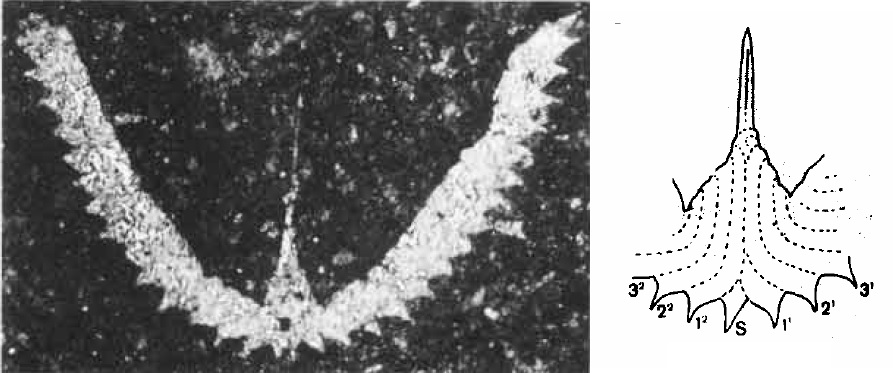
Pseudisograptus manubriatus koi, entire fossil and close-up diagram of initial thecae, from Cooper & Ni (1986).


The graptoloid genus Pseudisograptus has been collected from rocks in Australia, North America and eastern Asia dating to the latter part of the Floian stage of the early Ordovician, a bit over 470 million years ago (Cooper & Ni 1986). It is characterised by colonies growing in two branches (stipes) with the stipes spreading outwards and upwards like a pair of wings (indeed, one species of this genus luxuriates in the name of Pseudisograptus angel). In large specimens, the stipes reach about two centimetres in length and about three millimetres wide (from inner margin to the outer apex of the individual thecae). Pseudisograptus species are very similar to, and until 1972 where classified with, species of the related genus Isograptus. They differ, however, in the arrangement and growth of the earliest thecae in the colony. Whereas Isograptus stipes grow outwards immediately from the oldest theca, Pseudisograptus have the first few thecae on each stipes elongated and growing downwards before the stipes makes a later sharp turn upwards. As a result, between the two 'wings' of the stipes there is a more or less distinct triangle (referred to as the manubrium) formed from the bases of the early thecae. At the top of the manubrium is an upright thread, the nema. In a number of graptoloid fossils, an inflated structure has been identified at the top of the nema that probably functioned as a float. I don't know if such a structure has ever been identified in a Pseudisograptus fossil but I imagine it would quite easily be lost in the course of preservation.

Basal section of Cardiograptus amplus, from Fortey et al. (2005). Not a true biserial graptoloid but illustrative of the way biserial forms may have evolved from biramous ancestors.


Pseudisograptus' disappearance from the fossil record coincides with one of the aforementioned turnovers in graptoloid diversity, the appearance of the biserial graptoloids. These forms, which had two rows of thecae arising from a single central line, rapidly replaced most of the earlier branched forms. The rapid appearance of the biserial graptoloids has made their origins difficult to work out but current thinking is that they arose from a form similar to Pseudisograptus, in which the upward growth of the stipes became steep enough that they met in the middle along the nema. One interesting detail is that two lineages appear to have achieved biseriality at about the same time from closely related but separate ancestors. In the glossograptids, the conjoined stipes met each other side-by-side; in the diplograptids, they met back to back. Pseudisograptus has, at different times, been implicated in the ancestry of both of these groups. Cooper & Ni (1986) regarded Pseudisograptus as paraphyletic and including the direct ancestors of the glossograptids. In contrast, more recent studies by Fortey et al. (2005) and Maletz et al. (2009) have placed Pseudisograptus closer to the diplograptids. These studies have been more agnostic as to whether Pseudisograptus was a direct ancestor or a close relative. If the former is the case then, while the exact Pseudisograptus morphotype would disappear at the end of the Floian, their genetic lineage would continue strong for nearly ninety million more years.

REFERENCES

Cooper, R. A., & Ni Y. 1986. Taxonomy, phylogeny, and variability of Pseudisograptus Beavis. Palaeontology 29 (2): 313–363.

Fortey, R. A., Y. Zhang & C. Mellish. 2005. The relationships of biserial graptolites. Palaeontology 48 (6): 1241–1272.

Maletz, J., J. Carlucci & C. E. Mitchell. 2009. Graptoloid cladistics, taxonomy and phylogeny. Bulletin of Geosciences 84 (1): 7–19.

Tetragraptines

Colonies of Tetragraptus quadribrachiatus, from the University of Oslo.


In preparation for this post, I have been attempting to develop an understanding of graptolite branching patterns. This is not something that should be attempted lightly, if at all. If anything in this post seems confused, it's because it is.

The Tetragraptinae were a group of graptolites that lived during the Lower Ordovician, and formed part of the early radiation of planktonic graptoloids. In one of the earlier phylogenetic (or at least quasi-phylogenetic) classifications of graptolites, that of Fortey & Cooper (1986), the tetragraptines (including the genera Tetragraptus and Pseudophyllograptus) were recognised on the basis of what was called the 'Tetragraptus serra proximal type'. In an earlier post, I explained how graptolite colonies grew as a series of branching zooids (individuals). The colony section for each individual zooid is called the theca, and graptolite workers usually refer to the thecae in discussions rather than the zooids (as the zooids are generally not preserved in fossils). A developing colony starts with the initial larval zooid, called the sicula. Out of the side of the sicula grows the first mature theca, which is referred to as th11 (the sicula is not included in the thecal count because it has a different growth pattern from the sequential thecae). The second theca, th12, then buds off from th11. The third theca to arise is th21, then th22, then th31, and so on and so forth. If all these bud in a simple sequence, the colony is not branching. However, if one or more of these basal thecae is what is known as a dicalycal theca (it produces two daughter thecae instead of just one), the colony branches. In most tetragraptines, th12 is a dicalycal theca, as are its two daughter thecae, so the mature colony has four branches. The basal canals of th12 and th21 crossing over the sicula, plus the proximal part of th22, make the lower part of the proximal region very robust: this massiveness is what characterises the Tetragraptus serra proximal type. Other characters listed by Fortey & Cooper (1986) as synapomorphies for the Tetragraptinae, reclined colony branches and a reduction in the number of branches, were also found in other lineages.

Proximal region of Tetragraptus bigsbyi, showing robust morphology, together with diagrammatic representation of thecal connections in early colony. From Bulman (1970).


The Tetragraptinae were one of a number of groups of Ordovician graptolites with four-branched colonies, though other taxa lacked the T. serra proximal region. In a phylogenetic analysis of graptoloids, Maletz et al. (2005) identified four-branched graptoloids as a single clade that they called the Tetragrapta. This is in contrast to Fortey & Cooper (1986), who placed these taxa at a number of places in the graptoloid tree. The analysis of Maletz et al. (2005) differed from that of Fortey & Cooper (1986) in being a computational analysis rather than being constructed 'by hand'. Some characters given high weight by Fortey & Cooper (1986), such as the presence of a structure called a virgella, were found to be less significant by Maletz et al. (2005). However, in some regards the coverage of the latter study was less complete than the earlier. Most notable for the present post is that Fortey & Cooper (1986) had also included 'Dichograptus' solidus in the Tetragraptinae. This species apparently also has the T. serra proximal region, but also has more than four branches in the colony. It is possible that its inclusion in a computational analysis would weaken the association of four-branched graptoloids as a clade.

By the end of the Ordovician, the graptoloid lineages with multi-branched colonies were extinct. There have been numerous suggestions for why this may have happened—buoyancy issues or competition between zooids are among the front runners—but for the rest of graptoloid history, simplicity would become the watchword.

REFERENCES

Bulman, O. M. B. 1970. Graptolithina with sections of Enteropneusta and Pterobranchia. In Treatise on Invertebrate Paleontology Part V 2nd ed. (C. Teichert, ed.) pp. V1-V149. The Geological Society of America, Inc.: Boulder (Colorado), and the University of Kansas: Lawrence (Kansas).

Fortey, R. A., & R. A. Cooper. 1986. A phylogenetic classification of the graptoloids. Palaeontology 29: 631-654.

Maletz, J., J. Carlucci & C. E. Mitchell. 2009. Graptoloid cladistics, taxonomy and phylogeny. Bulletin of Geosciences 84 (1): 7-19.

Rastrites: Stringing Out Thecae

Fossil of Rastrites cf. longispinus, from here.


The latter part of the Ordovician saw a turnover in the graptoloids, the planktonic branch of the early Palaeozoic colonial graptolites (earlier posts on graptolites can be found here and here). The basally-branched forms that had been among the earliest graptoloids became extinct, leaving only the scandent forms surviving in the Silurian. Scandent colonies grew as a single linear stipe, which might have thecae (the openings for individual members of the colony) in two lines, one on either side of the stipe, or in a single line on one side of the stipe. The latter form characterised the Monograptidae, which were to become the latest surviving graptoloids (Bulman 1970).

Despite their long survival, monograptids were mostly a fairly uniform bunch. Their simple morphology did not give much scope for obvious morphological variation, and many monograptid lineages were not greatly distinct in colony form. One of the more distinct forms was the short-lived genus Rastrites which occurred during the Llandovery period of the early Silurian (and so relatively early in the history of the monograptids). Species of Rastrites developed very long and slender, widely spaced thecae that stode out perpendicular from the connecting stipe like the strings on an Incan quipu.

Rickards et al. (1977) suggested that the genus Rastrites is polyphyletic, deriving separate lineages within the genus from a number of different (albeit closely related) species assigned to the separate genus Monograptus. To a certain extent, the distinction is a little arbitrary: these ancestral Monograptus (treated by some authors as a third genus, 'Demirastrites') also had elongate thecae, but not yet to the same degree as developed by Rastrites proper, and not as widely spaced. But that, after all, is the nature of evolution, and the limitation of any classificatory system. You have to draw a line somewhere.

REFERENCES

Bulman, O. M. B. 1970. Graptolithina with sections of Enteropneusta and Pterobranchia. In Treatise on Invertebrate Paleontology Part V 2nd ed. (C. Teichert, ed.) pp. V1-V149. The Geological Society of America, Inc.: Boulder (Colorado), and the University of Kansas: Lawrence (Kansas).

Rickards, R. B., J. E. Hutt & W. B. N. Berry. 1977. Evolution of the Silurian and Devonian graptoloids. Bulletin of the British Museum (Natural History): Geology series 28 (1): 1-120.

Name the Bug: Acanthastus luniewskii


Acanthastus luniewskii. Plate from Kozłowski (1948).


The five known species of Acanthastus were all described by Roman Kozłowski in his legendary 1949 monograph Les graptolithes et quelques nouveaux groupes d'animaux du Tremadoc de la Pologne which has done more than any other book to make me wish that I could read French. It was in this book that Kozłowski established the currently accepted relationship between the Palaeozoic graptolites and the recent pterobranchs (see this post here) based on his descriptions of early sessile graptolites from the early Ordovician of Poland. The Acanthastus remains were found in the same deposits, but establishing their affinities was just a little more difficult.

Acanthastus was represented by small flattened circular chitinous fossils (up to a few millimetres across) with a central dorsal opening surrounded by a ring of upwards-pointing spines. This central opening was crossed by tubes connected to the spines with a central cavity underlying this opening. Beneath and around this central cavity were a number of further chambers, divided by internal walls from the central cavity. The dorsal surface surrounding the central opening was roughened by a covering of small projections.


Diagram showing the internal structure of an idealised Acanthastus specimen, from Kozłowski (1949).


Kozłowski interpreted Acanthastus as a colonial animal, with each fossil representing a collection of individuals (presumably one in each chamber). I'm not entirely convinced by this - except for the central cavity, each of the chambers appears to have been entirely sealed off from the outside world, nor were the chambers connected in any way that would have allowed for the ready transfer of nutrients from the outside. But then, I've never been able to understand how on earth blastoids were able to survive either.

Because all the other taxa described by Kozłowski (1949) were graptolites or likely graptolite relatives, Acanthastus has always been associated with graptolites as well (for instance, appearing on a Wikipedia list of graptolite genera). However, Kozłowski himself was much less confident, noting that "Comme nous ne connaissons aucun organisme fossile ou vivant dont la morphologie ressemblerait à celle des Acanthastida il n'est pas possible de préciser actuellement leur position taxonomique" ("As we do not know any fossil or living organism whose morphology resembles that of Acanthastida it is not possible to currently define their taxonomic position"). After ruling out a relationship with coelenterates, bryozoans or tunicates, Kozłowski tentatively suggested that Acanthastus might be related to graptolites and pterobranchs by a vague similarity in skeletal structure, while admitting that its overall morphology was vastly different. His comment about relationships between Acanthastus and graptolites was that "Le plus qu'on pourrait admettre c'est que les Acanthastida appartiennent au même embranchement que ces derniers" ("The most one could admit is that Acanthastida belong to the same embranchement [phylum?] as the latter"), hardly a ringing endorsement. Unfortunately, no further study has been conducted on Acanthastus since Kozłowski (1949). I don't know how much of Kozłowski's original material still remains (see below), nor do any further specimens seem to have been recorded.

As well as being one of the most significant publications in the history of graptolite research, Kozłowski's 1949 monograph has to have one of the most dramatic publication histories. Though Kozłowski seems to have finished composing it in 1938, its publication was delayed for ten years by a small distraction known as World War II* (Kielan-Jaworowska & Urbanek, 1978). The Palaeontology department of the Warsaw University where Kozłowski worked was firebombed by the Germans in 1939 and all the material held in it destroyed. Some of Kozłowski's collection, as well as the monograph manuscript, was saved because it had been hidden in the basement of the Warsaw Seismological Observatory a few days before the destruction of the Palaeontology Department. When Kozłowski was able to return to the Observatory over a month later (German troops had been occupying it over that time), he found the place ransacked and all his material apparently lost. It wasn't until a few months later that he found his specimens and part of the manuscript among the ruins of the University, while a colleague found the remainder of the manuscript buried in a snowdrift.

In 1944, hundreds of thousands of Warsaw's inhabitants, including Kozłowski, were forced to flee the city. Again, the monograph manuscript was hidden, this time in the central heating pipes of Kozłowski's house. Kozłowski returned in 1945 to find the house ruined but the manuscript still safely hidden and waiting to be published. Also surviving the war intact were the negative for the monograph's plates which had been forwarded to Paris shortly before the war's beginning.

Which all kind of puts any problems you might have with reviewer delays into perspective, doesn't it?

*There's a fantastic story about British television and World War II. Television broadcasting was halted in Britain after the declaration of war. Supposedly, the first broadcast after the end of the war was introduced with the words "As we were saying before we were so rudely interrupted..."

REFERENCES

Kielan-Jaworowska, Z., & A. Urbanek. 1978. Dedication: Roman Kozłowski (1889-1977). Acta Palaeontologica Polonica 23 (4): 415-425.

KozÅ‚owski, R. 1949. Les graptolithes et quelques nouveaux groupes d’animaux du Tremadoc de la Pologne. Palaeontologica Polonica 3: 1-235. (The publication itself is dated 1948, but all secondary sources seem to agree that it was actually published in 1949.)

Further Readings from the Rocks (Taxon of the Week: Graptolithina)


Colony of the crustoid graptolite Hormograptus sphaericola, showing the triad mode of branching. Image via Graptolite Net (Warning: While an excellent resource for all things graptolite-y, for an unknown reason some pages of Graptolite Net do try to play elevator music at you. Click link at own risk.)


Today, I'm going back to Graptolithina, the graptolites. For those of you who aren't familiar with graptolites, you can read my previous post on the subject.

As mentioned in that post, it is by now universally accepted that the closest living relatives of the Palaeozoic graptolites are to be found in the Pterobranchia. Pterobranchs are, admittedly, a fairly obscure group in their own right, being minute colonial animals that feed by means of a tentacled lophophore*. Despite their obscurity, though, pterobranchs are not devoid of interest, belonging as they do to the phylum Hemichordata and hence among the closer invertebrate relatives to ourselves. The most basic character uniting graptolites and pterobranchs is that they both have an external covering of chitinous fuselli - their skeleton is constructed in bands, a bit like the bandages wrapping a mummy.

*Yes, you heard me - lophophore.

Despite the two groups usually being treated as separate classes, the distinction between graptolites and pterobranchs is a little vague. Okay, it's a lot vague. The problem doesn't lie so much with the graptolites as it does with the pterobranchs. There are three living genera of pterobranchs, each of theme very distinct from each other. In fact, the genera Rhabdopleura and Cephalodiscus are easily more distinct from each other than either is to the graptolites. Rhabdopleura forms a long, linear colony with individual zooids budding off one by one, zooids remaining permanently attached to each other by a stolon, and with a skeleton of only a single banded fusellar layer. Cephalodiscus colonies bud irregularly to form irregular-shaped colonies, zooids do not remain permanently attached to each other but remain in loose association, and the fusellar layer of the skeleton is covered over by an external unbanded cortex. The third genus, Atubaria, has zooids very similar to those of Cephalodiscus, but doesn't secrete a colonial skeleton at all.


Modern pterobranchs - Cephalodiscus above, Rhabdopleura below. Image from here.


Graptolites combine the regular colony structure and permanent stolon of Rhabdopleura with the external cortex of Cephalodiscus. In Cephalodiscus, cortex is produced by individual zooids crawling out of the colony to plaster cortex on from outside, but it is difficult to imagine how graptolites would have managed this with their permanent stolon. Some authors have suggested that graptolites possessed an extensive evagination of the outer epithelium emerging from the colony openings, partially or entirely converting the exoskeleton into an endoskeleton. To further confuse matters, cortex-like structures have also been identified in fossil rhabdopleurids (Mierzejewski & Kulicki, 2001). Overall, it is highly possible that graptolites should really be included within pterobranchs (some authors have used the name "Graptolithoidea" for such a grouping). There are five well-established graptolite orders*. The Graptoloidea are the familiar planktic graptolites, the Dendroidea were upright-branching benthic forms, and the Crustoidea, Tuboidea and Camaroidea were all horizontally-growing encrusting forms. Among these orders, there is a clear division between the Tuboidea and Camaroidea on one hand (in fact, the distinction of these two orders is a little doubtful), and the Crustoidea, Dendroidea and Graptoloidea on the other (Mierzejewski, 2001). Colonies of Tuboidea and Camaroidea exhibit diad branching as in modern Rhabdopleura, with zooids branching off the stolon one by one**. The other three orders, in contrast, possess triad branching. Instead of only one zooid branching at a time, two zooids branch alongside each other, a larger autotheca and a smaller bitheca (most graptoloids later showed a secondary reduction or loss of bitheca production). Many different suggestions have been made as to what the distinction between the two zooid forms could have been in life - feeding vs. reproductive zooids, males vs. females, feeders vs. cleaners, etc. - but, of course, there's really no way of knowing (modern pterobranchs don't show such inter-zooid specialisations). Many tuboids and camaroids also possessed distinct autothecae and bithecae, but bithecae were distributed irregularly within the colony rather than in regular association with autothecae. A collection of stolon fragments described as early crustoids by Mierzejewski et al. (2005) shows an effectively triad branching pattern but with a slight lag between side-branches, suggesting that the triad pattern could have derived from an ancestral diad pattern by simple shortening of the gap between regular autothecal and bithecal branchings.

*Bulman (1970) recognised six, but the Stolonoidea have not been universally accepted as graptolites. Other authors have recognised further orders such as Dithecoidea, but these have usually been poorly characterised and/or possibly not graptolites.

**Technically, the colony produces one lateral theca at a time. Being soft and squishy, the zooids themselves are not preserved as fossils, but it seems a reasonably safe assumption that each thecal opening housed an individual zooid.


The holotype of the camaroid graptolite Tubicamara coriacea. Camaroids had autothecae divided into an inflated basal camara (chamber) and an upright collum. From Kozłowski (1949), via Graptolite Net. Kozłowski (1949), offhand, is one of the books that has most made me wish I could read French.


Records of the three encrusting orders are decidedly limited compared to the dendroids and graptoloids, and all three are only known from the Ordovician and Silurian (camaroids are Ordovician only). However, it is debatable to what extent this lower record reliably indicates the encrusting graptolites to have been rarer. The graptolite fossil record is heavily biased towards remains preserved in low-energy environments (Kirk, 1979), with the relatively frail graptolite skeleton rapidly being destroyed in high-energy environments. Perhaps the rarity of encrusting forms reflects a higher-energy habitat preference rather than true lack of abundance.

REFERENCES

Bulman, O. M. B. 1970. Graptolithina with sections of Enteropneusta and Pterobranchia. In Treatise on Invertebrate Paleontology Part V, 2nd ed. (C. Teichert, ed.) pp. V1-V149. The Geological Society of America, Inc.: Boulder (Colorado), and the University of Kansas: Lawrence (Kansas).

Kirk, N. H. 1979. Thoughts on coloniality in the graptolites. In Biology and Systematics of Colonial Organisms (G. Larwood & B. R. Rosen, eds.) pp. 411-432. Academic Press: London.

KozÅ‚owski, R. 1949 ("1948"). Les graptolithes et quelques nouveaux groupes d’animaux du Tremadoc de la Pologne. Palaeontologica Polonica 3: I-XII, 1-235.

Mierzejewski, P. 2001. A new graptolite, intermediate between the Tuboidea and the Camaroidea. Acta Palaeontologica Polonica 46 (3): 367-376.

Mierzejewski, P., & C. Kulicki. 2001. Graptolite-like fibril pattern in the fusellar tissue
of Palaeozoic rhabdopleurid pterobranchs. Acta Palaeontologica Polonica 46 (3): 349-366.

Mierzejewski, P., C. Kulicki & A. Urbanek. 2005. The world’s oldest crustoid graptolites from the upper Tremadocian of Poland. Acta Palaeontologica Polonica 50 (4): 721-724.

The Writing in the Rocks

Okay, we'll see how long this one lasts - I'm going to attempt to add another feature to this site. Like anyone working in the field of science (and doubtless any other academic discipline), I've accumulated quite a pile of references of one form or another. In fact, my EndNote library has a little shy of 6000 entries, most of which lurk in a pair of ominous-looking filing cabinets sitting in the back of the office at home that Jack has given up trying to ask me to bring some order to. So the idea is that each week I'll select one of the entries in my EndNote more or less at random to read over and review. It may be a paper of great significance, it may be something completely trivial. It may be of interest to many, it may be of interest to almost none. All I know is that it will hopefully give me an opportunity to actually read some of the things I've probably taken a copy of at some point ande flicked through briefly before filing it away never to be seen again. So, on to this week's review, of the article that was my 1000th entry into EndNote:


Zhang, Y.-D., & A. C. Lenz. 1997. Uppermost Wenlock and Ludlow graptolites from southern Yunnan, China. Canadian Journal of Earth Sciences 34: 1220-1238.

I'm probably showing unbelievable levels of geekiness in saying so, but I have a certain degree of affection for graptolites. They were one of first examples I became aware of as a lad of a completely extinct lineage of fossil organisms of uncertain relationships to anything alive today. Graptolites were an abundant group of colonial animals in the Palaeozoic. The name Graptolithus can be translated from Latin as "rock with writing", and was originally coined by Linnaeus for what he thought were mineralisations of inorganic origin (Linnaeus' original classification covered minerals as well as plants and animals).

The most speciose lineage of graptolites, the Graptoloidea, was planktonic (the picture above comes from here, and shows a reconstruction of the basal planktonic graptolite Rhabdinopora), but other orders of graptolites were sessile and benthic. Most modern authors agree that the graptolites were closely related to the pterobranchs, a small group of modern colonial animals (both in the sense of not including many species, and in being small in size). The story of how the relationship between graptolites and pterobranchs came to be recognised is an interesting one in its own right - critical well-preserved specimens of early sessile graptolites were described by Roman Kozłowski from the Holy Cross Mountains in Poland (Kozłowski, 1949), but the results of his research almost never saw the light of day due to the minor inteference of the Second World War.

As I've already indicated, the earliest graptolites were benthic, and one of the most successful benthic orders were the Dendroidea, so-called because of their multi-branching tree-like structure. The Graptoloidea were derived from dendroid-type ancestors, and basal graptoloids such as Rhabdinopora can essentially be described as a dendroid detached from the bottom and hung upside down. Many popular books will then go on, as I am about to, to describe the subsequent history of graptoloids in a misleadingly linear way. However, the dendroids did not disappear with the rise of the graptoloids, though they never achieved the diversity of the latter. In fact, the dendroids survived long after the graptoloids had fallen by the wayside - dendroids were still alive and well in the early Carboniferous, while graptoloids never made it past the Devonian.


Nevertheless, as time went by the early multi-branched planktonic forms gave way to descendents with a far simpler organisation. Four-branched taxa gave rise to two-branched taxa, which in turn gave way to the linear monograptids (the illustration at left comes from the University of Oslo, and shows the single-rowed Spirograptus turriculatus). Another group of graptoloids, the retiolitids, took a different approach to lightening the colony structure, and reduced the colonial wall to a minimalist net-like framework (Kozłowska-Dawidziuk, 2004 - I'd recommend taking a look at this article, especially if, like me, you've had some difficulty in imaging retiolitids as live animals).

Graptoloids are a very useful group of organisms for biostratigraphy, combining the ideal features of wide distribution of individual species with relatively rapid species turnover. Biostratigraphy is the main focus of Zhang & Lenz's (1997) paper. The Ludlow epoch was in the later Silurian (see the Palaeos page) and the fauna described by Zhang & Lenz consists entirely of monograptids and retiolitids, the only graptoloid groups to survive the end of the preceeding Wenlock epoch. There's not much to say about this paper - it's a fairly standard example of a faunal survey, describing the graptolites found in the Shuiqingliangzi section in southern China. No new taxa were described, though detailed redescriptions were given of a number of taxa.

REFERENCES

Kozłowska-Dawidziuk, A. 2004. Evolution of retiolitid graptolites - a synopsis. Acta Palaeontologica Polonica 49 (4): 505-518.

KozÅ‚owski, R. 1949. Les graptolithes et quelques nouveaux groupes d’animaux du Tremadoc de la Pologne. Palaeontologica Polonica 3: 1-235.

I Can Has Mutant Larvae?


I've covered Salinella and Buddenbrockia, now I'll move onto another of the 'living problematica', though today's subject is arguably not as problematic. Let me introduce you (assuming you've not already met) to the giant planktonic larva Planctosphaera pelagica Spengel, 1932.

'Giant' is, of course, a relative term. The roughly spherical Planctosphaera reaches about 10mm in diameter (van der Horst, 1936) or even 25mm (Williamson, 2001). A diagram of the internal anatomy above comes from van der Horst (1936). Compared to its generally believed closest relative, the tornaria larva of Enteropneusta (acorn worms), this is huge - tornariae may be about a millimetre in size (Bourne, 1889). The intriguing point about Planctosphaera is that the adult form has never been identified. The similarity between Planctosphaera and tornariae means that it is almost universally accepted as a member of the Hemichordata (see the comparison to the left between the two, again from van der Horst), but it is different enough that the adult may not be a typical acorn worm (not to mention the size...) Williamson (2001) provides one exception - he maintains that Planctosphaera as currently known is the adult form. However, this interpretation is connected with Williamson's unusual theory of 'larval transfer', which is not widely accepted*, and jibes with the fact that known Planctosphaera do not have any sort of gonads or other reproductive structure (van der Horst, 1936).

*Williamson maintains that distinct adult and larval forms in various animals result from hybridisation between animals with distinct bauplans, with one stage in the life cycle resembling one parent and one resembling the other. For instance, caterpillars and other insect larvae would be derived from a hybridisation between a direct-developing winged insect and an onychophoran-like animal. First, try to imagine a butterfly mating with an onychophoran. Then, try to stop imagining a butterfly mating with an onychophoran.

One imaginative interpretation of Planctosphaera that does have a lot going for it is the idea that Planctosphaera is a normal tornaria larva that has become hypertrophied by a long planktonic period. The reference for this idea is Hart (1994) - unfortunately, I haven't been able to obtain the paper in question and I am unclear whether this is meant to be an adaptive change, or whether Planctosphaera represents a pathological form of a normal tornaria that has failed to develop in the normal way. Such pathologies are not unknown - Temereva et al. (2006) describe a giant phoronid larva (which even possesses rudimentary gonads!) that they interpret as such, and note the existence of giant larvae of ceriantharians, sipunculids and even fish.

Of course, the adult form of Planctosphara could still be out there somewhere, lurking in the ooze at the bottom of the oceanic abyss. As the relatively recent description of Torquarator Holland et al., 2005 demonstrated, we may have only scratched the surface of enteropneust diversity.

REFERENCES

Bourne, G. C. 1889. On a tornaria found in British seas. Journal of the Marine Biological Association 2 (1): 63-68, pl. 7, 8.

Hart, M. W., R. L. Miller, & L. P. Madin. Form and feeding mechanism of a living Planctosphaera pelagica (phylum Hemichordata). Marine Biology 120: 521-533.

Holland, N. D., D. A. Clague, D. P. Gordon, A. Gebruk, D. L. Pawson & M. Vecchione. 2005. 'Lophenteropneust' hypothesis refuted by collection and photos of new deep-sea hemichordates. Nature 434:374-376.

Horst, C. J. van der. 1936. Planctosphaera and Tornaria. Quarterly Journal of Microscopical Science: 605-613.

Temereva, E. N., V. V. Malakhov & A. N. Chernyshev. 2006. Giant actinotroch, a larva of Phoronida from the South China Sea: the giant larva phenomenon. Doklady Akademii Nauk 410 (5): 712-715 (transl. Doklady Biological Sciences 410: 410-413).

Williamson, D. I. 2006. Hybridization in the evolution of animal form and life-cycle. Zoological Journal of the Linnean Society 148: 585-602.