Field of Science

Showing posts with label Ornithurae. Show all posts

Conformed Flycatchers

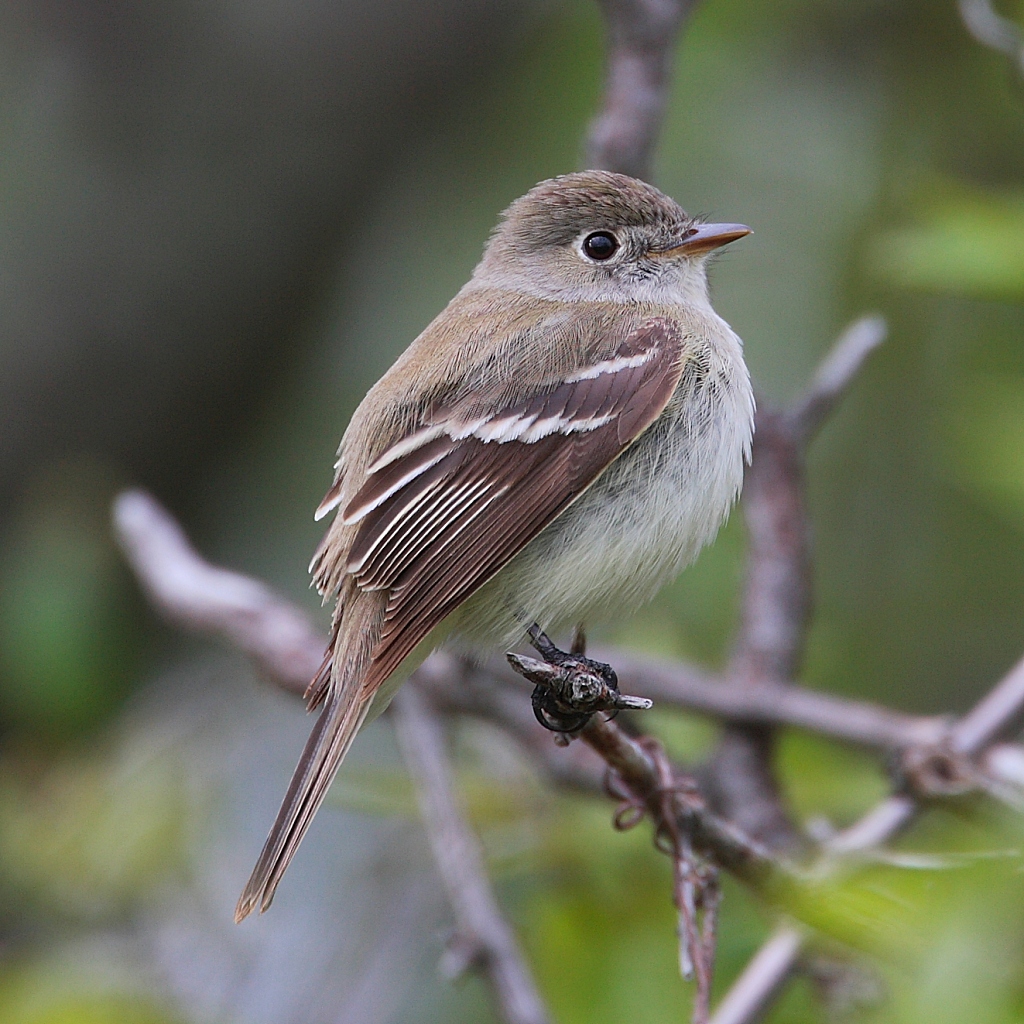
A quote I have often had cause to refer to—I believe it originally came from Toby White of Palaeos.com—is that "organisms are under no obligation to speciate with regard to the convenience of taxonomists". For birdwatchers in North America, perhaps no group more embodies this principle than the flycatchers of the genus Empidonax. These small members of the hyperdiverse New World family Tyrannidae comprise fifteen recognised species that have become notorious for the difficulty in telling them apart.

Immature alder flycatcher Empidonax alnorum, copyright Cephas.


The species of Empidonax are uniformly olive brown above, lighter below, with pale rings around the eyes and bands on the wings. They are inhabitants of woodlands (more on that in a moment) and watch for flying insects from a perch, making short flights to capture prey. Though individual species are generally similar in their feeding habits, they are often specifically distinct in their preferred habitats. A molecular (mtDNA) analysis of Empidonax species by Johnson & Cicero (2002) identified four likely clades within the genus with members of a clade each differing in their specific breeding range. Species found in the US and Canada often migrate long distances and closely related species may be found close together outside their breeding ranges (references to ranges below refer to breeding ranges). Species found in Mexico and Central America are more likely to migrate only short distances or be resident year-round.

Acadian flycatcher Empidonax virescens, copyright Aitor.


The Acadian flycatcher E. virescens seems to be relatively isolated from other members of the genus. This species is found in shady forests near water in the eastern US and Canada. Its nest is a cup made from plant fibres suspended in a horizontal branch fork, and it lays lightly speckled eggs.

The yellow-bellied flycatcher E. flaviventris, yellowish flycatcher E. flavescens, Cordilleran flycatcher E. occidentalis and Pacific slope flycatcher E. difficilis form a clade of species that tend to have more yellowish underparts than other members of the genus. Their nests are mossy cups constructed on a protected ledge or crevice. Members of this clade tend to be found in relatively damp forest areas, such as boggy areas of boreal forests in the case of E. flaviventris, or shady canyons in the case of E. occidentalis or E. difficilis. A notable exception is the Channel Islands population of E. difficilis which is found in more open woodlands than its mainland counterparts. Empidonax occidentalis and E. difficilis are found in the western United States with E. difficilis occupying coastal regions and E. occidentalis found further inland. Until fairly recently, the two were confused as a single species; they are almost indistinguishable morphologically but can be separated by their calls.

Least flycatcher Empidonax minimus, copyright Mdf.


The white-throated flycatcher E. albigularis, alder flycatcher E. alnorum and willow flycatcher E. traillii form a clade of species nesting in damp thickets. Again, it was only fairly recently that the more northerly E. alnorum was distinguished from the more southerly E. traillii.

Finally, the remaining species form a clade whose members lay eggs without speckled markings. They are often relatively dark compared to other Empidonax; the black-capped flycatcher E. atriceps of Costa Rica and Panama stands out for the sooty-black coloration of the head. They often inhabit relatively open forest, often at higher altitudes.

Johnson & Cicero (2002) suggested that the largely allopatric (non-overlapping) breeding ranges of species within clades of Empidonax reflected speciation as a result of isolation in glacial refuges during the ice ages. As the ice retreated, the now-distinct species expanded their ranges but excluded each other where they met. Differences in mating calls between related species dissuaded interbreeding. Physical appearance, meanwhile, remained frustratingly monotonous.

REFERENCE

Johnson, N. K., & C. Cicero. 2002. The role of ecologic diversification in sibling speciation of Empidonax flycatchers (Tyrannidae): multigene evidence from mtDNA. Molecular Ecology 11: 2065–2081.

The Origins of Song

The world is currently home to roughly ten thousand known species of bird. These come in a significant range of varieties and sizes: ostriches, hummingbirds, penguins, sandgrouse. But one particular clade of birds accounts for roughly half of all living species: the true songbirds of the Euoscines.

Brown treecreeper Climacteris picumnus, a representative of an early-diverging Australian clade of songbirds, copyright Patrick Kavanagh.


Though the name 'Euoscines' doesn't appear to have received a whole lot of usage in the literature, the clade it refers to actually has a long history of recognition. The Euoscines are one of the major subgroups of the well-recognised order Passeriformes, the perching birds. Members of the Euoscines include such familiar animals as finches, crows, wrens, swallows, skylarks, sparrows, and a whole host of others. On a morphological basis, Euoscines are mostly united by the distinctive structure of their syrinx, or voice-box, which is controlled by five pairs of intrinsic muscles (Ericson et al. 2002; by way of contrast, the lyrebirds and scrubbirds that form the clade most closely related to the Euoscines have only three pairs). This complex syringeal structure is doubtless a factor in the elaborate songs that characterise many representatives of the clade and from which the group gets its vernacular name. Molecular data has further strengthened the case for the Euoscines.

Whereas the phylogenetic integrity of the Euoscines is no considered by most researchers to be beyond reproach, its exact origins are a little more mysterious. Outside the Euoscines, the members of the Passeriformes fall into three well supported clades. As noted above, the immediate sister group of the Euoscines is a small Australian clade, the Menurae (the Menurae and Euoscines together form the singing birds, the Oscines). Another very small clade, the New Zealand wrens of the Acanthisittidae, is thought to represent the sister group of all other Passeriformes. The largest clade of Passeriformes outside the Euoscines is the Suboscines, whose members include such examplars as the broadbills and pittas of the Old World tropics, and the antbirds, tapaculos and tyrant flycatchers of the New World. The Suboscines form the sister clade to the Oscines.

Australian logrunner Orthonyx temminckii, another early-diverging exemplar, copyright JJ Harrison.


We also have a fairly clear idea of basal relationships within the Euoscines, primarily from molecular data. I won't dwell on details here (I am aware that while litanies of names can hold a lot of interest for myself, others may find them more tedious) but a detail that has garnered attention is that a preponderance of the basal euoscine lineages are enitrely or predominantly Australasian. This, together with the Australasian distribution of two of the other three major passerine clades, has lead to the proposal that Australasia represents the ancestral homeland for the Euoscines as a whole. But when did the Euoscines first make their appearance?

This is where things begin to get fuzzier. The fossil record of Passeriformes, as for many other birds, is very patchy and often difficult to interpret. Possible passerine bones have been identified from the early Eocene of Australia but they are fragmentary and their identity has been questioned. The earliest well-preserved passerines come from the early Oligocene of Europe (Bochenski et al. 2021). These fossils preserve features indicating that at least the oscine and suboscine lineages had diverged by this time. Attempts to apply molecular dating to the passerine phylogeny, however, have lead to proposals that the major lineages of passerines diverged much earlier, during the Cretaceous era in fact. The divergence of the passerines has then been linked to the break-up of Gondwana, beginning with the isolation of the New Zealand wrens as New Zealand separated from Antarctica about 80 million years ago.

Spotted pardalote Pardalotus punctatus, representing the meliphagoid lineage of Australasian songbirds, copyright Patrick Kavanagh.


Personally, I find this completely incredible. Firstly, it implies a gap of at least 25 million years or so at the beginning of the passerine fossil record (if we accept the Australian fossils as passerines). I've already noted that passerines do not have a great fossil record overall, particularly in the Southern Hemisphere where they are supposed to have originated, but other small birds do have a decent fossil record in the Northern Hemisphere during this time period. The absence of passerines from Europe and North America in the Palaeocene and Eocene does seem likely to be genuine. Secondly, it implies the survival through the devastation of the end-Cretaceous extinction event of not just at least three lineages of passerines but also those bird lineages that diverged before the passerines. At a bare minimum, that requires at least ten clades of birds surviving the Cretaceous and more than likely requires significantly more, most of those lineages also having no recognisable Cretaceous fossil record. Meanwhile, all other non-bird dinosaurs that we do know were around, many of them ecologically very similar, were completely wiped out. Thirdly (and this is perhaps the one that really gets me), it requires that these passerine lineages divided by continental drift then failed to disperse enough over the next eighty million years to obscure the imprint of said drift. Need I remind you that birds can fly? Hand-waving explanations such as the members of many of these early-diverging lineages being poor fliers, or the northern and southern continents being further apart at the time, just don't cut it in my opinion. Why should we assume that if modern Acanthisittidae or Menurae are poor fliers, their extinct relatives also had to be? Eighty million years seems like more than enough time for variation in flight strength to evolve. And a re Suboscines even any more prone to being poor fliers than Euoscines? As for the greater distance between continents, passerines have made their way to isolated oceanic islands (such as those in the mid-Atlantic) that were never close to any landmass. Phylogenetic evidence suggests that some modern passerine groups are indeed the descendants of long-distance dispersals, such as the South American vireos being apparently descended from Asian ancestors, or Hawaiian honeycreepers originating from near the Arctic. And of the previously mentioned European Oligocene passerines, some such as Wieslochia weissi were possibly not part of the Suboscines + Oscines clade (Manegold 2009), indicating that passerines of this grade could indeed make the ocean crossing. So no, the idea of Cretaceous songbirds is just not something I buy right now.

REFERENCES

Bochenski, Z. M., T. Tomek, M. Bujoczek & G. Salwa. In press 2021. A new passeriform (Aves: Passeriformes) from the early Oligocene of Poland sheds light on the beginnings of Suboscines. Journal of Ornithology.

Ericson, P. G. P., L. Christidis, M. Irestedt & J. A. Norman. 2002. Systematic affinities of the lyrebirds (Passeriformes: Menura), with a novel classification of the major groups of passerine birds. Molecular Phylogenetics and Evolution 25: 53–62.

Manegold, A. 2009. The early fossil record of perching birds (Passeriformes). Palaeontologia Africana 44: 103–107.

Stilts and Avocets

Visit a healthy wetland in many parts of the world and you may be able to see boldly patterned, lightly built birds with remarkably long legs and bills wading through the shallows. These are the members of the Recurvirostridae, commonly known as the stilts and avocets.

American avocets Recurvirostra americana, from here.


About a dozen species of recurvirostrid are currently recognised, depending on the exact classification scheme in play. They are divided between three genera with the avocets forming the genus Recurvirostra and the stilts divided between Himantopus and Cladorhynchus. The most obvious distinction between the two subgroups is in the shape of the bill: that of stilts is straight but avocets have a distinct upwards curve towards the end of theirs. A fourth genus has often been included in the Recurvirostridae for the ibisbill Ibidorhyncha struthersii, a striking-looking inhabitant of the upland rivers of the Himalayan plateau, but uncertainty about this bird's phylogenetic position has led most recent authors to exclude it from the family.

The recurvirostrids feed mostly on small aquatic invertebrates such as brine shrimp or insect larvae. Their long legs, among the longest relative to body size of any bird, allow them to wade in deeply in search of prey. Stilts actively probe the waters and underlying sediment whereas avocets tend to forage by sweeping their bill through the water side to side. Avocets and the banded stilt Cladorhynchus leucocephalus of Australia prefer brackish waters such as lagoons and estuaries, with the banded stilt congegrating around the great salt lakes of inland Australia. Breeding is conducted by monogamous pairs that share the duty of incubating their simple nest on the ground near water. These nests may be gathered into loose colonies; the banded stilt forms particularly large colonies in which the chicks are herded into communal creches of several hundred.

Pied stilt Himantopus leucocephalus, copyright JJ Harrison.


The majority of recurvirostrids are patterned with black or dark brown and white. The red-necked avocet Recurvirostra novaehollandiae has the head and neck coloured reddish-brown as does the American avocet R. americana during the breeding season. The banded stilt has a broad reddish-brown band across the top of the breast. There is also the black stilt Himantopus novaezelandiae of New Zealand, which is somewhat self-explanatory. Beaks are black in all species; the legs are grey in avocets and red in stilts.

Four geographically distinct species of avocet occupy the modern world: the American avocet in North America, the red-necked avocet in Australia, the pied avocet Recurvirostra avosetta in Eurasia and Africa, and the Andean avocet R. andina in South America. The Andean avocet is a bird of high altitudes, occupying shallow, alkaline lakes in the upper Andes. Cladorhynchus includes only the banded stilt. The most varied taxonomy concerns the genus Himantopus. Historically, all the black-and-white stilts (and sometimes also the black stilt) have been recognised as a single near-cosmopolitan species. In more recent years, the trend has been towards recognition of five or six distinct species in the genus. Most of these species are well separated geographically except for in New Zealand where the black stilt shares its range with the pied stilt Himantopus leucocephalus, a more recent immigrant from Australia. The breeding range of the black stilt is currently restricted to a relatively small area of New Zealand's South Island, and the species is considered endangered due to factors such as habitat alteration and the threat of hybridisation with the more abundant pied stilt*.

*It's worth spending some thought on the role of hybridisation as a conservation risk. Some observers may express concern that regarding hybridisation as a threat per se carries uncomfortable intonations of "racial purity", and that limiting the available gene pool may do more harm than good. After all, it's not as if the black stilt heritage of hybrid individuals is just gone (hybrids between the two species are, I believe, fully fertile and able to produce offspring of their own). The question is, I suppose, do the black stilt genes actually persist in the mixed population? Or does selection and/or drift winnow them out over time? This would be a difficult question to answer, and not without risk to find out.

Banded stilts Cladorhynchus leucocephalus and red-necked avocets Recurvirostra novaehollandiae, copyright Ed Dunens.


Phylogenetically, it is reasonably well established that recurvirostrids form a clade with the ibisbill and oystercatchers. This clade is in turn closely related to the plovers of the Charadriidae; indeed, many recent phylogenies have indicated that the recurvirostrid-oystercatcher clade may even be nested within the plovers as generally recognised. Considering the relatively small number of species in each clade, it might seem reasonable to suggest the recurvirostrids be reduced to a subfamily of the Charadriidae, but bird taxonomists being bird taxonomists, there seems to be more of a push to divide the Charadriidae up instead.

The fossil record of the Recurvirostridae is limited. A handful of species have been assigned to this family from the Eocene, but all are known from limited remains and their position is questionable. Coltonia recurvirostra is known from part of a wing from Utah; it was a relatively large bird, appearing to be more than one-and-a-half times the size of any living recurvirostrid. Fluviatilavis antunesi was described from a femur, humerus and radius from Portugal but was described as exhibiting some primitive features not found in modern recurvirostrids. It is also worth noting that its original description (Harrison 1983) compared it most favourably with the ibisbill, so if that species is not to be regarded as a recurvirostrid, probably neither is Fluviatilavis.

REFERENCE

Harrison, C. J. O. 1983. A new wader, Recurvirostridae (Charadriiformes), from the early Eocene of Portugal. Ciências da Terra 7: 9–16.

The Psitteuteles Lorikeets

Varied lorikeet Psitteuteles versicolor, copyright Joshua Robertson.


Few groups of birds have been the object of human interest as much as parrots, with their striking coloration and intelligence inviting comment at least as far back as ancient Greek times. This interest has continued into recent times and scientific research into all aspects of parrot life has been extensive. Nevertheless, the classification of parrots has long been problematic. As a group, parrots combine a high degree of superficial disparity in features such as colour pattern with an underlying overall morphological conservatism (a not uncommon issue with birds). As such, though recognition of distinct species may be fairly straightforward, establishing the relationships between those species may be less so. Prior to the advent of molecular studies, few higher groups of parrots could be considered widely accepted. One such group was the lories, found in Australasia and the Pacific Islands (smaller members of this group are known as 'lorikeets' but, as with 'parrots' vs 'parakeets', the difference between the two is a question of size and shape rather than affinities). Members of this group evolved a long, narrow, brush-tipped tongue that allowed them to pursue a diet of nectar and pollen (Schweizer et al. 2015). About a dozen genera of lories are currently recognised: one such genus, Psitteuteles, is the subject of the current post.

Goldie's lorikeets Psitteuteles goldiei, copyright Ltshears.


Psitteuteles is commonly recognised to include three species of smaller lory: the varied lorikeet P. versicolor, the iris lorikeet P. iris and Goldie's lorikeet P. goldiei. In general, these are primarily green species with a red forehead and with varying amounts of blue across the back of the head and/or behind the eyes. The plumage is longitudinally streaked in the varied lorikeet and Goldie's lorikeet. Goldie's lorikeet has mauve cheeks whereas those of the varied lorikeet are partially yellow. The varied lorikeet is also mauve across the upper breast whereas the other two species are more evenly green. All three species are separated geographically: the varied lorikeet is widespread in northern Australia, Goldie's lorikeet is found in New Guinea and the iris lorikeet is found on the islands of Timor and Wetar in Indonesia. The varied lorikeet is particularly common in association with paperbarks and eucalypts around streams and waterholes, migrating as required to find trees in flower. Similar wandering habits are characteristic of Goldie's lorikeet which is mostly found in montane forest. The more sedentary iris lorikeet is mostly found in lowland monsoon forest. The varied and Goldie's lorikeets are not currently regarded as being of conservation concern but the iris lorikeet is more threatened by habitat loss and collection for the pet trade.

Iris lorikeet Psitteuteles iris, copyright Dick Daniels.


Not all authors have recognised Psitteuteles as a distinct group: some have included its species in the related genus Trichoglossus with the rainbow and scaly-breasted lorikeets. Recent phylogenetic studies suggest that suspicion of Psitteuteles' status may not be unwarranted. Molecular studies by Schweizer et al. (2015) and Provost et al. (2018) both fail to identify the three Psitteuteles species as forming a single clade. Instead, P. iris is placed close to Trichoglossus species whereas P. versicolor and P. goldiei are both placed outside a clade including Trichoglossus and related genera such as Eos, the red lories, and the musk lorikeet Glossopsitta concinna. A case could probably be made for restricting Psitteuteles to the varied lorikeet as type species while including the iris lorikeet in Trichoglossus. The fate of P. goldiei is more uncertain: though neither of the aforementioned studies identified P. versicolor and P. goldiei as sister species, it might be too early to exclude the possibility. Alternatively, should P. goldiei prove too phylogenetically isolated to include in any pre-existing genus, I am not aware of any available genus name for it. As seems to be one of my standard sign-offs on this site, further study is required.

REFERENCES

Provost, K. L., L. Joseph & B. T. Smith. 2018. Resolving a phylogenetic hypothesis for parrots: implications from systematics to conservation. Emu 118 (1): 7–21.

Schweizer, M., T. F. Wright, J. V. Peñalba, E. E. Schirtzinger & L. Joseph. 2015. Molecular phylogenetics suggests a New Guinean origin and frequent episodes of founder-event speciation in the nectarivorous lories and lorikeets (Aves: Psittaciformes). Molecular Phylogenetics and Evolution 90: 34–48.

The Wingless Penguin

A couple of weeks ago, I put up a page on the 'terrestrial penguin' Cladornis pachypus, described from the Oligocene of Patagonia by the Argentine palaeontologist Florentino Ameghino. As it happens, Cladornis wasn't the only unusual penguin recognised from the Patagonian fossil record by Ameghino nor was it even necessarily the most unusual. That title should probably go to another species, the wingless Palaeoapterodytes ictus.

Anterior (left) and posterior view of humerus of Palaeoapterodytes ictus, from Acosta Hospitaleche (2010). Scale bar = 10 mm.


Like Cladornis, Palaeoapterodytes was based on only a single bone, in this case a humerus (upper wing bone) from the Early Miocene. And also like Cladornis, Ameghino's description of this bone indicated a truly remarkable bird. The distal part of the humerus lacked any sign of the facets that would normally articulate with the succeeding wing bones and, as a result, Ameghino concluded that the wing skeleton had been reduced to the humerus only. The crest and pits on the humerus marking the attachment of the wing muscles were also reduced. Ameghino's Palaeoapterodytes presumably had wings reduced to the merest nubs, effectively functionless and probably of little mobility. Nevertheless, the humerus of Palaeoapterodytes remained relatively robust, its breadth little less than that of other penguins.

I am not aware of any other bird with a wing structure anything like this. In other birds without functional wings, the entire wing skeleton becomes reduced, not simply truncated. Perhaps the closest approximation I have found is the wing of Hesperornis, which also lacks known wing bones beyond the humerus. However, the Hesperornis humerus is slender and gracile, and even without direct indication of the presence of more distal bones, it still looks to retain some remnant of the ancestral articulation. Also, the whole concept of a wingless penguin is decidedly problematic. Hesperornis derived its main propulsion in swimming from its feet and so its wings became reduced because they served little function. Penguins, on the other hand, get most of their propulsion from their wings, swimming in a manner that has been compared to flying underwater. Despite being flightless, penguins retain a wing skeleton that is, if anything, even more well developed than that of their flying relatives. For Palaeoapterodytes to have lost functional wings, it would have somehow had to change its mode of propulsion.

Reconstruction of the Palaeoapterodytes humerus with missing sections restored, from Acosta Hospitaleche (2010).


As a result, even while authors were cautiously considering Ameghino's interpretation of Cladornis, they treated Palaeoapterodytes with more scepticism. This scepticism was eventually concerned when the humerus was re-examined by Acosta Hospitaleche (2010). The reason for the lack of structure at its distal end was very simple: the original distal end had been broken off. The apparent lack of development of the muscle attachment structures was the result of erosion, not any indication of the bone's original appearance. When alive, Palaeoapterodytes had probably been very similar to, if not identical with, one of the several other penguin species known from around the same time and place. Unfortunately, the state of preservation of the type humerus is so poor that its exact identity cannot be determined, and Palaeoapterodytes ictus has been cast into the taxonomic limbo of nomen dubium. Ameghino's Cladornis may remain an intriguing mystery, but his Palaeoapterodytes is just a red herring.

REFERENCES

Acosta Hospitaleche, C. 2010. Taxonomic status of Apterodytes ictus Ameghino, 1901 (Aves; Sphenisciformes) from the Early Miocene of Patagonia, Argentina. Neues Jahrbuch für Geologie und Paläontologie—Abhandlungen 255 (3): 371–375.

The Patagonian Land Penguin


Take a good look at the figure above, which comes from Mayr (2009). It shows the fossilised tarsometatarsus (the fused long bone of the foot) of a bird from the late Oligocene of Patagonia. This may be one of the single most mysterious specimens in the fossil record. It represents all we know to date of Cladornis pachypus, described by Argentinean palaeontologist Florentino Ameghino in 1895. The appearance of the bone, being very broad and flat relative to its length, is quite bizarre and does not much resemble the tarsometatarsus of any other known bird.

The first thing that should be pointed out is that, whatever it was, Cladornis was a large bird. The specimen is not completely preserved (part of the proximal end of the bone has been lost) but its overall shape suggests that its original length was probably not too much longer than what we have. As such, the tarsometatarsus was probably comparable in length to that of a large pelican. However, it was much wider relative to length than that of a pelican, suggesting the possibility of a more robust bird. The shape of the bone's end indicates that the toes would have been widely spaced, and it may have even approached a zygodactyl arrangement (with two toes pointed rearwards and two forwards, like a modern parrot*) (Mayr 2009).

*When explaining this to my partner, I suggested that he imagine a parrot the size of a pelican. He shuddered and declared that he would rather not.

When Ameghino (1895) first described Cladornis, he interpreted it as an aquatic bird and suggested a relationship to the penguins, albeit in an extinct family Cladornidae (later authors would correct this to Cladornithidae). Later, noticing that it was preserved in association with terrestrial mammals, he declared that it was not marine and was possibly even terrestrial (he also included another species from the same formation, Cruschedula revola, in the Cladornithidae; this species is based on part of a scapula and there is no telling if it was related to Cladornis or not). He still maintained its relationship to the penguins (Ameghino 1906). Ameghino had a bit of a thing for trying to find the origins of all major modern vertebrate groups in his native South America (one of his other works was a book arguing for an Argentinean origin of humans) and it is possible that this was in play here. Nevertheless, the idea of a 'Patagonian land penguin' held sway until Simpson's (1946) review of the fossil penguins, in which he declared that Cladornis was "so very unlike any other penguin, recent or fossil, that I can only consider its reference to that group as erroneous".

This left Cladornis' taxonomic position completely up in the air (the question of whether Cladornis itself could get up in the air is, of course, currently completely unswerable). Wetmore (1951) included Cladornis in the Pelecaniformes, because...reasons. The closest he gave to an explanation was, "The only suggestion that has come to me is that possibly they may belong in the order Pelecaniformes, in which I have placed the family tentatively in the suborder Odontopteryges, where it is located with two others of almost equally uncertain status. This allocation is wholly tentative and is no indication of belief in close relationship in the three diverse groups there assembled". He would later move Cladornis into its own suborder, Cladornithes, and no close relationship to the 'Odontopteryges' (now the Pelagornithidae) has been suggested since. Our current understanding of bird phylogeny finds Wetmore's remaining 'Pelecaniformes' to correspond to three or four independent clades (the Pelecanidae, Suliformes, Phaethontidae and probably Pelagornithidae) so his assignment of Cladornis to this group becomes almost completely uninformative.

Which is pretty much where we're forced to leave things. Mayr (2009) included Cladornis in his chapter on 'land birds', with other taxa discussed in this chapter belonging to the clade Telluraves. However, this was motivated more by a lack of any idea what to do with it otherwise than anything else (it is possible that Cladornis' sub-zygodactyly played a role, but not all zygodactylous birds belong to the Telluraves). I did notice a similarity in proportions between the Cladornis tarsometatarsus and the corresponding bone in the large phorusrhacid Brontornis, making me wonder if anyone had ever compared the two, but this may well be only superficial. Most recent authors have assumed that the Cladornis tarsometatarsus is simply too weird, too unique, for any resolution of its affinities to be reached without first finding more complete remains of the animal.

REFERENCES

Ameghino, F. 1895. Sur les oiseaux fossiles de Patagonie et la aune mammalogique des couches a Pyrotherium. Boletín del Instituto Geográfico Argentino 15 (11–12): 501–602.

Ameghino, F. 1906. Enumeración de los Impennes fósiles de Patagonia y de la Isla Seymour. Anales del Museo Nacional de Buenos Aires, serie 3, 6: 97–167.

Mayr, G. 2009. Paleogene Fossil Birds. Springer.

Simpson, G. G. 1946. Fossil penguins. Bulletin of the American Museum of Natural History 87 (1): 1–99.

Wetmore, A. 1951. A revised classification for the birds of the world. Smithsonian Miscellaneous Collections 117 (4): 1–22.

Screech Owls

Eastern screech owl Megascops asio emerging from a nest-hole, copyright Zach.


For many people, owls are a group of birds known more by reputation than by encounter. Their nocturnal lifestyles and often cryptic habits make them rarely seen, and their diversity is often little appreciated. But despite being commonly referred to as a single homogeneity, owls actually come in a whole range of shapes and forms.

Megascops, the screech owls, is a genus of more than twenty species found over most of the Americas, though they are less diverse in North America than in the remainder of their range. They are also notably absent from the Caribbean; a single species from that region assigned to this genus, the Puerto Rican screech owl Megascops nudipes, was found in a recent phylogenetic study (Dantas et al. 2016) to be closer to the flammulated owl Psiloscops flammeolus of North America and may require reclassification. Despite what one might presume from the genus name alone, species of Megascops are small owls, around 20–25 cm in length. They have prominent grey facial discs and distinctly developed ear tufts. When disturbed, they will freeze upright in place with the ear tufts raised and the eyes almost closed; this, together with their broken brown or grey coloration, allows them to pass as an unremarkable piece of the tree they are sitting on. The most distinctive characteristic of the genus is their song, produced by members of both sexes, which comprises a rapid trill of several closely placed notes. The exact pattern of the song varies from species to species, and is commonly the most reliable method of telling each species apart (though, just for the sake of perversity, individuals that live in sympatry with members of another species may engage in mimicry). The species are otherwise often difficult to distinguish by external features alone. Just to confuse matters further, many (but not all) species of screech owl exhibit distinct colour morphs, with one morph being predominantly grey and the other rufous, that might be mistaken by the unwary for distinct species.

Pair of tropical screech owls Megascops choliba exhibiting distinct colour morphs, from Nucleo de Fauna.


As is not uncommon for owls, the majority of Megascops species are poorly known from a natural history perspective. Gehlbach & Stoleson (2010) provided a review of one of the North American species, the western screech-owl Megascops kenniscottii, that is probably typical of the genus. The diet of screech owls (like other small owls) is dominated by insects, with small vertebrates making up less than a fifth of their regular daily intake. Nesting takes place in holes in trees; nesting holes are claimed and defended by the male, who advertises its (and his) availability to females via the medium of song. Females respond to the males' advertisements by singing in reply, and pairs of owls will also respond defensively to songs from other owls nearby. The series of calls and responses in densely populated regions may develop into a full chorus of acknowledgements and challenges. Incubation of the clutch of about four eggs (which in the western screech owl is usually laid around late March–early April) is done solely by the female with the eggs taking about a month to hatch. The male collects food for her and the newly hatched chicks; after the chicks begin to fledge, both parents hunt for food for them.

The majority of screech owl species are not considered threatened conservation-wise though some of the more localised species may be vulnerable to habitat loss. Screech owls are reasonably tolerant of human activity and will even live and nest in suburban regions. They usually only disappear from a region once it becomes completely urbanised.

REFERENCES

Dantas, S. M., J. D. Weckstein, J. M. Bates, N. K. Krabbe, C. D. Cadena, M. B. Robbins, E. Valderrama & A. Aleixo. 2016. Molecular systematics of the new world screech-owls (Megascops: Aves, Strigidae): biogeographic and taxonomic implications. Molecular Phylogenetics and Evolution 94: 626–634.

Gehlbach, F. R., & S. H. Stoleson. 2010. Western screech-owl (Megascops kennicottii). In: Cartron, J.-L. (ed.) Raptors of New Mexico pp. 511–523. University of New Mexico Press: Albuquerque.

The Ostrich: From Whence this Derpy Horror?

Male and two female ostriches Struthio camelus, copyright Yathin S. Krishnappa.


Ostriches are widely known for two things: firstly, that they are the largest living bird by a quite respectable margin, and secondly, that they look ridiculous. Seriously, is there anyone out there who can look at the animals in the picture above and not think them ludicrous. Though I am, admittedly, invoking the luxury of distance: my uncle spent a year or two raising ostriches back during the brief boom of ostrich farming in New Zealand in the early 2000s, and I can say from experience that what looks humorous from afar is, close up, intimidating in a way no other animal is. They're just so tall*.

*Not to mention their well-earned reputation for gobbling down any item that attracts their attention. There are numerous stories out there demonstrating that wearing jewellery in an ostrich enclosure is a bad idea.

The modern ostrich is commonly regarded as a single species, Struthio camelus, found in savannah and semi-desert habits around Africa. There are some grounds for recognising the Somali ostrich S. molybdophanes of the Horn of Africa as a separate species—it is both genetically and morphologically divergent from other ostrich populations (for instance, its skin is blue rather than pink or red), and there is a small amount of overlap in range between Somali and typical ostriches—but this question remains open. Other subspecies are the North African ostrich S. c. camelus, the southern ostrich S. c. australis, and the Masai ostrich S. c. massaicus of Tanzania and Kenya. A fifth subspecies, the Arabian ostrich S. c. syriacus, became extinct around 1940, though it is worth noting that mitochondrial DNA extracted from specimens of Arabian ostriches in the British Museum did not separate them from the North African ostrich (Robinson & Matthee 1999). Ostriches can not really be confused with any other modern bird: not only is their remarkable size (matched by the remarkable size of their eggs), but they are the only birds to have reduced the number of toes to just two, with only the third and fourth toes of the standard bird foot remaining. This feature is generally presumed to be related to their cursorial lifestyle.

More evidence that ostriches are just daft. Copyright Georges Olioso.


Ostriches are members of the group of birds known as palaeognaths, that also includes such birds as the emu, kiwis, cassowaries, rheas and tinamous (the flightless members of the palaeognaths are commonly referred to as the ratites, but recent studies have cast doubt on whether flightlessness in the palaeognaths has a single origin). Phylogenetic relationships within the palaeognaths have been shuffled about considerably over the years (and even now are probably not really settled), but it is generally agreed that ostriches probably diverged from their nearest living relatives a long time ago (Burleigh et al. [2015], for instance, place them as the sister taxon to all other palaeognaths). Just how long ago we can't really say, the early fossil record of ostriches (and palaeognaths in general) being pretty dire. The heron-sized middle Eocene Palaeotis weigelti from Germany has been suggested to be a direct relative of ostriches but the evidence for this is equivocable (Mayr 2009). The earliest undoubted ostrich is the early Miocene Struthio coppensi from Namibia, and this is already similar enough to modern ostriches to be placed in the same genus.

Fossil ostriches are known from southeastern Europe to China, and survived across much of Asia until the Pleistocene. Several species have been named, but the usual vagaries of preservation make it debatable how many are distinct. Matters are complicated by several 'species', such as the Ukrainian Struthio chersonensis, that have been named based on fossil eggshells, raising questions as to whether such names can or should be applied to associated body fossils. Also unknown are the phylogenetic relationships between modern and fossil ostriches: whether the Eurasian ostriches represented a single or multiple dispersals out of Africa, or even whether ostriches may have originated in Eurasia*.

*It was suggested at one point that ostriches may have originally come from India, only dispersing to Africa after the subcontinent latched onto the rest of Eurasia. Support for this was based on the phylogenetic hypotheses that ostriches and the South American rheas formed an exclusive clade within the palaeognaths, and that the divergence of the flightless ratites was directly influenced by the division of the Gondwanan supercontinent (a South American-African connection being inconsistent with Africa being the first part of Gondwana to be separated). As support for both these arguments has declined, the need to somehow get ostriches out of Africa has evaporated.

The earliest known ostrich, the aforementioned Struthio coppensi, was a smaller and more slender bird than the modern ostrich, but some fossil species were larger. Perhaps the tallest ostrich species was S. oldowayi of the Tanzanian Pleistocene, which had a femur about a third as long again as the modern species. The femur of the Georgian Plio-Pleistocene S. dmanisiensis was not quite as long as that of S. oldowayi but it was considerably more robust, suggesting a proportionally solidly-built bird (Vekua 2013). Struthio brachydactylus (which sometimes moonlights as S. chersonensis) from the Miocene of Ukraine was also robustly built, albeit probably no taller (if not shorter) than a modern ostrich, but its main distinction lies in it taking the toe reduction seen in other ostriches even further. The fourth toe was reduced, with more weight placed on the third toe, making this species functionally almost single-toed (Boev & Spassov 2009).

REFERENCES

Boev, Z., & N. Spassov. 2009. First record of ostriches (Aves, Struthioniformes, Struthionidae) from the late Miocene of Bulgaria with taxonomic and zoogeographic discussion. Geodiversitas 31 (3): 493–507.

Burleigh, J. G., R. T. Kimball & E. L. Braun. 2015. Building the avian tree of life using a large-scale, sparse supermatrix. Molecular Phylogenetics and Evolution 84: 53–63.

Mayr, G. 2009. Paleogene Fossil Birds. Springer.

Robinson, T. J., & C. A. Matthee. 1999. Molecular genetic relationships of the extinct ostrich, Struthio camelus syriacus: consequences for ostrich introductions into Saudi Arabia. Animal Conservation 2: 165–171.

Vekua, A. 2013. Giant ostrich in Dmanisi fauna. Bulletin of the Georgian National Academy of Sciences 7 (2): 143–148.

The Rosy Birds

Violet-necked lories Eos squamata, copyright Niels Poul Dreyer.


In taxonomic days of yore, it was a not uncommon practice for new genera to be baptised under the names of classical figures: gods, heroes, emperors, even the occasional prophet (the practice only died down once the barrel of available names became largely empty). In many cases, the connection drawn between the organism in question and its awarded namesake was tenuous at best. In others, it was simply non-existent. But in a favoured few cases, the association fit perfectly.

Eos is a small genus (recent authors have recognised six species) of lories found on islands in eastern Indonesia. They are named, of course, after the Ἠώς ῥοδοδάκτυλος, the 'rosy-fingered dawn', of the ancient Greeks. It takes no great insight to realise why they were so-called: all members of the genus are predominantly coloured in a vibrant red, together with varying extents of blue, purple and/or black. Green is usually absent from their plumage (with some noteworthy exceptions that I'll have cause to mention again), distinguishing them from most closely related parrots such as the rainbow lorikeets in the genus Trichoglossus. Charles Lucien Bonaparte (nephew to the other Bonaparte, and a prominent nineteenth-century ornithologist) stated in 1850 that Eos could be recognised by its "elegant form, small stature, compact, red plumage with more or less blue; compressed, moderate, red bill, with the cere apparent... and longish, not very broad, wedged tail".

Blue-streaked lories Eos reticulata, copyright Doug Janson.


For the most part, Eos species are found on islands between Sulawesi and New Guinea. The black-winged lory Eos cyanogenia is found on islands in Geelvink Bay, in the north-west part of West Papua, but not on the mainland of New Guinea itself. For the most part, no island is home to more than one species of Eos. The island of Seram is an exception, with the endemic blue-eared lory Eos semilarvata found in the central highlands, and the red lory Eos whatchumacallit (see below) closer to the coast (this species is also found on other islands in the South Moluccas). The blue-streaked lory Eos reticulata is found in the Tanimbar group east of Timor. The violet-necked lory Eos squamata lays claim to the North Moluccas, and the red-and-blue lory Eos histrio is found on Talaud and other islands to the north-west of Sulawesi (Juniper & Parr 1998).

Black-winged lory Eos cyanogenia, copyright Lip Kee Yap.


While the taxonomy of the group has been mostly stable in recent years, it was not always so. Bonaparte (1850) snidely commented that some species of Eos had been described "too many times". Hume & Walters (2012) referred to five described species of Eos, all based on isolated specimens since lost, whose identity has been contested. While it is possible that some may represent species now extinct, it is equally possible that they represented unusual individuals of living species. In the absence of examinable type specimens, the identity of most is of academic interest only. The exception is the 'red-and-green lory' Eos bornea, which was originally named Psittacus borneus by old Carolus Linnaeus himself on the basis of a description and plate of a lory supposedly from Borneo published in 1751 by George Edwards (Walters 1998). Edwards' bird, which he had bought as a stuffed specimen from a toyshop in London, was described as dark pink, with a yellow bill, and green patches on the wings and tail. However, no species quite matching Edwards' description is known from Borneo or anywhere else, and it was subsequently suggested that he may had an unusual or a faded specimen of the Moluccan red lory, with the Bornean locality being an error. As such, the name Eos bornea came into use for the red lory, replacing the later-published name 'Eos rubra'. However, Walters (1998) subsequently disputed this identification, recommending the continued use of E. rubra. At present, 'Eos bornea' still seems to be the more commonly used name, and my own sympathies would be more with maintaining the familiar usage than with insisting on strict adherence to the original concept.

Red lories, Eos... let's just say bornea, shall we? Copyright Arnaud Delberghe.


Because of their striking appearance, Eos species have been heavily collected for the pet trade. The have also been widely affected by habitat degradation with the clearing of primary forests. While populations of most species are still regarded as reasonably robust, the IUCN regards all except E. squamata as on the decline. Eos histrio is regarded as actively endangered, having all but disappeared from some of its home islands. In 1999, it was estimated that 1000 to 2000 red-and-blue lories were being captured and exported for the pet trade each year—despite the total population of this species probably being not much more than 20,000 individuals!

REFERENCES

Bonaparte, C. L. 1850. On the trichoglossine genus of parrots, Eos, with the description of two new species. Proceedings of the Zoological Society of London 18 (1): 26-29.

Hume, J. P., & M. Walters. 2012. Extinct Birds. T. & A. D. Poyser.

Juniper, T., & M. Parr. 1998. Parrots: A guide to the parrots of the world. Christopher Helm Publishers.

Walters, M. 1998. What is Psittacus borneus Linnaeus? Forktail 13: 124-125.

Barn Owls and Such

European barn owl Tyto alba, photographed by Nuno Barreto.


I have no idea where the 'wise old owl' stereotype originally came from. Perhaps it simply originated from their appearance: their broad faces, sedate manner, and slightly supercilious half-lidded gaze (those last two, of course, only applying under the circumstances most people would actually see an owl: as a half-asleep night-dweller rudely awakened during the day). Whatever the cause for their associations, owls are one group of birds that have commonly featured in popular culture. The Eurasian barn owl Tyto alba is one owl species that has long held a particular association with humans. Owls mostly do not build their own nests, but make use of suitable hollows and crannies that they find ready-made. The preferred food of barn owls is small mammals such as rats and mice (though they will not turn up their beaks at alternative fare such as reptiles or large insects when their favourite is not available). Put these two facts together, and human constructions (i.e. barns) can be paradise for a barn owl: ready-made secluded nesting spots in the roof-space, and a steady supply of rodents attracted to stored foodstuffs and/or refuse.

Greater sooty owl Tyto tenebricosa arfaki, photographed by Nik Borrow.


The European barn owl is just one species in the genus Tyto, within which König & Weick (2010) recognised 25 species from around the world. While some Tyto species, like T. alba, are found over a wide range, others are found in restricted localities (many on particular oceanic islands). Some are very poorly known: the Taliabu masked owl Tyto nigrobrunnea from Indonesia was described from a single specimen in 1939, with only a handful of sight records since to attest to its continued existence. The Itombwe owl Tyto prigoginei of central Africa was similarly unknown between its initial description in 1952 and the mistnet capture of a live female in 1996. Prior to its transfer to Tyto by König & Weick (2010), this last species was included in the genus Phodilus, the bay owls, which is the living sister group to Tyto. Together, these two genera form the family Tytonidae, separate from all other owls in the family Strigidae. Tytonid owls differ from strigid owls in a features such as having the inner and central toes of the foot similar in length (versus the inner toe being distinctly shorter than the central one in strigids), with the central toe being serrated on the underside. The species of Tyto have a distinctly heart-shaped facial disc (that of Phodilus species is almost reminiscent of Hello Kitty). Many Tyto species, such as T. alba, prefer open habitats, but some, such as the sooty owls Tyto multipunctata and T. tenebricosa of eastern Australia and New Guinea, inhabit rainforests. The smallest Tyto species are T. prigoginei at about 24 cm total length and the Galapagos barn owl T. punctatissima at about 26 cm, and the largest is the Tasmanian grass owl T. castanops, reaching up to 55 cm in length and about 1.25 kg in weight.

Tasmanian grass owl Tyto castanops, photographed by Murray Lord.


Other extinct species would have also probably broken the 1 kg mark. Tyto species have a long fossil record, going back to the Middle Miocene European species T. sanctialbani (Kurochkin & Dyke 2011). Tytonids of now-extinct genera had been abundant in Europe before that time, but Mlíkovský (1998) suggested that they had become temporarily extinct there in the Early Miocene, owing to a gap in the fossil record. Tyto sanctialbani was similar in size to the modern T. alba (Mlíkovský 1998), but a number of giant fossil barn owls are known from islands around the world. The largest include Tyto pollens and T. riveroi in the West Indies (the Bahamas and Cuba, respectively), and T. robusta and T. gigantea from Gargano. Gargano is a peninsula of southern Italy that was a separate island during the Late Miocene to Early Pliocene, at which time it was home to a distinctive endemic fauna including such animals as the absolutely insane small ruminant Hoplitomeryx, which possessed both a crown of five spike-shaped horns and long dagger-like canines. It has been suggested that this over-exuberant armature had evolved as a defence against Gargano's main predators, an assemblage of raptors including the aforementioned Tyto species. The larger of the two, T. gigantea, was about twice the size of a living European barn owl, and perhaps larger than any living owl (Ballmann 1976), though it was more gracile in build than the largest living Bubo species. Ballmann provides measurements for leg bones of T. gigantea and not wing bones, but if we assume similar proportions to a modern barn owl then we'd be looking at a wingspan for T. gigantea of about two metres. That, I submit, is enough to scare seven colours of crap out of any number of small mammals.

REFERENCES

Ballmann, P. 1976. Fossile Vögel aus dem Neogen der Halbinsel Gargano (Italien), zweiter Teil. Scripta Geol. 38: 1-59, 7 pls.

König, C., & F. Weick. 2010. Owls of the World, 2nd ed. Christopher Helm: London.

Kurochkin, E. N., & G. J. Dyke. 2011. The first fossil owls (Aves: Strigiformes) from the Paleogene of Asia and a review of the fossil record of Strigiformes. Paleontological Journal 45 (4): 445-458.

Mlíkovský, J. 1998. A new barn owl (Aves: Strigidae) from the early Miocene of Germany, with comments on the fossil history of the Tytoninae. J. Ornithol. 139: 247-261.

A King among Parrots

Moluccan King parrot Alisterus amboinensis, photographed by Helsinki***.


For today's post, I'm looking at the King parrots of the genus Alisterus. There are three recognised species in this genus: the Australian King parrot Alisterus scapularis of eastern Australia, the green-winged or Papuan King parrot A. chloropterus of central and eastern New Guinea, and the Amboina or Moluccan King parrot A. amboinensis of eastern Indonesia and western Papua. However, each species is divided into subspecies, and some subspecies are quite distinct from each other. For instance, Alisterus scapularis shows distinct sexual dimorphism: the male has a bright red head and breast while the female has a green head and breast. In A. amboinensis, both sexes have red heads. In A. chloropterus, the nominate subspecies has a green-headed female like that of A. scapularis, but the northwesternmost subspecies A. chloropterus moszkowskii has a red-headed female like that of A. amboinensis (Forshaw & Knight 2010). In relation to other parrots, Alisterus belongs to the tribe Psittaculini that extends into eastern and southern Asia and the Mascarenes, among which it forms a clade with the other Australian genera Aprosmictus and Polytelis (Mayr 2010) (and hybrids have even been recorded between A. scapularis and species of these two genera—Rutgers & Norris 1972).

Female (left) and male Australian King parrot Alisterus scapularis, photographed by Peter Firminger.


You might be wondering why, among an entire order of particularly regal birds, it is this particular genus that is honoured with the title of 'King' (I know I certainly did). As it turns out, the reason appears to be that Alisterus is not, properly speaking, the 'king of parrots', but 'King's parrot', named after Philip Gidley King, governor of New South Wales from 1800 to 1806 ('Stentoreus' 2004; I might as well also point out for the benefit of those not familiar with Australian history that the original 'New South Wales' was considerably larger than the current state by that name, taking in the entire eastern seaboard of Australia).

Papuan King parrot Alisterus chloropterus, photographed by Mehd Halaouate.


King parrots are generalist feeders on fruit and seeds, which has not always endeared them to horticulturalists. They nest in deep holes in hollow trees: while the entrance to an Alisterus scapularis nest may be more than nine metres high, the actual nest may be nearly at ground level (Rutgers & Norris 1972). They lay 3-6 eggs between October and December.

REFERENCES

Forshaw, J. M., & F. Knight. 2010. Parrots of the World. Princeton University Press.

Mayr, G. 2010. Parrot interrelationships—morphology and the new molecular phylogenies. Emu 110: 348-357.

Rutgers, A., & K. A. Norris. 1972. Encyclopaedia of Aviculture vol. 2. Blandford Press: London.

Coscoroba

So what was the bird in Wednesday's photo? It didn't take long for it to be recognised for what it was, a coscoroba.

The coscoroba Coscoroba coscoroba, photographed by Christopher Valentine at the Jardin des Plantes, Paris. Photographing this animal was not entirely easy: it was in the process of preening, and every time that we tried to get a photo, its head would dive back into its feathers and we'd have yet another photo of a headless coscoroba.


The coscoroba (its name refers to the sound of its call) is a waterbird of coastward parts of southern South America, with its range having extended over the past century as far north as Uruguay (Kear 2005). In general appearance, it resembles a small swan (and is often called the 'coscoroba swan'). The most obvious difference between a swan and a coscoroba is that the latter lacks a bare patch of skin between its eyes and its beak. Coscorobas also have a flatter, more 'duck-like' beak than swans. Another significant difference can be seen in their behaviour: swans and geese are characterised by what is called a 'triumph ceremony', where a male approaches his partner (swans form life-long pair bonds), raising and lowering his head while calling, and is answered by her in kind. This behaviour is particularly common after the male has seen off a potential rival (hence the name), and probably serves to maintain the pair bond. Coscorobas, it seems, are far too refined for such brazen posturing, and limit themselves to a little quiet murmuring of their eponymous call (Johnsgard 1965).

Because of its 'not-quite-swannish' nature, the coscoroba has often been seen as a link between swans and some other group of waterfowl, such as geese or whistling ducks. Molecular studies (e.g. Donne-Goussé et al. 2002) have placed it as sister to the Cape Barren goose Cereopsis novaehollandiae of Australia, with the two together sister to the swans. This does seem a little counter-intuitive, as superficially Cereopsis does not appear very coscoroba-like, but it is relatively well-supported. The purported similarities between the coscoroba and whistling ducks, on the other hand, are quite possibly plesiomorphies retained from the ancestral waterfowl.

The Cape Barren goose Cereopsis novaehollandiae, potential sister to the coscoroba. Photographed by Norm Hanson.


REFERENCES

Donne-Goussé, C., V. Laudet & C. Hänni. 2002. A molecular phylogeny of Anseriformes based on mitochondrial DNA analysis. Molecular Phylogenetics and Evolution 23: 339-356.

Johnsgard, P. 1965. Handbook of Waterfowl Behavior. University of Nebraska: Lincoln.

Kear, J. 2005. Ducks, Geese and Swans. Oxford University Press.

Name the Bug #8: Prosobonia cancellata


Prosobonia cancellata - photo by Ron Hoff.


Prosobonia cancellata, the Tuamotu sandpiper, is a small to medium-sized bird found on a small number of coral atolls in French Polynesia. It is currently endangered with probably about 1200-1300 surviving individuals in 2003, mostly on the two islands of Tenararo and Morane (Pierce & Blanvillain, 2004). Zusi & Jehl (1970) included Prosobonia in the subfamily Tringinae, which also includes the Tringa sandpipers, Numenius (curlews) and Limosa (godwits). Prosobonia differs from these genera in living higher up on the shoreline, including the atoll forest, feeding on small invertebrates gleaned among leaf litter and off trees. They also seem to eat a reasonable amount of plant material such as seeds.

Other Prosobonia species were once found on a number of tropical Polynesian islands, while P. cancellata itself was previously more widespread with a range extending to Kiritimati (Christmas Island) in Kiribati. Some authors have regarded the Tuamotu and Kiritimati populations as separate subspecies or species, but Zusi and Jehl (1970) pointed out that the only known specimen from Kiritimati (unfortunately no longer available) probably lay within the known range of variation for Tuamotu specimens. Prosobonia leucoptera was found on Tahiti and Moorea (again, some authors have regarded the two populations as separate species) while undescribed subfossils have been found on Henderson, Marquesas and Cook Islands. Prosobonia cancellata has also been placed in a separate genus, Aechmorhynchus, from P. leucoptera, but again Zusi & Jehl established that significant differences between the two species were few except for coloration pattern (P. cancellata has barred plumage, while P. leucoptera was plainer) so there can be little doubt of their close relationship relative to other taxa.

REFERENCES

Pierce, R. J., & C. Blanvillain. 2004. Current status of the endangered Tuamotu sandpiper or titi Prosobonia cancellata and recommended actions for its recovery. Wader Study Group Bulletin 105: 93-100.

Zusi, R. L., & J. R. Jehl Jr. 1970. The systematic relationships of Aechmorhynchus, Prosobonia, and Phegornis (Charadriiformes; Charadrii). Auk 87: 760-780.

A Pathetic Plea for Recognition, and a Platypus-billed Duck

The closing date of submissions for this year's OpenLab, an annual collection of the year's best science-blog writting (as judged by the judges), is the 1st of December - a week from today. If there has been anything here at Catalogue of Organisms over the past year (since December the 1st last year), please (please!) submit it for consideration. Please! Go through the archive in the right sidebar, pick out your favourites, and make your contribution towards restoring my fragile sense of self-worth.

Otherwise, your humble host is still fairly knackered after getting back from the field yesterday (two weeks away = nearly three hundred e-mails [mostly spam], 1000+ entries on Google Reader, one pair crossed eyes). So just a brief finishing note:


This is the braincase of Talpanas lippa, a subfossil duck species, about the size of a mallard, described from Kauai by Iwaniuk et al. (2009) in Zootaxa today (and the article is freely available to all comers). As well as the braincase, Talpanas is also represented by pieces of jaw and leg bones and a partial pelvis. The name means "nearly blind mole-duck" - Talpanas would have had small, piggy little eyes, quite unusual in a bird, and would have almost certainly been nocturnal and flightless (flying blind is not usually recommended). Though the complete beak is still unknown, the available jaw pieces indicate that it would have been very broad. The leg bones indicate that Talpanas was a walker rather than a swimmer, so Talpanas was probably a forager for small invertebrates among forest litter; this is the lifestyle currently pursued by the kiwi, another nocturnal bird with relatively small eyes. Iwaniuk et al. suggest that Talpanas also resembled a platypus in using its broad bill to feel for invertebrates amongst the soil. The opening for the trigeminal nerve in the braincase is very large like that of a platypus (it's the opening labelled 'V' on the images above - take a look, it's freaking huge), indicating that Talpanas' bill would have been very sensitive to touch. Unfortunately, the skull of Talpanas is so unusual that its relationships with other anseriforms are obscure.

Cranes Off the Rails (Taxon of the Week: Grues)


The 'Messel rail' Messelornis cristata - a specimen with preserved plumage. Photo from here.


Despite its presentation in years of fieldguides and other popular books, the bird order 'Gruiformes' has in recent times been scattered to the four winds, with analyses both morphological and molecular proclaiming its polyphyly. Nevertheless, molecular analyses such as Hackett et al. (2008) continue to support a clade roughly corresponding to the suborder Grues as recognised by Cracraft (1973)* containing the cranes and the rails. The morphological analysis of Livezey & Zusi (2007) on the other hand, does not support this clade, but it does support monophyly for each of the two primary divisions within Grues, the ralloid and gruoid lineages.

*Just to confuse matters, the name "Grues" has been used by different authors for clades of differing inclusivity. Mayr (2009), for instance, uses "Grues" for the Aramus + Gruidae clade, and refers to the larger clade as "core Gruiformes".

The ralloid line contains the living families Rallidae*, the rails, and Heliornithidae, the finfoots (or should that be finfeet?) Cracraft (1973) regarded the Cretaceous Laornis edvardsianus as a stem ralloid, but no-one else seems to have taken him up on this suggestion. More reliably on the ralloid stem are the Palaeocene to Oligocene Messelornithidae (Mayr, 2009). Messelornithids were medium-sized birds (about the size of a small chicken) best known from Messelornis cristata for which over 500 specimens are available, some even with preserved feathering. Messelornis was highly terrestrialised with limited flight capabilities and almost ludicrously long legs (loss or reduction of flight has been a common occurrence among the Grues). Its beak was relatively short and the overall appearance of Messelornis would probably have not been dissimilar to the modern cariamas.

*Hackett et al. (2008) resolved the Rallidae as paraphyletic to Heliornithidae, with Sarothrura (the flufftails) closer to Heliornis than to the other two included rails Himantornis and Rallus. A few places, at least online, have suggested recognising Sarothrura as a separate family from the Rallidae as a result, but I'd recommend waiting for a more detailed analysis with greater coverage of the Rallidae. Increased taxonomic coverage may return the flufftails to the other Rallidae, or it may make it more appropriate to treat the finfoots as derived rallids.


The sungrebe Heliornis fulica of tropical South America (I tried to find a picture of one carrying chicks, but no luck). Photo by Jerry Oldenettel.


The finfoots of the Heliornithidae are three species (one in Asia, one in Africa, one in South America) of tropical grebe-like birds, renowned for their reclusiveness. The South American sungrebe Heliornis fulica is the most distinctive in appearance of the three species (though mitochondrial analysis indicates that it and the Asian Heliopais personata form a clade to the exclusion of the African Podica senegalensis - Fain et al., 2007) and is also very distinct in its nesting behaviour. Heliopais and Podica, like most aquatic birds, have chicks that hatch out reasonably well-developed and immediately able to swim after their parents. Heliornis, in contrast, has altricial chicks that hatch out after only ten to eleven days of incubation. The really amazing bit, though, is what happens after the chicks hatch. The male sungrebe has a shallow pouch under each wing and he is able to transport the chicks inside this pouch, even flying with them. Whether the chicks remain in the pouches permanently or whether they are only placed in them while the male is travelling remains unknown. Funnily enough, while this chick-carrying behaviour was described by Alvarez del Toro in 1971, it had originally been recorded almost 140 years earlier by Prince Maximilian of Wied. It seems that everyone else had assumed the prince was smoking something.


Grey-winged trumpeters, Psophia crepitans. Photo by A. Vinot.


The gruoid lineage includes Psophia, the trumpeters, Aramus guarauna, the limpkin, and Gruidae, the cranes, as well as the fossil taxa Parvigrus pohli, Geranoididae and Eogruidae. Most recent authors agree that Aramus and Gruidae form a clade to the exclusion of Psophia. The chicken-sized Oligocene Parvigrus was originally described by Mayr (2005) as sister to Aramus + Gruidae, but he later (Mayr, 2009) revised its position to stem gruoid. Parvigrus lacked the long beak of limpkins and cranes, as do the Recent trumpeters, three species of similarly chicken-sized birds found in northern South America.

Whether Geranoididae and Eogruidae possessed crane-like long beaks is an unknown factor as skull material for both has not been found. Cracraft (1973) placed both outside the crown gruoids, but Clarke et al. (2005) placed Eogruidae inside the gruoid crown as sister to Aramus + Gruidae. The Eocene Geranoididae have been described only from leg bones (Wetmore, 1933, assigned some wing bones to Geranoides jepseni in his original description of this species but did not describe them) so little can be said about them except that they were large and long-legged. Wetmore (1933) commented on the unusually wide spacing of the trochleae (the 'knuckles') at the end of the tarsometatarsus suggesting that Geranoides had very widely splayed toes, but Cracraft (1969) later attributed to wide spacing to post-mortem distortion. Cracraft (1969, 1973) included a number of Eocene birds in the Geranoididae but admitted a lack of derived characters uniting them; Geranoididae may represent a paraphyletic assemblage of basal gruoids.


Distal ends of tarsometatarsi of the eogruids Proergilornis and Ergilornis, showing reduction of the inner trochlea in Proergilornis and its loss in Ergilornis. Figure from Cracraft (1973).


The Eocene to Pliocene Eogruidae were also decent-sized long-legged birds from central Asia and (in later times) Europe. Earlier authors recognised two families, Eogruidae and Ergilornithidae, but 'ergilornithids' are now recognised as derived eogruids. Eogruids were highly cursorial birds and a humerus attributed to Ergilornis suggests that it was flightless, though the earlier Eogrus aeola shows no sign of being so (Clarke et al., 2005). Originally three-toed, eogruids showed a reduction in the size of the inner toe, and Ergilornis and Amphipelargus (the latest of the eogruids) lost it entirely (it is easy to present a progression from flying and three-toed to flightless and two-toed, but be warned that three-toed species survived into the Miocene, well after the appearance of the two-toed forms). The only other birds to reduce the number of toes to two are the ostriches, and a relationship between ostriches and eogruids has been suggested in the past (generally in association with the idea that the ratites do not form a monophyletic group). However, Cracraft (1973) confirmed that eogruids were more similar in their fine morphology to gruoids than ostriches, and modern phylogenetic analyses do not support a close relationship of ostriches and gruoids.

Many people carry the impression that flightlessness in birds is associated with lack of predators. However, eogruids evolved flightlessness in an environment in which predators were no rarity (amongst others, they shared their world with such horrors as hyaenodonts and entelodonts*). Similarly, while the exact circumstances in which they became flightless is unknown, modern ostriches (Africa), emus (Australia) and rheas (South America) all live alongside significant predators or at least did so until recently. Obviously, something other than lack of predators is at play here.

*I always imagine Roald Dahl's hornswogglers to be something like an entelodont.

REFERENCES

Clarke, J. A., M. Norell & D. Dashzeveg. 2005. New avian remains from the Eocene of Mongolia and the phylogenetic position of the Eogruidae (Aves, Gruoidea). American Museum Novitates 3494: 1-17.

Cracraft, J. 1969. Systematics and evolution of the Gruiformes (class, Aves). 1, The Eocene family Geranoididae and the early history of the Gruiformes. American Museum Novitates 2388: 1-41.

Cracraft, J. 1973. Systematics and evolution of the Gruiformes (class Aves). 3, Phylogeny of the suborder Grues. Bulletin of the American Museum of Natural History 151: 1-127.

Fain, M. G., C. Krajewski & P. Houde. 2007. Phylogeny of "core Gruiformes" (Aves: Grues) and resolution of the limpkin–sungrebe problem. Molecular Phylogenetics and Evolution 43: 515-529.

Hackett, S. J., R. T. Kimball, S. Reddy, R. C. K. Bowie, E. L. Braun, M. J. Braun, J. L. Chojnowski, W. A. Cox, K.-L. Han, J. Harshman, C. J. Huddleston, B. D. Marks, K. J. Miglia, W. S. Moore, F. H. Sheldon, D. W. Steadman, C. C. Witt & T. Yuri. 2008. A phylogenomic study of birds reveals their evolutionary history. Science 320: 1763-1768.

Livezey, B. C., & R. L. Zusi. 2007. Higher-order phylogeny of modern birds (Theropoda, Aves: Neornithes) based on comparative anatomy. II. Analysis and discussion. Zoological Journal of the Linnean Society 149 (1): 1-95.

Mayr, G. 2005. A chicken-sized crane precursor from the early Oligocene of France. Naturwissenschaften 92: 389-393.

Mayr, G. 2009. Palaeogene Fossil Birds. Springer.

Wetmore, A. 1933. Fossil bird remains from the Eocene of Wyoming. Condor 35: 115-118.