Field of Science

Showing posts with label Araneomorphae. Show all posts

The Monkey Orb of Asia

Just a quick entry for this week. And for the second week in a row, today's post will somehow involve monkeys.

Female monkey orb-weaving spider Neoscona punctigera, copyright Akio Tanikawa.


The orb-weavers of the family Araneidae are a highly diverse group of spiders, with well over 3000 known species. They are also one of the most familiar spider groups, often being relatively large as well as visible due to their construction of exposed and characteristic webs. The lady in the picture above represents one of the more moderately sized species, being about a centimetre in length (Tikader & Bal 1981). Neoscona punctigera is a widespread species in Asia, with a range extending from Madagascar and surrounding islands to Japan, as well as south into New Guinea and northernmost Australia. Vernacular names for the species include ghost spider or monkey orb-weaver. Like many other orb-weavers, N. punctigera only puts up its web at night; it sits in the web head downwards. When morning comes, the spider consumes the previous night's web and finds a concealed spot to hide until evening. On the underside of the body, N. punctigera has one or two pairs of bright white spots. When the spider is hunkered down for the day, these spots are concealed but when the spider is out on its web at night they are very visible; Chuang et al. (2008) found that these bright spots appear to attract prey, as spiders who had had their spots painted over caught less moths than usual.

Male Neoscona punctigera, copyright Suresh Kumar.


The name 'monkey orb-weaver' refers to the appearance of the male, which like the males of other orb-weavers is quite a bit smaller than the female (I have no idea where the name 'ghost spider' comes from; perhaps something to do with the spider's appearance on a web?) Resting males tend to adopt a pose with the front legs bent close together and the rear legs crossed behind the abdomen (as in the photo just above). Combined with eye-like spots on the abdomen, the overall effect has been compared to a monkey lying back with its legs crossed and its hands behind its head.

Orb-weaver taxonomy can often be confusing. Early authors tended to dump a large number of orb-weavers in a broad genus Araneus; though this genus is now used in a much narrower sense, many orb-weaver genera are difficult to distinguish without examining the genitalia. Individual species can also be quite variable in superficial appearance with a lot of variation in colour pattern, so many species were initially described under a number of names. Female Neoscona differ from Araneus in the presence of a longitudinal groove on the cephalothorax, as well as the presence of one or two lateral lobes at the base of the scape (a projecting process over the epigyne, the sclerotised structure around the female genital openings). Distingushing N. punctigera from other species of Neoscona requires even closer inspection of the genitalia. In a number of older sources the species now generally referred to as Neoscona punctigera (including in the World Spider Catalog) is commonly referred to as 'Araneus lugubris'. Confusingly enough, the latter name actually has priority (it dates to 1841 whereas the name pectinigera was only published in 1857) but has fallen out of disuse since Grasshoff (1986) stated that it was preoccupied in a review of African Neoscona. I'm not sure if he was correct—I suspect that he thought it was antedated by Aranea lugubris, published in 1802 for what is now a species of wolf spider, but as the 1841 species was originally placed in the now-obsolete genus Epeira I don't think they actually conflict. Nevertheless, the rules governing how preoccupation affects the use of older names can be complicated and if N. pectinigera has been settled as standard then it may be best to let it be.

REFERENCES

Grasshoff, M. 1986. Die Radnetzspinnen-Gattung Neoscona in Afrika (Arachnida: Araneae). Annalen Zoologische Wetenschappen 250: 1–123.

Chuang, C-Y., E.-C. Yang & I.-M. Tso. 2008. Deceptive color signaling in the night: a nocturnal predator attracts prey with visual lures. Behavioral Ecology 19 (2): 237–244.

Tikader, B. K., & A. Bal. 1981. Studies on some orb-weaving spiders of the genera Neoscona Simon and Araneus Clerck of the family Araneidae (=Argiopidae) from India. Records of the Zoological Survey of India, Occasional Paper 24: 1–60.

The Velvet Spiders: High Society

Communal web of Stegodyphus, copyright V. B. Whitehead.


In John Wyndham's novel Web (published in 1979, some ten years after Wyndham's own death), a group of settlers attempting to establish a utopian society on a remote Pacific island find themselves besieged by spiders. Contrary to the usual solitary habits of their kind, the spiders of Web have evolved a social structure like that of wasps or ants, and form roving packs that can overwhelm and devour animals many times their size. Fortunately for us, no such rapacious beasts exist in real life. But there are social spiders, even if they do not present a threat to anything much larger than a big insect.

The social habit has evolved in spiders on a number of occasions, but is perhaps best developed in some species of the genus Stegodyphus. This is a genus of the family Eresidae, commonly known as the velvet spiders. Eresids are small spiders, distinguished from most others by their subrectangular carapace with the front edge produced into a hood above the chelicerae (Miller et al. 2012). They have the full spider complement of eight eyes, with the posterior median eyes generally enlarged and directed forwards. Together with their covering of plush fur (hence the name 'velvet' spiders), this gives them an appearance distinctly reminiscent of some sort of carnivorous muppet.

Male Eresus cinnaberinus, copyright Ferenc Samu.


There are nine currently recognised genera of eresids, though only Stegodyphus includes social species. The family is mostly restricted to the Old World, with a single species Stegodyphus manaus known from Amazonian Brazil. A second species, S. annulipes, was originally described as Brazilian, but has since been collected from Israel and appears to have been mislabelled (Miller et al. 2010). Members of the temperate Eurasian genus Eresus are commonly known as 'ladybird spiders' as males often have a striking abdominal colour pattern of black spots on a red background. Most eresids live in silken tubes under objects such as stones or underground, whereas Stegodyphus species construct their webs in vegetation (Miller et al. 2012).

Mature Stegodyphus lineatus feeding hatchlings, copyright jorgemotalmeida.


The communal webs of social Stegodyphus species may extend for several metres. When an animal becomes trapped in the web, as many spiders as are able to reach it swarm over, all biting and salivating as they can. As a result, the members of the colony are able to kill and digest much larger prey than they could otherwise handle alone. Sociality in Stegodyphus appears to have arisen as an extension of the parental care found in other eresids. Females of both Stegodyphus and Eresus will regurgitate food for newly hatched young (Kullmann 1972). In social Stegodyphus, young are cared for communally and females will feed the young of their nest-mates as well as their own. Eventually, the young begin feeding directly on the caring female herself, draining her haemolymph to the point of rapid death. Again, in social Stegodyphus, this fate awaits all mature adults in the colony, and there is no overlap between generations (Schneider 2002). After the death of their mother, juvenile Eresus and non-social Stegodyphus remain in a group until they are closer to maturity; social behaviour could have arisen through a simple delay in the time of dispersal.

REFERENCES

Kullmann, E. J. 1972. Evolution of social behavior in spiders (Araneae; Eresidae and Theridiidae). American Zoologist 12: 419–426.

Miller, J. A., A. Carmichael, M. J. Ramírez, J. C. Spagna, C. R. Haddad, M. Řezáč, J. Johannesen, J. Král, X.-P. Wang & C. E. Griswold. 2010. Phylogeny of entelegyne spiders: Affinities of the family Penestomidae (NEW RANK), generic phylogeny of Eresidae, and asymmetric rates of change in spinning organ evolution (Araneae, Araneoidea, Entelegynae). Molecular Phylogenetics and Evolution 55: 786–804.

Miller, J. A., C. E. Griswold, N. Scharff, M. Řezáč, T. Szűts & M. Marhabaie. 2012. The velvet spiders: an atlas of the Eresidae (Arachnida, Araneae). ZooKeys 195: 1–144.

Schneider, J. M. 2002. Reproductive state and care giving in Stegodyphus (Araneae: Eresidae) and the implications for the evolution of sociality. Animal Behaviour 63: 649–658.

The Running of the Spiders

Nursery-web spider Dolomedes minor, sitting atop its nursery web. Copyright Konstable.


Spiders are one of the most familiar groups of invertebrates out there. There's no denying this: everybody knows what a spider is. But for various reasons, the classification of spiders tended to lag a bit behind that of other terrestrial invertebrates. Being softer-bodied than insects, they tend not to exhibit the wealth of features that made many insect groups instantly discernible. To the modern arachnologist's eye, the earliest classifications of spiders can verge on the humorous. Latreille (1802), in his Histoire Naturelle des Crustacés et des Insectes, classified the entirety of what would now be called the araneomorph spiders into a single genus Aranea, divided into sections labelled not with formal names but with schematic diagrams of the arrangement of eyes found in that section.

A few decades later, in 1829 (translated into English in Cuvier, 1831), Latreille was to present a more detailed classification of the spiders, in which they were divided into groups largely on the basis of their life habits. The araneomorphs were hence divided between the Sedentariae, those spiders which captured their prey in webs or laid in ambush, and the Vagabundae, those spiders that actively hunted down their prey. The Vagabundae were in turn divided between two sections: the Citigradae or runners, and the Saltigradae or jumpers. Latreille's classification was subsequently more or less abandoned, as his behavioural groupings failed to line up directly with morphological clusters. Almost by accident, however, those taxa included by Latreille in his Citigradae have continued to be associated, and in modern classifications are classified within the Lycosoidea (Jocqué & Dippenaar-Schoeman 2007).

The lycosoids are, indeed, mostly active hunters. Their behaviour is reflected in the vernacular names of a number of the constituent families: the wolf spiders of the Lycosidae (previously featured here and here), the lynx spiders of the Oxyopidae, the prowling spiders of the Miturgidae. But the correspondence to Latreille's 'araignées loups' is not perfect: the Zoropsidae, for instance, are lycosoids that spin extensive webs. Nor are they mere rapacious hunters: many are devoted parents, carrying and/or guarding their egg-sacs to protect them from predators, and in the case of the Lycosidae even providing a certain degree of care for the newly hatched spiderlings.

One group of lycosoids has even gotten a name for parental care. The nursery-web spiders of the Pisauridae construct protective webs for their babies, containing them within a tent constructed by wrapping sheets of silk around suitable vegetation. When I was a child in New Zealand, I used to be fascinated by the nursery webs constructed by the species Dolomedes minor. Like many pisaurids, this species is associated with water, diving into it to hunt for fish and other small aquatic animals. The females would often build their nursery webs by tying together the ends of nearby rushes. Though it seems a little cruel to my adult self, the younger me loved to pull these webs apart to see the eruption of tiny spiders come scurrying out.

REFERENCES

Cuvier, G. 1831. The Animal Kingdom arranged in conformity with its organization, vol. 3. The Crustacea, Arachnides and Insecta, by P. A. Latreille, translated from the French with notes and additions, by H. M'Murtrie. G. & C. & H. Carvill: New York.

Jocqué, R., & A. S. Dippenaar-Schoeman. 2007. Spider Families of the World. Royal Museum for Central Africa: Tervuren (Belgium).

Latreille, P. A. 1802. Histoire Naturelle, générale et particulière des Crustacés et des Insectes, vol. 3. F. Dufart: Paris.

The Terrestrial Fauna of Barrow Island

Nihara R. Gunawardene, Jonathan D. Majer, Christopher K. Taylor & Mark S. Harvey (eds) 2013. The Terrestrial Invertebrate Fauna of Barrow Island, Western Australia. Records of the Western Australian Museum, Supplement 83. 406 pp.

For several years now, my colleagues and I have been monitoring terrestrial invertebrates on Barrow Island here in Western Australia. Some of you will have already heard of Barrow Island; for anyone that hasn't, Barrow is the second-largest island off the coast of WA (it's about 25 km long and 12 km wide). It has two main claims to fame: (a) it has been a recognised nature reserve for over 100 years, with thriving populations of a number of animals that are rare or extinct elsewhere, and (b) for the last 50 years, it has also been a working oil field, most recently managed by the oil company Chevron. It also lies close to large offshore natural gas deposits, and in 2003 Chevron and its associates were given permission to build a processing plant on Barrow Island for extraction of the gas. This permit, however, carried strong caveats: development of the plant is not to compromise the value of Barrow as a nature reserve. That's where we come in: on a regular basis, we travel to the island to look for any undesirables that may have managed to slip through the stringent quarantine requirements that have been placed on transport to Barrow (nothing so far, touch wood). Before plant development was begun, a large-scale survey was also conducted to identify the pre-existing invertebrate fauna of Barrow Island: before you can say whether something isn't there, you need to be able to say what is.

Over the course of these surveys, a sizeable collection of material has been accumulated from an area that had previously been only sporadically sampled. Over two dozen taxonomic experts were consulted in the process of identifying this material, a lot of which represented species potentially new to science. And so, some time in 2012, we asked the people who had been involved with the project if they would like to contribute to a collection of papers on Barrow Island invertebrates. The response was mostly positive, and The Terrestrial Invertebrate Fauna of Barrow Island, Western Australia was released to the world a couple of weeks ago.

We're very pleased with how it turned out. Some of the contributors provided overviews of their taxon of interest; others provided descriptions of new species. Authors came from both the academic and private sectors, and we're grateful to everyone who put time and effort into answering our calls. In the end, we had 22 chapters on hand, including material on animals from arachnids to isopods to ants, and 25 new species: one snail, two spiders, a silverfish and 21 flies. Not all of these new species were from Barrow Island alone: the chapter on Dolichopodidae (long-legged flies) by Dan Bickel represents a review of the fauna of the entire Pilbara region.

The book is available for purchase from the Western Australian Museum, but I've noticed that their site doesn't provide an article listing. Therefore, I'm including one below, with the abstracts for each article. Contact details for the corresponding authors have been included as hyperlinks, if you want to ask them about their articles. And again, thank you to everyone involved.

The camaenid snail Rhagada barrowensis. The identity of Barrow Island's common Rhagada species has been subject to a bit of confusion over the years; Johnson et al. describe it as a new species in this book.


Dorian Moro and Russell Lagdon, pp. 1-8.
History and environment of Barrow Island
Barrow Island represents a unique island ecosystem off north-western Australia. It has ecological affinities to the Cape Range region of the Australian mainland, and it also supports an oil and gas resource industry. The island hosts a long-unburnt vegetation complex, and a diverse community of vertebrate and invertebrate fauna occupy the disturbed and undisturbed habitats of the island. In the absence of non-indigenous predators or herbivores, without extensive land clearing, and with an instituted level of island quarantine, these environmental values have persisted to make Barrow Island an important environmental asset for Australia, and an example where island ecology functions in the presence of resource extraction. To date, almost 2,800 species of terrestrial and subterranean species have been consistently recorded from Barrow Island. These include 378 native plant species, 13 mammal species (including two species of bats), at least 119 species of terrestrial and migratory birds, 43 species of terrestrial reptiles, one species of frog, three subterranean vertebrates, at least 34 species of subterranean invertebrates, and the most speciose of all, over 2,200 terrestrial invertebrates.


Russell Lagdon and Dorian Moro, pp. 9-11.
The Gorgon gas development and its environmental commitments
Chevron has made an important contribution to our knowledge and understanding of the Barrow Island flora and fauna, and to the Australian economy. This knowledge has been primarily founded from the investigations and commitments of joint venture partners associated with the environmental impact assessment for the Gorgon Gas Development. The Gorgon Gas Development is one of the world’s largest natural gas projects and the largest single natural gas project in Australia’s history. Development has been balanced between energy needs and environmental management. Through plans, procedures, programs and research, Chevron Australia and its joint venture participants have established a benchmark for environmental management of this important island reserve. Furthermore, the Gorgon Joint Ventures have contributed to one of the largest biodiversity offset and Net Conservation Benefit programs in Western Australia.


Jonathan D. Majer, Shae K. Callan, Karl Edwards, Nihara R. Gunawardene and Christopher K. Taylor, pp. 13-112.
Baseline survey of the terrestrial invertebrate fauna of Barrow Island
Barrow Island is Western Australia’s second largest offshore island and its flora and fauna have been able to evolve without major human disturbances. Chevron Australia Pty Ltd and its Joint Venture Participants made an application to construct a plant to liquefy natural gas on the island in 2001. One of the conditions under which approval was granted was the implementation of a rigorous biosecurity effort to ensure that no non-indigenous species (NIS) are introduced or allowed to establish on the island. To fulfil this condition it was first necessary to characterise what was already present on the island. A series of surveys have been performed using a purpose-designed sampling protocol in order to provide baseline data on the existing terrestrial invertebrates on Barrow Island. A total of 1,873 morphospecies were sampled but subsequent surveys and taxonomic developments have increased the count to 2,397. This compares with an estimated species richness of 2,481 terrestrial invertebrate species on the island. Composition of the fauna varied considerably between the wet and dry seasons and between years, even when samples were taken during the same month. Composition also varied with distance from the coast, which may be associated with soil type and vegetation association. Twenty five non-indigenous species and seven putative non-indigenous species have been found, all of which are believed to have been present prior to commencement of the Gorgon Gas Development project.


Peter Whittle, Frith Jarrad and Kerrie Mengersen, pp. 113-130.
Design of the quarantine surveillance for non-indigenous species of invertebrates on Barrow Island
The Ministerial conditions for regulatory approval for the Gorgon gas project on Barrow Island included a quarantine surveillance program having detection power of 0.8 for non-indigenous species of terrestrial invertebrates, vertebrates and plants. No method was available for design of such a program, so we developed a new method and designed surveillance systems that were implemented successfully in 2010−11 for the first of four years over the construction period. Here we describe the method and outline the invertebrate surveillance system, after the experience of the first year. We discuss a set of issues that characterised the design problem, which we consider typical of many surveillance applications. We suggest that the method is broadly applicable for objective design of surveillance, for biosecurity and other settings.


Ken Walker, pp. 131-134.
Providing web based diagnostics for the Barrow Island baseline survey
During the years of 2005 to 2007, an extensive baseline study of the Barrow Island invertebrate fauna was conducted. This survey included more than 50 sample sites across the island and multiple collecting techniques were used at each site. Over 14,000 specimens were collected during this survey. Taxonomic specialist who examined this material nominated over 2,000 morphospecies of which about 300 could be placed to species rank. Having done all of this collecting and identification, the question then was how best to access and use this valuable resource. All of the specimens were stored in two institutions in Perth – several thousand kilometres south of Barrow Island. Manual access to these specimens was slow which hindered the decision making processes needed when a suspected non-indigenous species was found on the island. The decision was made to digitise the diagnostic characters for representative of each morphospecies. These images were to be made available through a website called PaDIL (Pests and Diseases Image Library). Each species was to have its own webpage containing at least 4 diagnostic images of each species and all of the species collection points to be displayed on an interactive Google Map. Species, as well as higher ranks, could be queried alone or against sample localities or against Indigenous or Non-Indigenous status. Individual species pages could be opened and comparative images tables could be pre-defined and presented or users could build their own comparative image tables in real time. The development of the Barrow Island PaDIL website made the results of the entire Baseline Study accessible to anyone with a web browser from anywhere with an internet connection. The Barrow Island PaDIL website is a major part of the Quarantine efforts of Chevron on Barrow Island.


Christopher K. Taylor, pp. 135-144.
Annotated bibliography for Barrow Island terrestrial invertebrates
A bibliography is provided of publications treating terrestrial invertebrates on Barrow Island. A brief overview is also given of natural history and invertebrate collections on Barrow Island.


Garth Humphreys, Jason Alexander, Mark S. Harvey and William F. Humphreys, pp. 145-158.
The subterranean fauna of Barrow Island, north-western Australia: 10 years on
Barrow Island, situated off the north-west Australian coast, is well recognised for its subterranean fauna values. Sampling for both stygobitic and troglobitic fauna has taken place on the island since 1991, and Humphreys (2001) summarised the then current state of knowledge of the island’s subterranean fauna. Sampling for impact assessment purposes on the island over the past decade has substantially increased the recorded species richness of Barrow Island. The number of documented stygal taxa has more than doubled since 2001, from 25 to 63 species now known. Troglobitic diversity has also substantially increased, with six species known in 2001 and 19 troglobitic taxa known today. The total recorded subterranean species richness for Barrow Island at this time stands at 82 species. It is likely that considerably more species remain to be recorded, as even the additional surveys of the past decade leave many areas of the island unsampled.
The distributions and minimum area of occupancy for many species known from Barrow Island in 2001 have also been significantly expanded by the sampling efforts of the last decade. This includes specially protected species listed under State and Commonwealth Government legislation. The available data suggest the fauna of the island may number in the hundreds of species, many of which are endemic, confirming its status as internationally significant for subterranean biota.


Michael S. Johnson, Sean Stankowski, Corey S. Whisson, Roy J. Teale and Zoë R. Hamilton, pp. 159-171.
Camaenid land snails on Barrow Island: distributions, molecular phylogenetics and taxonomic revision
Three species of camaenid land snails occur on Barrow Island: Quistrachia barrowensis and two previously unassigned species of Rhagada. Based on morphological re-evaluation and analysis of sequences of the mitochondrial gene COI, we have revised the taxonomy of these species, providing a clearer understanding of their geographic distributions and origins. The supposed Barrow Island endemic Q. barrowensis is synonymous with Q. montebelloensis from the Montebello and Lowendal Islands. The small species of Rhagada, confined to the northern tip of Barrow Island, is conspecific with R. plicata, whose distribution also includes the Montebellos and the Lowendals. The large species of Rhagada is described here as R. barrowensis sp. nov., known only from Barrow Island and adjacent Pascoe Island. The three camaenids represent deeply divergent lineages with different geographic origins, indicating that the local diversity on Barrow Island has come about through a complex history. With maximum geographic spans of only 22 to 70 km, the short-range endemism of these species highlights the conservation significance of Barrow Island.


Volker W. Framenau and Anna E. Leung, pp. 173-184.
Costacosa, a new genus of wolf spider (Araneae, Lycosidae) from coastal north-west Western Australia

A new genus of wolf spider (family Lycosidae Sundevall, 1833), Costacosa gen. nov. is described from north-west Western Australia to include C. torbjorni sp. nov. (type species) and C. dondalei sp. nov. The genus belongs to the subfamily Lycosinae Sundevall, 1833 and differs from all other Australian genera in this subfamily with similar somatic morphology, in particular Venator Hogg, 1900 and Knoelle Framenau, 2006, mainly in genitalic characters. The tegular apophysis of the male pedipalp has a pronounced ventral spur, a distinct ventral edge of species-specific shape and serrations along its apical edge. The female epigyne has an elongated triangular atrium and the medium septum is longer than the posterior transverse part. Costacosa are medium-sized wolf spiders of overall brown colouration and with broad light median and sublateral bands on the carapace and a black patch in the frontal two-thirds of the venter. Costacosa torbjorni is the most commonly recorded wolf spider on Barrow Island, from where currently seven species of Lycosidae are known.


Simon Judd and Giulia Perina, pp. 185-207.
An illustrated key to the morphospecies of terrestrial isopods (Crustacea: Oniscidea) of Barrow Island, Western Australia
This paper presents an illustrated key to eighteen morphospecies of terrestrial isopods from Barrow Island with a brief summary regarding their currently known distribution and potential endemicity to the island. Six described species are recorded, Ligia exotica (family Ligiidae), Alloniscus pallidulus (Alloniscidae), Laevophiloscia yalgooensis (Philosciidae), Porcellionides pruinosus (Porcellionidae), Barrowdillo pseudopyrgoniscus, Buddelundia hirsuta (both Armadillidae), but the identifications of most need to be confirmed following genus-level revisions and examination of type- or topotypical material. The key includes twelve undescribed species and at least two undescribed genera from the family Armadillidae, one of which is apparently restricted to Barrow Island. Although there is still considerable taxonomic work required to evaluate distributions, it appears that at least six of the eighteen species are potential short-range endemics (SRE).


Catherine A. Car, Megan Short, Cuong Huynh and Mark S. Harvey, pp. 209-219.
The millipedes of Barrow Island, Western Australia (Diplopoda)
Six species of millipedes are recorded from Barrow Island, including three species of pin-cushion millipedes of the order Polyxenida, Lophoturus madecassus (Marquet and Condé, 1950) (Lophoproctidae), Unixenus mjoebergi (Verhoeff, 1924) (Polyxenidae) and Phryssonotus novaehollandiae (Silvestri, 1923) (Synxenidae), a single species of the order Spirobolida, Speleostrophus nesiotes Hoffman, 1994 (Trigoniulidae), and two species of the order Polydesmida, Boreohesperus dubitalis Car and Harvey, 2013 (Paradoxosomatidae) and one species of the family Haplodesmidae (genus and species indet.). Lophoturus madecassus is circum-tropical in distribution, Unixenus mjoebergi and Phryssonotus novaehollandiae are found also on mainland Australia, but the other three species are endemic to the island. Speleostrophus nesiotes is a highly modified troglobiotic species, currently listed as threatened by the Western Australian government. It is unclear at present whether the haplodesmid specimen is a troglobite.


Penelope Greenslade, pp. 221-228.
Composition of Barrow Island collembolan fauna: analysis of genera
Collembola have been collected from Barrow Island for the first time; a maximum of seventy one species were detected, of which a high proportion are undescribed. Only four non-indigenous species (NIS) species have been collected, three in very small numbers but one was a large population introduced to the island in lengths of timber which were subsequently sent off the island. Despite few of the species being described, most have been collected before and endemism is low. One new genus record for Australia, Calx, was found. The presence of a species of Temeritas is unusual in that the males showed strong sexual dimorphism, and a species of Acanthocyrtus that lacked any pigment was collected in reasonable numbers. Collections from bore holes were rich in species. Five species were recorded only from bore holes and may be island endemics. The intertidal fauna was also rich in species with 14 found, all restricted to this habitat. Soil fauna density of Collembola was found to be high, with a mean average potential density of nearly 47,000/m2. A proportion of the terrestrial Collembola fauna is active under all weather conditions but other species are only active after rain. In general, the terrestrial fauna shows a dominance of the families Isotomidae and Bourletiellidae, which is typical for the wet/dry tropics where trees are absent.


Graeme Smith, pp. 229-240.
A new species of Heterolepisma from Barrow Island (Zygentoma: Lepismatidae)
The silverfish fauna of Barrow Island is discussed and Heterolepisma parva sp.nov. is described from extensive material collected mostly in pitfall traps or Winkler sac leaf litter samples.


David T. Jones, pp. 241-244.
The termites of Barrow Island, Western Australia
Forty years ago D. H. Perry, the renowned termite expert, published a checklist of 18 species that he had collected on Barrow Island. That checklist is now updated with the results of a recent invertebrate survey of the island, and a literature search for additional records. The updated list now runs to 27 species, all of which appear to be indigenous to the island.


Christopher K. Taylor, pp. 245-252.
The genus Lithoseopsis (Psocodea: Amphientomidae) in the Western Australian fauna, with description of the male of Lithoseopsis humphreysi from Barrow Island
The Australian Amphientomidae species Seopsis incisa Smithers, 1989 and S. humphreysi New, 1994 are transferred to the genus Lithoseopsis Mockford, 1993 as L. incisa new combination and L. humphreysi new combination, as a result of the discovery of speciens of L. humphreysi from Barrow Island, Western Australia. The male of L. humphreysi is described for the first time, and both macropterous and brachypterous individuals are described. The genus Lithoseopsis was previously known from North America only, and the addition of the Western Australian species significantly increases its range. A key is provided to the genera of Amphientomidae.


David Gopurenko, Murray Fletcher, Holger Löcker and Andrew Mitchell, pp. 253-285.
Morphological and DNA barcode species identifications of leafhoppers, planthoppers and treehoppers (Hemiptera: Auchenorrhyncha) at Barrow Island
The hemipteran suborder Auchenorrhyncha comprises a rich assemblage of plant feeding species, many of which are widespread in distribution and act as vectors of viral and fungal diseases affecting plants. Species level identifications in this group generally are possible only by examination of male specimens; prior DNA barcode analyses of a limited range of Auchenorrhyncha indicate that this approach may provide an expedient means to identify species within this diverse group. In this study we explored the utility of DNA barcoding for identification of a wider range of Auchenorrhyncha species than has been examined previously. Diverse fulgoroid (planthopper) and membracoid (leafhopper and allies) Auchenorrhyncha were sampled from Barrow Island, Western Australia, and identified to the least inclusive taxonomic units using morphology. DNA barcodes from 546 adult specimens were obtained and analysed using a General mixed Yule – Coalescent (GMYC) modelling approach to genetically delimit putative species, as a comparison to the morphospecies identifications. Additional DNA barcodes (N = 106) were obtained from nymphs and these were compared to adult DNA barcodes to identify species present among immature specimens.
Among adult specimens, 73 species were congruently delimited by morphology and genetic analyses when modelled using a single threshold GMYC. Congruence between morphological and molecular species assignments was greatly reduced when the Yule – Coalescent transition was allowed to vary across genetic lineages. In a separate DNA barcode analysis of all specimens using neighbour joining distance metrics, nymphs and physically degraded specimens were in most cases genetically linked to adult conspecifics. Ten genetic clades detected among the nymphs were not observed among adults and did not match pre-existing sequence accessions in GenBank or DNA barcode records in BOLD.
Of the 73 adult Auchenorrhyncha species congruently identified by DNA barcoding and morphology, most were Cicadellidae (N = 53 morphospecies), the remaining 20 morphospecies were sparsely representative of ten other families. Formal identifications to species level were available for only 36% of these 73 morphospecies, owing mainly to an absence of diagnostic male specimens within many of the delimited species. Indeterminate species detected among adults and nymphs are designated with interim species codes.
The work presented here demonstrates that DNA barcoding is likely to be a powerful investigative tool for identifying and understanding species limits in the Auchenorrhyncha, particularly if it is used within an integrative taxonomic framework.


Laurence A. Mound, pp. 287-290.
Thysanoptera (Insecta) of Barrow Island, Western Australia
Almost 50 species of the insect order Thysanoptera are here listed from Barrow Island, Western Australia, of which several are known only from this island. This cannot be interpreted as indicating that any species is endemic to the island, because almost nothing is known of the Thysanoptera fauna of the nearby mainland.


Daniel J. Bickel, pp. 291-348.
The family Dolichopodidae (Diptera) of the Pilbara region, Western Australia in its Australasian biogeographic context, with the description of 19 new species
The Dolichopodidae (Diptera) of the Pilbara Region (here also including Barrow Island and Cape Range), Western Australia are described, keyed and illustrated. The fauna comprises 41 species, including three with generic names only, being represented by females or badly damaged males. The following 19 species are newly described: Pseudoparentia canalicula sp. nov., Pseudoparentia niharae sp. nov., Paraclius manglar sp. nov., Medetera junensis sp. nov., Corindia gascoynensis sp. nov., Thinophilus eboricoxa sp. nov., Thinophilus yarraloola sp. nov., Chaetogonopteron capricorne sp. nov., Chaetogonopteron vexillum sp. nov., Sympycnus colliepa sp. nov., Sympycnus lacrimulus sp. nov., Sympycnus pistillus sp. nov., Sympycnus weano sp. nov., Sympycnus ephydroides sp. nov., Sympycnus hamulitarsus sp. nov., Diaphorus karijini sp. nov., Diaphorus garnetensis sp. nov., Chrysotus austrotropicus sp. nov. and Chrysotus pilbarensis sp. nov. Paraclius obtusus Hardy, 1939 is regarded as a new senior synonym of Paraclius albodivisus Parent, 1941, syn. nov. The Pilbara fauna is treated in the context of the wider Australian fauna, and many extralimital records are included. Many Pilbara species are found across tropical northern Australia, and sometimes into adjacent Melanesia. However, some species have a trans-continental distribution south of the monsoonal belt and also occur in central Northern Territory and subtropical interior Queensland suggesting a biogeographic track that now comprises favorable relictual habitats in a largely arid region. The Millstream site along the Fortescue River is particularly rich in species, and it is the only known locality of the isolated monotypic genus Pilbara Bickel.


David K. Yeates and Stefanie K. Oberprieler, pp. 349-354.
Two new species of the Australian bee fly genus Comptosia (Diptera: Bombyliidae) from Barrow Island, Western Australia
Two new species of the bee fly genus Comptosia Macquart from Western Australia, C. barrowensis and C. karijinii, are described.


Nicholas B. Stevens, Syngeon M. Rodman, Tamara C. O’Keeffe and David A. Jasper, pp. 355-374.
The use of the biodiverse parasitoid Hymenoptera (Insecta) to assess arthropod diversity associated with topsoil stockpiled for future rehabilitation purposes on Barrow Island, Western Australia
This paper examines the species richness and abundance of the Hymenoptera parasitoid assemblage and assesses their potential to provide an indication of the arthropod diversity present in topsoil stockpiles as part of the Topsoil Management Program for Chevron Australia Pty Ltd Barrow Island Gorgon Project. Fifty six emergence trap samples were collected over a two year period (2011 and 2012) from six topsoil stockpiles and neighbouring undisturbed reference sites. An additional reference site that was close to the original source of the topsoil on Barrow Island was also sampled. A total of 14,538 arthropod specimens, representing 22 orders, were collected. A rich and diverse hymenopteran parasitoid assemblage was collected with 579 individuals, representing 155 species from 22 families. The abundance and species richness of parasitoid wasps had a strong positive linear relationship with the abundance of potential host arthropod orders which were found to be higher in stockpile sites compared to their respective neighbouring reference site. The species richness and abundance of new parasitoid wasp species yielded from the relatively small sample area indicates that there are many species on Barrow Island that still remain to be discovered. This study has provided an initial assessment of whether the hymenoptera parasitoid assemblage can give an indication of arthropod diversity. However, further work would still be required to more robustly establish the use of the hymenoptera parasitoid assemblage as indicators of arthropod diversity.


B. E. Heterick, pp. 375-404.
A taxonomic overview and key to the ants of Barrow Island, Western Australia
This work characterises the ant (Hymenoptera: Formicidae) fauna of Barrow Island, Western Australia, and provides a key to the workers and several unique reproductives of the 117 species recorded from the island thus far. In all, 11 of the 13 subfamilies of Western Australian ants have been recorded from Barrow Island, but Myrmeciinae and Heteroponerinae are absent. At a generic level, the fauna of the island is less rich, holding 36 of the 71 genera currently known from Western Australia. The ant fauna is characteristic of the Eremaean Botanical Province of the Pilbara, rather than that of the Carnarvon Basin from which Barrow Island is geologically derived. Ninety-three ant species (79.5% of the total on Barrow Island) are shared with the ant fauna of the Pilbara region on the adjoining mainland, but only 52 species (44.4% of the total) are shared with the ant fauna of the Carnarvon Basin. The island is very rich in unspecialised and thermophilic ant species. Five such genera, i.e., Iridomyrmex (14 spp.), Monomorium (13 spp.), Polyrhachis (12 spp.), Melophorus (10 spp.), and Camponotus (nine spp.) make up almost 50% (i.e., 49.6%) of the island’s ant fauna. Very few ants appear to be endemic to Barrow Island. The relative proportions of the two major subfamilies (Formicinae and Myrmicinae, together comprising 61.5% of the total ant richness) are similar to the proportions found in the South-west Botanical Division for these two subfamilies (i.e., 65.9%), with Barrow Island having a slightly lower ratio of formicines to myrmicines than is found in the south-west of the state. An estimate of the total number of ant species likely to occur on Barrow Island, using the Estimate-S program (Colwell 2009), suggests that a maximum of fourteen additional species may be as yet unrecorded.


Jonathan D. Majer, Nihara R. Gunawardene, Christopher K. Taylor and Mark S. Harvey, pp. 405-406.
A last word
The work reported on in this volume is the culmination of nine years of data gathering stemming from the original baseline surveys on Barrow Island. Not surprisingly, this has resulted in one of the most comprehensive terrestrial invertebrate surveys ever performed on an offshore island on this continent. There are other substantial surveys, but these have generally focussed on specific taxonomic groups, rather than the whole spread reported here.

The Zealot Spiders

Female Zelotes longipes, photographed by Jørgen Lissner.


The spider in the photo above is a fairly typical representative of the genus Zelotes. As it currently stands, this is a large genus found worldwide, with around 400 species described so far and new ones continuing to debut at a fair rate of knots. I have no idea why Johannes Gistel, when he named this genus back in 1848, thought it to be especially zealous. My guess would be that there was probably no particular significance to the name; Gistel may have simply chose it in the well-established tradition of the time of providing organisms with classical names.

Members of the Gnaphosidae, the family of spiders to which Zelotes belongs, do not construct a permanent web but are ground-running active hunters. 'Running' being the operative word: part of the reason why new gnaphosid species continue to be described even from well-populated parts of the world is that, if you want to describe them, first you have to catch them. Zelotes species seem to be generalist in their habitats, with members of a single species found in a wide range of environments. Gnaphosids are something of a notoriously difficult group of spiders to identify, and Zelotes is no exception. Distinguishing features of Zelotes include the presence of a ventrodistal comb of stiff hairs on the metatarsi of the third and fourth pairs of legs, used in preening; the posterior median pair of eyes being roughly similar in size to the outer posterior eyes (gnaphosids have eight eyes in two rows of four); and the presence of an extra sclerite in the male genitalia (Ubick 2005). The genital sclerite was recognised as an important characteristic of the genus by Platnick & Shadab (1983), but their review was mostly restricted to North American species. Many species in other parts of the world remain unrevised, and future studies may affect their placement in Zelotes.

That said, most Zelotes species are fairly uniform in overall appearance (but then, so are gnaphosids in general). The species pictured at the top of this post is European. Compare it with a typical East Asian species:
Female Zelotes iriomotensis, photographed by Akio Tanikawa.


Or a North American species:
Female Zelotes fratris, photographed by Kyron Basu.


In general, the myriad Zelotes species can only be distinguished by examination of their genitalia. Most of us would be doing well to even identify it as a Zelotes.

REFERENCES

Platnick, N. I., & M. U. Shadab. 1983. A revision of the American spiders of the genus Zelotes (Araneae, Gnaphosidae). Bulletin of the American Museum of Natural History 174 (2): 97-192.

Ubick, D. 2005. Gnaphosidae. In: Ubick, D., P. Paquin, P. E. Cushing & V. Roth (eds) Spiders of North America: an identification manual, pp. 69-74. American Arachnological Society.

Lace Web Weavers

Male of the Madagascan Ambohima sublima, with enlarged inset of the clasping apparatus of metatarsus I, from Griswold et al. (2012).


The Phyxelididae, the lace web weavers, are one of the families of spiders to have appeared on the scene in recent years as a result of the collapse of the 'amaurobioids'. They are a family of smallish spiders found mostly in eastern Africa (including Madagascar). A single species, Phyxelida anatolica, is found in Cyprus and southeast Turkey, and the genus Vytfutia includes two species found in Sumatra and Borneo. Distinguishing features of the family include a series of thickened setae on the inner side of the pedipalp femur in both sexes. These are expected to function as a stridulatory apparatus; this has not yet been robustly confirmed, though individuals have been observed making jerking movements of the palp prior to copulation that may suggest stridulation (Griswold et al. 2012). Another significant feature is the presence in most species of modified first (and sometimes second) metatarsi in the males, used for grasping the female during mating (Griswold et al. 2012). In Vytfutia and members of the tribe Phyxelidini, a large articulate spur atop an apophysis on the metatarsus sits against a spinose depression. In the tribe Videoleini, there is no spur but there may still be a spinose apophysis (Griswold 1990).

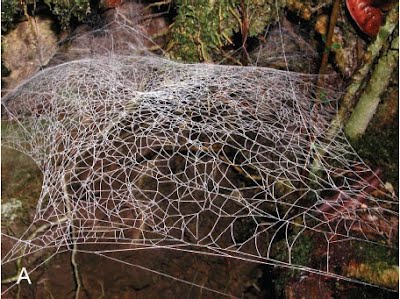
Web of Ambohima sublima photographed by Joel Ledford, from Griswold et al. (2012).


Phyxelididae produce tangled or sheet webs from cribellate silk, which they generally place in secluded locations such as under rocks or logs (a few tropical African species are found in caves). For the most part, the family exhibits what is known as an 'afromontane' distribution: though found in most altitudes in the southernmost part of Africa, tropical African members of the family are restricted to alpine localities or caves. The southeast Asian Vytfutia, placed by Griswold (1990) as the sister taxon to the other phyxelidids, differs in being found in a lower altitude in primary rainforest. A molecular analysis by Griswold et al. (2012) agreed with the morphological analysis of Griswold (1990) in separating Vytfutia from the rest of the Phyxelididae (the molecular analysis also failed to confirm monophyly of Phyxelididae including Vytfutia, but its coverage was perhaps not adequate to make this a reliable result). However, rather than dividing the African phyxelidids between the Vidoleini and Phyxelidini, Griswold et al.'s (2012) analysis placed the Vidoleini as a monophyletic subgroup of a paraphyletic Phyxelidini. Nevertheless, this would strengthen Griswold's (1990) earlier inference that the modified metatarsus I was part of the ancestral morphology of the Phyxelididae, and its absence in certain Vidoleini a secondary loss.

South African phyxelidid photographed by Alan. Though identified as a possible Vidole species, the morphology of metatarsi I indicates a member of the Phyxelidini.


REFERENCES

Griswold, C. E. 1990. A revision and phylogenetic analysis of the spider subfamily Phyxelidinae (Araneae, Amaurobiidae). Bulletin of the American Museum of Natural History 196: 1-206.

Griswold, C. E., H. M. Wood & A. D. Carmichael. 2012. The lace web spiders (Araneae, Phyxelididae) of Madagascar: phylogeny, biogeography and taxonomy. Zoological Journal of the Linnean Society 164: 728-810.

More Wolfies (Taxon of the Week: Artoriinae)


Artoria mckayi, an inhabitant of alpine gravel river banks in eastern Australia. Photo by D. Paul.


Wolf spiders, or "wolfies" as I tend to refer to them, were previously covered here in an earlier post. The subject of today's post is one of the specific subgroups of wolf spiders, the Artoriinae.

Though one of primary assemblages of wolf spiders in the Australian region, the Artoriinae were only formally established as a distinct group in 2007 (Framenau, 2007). The group had previously been identified in molecular phylogenies as an unnamed clade sister to the combined clade of the subfamilies Lycosinae and Pardosinae. At least one morphological character has also been identified supporting the clade, the presence of a basal apophysis (side-branch) on the embolus, the intromittent part of the male's copulatory pedipalp.


A Tetralycosa specimen captured in the Great Victoria Desert. Photo by June Hudson.


Artoriinae are primarily restricted to Australia and the Pacific islands except for Artoria parvula which is found from northern Australia to the Philippines. Inclusion of the Sumatran Lycosella tenera is contingent on whether or not it is truly congeneric with Hawaiian Lycosella species (Framenau, 2007) while three African species listed in Artoria by Platnick's World Spider Catalog owe their position to Carl-Friedrich Roewer, whose classification of wolf spiders is generally regarded as unmitigated bollocks, and require a second look. More recently, it was suggested that the South American genera Lobizon and Navira may warrant consideration as possible artoriines (Piacentini & Grismado, 2009). Framenau (2007) placed eight genera in the Artoriinae (including Lycosella) plus two probable undescribed genera; Framenau's (2007) "new genus 2" has since been dubbed Kangarosa* (Framenau, 2010).

*One of the new Kangarosa species was named by Volker Framenau after his recently born son, placing Yannick Framenau in an exclusive club of people to have a new species named after them before they've even completed toilet training.


Lobizon corondaensis, an Argentinian species that may or may not be related to the Artoriinae. From Piacentini & Grismado (2009). 'Lobizón' is apparently Spanish for 'werewolf'.


Like other wolf spiders, artoriines are mostly conservative in their overall appearance. They do exhibit a reasonable size range, from the 2.6 mm Artoria palustris to 25 mm Tetralycosa species. Males of the South-West Australian species Artoria schizocoides possess a unique brush of spatulate setae on the underside of the first tibia (Framenau & Hebets, 2007). The members of the genus Tetralycosa are burrowing species that are invariably found in high salinity environments such as around salt lakes.

REFERENCES

Framenau, V. W. 2007. Revision of the new Australian genus Artoriopsis in a new subfamily of wolf spiders, Artoriinae (Araneae: Lycosidae). Zootaxa 1391: 1-34.

Framenau, V. W. 2010. Revision of the new Australian wolf spider genus Kangarosa (Araneae: Lycosidae: Artoriinae). Arthropod Systematics and Phylogeny 68 (1): 113-142.

Framenau, V. W., & E. A. Hebets. 2007. A review of leg ornamentation in male wolf spiders, with the description of a new species from Australia, Artoria schizocoides (Araneae, Lycosidae). Journal of Arachnology 35 (1): 89-101.

Piacentini, L. N., & C. J. Grismado. 2009. Lobizon and Navira, two new genera of wolf spiders from Argentina (Araneae: Lycosidae). Zootaxa 2195: 1-33.

Big Bad Wolfies (Taxon of the Week: Lycosidae)


Female wolf spider with an abdomen-load of young. Photo by J. Centavo.


The wolf spiders (I usually call them simply 'wolfies') of the family Lycosidae are one of the more easily recognisable groups of ground-dwelling spiders. Their eyes are placed in three rows clustered together at the front of the cephalothorax with the median posterior eyes large and sitting above a straight row of the small anterior eyes. Some wolf spiders reach relatively large sizes and large wolfies tend to usually be some variant of brown or grey with longitudinal stripes. Most members of the family, particularly the larger species, tend to be morphologically quite conservative and despite the recognition of well over 2000 species in the family (a number that is increasing with no sign of slowing down) distinguishing those species is not usually easy without close examination. Wolf spiders are not often inclined to bite humans and their bites are not usually regarded as dangerous (though a bite from a large species could be painful).


A slightly more distinctively coloured member of the family - Geolycosa archboldi from central Florida. Photo by H. K. Wallace.


Wolf spiders get their name because most members of the family are active hunters rather than snare builders though a smaller number of genera build distinctive sheet webs with a silk retreat tunnel. Most authors have regarded the sheet web builders as retaining the ancestral behaviour for the family but phylogenetic analysis has not determined this conclusively (Murphy et al., 2006); if web building is ancestral then it has been convergently lost on numerous occasions. Those lycosids that do not build sheet webs may be permanently vagrant or they may dig themselves a home burrow into which they retreat when not hunting. All wolf spiders wrap their eggs in a silken egg-sac which the female carries on the underside of her spinnerets; after the eggs hatch she carries her young around clinging to her abdomen.


A more typical lycosid photographed by Sander van der Molen.


Recent studies have shown the need for a fair amount of revision of lycosid systematics; the main genus Lycosa in particular had been shown to be a polyphyletic assemblage of conservative large lycosids. Researchers are slowly chipping away at the necessary revisions; a great deal of progress has been made (see, for instance, Volker Framenau's webpage on Australian lycosids), but a great deal remains to be done. Matters have not been helped by the fact that wolf spiders were another group of arachnids to be subjected to the loving care and attention of Carl-Friedrich Roewer, demonstrating his usual talent for producing extensive revisions based on the most superficial and inconsequential of characters. Also, until recently there was debate over the identity of Lycosa's type species, the Mediterranean L. tarantula originally named by Linnaeus. This species, it should be noted, was the original tarantula; it was only later that the name became associated with South American mygalomorph spiders.

REFERENCES

Murphy, N. P., V. W. Framenau, S. C. Donnellan, M. S. Harvey, Y.-C. Park & A. D. Austin. 2006. Phylogenetic reconstruction of the wolf spiders (Araneae: Lycosidae) using sequences from the 12S rRNA, 28S rRNA, and NADH1 genes: implications for classification, biogeography, and the evolution of web building behavior. Molecular Phylogenetics and Evolution 38 (3): 583-602.

Taxon of the Week: Amphinectidae


Male of Metaltella simoni, a South American spider that has become established in the southern United States. Photo by johnnyn.


The Amphinectidae are a family of spiders described from Australia, New Zealand and South America. They are members of the 'amaurobioid' group of spiders, and share all the issues of poor definition associated with that group. Indeed, Davies (2002) made the admission that "there is no clear diagnosis of the family Amphinectidae". In general, most amphinectids are ground-dwelling (like many other 'amaurobioids'), and they are active hunters or construct small sheet-webs. They have two nearly straight rows of four eyes each at the very front of the cephalothorax. The metatarsi of the thrid and fourth legs have preening combs (Griswold et al., 2005). Since the Amphinectidae was originally established for a group of sixteen New Zealand genera, it has been enlarged to include the Australian and South American subfamily Metaltellinae (Davies, 1998) and the Tasmanian Tasmarubriinae (Davies, 2002). A further subfamily, the Kababininae, was initially regarded as amphinectid but has since been removed (Davies, 1999). Oddly enough, while the use of the names "Metaltellinae" and "Tasmarubriinae" would seem to imply an "Amphinectinae" (probably for the original New Zealand genera), I haven't been able to find a single case of such a name being used. Norm Platnick's World Spider Catalog simply lists the genera in this family in alphabetical order, without using subdivisions.

Metaltellinae are a reasonably distinct group - they differ from all other 'amaurobioids' in that the embolus (the intromittent part of the male genitalia through which the end of the sperm duct passes) turns anticlockwise rather than clockwise as in other families (Davies, 1998). Of the ten genera included in this subfamily by Davies (1998), eight are Australian and two (Metaltella and Calacadia) are South American, but I would not be surprised if this difference simply reflects the better-studied nature of Australian spiders. A single South American species, Metaltella simoni, has been introduced to southern North America with records from Florida to California. A relationship between Amphinectidae and Metaltellinae was first supported by Griswold et al. (1999), with the supporting characters being a proximal dorsal process on the tibia of the male pedipalp and possession by the females of a convoluted vulva*. The subfamily Tasmarubriinae was established by Davies (2002) and distinguished from Amphinecta (but not necessarily the other amphinectid genera, which were not examined) on the basis of features of the male genitalia.

*Davies (1998) had already transferred the Metaltellinae into the Amphinectidae on the basis that her own phylogenetic analysis "showed" the Metaltellinae to be closer to the Amphinectidae than to the Amaurobiidae (among which they had previously been included). However, Davies' analysis only included representatives of Amaurobiidae, Amphinectidae and Metaltellinae, with the single amaurobiid set as the outgroup, so it would have been impossible for the analysis to have shown anything else.


Unidentified amphinectid from Southland, New Zealand. Photo from here.


Other analyses have not supported an exclusive Amphinectidae-Metaltellinae connection. Davies (1999) included representatives of New Zealand Amphinectidae, Tasmarubriinae and Metaltellinae in an analysis of 'amaurobioid' spiders; while Tasmarubriinae and Amphinectidae formed a clade (supported by the first leg in females being shorter than the fourth leg, the presence of metatarsal preening combs, and a rounded conductor as part of the male genitalia), Metaltellinae were not part of that clade. Griswold et al. (2005) placed their included representatives of the two as successive outgroups to a clade of Desidae (marine spiders) and Dictynidae (slater spiders)*. Griswold et al. (1999) recognised a "fused paracribellar clade" including Amphinectidae, Desidae, Agelenidae, Stiphidiidae and Neolana, supported by features of the silk-spinning organs. This clade was still recognised by Griswold et al. (2005) but with slightly different contents, including the Dictynidae and excluding the Stiphidiidae.

*It is also noteworthy that neither of the two analyses by Griswold et al. (1999, 2005) have supported a close connection between Amphinectidae and Neolana, a genus included in Amphinectidae by Platnick's Spider Catalog, but placed in its own family by many other authors.

One final thing, which has nothing to do with the previous paragraphs, but which I felt compelled to include. The following passage is taken from a description of a New Zealand genus of Amphinectidae in Forster & Forster (1999):

Although the Otago species, Akatorea otagoensis, was occassionally found in rotting logs like its Fiordland relative, it was surprisingly rare until a sudden emergency with drains on our Dunedin property required an excavation. A metre or so below the surface of our lawn the likely answer to the true home of these spiders was revealed. There, lining the cracks and crevices in the clay subsoil, were webs (and eggsacs) all inhabited by these pale straw-coloured spiders, which proved to be the previously rare Akatorea otagoensis.


Science is often a matter of detailed planning and careful investigation. However, never underestimate the importance on many an occassion of sheer dumb luck.

REFERENCES

Davies, V. T. 1998. A revision of the Australian metaltellines (Araneae : Amaurobioidea : Amphinectidae : Metaltellinae). Invertebrate Taxonomy 12: 211-243.

Davies, V. T. 1999. Carbinea, a new spider genus from north Queensland, Australia (Araneae, Amaurobioidea, Kababininae). Journal of Arachnology 27 (1): 25-36.

Davies, V. T. 2002. Tasmabrochus, a new spider genus from Tasmania, Australia (Araneae, Amphinectidae, Tasmarubriinae). Journal of Arachnology 30 (2): 219-226.

Forster, R. R., & L. M. Forster. 1999. Spiders of New Zealand and their Worldwide Kin. University of Otago Press: Dunedin (New Zealand), and Otago Museum: Dunedin.

Griswold, C. E., J. A. Coddington, N. I. Platnick & R. R. Forster. 1999. Towards a phylogeny of entelegyne spiders (Araneae, Araneomorphae, Entelegynae). Journal of Arachnology 27: 53-63.

Griswold, C. E., M. J. Ramírez, J. A. Coddington & N. I. Platnick. 2005. Atlas of phylogenetic data for entelegyne spiders (Araneae: Araneomorphae: Entelegynae) with comments on their phylogeny. Proceedings of the California Academy of Sciences, Fourth Series 56 (suppl. 2): 1-324.

Salticid Spider Bollocks

The "information sheet" below was forwarded to my e-mail this afternoon. The person who forwarded it to me did so as a joke, but apparently it has taken some people in:

Really terrifying

Three women turned up at hospitals over a 5-day period, all with the same symptoms.
Fever, chills, and vomiting, followed by muscular collapse, paralysis and finally, death..

There were no outward signs of trauma.

Autopsy results showed toxicity in the blood. These women did not know each other and seemed to have nothing in common. It was discovered, however, that they had all visited the same Restaurant (Olive Garden , Western Cape ) within days of their deaths. The Health Department descended on the restaurant , shutting it down. The food, water, and air conditioning were all inspected and tested, to no avail.
The big break came when a waitress at the restaurant was rushed to the hospital with similar symptoms. She told doctors that she had been on vacation, and had only went to the restaurant to pick up her check.

She did not eat or drink while she was there, but had used the restroom
That is when one toxicologist, remembering an article he had read, drove out to the restaurant, went into the restroom and lifted the toilet seat

Under the seat, out of normal view, was a small spider. The spider was captured and brought back to the lab, where it was determined to be the Two-Striped Telamonia (Telamonia dimidiata), so named because of its reddened flesh color. This spider's venom is extremely toxic, but can take several days to take effect. They live in cold, dark, damp climates, and toilet rims provide just the right atmosphere..

Several days later a lawyer from Jacksonville showed up at a hospital emergency room. Before his death, he told the doctor, that he had been away on business, had taken a flight from Indonesia , changing planes in Singapore , before returning home He did NOT visit (Olive Garden), while there. He did (as did all of the other victims) have what was determined to be a puncture wound, on his right buttock. Investigators discovered that the flight he was on had originated in India .
The Civilian Aeronautics Board (CAB) ordered an immediate inspection of the toilets of all flights from India and discovered the Two-Striped Telamonia (Telamonia dimidiata) spider's nests on 4 different planes!
It is now believed that these spiders can be anywhere in the country.
So please, before you use a public toilet, lift the seat to check for spiders. It can save your life!


And please pass this on to everyone you care about.


Aww, look! It's a salticid! Innit cute?

I find it fitting that I am writing this post in Australia - which, as we all know, is the spiritual home of all toilet-seat lurking spiders. Not surprisingly, this particular story is total bollocks. And according to Snopes, it's ancient bollocks - this story has been floating about the interweb since 1992, albeit with the occasional variation to where exactly it's supposed to have taken place. Snopes also notes that the "Civil Aviation Board" referred to garbledly in the e-mail hasn't been in existence since 1984. I noticed the problem with "They live in cold, dark, damp climates, and toilet rims provide just the right atmosphere.." Ummm, a toilet-seat isn't a damp climate at all - quite the opposite - and any spider wanting to occupy the damp space under the rim is going to want to have invested in some scuba gear any time anyone flushes.

I'll put this simply ('scuse caps) - THERE ARE VERY FEW SPIDERS THAT CAN HARM YOU. Of those spiders that can harm you (and Telamonia dimidiata - scroll down a bit if you click the link - ain't one of them), even fewer of them are likely to come into contact with you. "Toxic" is not necessarily the same as "dangerous" - most toxic animals such as venomous snakes and spiders are far more likely to discretely get out of your way rather than attack. You probably won't even know they were there.

The Strangest of Spiders


In the comments to an earlier post, I promised to write a post sometime on micro-spiders. As alluded to in that post, some of the smallest spiders are mind-bogglingly tiny - the smallest known male spider, Patu digua, reaches all of 0.37 mm in length as an adult, but at least one other species known as yet only from females could potentially have a male even smaller. If one of these spiders crawled into your ear while you were sleeping, it could probably slip into your Eustachian tubes and tap on the back of your eyeballs. But even more remarkable than their small size is the bizarre morphologies on show among the micro-spiders. And no group of micro-spiders is more bizarre than the Archaeidae.

Archaeids are a bit bigger than Patu, but still pretty small - the largest examples reach about six millimetres. The name "Archaeidae", of course, means "old", and archaeids received their name because they were first described in 1854 from fossils in Baltic amber from northern Europe. In Europe, the archaeids are long gone (they may have disappeared along with the amber forests), but nearly thirty years after their initial description living examples were found in Madagascar. They are also known from Australia, while a specimen from Cretaceous Burmese amber has been placed in a living genus from South Africa and Madagascar (Penney, 2003). A species has also been described from the Jurassic of Kazakhstan, but it is uncertain whether this species is an actual archaeid or belongs to another micro-spider family such as Pararchaeidae.

Many micro-spiders show relatively long chelicerae (the fangs and their base) relative to body size, but in Archaeidae this is taken to the extreme, as can well be seen in the photo by Jeremy Miller at the top of this post. Because the trochanter (base) of the chelicerae is a rigid structure, lengthening them in spiders requires that the carapace as a whole be raised, otherwise the fangs would not be able to get anywhere near the mouth. Archaeids have developed a long "neck" supporting the eyes and chelicerae. The distinct shape of the cephalothorax together with the long chelicerae gives them an unmistakeable profile, and one common name used for the group is "pelican spiders". Despite their small size, archaeids are active hunters and voracious exclusive predators of other spiders (another common name is "assassin spiders"). It has been suggested that the lengthened chelicerae are directly related to their araneophagous diet, allowing them to strike their prey without getting too close, but as I already noted archaeids are not the only small spiders with lengthened chelicerae (though they are still the most dramatic), and I'd be interested to know if there is a correlation between small size and long chelicerae.


I'd also like to share this diagram from Wood et al. (2007) showing a molecular-derived phylogeny of the endemic Madagascan genus Eriauchenius. As can be seen, there is a fair amount of variation in the thickness of the "neck" (the darkness of the bars reflects the mean carapace height/length ratio for whichever group they subtend), and it had been suggested that those species with a particularly slender neck formed a derived clade. Wood et al. (2007) found that this does not appear to be the case, with at least two extreme narrow-neck groups - E. workmani in one and E. gracilicollis and E. lavatenda in the other - at quite divergent points in the tree. I also looks to me like at least one group - E. tsingyensis and its allies - may have gone the other way. To paraphrase a Rocky Horror Picture Show audience member - that spider has no neck.

REFERENCES

Penney, D. 2003. Afrarchaea grimaldii, a new species of Archaeidae (Araneae) in Cretaceous Burmese amber. Journal of Arachnology 31 (1): 122-130.

Wood, H. M., C. E. Griswold & G. S. Spicer. 2007. Phylogenetic relationships within an endemic group of Malagasy ‘assassin spiders’ (Araneae, Archaeidae): ancestral character reconstruction, convergent evolution and biogeography. Molecular Phylogenetics and Evolution 45 (2): 612-619.

Amaurobioidea: Rummaging through a Wastebasket


A representative of the strikingly-coloured Nicodamidae from Australia. Photo by Nick Monaghan. While such spiders were previously identified as Nicodamus bicolor, there are no less than 23 species in seven genera that have previously been included under that name.


One term that you may come across in discussions of phylogeny is the concept of a "wastebasket" taxon. As the name suggests, a wastebasket taxon is one into which authors tend to throw everything that they can't really deal with. Often, a wastebasket will include the members of a group that are relatively unspecialised, often primitive, and united less by their shared characters than their lack of distinct features to connect them to one or another of the specialised subgroups that the author may recognise within the parent group. Phalangodidae among short-legged harvestmen, Sylviidae among passerine birds and Perciformes among spiny-finned fishes are all examples of taxa that have become wastebaskets in the past. Some wastebasket taxa are explicitly established as such, like the 'Deuteromycota' that included asexual fungi before techniques were developed that made it significantly easier to relate asexual and sexual fungal taxa. More often, though, a taxon originally based on a certain combination of features will develop into a wastebasket over time as phylogenetic studies show that the original basis characters for that taxon represent plesiomorphies (ancestral characters). This week's highlight taxon, the spider superfamily Amaurobioidea, perhaps belongs to the latter group.


Tegenaria gigantea (Agelenidae). Photo from Wikipedia. Agelenids build funnel-shaped webs and are apparently often called some variant of "funnel spiders" in North America, but such names are likely to cause confusion here in Australia with a certain notorious mygalomorphs. Some species of Tegenaria such as the hobo spider are also known for being toxic, but nowhere near as toxic as the Australian funnel-web.


In an earlier post, I included a quick overview of basal spider phylogeny, going as far down as the clade Araneoclada that unites those spiders that have only a single pair of book lungs (ancestrally, at least - many families of Araneoclada have lost the book lungs entirely, or evolved tracheae in their place). Members of the Araneoclada are further divided between the Haplogynae and the Entelegynae, originally based on the presence (Entelegynae) or absence (Haplogynae) in females of paired copulatory ducts opening on a sclerotised plate called the epigyne. While the absence of such ducts in the Haplogynae is obviously a primitive character and no longer regarded as uniting them, the group has funnily enough been supported as monophyletic based on a number of other characters (except for a small number of 'haplogyne' taxa that are phylogenetically entelegynes) (Coddington & Levi, 1991). However, the Amaurobioidea belong to the Entelegynae, which is by far the larger of the two clades. Within the Entelegynae, the primary division was long based on whether or not a species possessed a cribellum, a plate-like structure among the spinnerets that bears hundreds of tiny silk-producing spigots. As these spigots exude silk simultaneously, the spider uses a specialised arrangement of bristles on the fourth pair of legs to weave them together to form a woolly thread (see here for a more detailed description). Because this woolly thread is composed of multiple tangled strands, it can effectively entangle prey such as small insects that get caught among the strands. Unfortunately, as knowledge of entelegyne spiders improved it became clear that possession of a cribellum did not define a phylogenetically coherent group. A number of cases were identified of pairs of taxa clearly related by other characters in which one taxon possessed a cribellum and the other did not. The eventual conclusion was that the cribellum was an ancestral character for the Entelegynae (as also supported by its presence in one haplogyne family, the Filistatidae) that had been lost on numerous occassions.


Ctenus floweri (Ctenidae), from Singapore. Photo by David Court. Ctenids are active hunters.


In general, the Amaurobioidea included cribellate spiders with unbranched abdominal median tracheae, as opposed to Dictynoidea with branched abdominal median tracheae (Coddington & Levi, 1991). Families that have been assigned to Amaurobioidea include (among others) Amaurobiidae, Agelenidae, Ctenidae, Amphinectidae and Nicodamidae, but relatively little unites these families. Most of them are generally ground-dwellers (which may explain the common name of one of the best-known members, the hobo spider Tegenaria agrestis). Many members build small sheet-webs, but others are active hunters. Both the characters referred to above have since been shown to represent plesiomorphies of larger clades, with the alternative conditions arising multiple times. The phylogenetic analysis of entelegyne spiders by Griswold et al. (1999) found the 'Amaurobioidea' to fall within a clade that was sister to the clade including the orb-weavers, but the same clade included the Dictynoidea and Lycosoidea (wolf spiders and such) nested within 'amaurobioids'. Indeed, not even the type family of Amaurobiidae was monophyletic, with some members closer to the lycosoids while others were closer to the agelenoids. The Amaurobioidea, it seems, was a bust.

Coming up - science and art, whether taxonomy is science, why family names are so awful, micro-spiders, and Parapseudoleptomesochrella almoravidensis.

REFERENCES

Coddington, J. A., & H. W. Levi. 1991. Systematics and evolution of spiders (Araneae). Annual Review of Ecology and Systematics 22: 565-592.

Griswold, C. E., J. A. Coddington, N. I. Platnick & R. R. Forster. 1999. Towards a phylogeny of entelegyne spiders (Araneae, Araneomorphae, Entelegynae). Journal of Arachnology 27: 53-63.