Field of Science

Showing posts with label Crinoidea. Show all posts

The Pelecocrinidae

The latter part of the Palaeozoic represented a peak in crinoid diversity. More families of crinoid have been recognised from the Carboniferous and Permian than any period before or since. Among the various families of the Late Palaeozoic were representatives of the Pelecocrinidae.

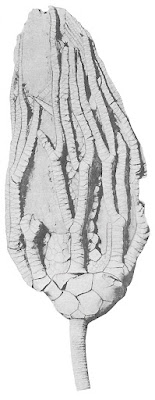
Pelecocrinus insignis, from Moore & Teichert (1978).


The fossil record of the pelecocrinids was long-lasting but patchy. They are known from the early Carboniferous of North America (Pelecocrinus) and Great Britain (Forthocrinus), the late Carboniferous of North America (Exoriocrinus), and the late Permian of Italy (Tetrabrachiocrinus) and Indonesia (Drepaocrinus, Malaiocrinus). These locations largely correspond to what would have been a distribution along the northern coast of the Palaeotethys Ocean, possibly becoming extinct in the west as the gap between North America and the southern continent of Gondwana closed to form the Pangean supercontinent. Pelecocrinids seem to be so far unknown from the southern continents.

In life, pelecocrinids were characterised by a high crown arising from a low, bowl-shaped cup. The stem could be round or pentagonal. The base of the cup was flattened or shallowly concave, so the infrabasals (the lowest circle of plates above the stem) were barely or not visible where the cup to be observed from the side. The articulations between the upper plates of the cup and the bases of the arms were angled downwards and outwards with the articular facets being somewhat narrower than the plates they sat on. The arms themselves had a wedge-shaped cross-section and divided into equal branches two or more times along their length. Each arm bore one or two rows of pinnules. The anal sac, as described for Pelecocrinus, was relatively short and slender and summited by heavy, spinose plates.

The structure of the arm articulations and pinnules indicates that the arms would have been subject to muscular control with individual arms being able to be moved in more than one plane. This arrangement became increasingly common among crinoids from the Carboniferous onwards, allowing them to function in more high-current habitats. The position of the arms and pinnules could be adjusted to optimise filtration from the water column, while the current provided lift to the crown so it did not need to be mechanically supported by the stem alone. The effectiveness of this arrangement is attested to by the long history of the pelecocrinids. Nevertheless, the end-Permian extinction was to end their lineage along with that of so many of their contemporaries.

REFERENCE

Moore, R. C., & C. Teichert (eds) 1978. Treatise on Invertebrate Paleontology pt T. Echinodermata 2. Crinoidea vol. 2. The Geological Society of America, Inc.: Boulder (Colorado), and The University of Kansas: Lawrence (Kansas).

Taxocrinus

Below is an example of Taxocrinus, a genus of fossil crinoids known from the later Devonian and earlier Carboniferous of Europe and North America. It is a relatively plesiomorphic representative of the flexible crinoids, one of the major crinoid lineages of the Palaeozoic era.

Taxocrinus colletti, copyright James St. John.


Flexible crinoids are characterised by arms that lack pinnules, the small side-branches found on the arms of most other crinoids. As a result, the preserved arms have a somewhat tentacle-like appearance, and are commonly preserved coiled in over the oral surface of the central cup. In Taxocrinus, the arms were regularly and isotomously bifurcated: that is, they divided between two branches of more or less equal size. The central cup itself in flexible crinoids was (somewhat counter-intuitively) quite inflexible, with the plates of the aboral surface firmly jointed together. The oral surface bore a more flexible covering of small plates, and an anal tube (visible near the midline of the fossil above) directed waste away from the mouth. The stem was round in cross section and lacked lateral cirri (Moore 1978).

Flexible crinoids were around for a very long time but it is rare for them to be found in abundance. As such, they were probably specialised for particular habitats that were either uncommon or less likely to be preserved. It has been suggested that, because their pinnule-less arms would have been poorly suited for filtering particles from strong currents, flexible crinoids may have inhabited calm, low-energy waters (Breimer 1978) (though I do wonder if enlarged tube feet may have partially filled the role of pinnules; is it possible to estimate the size of the tube feet from the preserved skeleton?) Crinoids living in such habitats will often hold the arms in a bowl arrangement so they may capture particles settling from higher in the water column. In the case of the flexible crinoids, moving the arms in and out may have created local water movements to further draw such particles in.

Though Taxocrinus itself would disappear in the mid-Carboniferous, flexible crinoids as a whole would persist to the end of the Permian. In more derived forms, the branching of the arms was often unequal, with the smaller branches effectively replacing the missing pinnules. In the end, though, the specialised flexibles were yet another casualty of the end-Permian cataclysm that so shook the composition of life on this planet.

REFERENCES

Breimer, A. 1978. Autecology. In: Moore, R. C., & C. Teichert (eds) Treatise on Invertebrate Paleontology pt T. Echinodermata 2 vol. 1 pp. T331–T343. The Geological Society of America, Inc.: Boulder (Colorado), and The University of Kansas: Lawrence (Kansas).

Moore, R. C. 1978. Flexibilia. In: Moore, R. C., & C. Teichert (eds) Treatise on Invertebrate Paleontology pt T. Echinodermata 2 vol. 2 pp. T759–T812. The Geological Society of America, Inc.: Boulder (Colorado), and The University of Kansas: Lawrence (Kansas).

The Pisocrinidae: Babyface Crinoids

One question that I haven't yet found an answer to is why the Palaeozoic marine fauna seems to have included so many filter feeders. Cystoids, blastoids, graptoloids... so many of the distinctive taxa occupying this niche would be gone by the period's end, without leaving any clear analogues behind them. What was the cause underlying this abundance? Is it simply a misapprehension caused by the filtering effect of history, with the modern fauna containing fewer major lineages but no fewer actual species? Is it the distorting lens that causes us to tend to assign a higher 'rank' to those lineages arising earlier in time, whatever their practical levels of disparacy? Or was there actually something different about what could be found in Palaeozoic seawater?

Reconstructions of short-armed and long-armed species of Pisocrinus, from Rozhnov (2007).


The Pisocrinidae are one of those distinctive Palaeozoic marine groups, known from around the world during the Silurian and Devonian. As crinoids, they were perhaps not as immediately unfamiliar to the modern eye as some of the other taxa that could be found at that time, but they were certainly different from any modern crinoid. The majority of the crinoids that have ever lived can be assigned to one of two main clades. One, the cladid lineage, includes all the crinoids alive today. Pisocrinids belong to the other major lineage, the disparids, which were prominent for most of the Palaeozoic era but failed to make it past the end of the Permian. Disparids differed from cladids in that their calyx included a single circlet of plates (the inferradials) beneath the circlet of the radials (the large plates making up the main body of the calyx) whereas cladids (at least to begin with) had two such circlets. Many disparid sublineages showed a tendency towards reduction and/or simplification of the calyx. In pisocrinids, most of the calyx was made up of just three plates: two large radials (representing the A and D rays of the basic crinoid calyx) and a greatly enlarged B inferradial. The B, C and E radials were all reduced in size. The arms of pisocrinids mostly lacked lateral pinnules and were undivided; one genus, Cicerocrinus, had bifurcating arms bearing lateral ramules (Moore et al. 1978). The length of the arms varied considerably between species: in some they were quite short and broad, in others they were remarkably long. Because their derived morphology made it difficult to compare pisocrinids to related families, their origins have been regarded as mysterious. Rozhnov (2007) suggested a derivation from an earlier, more typical crinoid family, the Homocrinidae, via paedomorphosis, possibly as a result of the evolution of a longer larval period in the life cycle (he specifically suggested that this extended larval phase may have allowed the ancestors of pisocrinids to spread across the Iapetus Ocean between the then-existing continents of Laurentia and Baltica). A direct pisocrinid-homocrinid connection was not supported in the phylogenetic analysis of disparids by Ausich (2018) but Rozhnov's overall model of pisocrinid paedomorphosis remains a possibility.

Assemblage of Triacrinus, from here.


During the Silurian, pisocrinids were among the most abundant, if not the most abundant, groups of crinoids. They were found in a variety of habitats but were particularly abundant around reefs in deeper waters. At first glance, the non-pinnulate arms of pisocrinids appear poorly suited for filter feeding, and one might be inclined to propose a more tentacular method of obtaining food items. However, such a method would seem unlikely for the short-armed species, whose arms would have been almost entirely inflexible. Even the long-armed species sometimes had arms made up of relatively long segments whose flexibility may have been limited. An alternative possibility, I suppose, is that in life pisocrinids may have had long tube feet that took the place of the missing pinnules. Meanwhile, the absence of the pinnules meant that the arms could be lain tightly alongside each other when the crown was closed. Earlier authors presumed that, because of their preference for deeper waters, pisocrinids were rheophobic (that is, they were found in places where the water lacked a noticeable current). However, Ausich (1977) proposed that they were low-energy rheophilic, seeking locations where a moderate but steady current prevailed. The current would provide a steady supply of organic particles that could be captured by the crown, and the ability to close the arms tight would protect the oral region during occasional bouts of rougher conditions.

REFERENCES

Ausich, W. I. 1977. The functional morphology and evolution of Pisocrinus (Crinoidea: Silurian). Journal of Paleontology 51 (4): 672–686.

Ausich, W. I. (in press, 2018) Morphological paradox of disparid crinoids (Echinodermata): phylogenetic analysis of a Paleozoic clade. Swiss Journal of Palaeontology.

Moore, R. C., N. G. Lane, H. L. Strimple, J. Sprinkle & R. O. Fay. 1978. Inadunata. In: Moore, R. C., & C. Teichert (eds) Treatise on Invertebrate Paleontology pt T. Echinodermata 2. Crinoidea vol. 2 pp. T520–T759. The Geological Society of America, Inc.: Boulder (Colorado), and The University of Kansas: Lawrence (Kansas).

Rozhnov, S. V. 2007. Changes in the Early Palaeozoic geography as a possible factor of echinoderm higher taxa formation: delayed larval development to cross the Iapetus Ocean. Palaeogeography, Palaeoclimatology, Palaeoecology 245: 306–316.

The Erisocrinoidea: Shallow Crinoids

Articulated calyx of Erisocrinus typus, copyright Richard Paselk.


The close of the Permian period saw the largest mass extinction ever recorded. It has been estimated that about 95% of all marine species were wiped out. Many prominent Palaeozoic lineages disappeared entirely; others were reduced to a mere remnant of their former selves.

One of the casualties of the end-Permian extinction was the crinoid group known as the Erisocrinoidea (or Erisocrinacea in older texts). These were a diverse group of crinoids divided between several families, recorded from the Carboniferous and Permian periods. One species, Erisocrinus typus, is known from a large number of well-preserved, articulated specimens from the mid-Late Carboniferous of the United States and is one of the best representatives of the Palaeozoic cladid crinoids. Erisocrinoids are characterised by a low cup, dominated by the ring of radial plates. The base of cup was often recessed, meaning that the basal and infrabasal plate rings were often partially or entirely obscured in outer view. Most significantly, the array of anal plates found in other crinoids was reduced to a single plate or even lost. The insertion points of the arms bear signs of strong muscular articulation, indicating that these were animals of higher-energy environments requiring more exertion to maintain an ideal feeding position. The anal sac, where it is preserved, was only weakly plated and would have been reasonably soft in life (Moore et al. 1978).

In other respects, though, the erisocrinoids could be somewhat disparate. Many, such as the type family Erisocrinidae and the families Protencrinidae and Catacrinidae, have biserial arms in which the arm's skeleton is comprised of paired rows of plates. In other families, such as the Graphiocrinidae and Diphuicrinidae, the arms were uniserial, with only a single row of plates. Webster & Maples (2006) noted that, even though all erisocrinoids shared the character of a reduced anal plate array, the exact position in the cup of the anal plate or its remnant differed between families. They therefore suggested that the erisocrinoids might not be a monophyletic group, but members of a number of different lineages that had converged on a similar morphology and presumably lifestyle.

This was not an entirely novel suggestion. Even while recognising a single superfamily Erisocrinacea, Moore et al. (1978) had suggested connections between individual erisocrinoid families and families placed in other superfamilies. The integrity of the Erisocrinoidea had also been questioned in relation to Encrinus, a genus from the Middle Triassic that had been included with the erisocrinoids on the basis of its combination of biserial arms and lack of an anal plate. If this assignment was correct, erisocrinoids would have survived the end-Permian extinction: the only crinoid lineage to do so other than the Articulata, the clade including the living sea lilies and feather stars. Articulates retain uniserial arms, a more plesiomorphic characteristic. However, while investigating the evolutionary origins of the articulates, Simms & Sevastopulo (1993) pointed out that Encrinus shared derived features with articulates that were absent in erisocrinoids. For instance, while Encrinus and the erisocrinoids both had each of the basic five echinoderm arms branching to form a total array of ten arms, in Encrinus they branched from the second primibrachial plate as in articulates, instead of from the first as in erisocrinoids. Rather than being a late-surviving erisocrinoid, Encrinus was an early side-branch of the articulates, and as far as is known only a single crinoid lineage survived the Permian.

REFERENCES

Moore, R. C., N. G. Lane, H. L. Strimple, J. Sprinkle & R. O. Fay. 1978. Inadunata. In: Moore, R. C., & C. Teichert (eds.) Treatise on Invertebrate Paleontology pt T. Echinodermata 2. Crinoidea vol. 2 pp. T520–T759. The Geological Society of America, Inc.: Boulder (Colorado), and The University of Kansas: Lawrence (Kansas).

Simms, M. J., & G. D. Sevastopulo. 1993. The origin of articulate crinoids. Palaeontology 36 (1): 91–109.

Webster, G. D., & C. G. Maples. 2006. Cladid crinoid (Echinodermata) anal conditions: a terminology problem and proposed solution. Palaeontology 49 (1): 187–212.

Paracomatula: Feather Star, or Feather Star Wannabe?

Fossilised accumulation of Paracomatula helvetica, from here.


Earlier posts on this site have discussed examples of the feather stars, the most successful representatives in the modern environment of the crinoids. Originally a group whose members lived permanently attached to the substrate by a stalk, at some point crinoids diversified to a more mobile (or least shiftable) lifestyle, discovering the joys of travel. This was not, it should be noted, an entirely direct process. Many stalked crinoids are also mobile, able to detach themselves from their substrate and crawl to a new position. Other crinoids than the feather stars lost their stalks. And at least one group within the feather stars, the Mesozoic Thiolliericrinidae, reverted back to retaining as adults the larval stalk that most feather stars lose in the course of development.

Nevertheless, the feather stars had definitely made their appearance by the early Jurassic. One of the earliest taxa that has been assigned to the feather stars is Paracomatula, which is known from the very late Triassic to the middle Jurassic (Hess 2013). Paracomatula would have largely resembled a modern feather star in appearance, but had one significant difference. In modern feather stars, the base of the central cup is formed by a large conical plate known as the centrodorsal. In Paracomatula, however, the centrodorsal is replaced by a stack of five narrow plates. These correspond to much-shortened versions of the columnals that make up the stalked in other crinoids, and Rasmussen (1978) and other authors suggested that Paracomatula's separate columnals became fused to form the centrodorsal of the feather stars proper.

However, not all authors have accepted this interpretation. Hess (2013) has argued that details of the development of modern feather stars from a stalked juvenile to a free-living adult indicate that the centrodorsal is derived from the enlargement of a single columnal rather than the fusion of a series. In the earliest definitive feather star, the Jurassic Palaeocomaster, the cirri (tentacle-like appendages) on the centrodorsal are arranged in a haphazard fashion consistent with their development on a single expanding plate, while Paracomatula has a more orderly array of one ring of cirri per columnal without the development of supernumerary cirri. Hess therefore argues that Paracomatula species were not the forebears of feather stars, but their rivals: a closely related group that was independently experimenting with a stalk-free way of life.

REFERENCES

Hess, H. (in press, 2013) Origin and radiation of the comatulids (Crinoidea) in the Jurassic. Swiss Journal of Palaeontology.

Rasmussen, H. W. 1978. Articulata. In: Moore, R. C., & C. Teichert (eds) Treatise on Invertebrate Paleontology pt T. Echinodermata 2: Crinoidea, vo. 3, pp. T813-T927. The Geological Society of America, Inc., and The University of Kansas Press.

The Antedoninae: (Relatively) Big-Bellied Feather Stars

Several individuals of Antedon bifida attached to a kelp stipe, photographed by Bernard Picton.


The feather stars and other crinoids are both the most divergent and least known of the modern echinoderms. This is the second post here at Catalogue of Organisms on modern feather stars; an earlier post gave a brief overview of some of the details of the feather star lifestyle and anatomy. The main subject of the earlier post was the family Charitometridae; this post will focus on a different group, the Antedoninae. Yes, Virginia, there are different varieties of feather star.

The Antedonidae and related families differ from most other feather stars in that the internal cavity of the centrodorsal, the plate that forms the base of the calyx (central cup) of the feather star, is relatively large compared to the centrodorsal's diameter (in life, this cavity has organs nestled in it). When the antedonids were reviewed by the American echinodermatologist Austin H. Clark (Clark & Clark 1957*), he regarded this difference as significant enough to treat the antedonids and related families as a separate group, the Macrophreata, from other families in the Oligophreata with only a small centrodorsal cavity. However, later researchers have downplayed the significance of this distinction (e.g. Wienberg Rasmussen 1978), and even the monophyly of the Antedonidae has been questioned. Well-developed muscular articulations in the upper part of the calyx also indicate that antedonids are generally stronger swimmers than other feather stars (Meyer 1972). Clark & Clark (1967) divided the antedonids between six subfamilies, but Ailsa Clark commented that the distinctions between subfamilies were not always clear.

*Austin Clark's epic revision of the living crinoids was left incomplete after his death in 1954, until it was taken up by the British researcher Ailsa Clark (no relation, as far as I've found). The section of Clark's monograph on the 'Macrophreata' therefore made its debut under both researcher's names.

Specimen of Dorometra photographed by Lyle Vail and Anne Hoggett. The page linked notes that this species swims actively when disturbed, before 'holding their arms above the disk to form a shuttlecock shape and then plummeting towards the bottom'.


The Antedoninae generally differ from other antedonids in having rather short cirri (though the Philippine species Eumetra chamberlaini has exceptionally long cirri, up to about a third of the length of its arms). The cirri are also rounded dorsally, without dorsal spines or ridges, and most species lack ventral spines except one on the penultimate segment of the cirrus that opposes the terminal claw. The centrodorsal is low and rounded in the majority of species, though it may become raised and closer to conical. Antedonines include some of the shallowest-living of recent crinoids, with some species even found in tide pools; the deepest-living antedonines are known from 932 m. Clark and Clark (1967) recognised ten genera within the Antedoninae; a fossil genus Palaeantedon (from the Eocene to Quaternary) was listed in addition to the Recent genera by Wienberg Rasmussen (1978), and an eleventh Recent genus Ctenantedon was described by Meyer (1972).

The rosy feather star Antedon bifida and the Mediterranean feather star A. mediterranea are among the best-studied of all feather stars, primarily due to both being found in shallow waters around Europe. However, the greater diversity of antedonines is known from the Indo-Pacific. Apart from species of Antedon, the only Recent antedonine known from the Atlantic is the Caribbean Ctenantedon kinziei (the fossil species of Palaeantedon are also Atlantic). Characters used to distinguish genera include features of the pinnules, the slender side-branches of the arms. Antedon species, for instance, usually have the second and third pinnules on each arm similar in size to each other, and both distinctly shorter than the first pinnule. Ctenantedon kinziei is unusual in having a comb of 'teeth' developed in the distal part of the proximal pinnules. The function of these teeth is not entirely certain, though Meyer (1972) noted that he had observed the oral pinnules of comasterid feather stars (which also bear similar teeth) moving in and out from the central disk in a manner that suggested they were being used to remove undigested food and other waste material.

REFERENCES

Clark, A. H., & A. M. Clark. 1967. A monograph of the living crinoids. Volume 1. The comatulids. Part 5—suborders Oligophreata (concluded) and Macrophreata. Smithsonian Institution, United States National Museum, Bulletin 82.

Meyer, D. L. 1972. Ctenantedon, a new antedonid crinoid convergent with comasterids. Bulletin of Marine Science 22 (1): 53-66.

Wienberg Rasmussen, H. 1978. Articulata. In Treatise on Invertebrate Paleontology pt. T. Echinodermata 2. Crinoidea (R. C. Moore & C. Teichert, eds) vol. 3 pp. T813-T927. The Geological Society of America, Inc.: Boulder (Colorado), and The University of Kansas: Lawrence (Kansas).

Crinoids of the Open Seas


Lateral view of calyx of Saccocoma tenella from Brodacki (2006) showing the emergence angle of the arms.

Living crinoids can be divided morphologically between the stalked sea lilies and the stemless feather stars but, as described in an earlier post, the feather stars are not really entirely stemless. Rather, the column has been reduced to a single plate that still functions as the point of attachment for the cirri, the small tentacle-like appendages that the feather star uses to hang onto the substrate or move about. There were two groups of Mesozoic crinoids that went a step further, completely losing both column and cirri.

The Uintacrinida (of the late Cretaceous) and the Roveacrinida (throughout the Mesozoic) were both subgroups of the Articulata, the clade that includes all living crinoids, but they are very distinct from each other and probably lost their stalks independently. Milsom et al. (1994) placed the Uintacrinida as a derived subgroup of the feather stars while the relationships of the Roveacrinida remain mysterious. Because of the lack of any means of attachment to the substrate, both have been regarded as pelagic; as I'll explain below, this seems likely for the roveacrinidans but not for the uintacrinidans.


Ventral reconstruction of Saccocoma from Milsom (1994) showing the arrangement of lateral plates in the proximal part and long branches in the distal part of the arms.

The roveacrinidans were absolutely tiny animals with the central cup only a couple of millimetres across and the total armspan up to a few centimetres. In the best-known example, Saccocoma, broad wing-like plates were attached to either side of the proximal part of the slender multi-branched arms while the skeleton as a whole was very thin and light. In an influential interpretation of Saccocoma, Otto Jaekel referred to the lateral plates on the arms as "Schwimmplatten" and suggested that they were used to propel the animal through the water. However, Brodacki (2006) pointed out that the mobility of the proximal part of the arms would not have been sufficient for the plates to be used in swimming. Instead, the distal branched parts of the arms would have provided the swimming force while the Schwimmplatten would have provided extra friction to reduce the rate of sinking. Because roveacrinidans would have been heavier than the surrounding water even with their lightened plates, they must have been active (and fairly continuous) swimmers rather than passive floaters. Swimming was probably done by slowly coiling the distal part of the arms inwards then rapidly straightening them outwards so the animal flicked itself through the water. An alternative suggestion (Milsom, 1994) that Saccocoma was benthic on soft mud with the "Schwimmplatten" protecting the animal from being buried is contradicted by the fact that the arms would have emerged from the top of the theca at an angle of 45° rather than being flat. Also, Saccocoma plates are commonly found in coprolites whose mode of deposition indicates that they were produced by pelagic animals (Hess, 1999a).


Fossil assemblage of the very aptly named Uintacrinus socialis, from Hess 1999b.

In contrast to the minute, light roveacrinidans, the two uintacrinidan genera Uintacrinus and Marsupites were very large crinoids with sack-like, flexible thecas up to 75 mm in diameter and arms up to a metre or more in length. Unlike roveacrinidans, uintacrinidan plates are not reduced but remain robust and heavy. The proximal parts of the arms were integrated into the theca which would have limited their ability to spread outwards as in Saccocoma. Orientation of preserved specimens (and Uintacrinus can sometimes be preserved in extraordinarily dense concentrations) indicates that the habitual life position of uintacrinidans was with the mouth upwards, contradicting suggestions that the theca could have contained some sort of buoyancy organ. Despite the lack of any means of attachment, without any clear adaptations for increasing buoyancy it seems that uintacrinidans would have been benthic rather than pelagic. They would have lived in soft mud with the theca buried (hence the lack of attachment structures) and the arms extending upwards from the substrate to collect food particles. Hess (1999b) compares the possible life appearance of Uintacrinus assemblages to "dense patches of tall eel grass".

REFERENCES

Brodacki, M. 2006. Functional anatomy and mode of life of the latest Jurassic crinoid Saccocoma. Acta Palaeontologica Polonica 51 (2): 261–270.

Hess, H. 1999a. Upper Jurassic Solnhofen Plattenkalk of Bavaria, Germany. In Fossil Crinoids (H. Hess, C. E. Brett, W. I. Ausich & M. J. Simms, eds) pp. 216-224. Cambridge University Press.

Hess, H. 1999b. Uintacrinus beds of the Upper Cretaceous Niobrara Formation, Kansas, USA. In Fossil Crinoids (H. Hess, C. E. Brett, W. I. Ausich & M. J. Simms, eds) pp. 225-232. Cambridge University Press.

Milsom, C. V. 1994. Saccocoma: a benthic crinoid from the Jurassic Solnhofen Limestone, Germany. Palaeontology 37 (1): 121-129.

Milsom, C. V., M. J. Simms & A. S. Gale. 1994. Phylogeny and palaeobiology of Marsupites and Uintacrinus. Palaeontology 37 (3): 595-607.

Forgotten Feather Stars


The Atlantic charitometrid Crinometra brevipinna. Photo by John E. Miller.


In earlier posts on this site, I've presented snippets of the diversity of fossil crinoids, so perhaps it was about time I finally worked up to the modern taxa. Today's Taxon of the Week is a family of feather stars, the Charitometridae.

Despite including the vast majority of modern species (and the best-studied of modern species), the feather stars (the order Comatulida) are in fact somewhat odd creatures within the main scope of crinoid historical diversity. The main point of oddness, of course, is their massively reduced stem (other strange features, which they share with other living crinoids, include the reduction of plating on the adoral side of the animal). When they first settle down from their free-swimming larval stage, feather stars are attached to the substrate by a stalk as in more typical crinoids, but before they reach maturity they once again break free. Technically, however, adult feather stars are not completely stemless - the proximalmost part of the stem is retained, and this becomes expanded and fused with the infrabasals (the lowermost ring of plates in the main body of the crinoid) to form the large basal plate known as the centrodorsal (Breimer, 1978a - it may seem odd to have something called the "centrodorsal" on the underside of the animal, but the thing is that, compared to other living echinoderms, crinoids are upside-down). The centrodorsal is the point of attachment for the cirri, tendril-like outgrowths of the underside. The cirri are used by the feather star for moving about, like something out of a Japanese cartoon.

Not that they necessarily do much moving about. Though feather stars are capable of a surprising amount of motility when the mood takes them (some even using their arms to become active swimmers), the mood does not often take them. Like their permanently attached ancestors, feather stars are still filter feeders, a lifestyle that is best achieved in a sedentary manner. Crinoids will only move if the local conditions become unfavourable, and then only as far as they must to find a more suitable location. Once there, they will fix themselves onto any available piece of substrate - Austin Clark provided a brief but disturbing description of the consequences of comatulids being denied a suitable attachment site (quoted in Breimer, 1978b):

If a dozen specimens of Antedon were thrown at night into a large basin of water and were left without any means of attachment they were all found dead in the morning, conglomerated at the bottom of the basin, clinging to each other with their cirri and having their arms intertwined in such a manner as to suggest the idea that they had died of the asphyxia produced by overcrowding after exhausting themselves in efforts to find suitable attachment...


Chondrometra robusta, a charitometrid from around the Philippines and Indonesia, with distinctly large cirri compared to other members of the family. Figure from Clark (1950).


The majority of studies on modern comatulids seem to relate to two families, the Antedonidae and Comasteridae - particularly the former. The Charitometridae, in contrast, have been much more neglected. As far as I can tell, they seem to have been pretty much untouched since being monographed in 1950 by Austin Clark, who recognised 32 species divided between eight genera, distributed pretty much world-wide but with the main centre of diversity in the Pacific (only a single genus, Crinometra, seems to have made it into the Atlantic*). Clark distinguished the Charitometridae from related families by the presence of distinct covering plates at the bases of the pinnules (the side-branches of the arms), by the lack of differentiation between pinnules at the bases and more distally on the arms, and by the relatively undifferentiated cirri. In general, Clark regarded the Charitometridae as a more generalised form than the closely related Thalassometridae, though of course in those pre-cladistic days its a little difficult to know exactly what he meant by this - whether or not he was actually saying that the charitometrids were ancestral to the thalassometrids, or whether he was just making a comparison.

*Clark recognised only a single species in this genus, Crinometra brevipinna, but a large number of varieties within that genus. Whether some of those varieties might be recognised as species were the genus to be revised, I couldn't say.

This lack of specialisation is perhaps part of the reason for the lack of study of charitometrids - Clark (1950) writes at length about the difficulties of distinguishing taxa within the family, and one gets the distinct impression that he was not particularly satisfied even with the system he himself ended up using. Even more of a factor, probably, is that charitometrids seem to be mostly inhabitants of deeper waters - Clark gives a depth range of 55 - 2194 metres. The ecology of the group, not surprisingly, seems to be completely untouched - we know that they're down there, but we don't really know what they're doing with their time.

REFERENCES

Breimer, A. 1978a. General morphology: recent crinoids. In Treatise on Invertebrate Paleontology pt. T. Echinodermata 2. Crinoidea (R. C. Moore & C. Teichert, eds.) vol. 1 pp. T9-T58. The Geological Society of America, Inc.: Boulder (Colorado), and The University of Kansas: Lawrence (Kansas).

Breimer, A. 1978b. Ecology of recent crinoids. In Treatise on Invertebrate Paleontology pt. T. Echinodermata 2. Crinoidea (R. C. Moore & C. Teichert, eds.) vol. 1 pp. T316-T330. The Geological Society of America, Inc.: Boulder (Colorado), and The University of Kansas: Lawrence (Kansas).

Clark, A. H. 1950. A monograph of the existing crinoids. Volume 1. The comatulids. Part 4c.-Superfamily Tropiometrida (the families Thalassometridae and Charitometridae). Bulletin of the United States National Museum 82 (4c): 1-383.

Clutching Crinoids


The Lower Carboniferous Parisocrinus labyrinthicus. The inclusion of Parisocrinus in Euspirocrinidae is uncertain - it was excluded by Eckert and Brett (2001), but included by Waters et al. (2003). Photo from The Virtual Fossil Museum.


This happens to be the third Taxon of the Week post on crinoids. In the earlier posts (see here and here), I mentioned the basic divisions within crinoids and some details of structure, so I'm just going to take those as read for this post.

The specific topic of this post is the cladid family Euspirocrinidae. I could start by saying that the Euspirocrinidae were found from the late Silurian to the early Carboniferous, but to be honest I already be fudging issues. As explained in the second of the posts linked to above, the Cladida have been the most successful of the three major crinoid clades. However, relationships within the Cladida are subject to a great deal of uncertainty. While a detailed subdivision between suborders, superfamilies and families was recognised in the Treatise on Invertebrate Paleontology by Moore et al. (1978), its apparent authority was largely an illusion. Apart from the two clades that have been recognised in the past as separate subclasses (the Flexibilia and Articulata), very few of the various cladid "families", "suborders", etc. that have been recognised are well-defined. The situation was bad enough that Kammer and Ausich (1996) apparently felt the need to abandon all attempts at subdividing the Cladida and simply listed all genera alphabetically, recognising at most a purely pragmatic division between primitive and advanced grades. As such, it is suspected that many of the cladid "families" represent polyphyletic groupings, and the Euspirocrinidae is one such grouping.

Such as it was, the Treatise Euspirocrinidae comprised crinoids with cone- or bowl-shaped cups, five large oral plates, slender isotomously-branching (i.e. branching into two equal parts) arms and stout round stems. A brief revision of the group by Eckert & Brett (2001) removed some of the more distinct taxa and added a few more defining features, most notably restricting the family to taxa with a large, non-porous anal sac. For sessile filter-feeders like most crinoids, excretion is often a serious matter, especially if you live in a low-energy environment. If indigestable wastes are released too close to the mouth, the poor animal could end up re-ingesting its own wastes. Many crinoids solved this problem by developing sizeable anal sacs or tubes that carried wastes a reasonable distance from the calyx before releasing them. The unusual stout, relatively inflexible columns of the Euspirocrinidae could indicate that they lived in habitats with relatively low currents (Breimer, 1978), as such a column provides extra support but would be prone to breakage in higher-energy environments. Euspirocrinids would have fed by passive capture of small food particles settling from above.

The type genus of the Euspirocrinidae, Euspirocrinus, is a particularly noteworthy genus. Uniquely among Silurian cladids, Euspirocrinus developed the ability to tightly coil its arms. Eckert & Brett (2001) suggest that rather than being a passive capturer of food particles like other euspirocrinids, Euspirocrinus was probably an active grabber and trapper of larger food items, such as small animals. The tightly coiled arms formed a chamber above the mouth in which prey could be captured, broken down and digested. A similar feeding style has been suggested for the living Holopodidae.

REFERENCES

Breimer, A. 1978. Autecology. In Treatise on Invertebrate Paleontology pt. T. Echinodermata 2. Crinoidea (R. C. Moore & C. Teichert, eds.) vol. 1 pp. T331-T343. The Geological Society of America, Inc.: Boulder (Colorado), and The University of Kansas: Lawrence (Kansas).

Eckert, J. D., & C. E. Brett. 2001. Early Silurian (Llandovery) crinoids from the Lower Clinton Group, western New York State. Bulletins of American Paleontology 360: 1-88.

Kammer, T. W., & W. I. Ausich. 1996. Primitive cladid crinoids from Upper Osagean-Lower Meramecian (Mississippian) rocks of east-central United States. Journal of Paleontology 70: 835-866.

Moore, R. C., N. G. Lane, H. L. Strimple, J. Sprinkle & R. O. Fay. 1978. Inadunata. In Treatise on Invertebrate Paleontology pt. T. Echinodermata 2. Crinoidea (R. C. Moore & C. Teichert, eds.) vol. 2 pp. T520-T759. The Geological Society of America, Inc.: Boulder (Colorado), and The University of Kansas: Lawrence (Kansas).

Return to the Crinoids


For the second time at Catalogue of Organisms, I'm presenting a fossil crinoid family as taxon of the week. However, while the last crinoid family I covered belonged to the subclass Camerata, today's family, the Sostronocrinidae, belongs to the Cladida (figure above from Waters et al., 2003).

The Cladida first put in an appearance in the late Ordovician, and were the most successful of the three major crinoid divisions* of Cladida, Camerata and Disparida. The two further groups of crinoids commonly recognised as subclasses, the Flexibilia and Articulata, are now both known phylogenetically to be within the Cladida (Ausich, 1998). Through the Articulata, the Cladida are also the only one of the three major clades to have survived the Mesozoic. Cladids have three circles of plates involved in the cup (a condition known as "dicyclic"), as opposed to the monocyclic disparids with two circles of plates**.

*At least one small early family of crinoids, the Aethocrinidae, does not fall into any one of these three groups.

**Yes, I know the terms don't quite add up. The outermost (or uppermost, depending on how you're looking at them) radial plates are present in both groups and aren't counted. Dicyclic crinoids have both basal and infrabasal plates, monocyclic crinoids have basal plates only.

The family Sostronocrinidae was recognised only recently, being established by Lane et al. in 2001 (despite its being described as a new family in Waters et al., 2003, the latter paper's authors include the authors of the 2001 paper, and the description is almost word for word identical). Previously, sostronocrinids had been included in the family Scytalocrinidae, but they differ from that family in having twenty arms rather than ten. They have relatively large infrabasal plates that are clearly visible in side view (in many other taxa the infrabasals are smaller and generally hidden by the basals). The arms were pinnulate, and branched once. Members of the family ranged from the late Devonian to the early Permian.

Waters et al. (2003) included four genera in the Sostronocrinidae - Sostronocrinus, Amadeusicrinus, Haeretocrinus* and Tundracrinus. One notable trend over time in the family was the reduction in the number of primibrachials (the plates in the initial section of arm before it branches) and hence a reduction in the length between the base of the arm and the division into branches. The earliest Devonian genera, Sostronocrinus and Amadeusicrinus**, branched on the third or fourth primibrachial. Sostronocrinus survived into the Carboniferous, but species in that time period branched on the second or third primibrachial. By the time Haeretocrinus and Tundracrinus appeared in the Permian, there was only a single primibrachial between the base of the arm and the branches.

*Misspelled as Haertocrinus in both Lane et al. (2001) and Waters et al. (2003).

**Waters et al. (2003) established Amadeusicrinus as a new genus, moving its type species from its original position in the unrelated genus Pachylocrinus. However, it is not clear what, if any, features are supposed to distinguish it from Sostronocrinus.

The implied suggestion in all this is that there is a continuous series of Devonian Sostronocrinus ancestral to Carboniferous Sostronocrinus, itself ancestral to the Permian genera. Unfortunately, workers on fossil crinoids seem to largely eschew cladistic analyses, or even explicit phylogenetic proposals. If I may briefly channel the style of Toby White, maybe there is some hidden crinoid temple somewhere where, like the Eleusinian Mysteries of old, initiates have revealed to them the secrets of knowing the cyathocrinid from the pachylocrinid, or which crinoid group gave rise to what. To the uninitiated, unfortunately, it all looks decidedly unclear.

REFERENCES

Ausich, W. I. 1998. Early phylogeny and subclass division of the Crinoidea (phylum Echinodermata). Journal of Paleontology 72(3): 499-510.

Lane, N. G., C. G. Maples & J. A. Waters. 2001. Revision of Late Devonian (Famennian) and some Early Carboniferous (Tournaisian) crinoids and blastoids from the type Devonian area of north Devon. Palaeontology 44(6): 1043-1080.

Waters, J. A., C. G. Maples, N. G. Lane, S. Marcus, Liao Z.-T., Liu L., Hou H.-F. & Wang J.-X. 2003. A quadrupling of Famennian pelmatozoan diversity: New Late Devonian blastoids and crinoids from northwest China. Journal of Paleontology 77(5): 922-948.

Taxon of the Week: So Many Arms

I haven't covered a fossil taxon for Taxon of the Week before, but that's exactly what I'm going to do today. Behold, therefore, the majesty of the Rhodocrinitidae! The photo here shows fossils of Rhodocrinites kirbyi and Cribanocrinus watersianus, both Rhodocrinitidae, and comes from the Smithsonian.

The Rhodocrinitidae are a family of the Camerata, a clade of crinoids restricted to the Palaeozoic. For those not in the know, crinoids (or "sea lilies") are a class of echinoderms, the phylum including such beasties as starfish and sea urchins, and like all echinoderms they have a skeleton of calcareous plates. The majority of fossil species were permanently attached to the sea-bed by a stalk, but the majority of recent species belong to a clade that has lost the stalk as adults and is free-living (actually, even stalkless forms start their lives attached to the substrate, but before they reach maturity they break off their stalk - Breimer, 1978a). Crinoids are filter-feeders, usually with large numbers of feathery arms that are used to sieve the surrounding water (the common name for the stalkless forms is "feather star"). Even the stalkless forms seemingly never move more than is strictly necessary to occupy the optimum position for filter-feeding - as commented by Breimer (1978b), "Seemingly, the stemless crinoids have only gained the vagile capacity of active movement in order to gain efficiency as sedentary animals".

The Camerata were characterised by the development of a calyx (the cup-shaped part of the body that the arms come off) with the skeletal plates rigidly sutured together. The tegmen (the upper covering of the central body - calyx below, tegmen above, if I understand correctly) forms a vaulted ceiling that conceals the mouth and the proximal parts of the ambulacra (the tube-foot-lined grooves that run down the arms and transport food particles to the mouth). The only external opening to the tegmen is the anus, which is usually raised on a tube (doubtless to carry food particles further from the mouth). Extra plates between the bases of the arms incorporated them into the calyx (Ubaghs, 1978b), though in later camerates these were reduced, freeing the arms (Ubaghs, 1978a). The Camerata are divided into two orders, Diplobathrida (including Rhodocrinitidae) and Monobathrida, distinguished by the number of rings of plates making up the calyx.

Rhodocrinitidae were around from the Middle Ordovician to the Lower Carboniferous. They were a heterogenous group encompassing a variety of forms (Eckert & Brett, 2001). The calyx was globular (Ubaghs, 1978), obconical or bowl-shaped (Eckert & Brett, 2001), and the arms could be uniserial or biserial (Eckert & Brett, 2001).

The largely immobile calyx and increased numbers of pinnules (side-branches of the arms) in camerates appear to be adaptations to a rheophilic lifestyle - living in high-current environments (Breimer, 1978c). Also as a probable adaptation to high currents, rhodocrinitids were attached to the substrate by coiling the end of the stalk around an anchoring object. This may have allowed for a less rigid attachment, allowing a certain degree of slippage around the anchor.

The Rhodocrinitidae were the only family of Diplobathrida to survive the Devonian, along with a number of families of Monobathrida. While the Rhodocrinitidae became extinct during the Carboniferous, the Monobathrida trickled along until the end of the Permian, which sounded the final death-knell for the camerates (Ubaghs, 1978a).

REFERENCES

Breimer, A. 1978a. General morphology - recent crinoids. In Treatise on Invertebrate Paleontology pt. T. Echinodermata 2. Crinoidea (R. C. Moore & C. Teichert, eds.) vol. 1 pp. T9-T58. The Geological Society of America, Inc.: Boulder (Colorado), and The University of Kansas: Lawrence (Kansas).

Breimer, A. 1978b. Ecology of recent crinoids. In Treatise on Invertebrate Paleontology pt. T. Echinodermata 2. Crinoidea (R. C. Moore & C. Teichert, eds.) vol. 1 pp. T316-T330. The Geological Society of America, Inc.: Boulder (Colorado), and The University of Kansas: Lawrence (Kansas).

Breimer, A. 1978c. Paleoecology - Autecology. In Treatise on Invertebrate Paleontology pt. T. Echinodermata 2. Crinoidea (R. C. Moore & C. Teichert, eds.) vol. 1 pp. T331-T343. The Geological Society of America, Inc.: Boulder (Colorado), and The University of Kansas: Lawrence (Kansas).

Eckert, J. D., & C. E. Brett. 2001. Early Silurian (Llandovery) crinoids from the Lower Clinton Group, western New York State. Bulletins of American Paleontology 360: 1-88.

Ubaghs, G. 1978a. Evolution of camerate crinoids. In Treatise on Invertebrate Paleontology pt. T. Echinodermata 2. Crinoidea (R. C. Moore & C. Teichert, eds.) vol. 1 pp. T281-T292. The Geological Society of America, Inc.: Boulder (Colorado), and The University of Kansas: Lawrence (Kansas).

Ubaghs, G. 1978b. Camerata. In Treatise on Invertebrate Paleontology pt. T. Echinodermata 2. Crinoidea (R. C. Moore & C. Teichert, eds.) vol. 2 pp. T408-519. The Geological Society of America, Inc.: Boulder (Colorado), and The University of Kansas: Lawrence (Kansas).