Field of Science

Showing posts with label Pompiloidea. Show all posts

Velvet Photomorphs

The velvet ants of the family Mutillidae are a diverse but relatively little-studied group of insects. As well as their often retiring habits, studies of this family are hindered by the difficulty of associating sexes. Females are wingless and superficially resemble hairy ants. Males are usually winged and resemble more typical wasps (there is a small handful of species in which both sexes are flightless). What we do know of velvet ant diversity suggests a high level of endemicity with different regions each having their own distinct assemblages of genera and species. In North America, one of the most diverse recognised genera is Photomorphus.

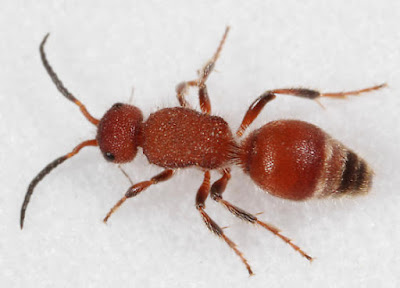
Female Photomorphus banksi, copyright Cotinis.


Species of Photomorphus are found across much of the United States and Mexico, being most diverse in the arid regions of the south-west (Brabant et al. 2010). The genus is currently divided between three subgenera, each originally described from males. Males have round, slightly protruding eyes, a more or less petiolate metasoma with a distinct constriction between the first and second segments, and a pair of ridges on the mesosternum behind the procoxae. The genus is currently divided between three subgenera: Photomorphus, Photomorphina and Xenomorphus. Males of subgenus Photomorphus have a distinct space between the mesocoxae and bidentate mandibles whereas Photomorphina males have the mesocoxae closely placed and tridentate mandibles (Manley & Pitts 2002). Females of Photomorphus have dense, silver setae on the mesosoma whereas females of Photomorphina have a less hairy mesosoma and typically have a band of plumose setae along the dorsal hind margin of the second metasomal segment (Brabant et al. 2010). The third subgenus, Xenomorphus, is known from a single Mexican species only and its female remains unidentified.
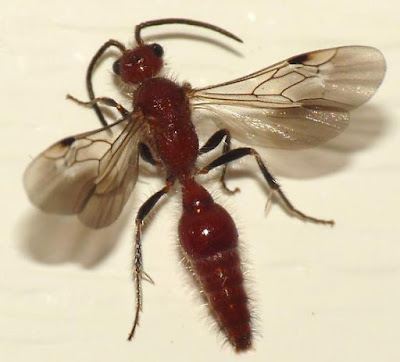
Male Photomorphus paulus, copyright J. C. Jones.


Photomorphus is part of a lineage of nocturnal mutillids common in arid regions of North America. Velvet ants develop as nest parasites of other wasps and bees; Photomorphus species are presumably no exception but their hosts are as yet unknown. A phylogenetic analysis of the North American nocturnal mutillids by Pitts et al. (2010) supported recognition of the group as a single clade but identified Photomorphus itself as polyphyletic. A clade corresponding to the subgenus Photomorphus was recovered but Photomorphina species were divided between multiple separate clades. This included the species P. myrmicoides which Brabant et al. (2010) had suggested should be moved from Photomorphina to subgenus Photomorphus. Females of P. myrmicoides have hair like that of subgenus Photomorphus but differs in the structure of the pygidial plate, a hairless area at the end of the metasoma. In the strict subgenus Photomorphus, this plate is completely smooth and shiny; in Photomorphina and P. myrmicoides, it is rough or marked by ridges. Clearly a reclassification of Photomorphus is on the cards but we are yet to see when we have the confidence to enact it.

REFERENCES

Brabant, C. M., K. A. Williams & J. P. Pitts. 2010. True females of the subgenus Photomorphina Schuster (Hymenoptera: Mutillidae). Zootaxa 2559: 58–68.

Manley, D. G., & J. P. Pitts. 2002. A key to genera and subgenera of Mutillidae (Hymenoptera) in America north of Mexico with description of a new genus. Journal of Hymenoptera Research 11 (1): 72–100.

Pitts, J. P., J. S. Wilson & C. D. von Dohlen. 2010. Evolution of the nocturnal Nearctic Sphaerophthalminae velvet ants (Hymenoptera: Mutillidae) driven by Neogene orogeny and Pleistocene glaciation. Molecular Phylogenetics and Evolution 56: 134–145.

Pompilus: Spider Wasps of the Dunes

I've commented before on the difficulties that can be attendent on identifying spider wasps (Pompilidae), one of those groups that combine a high species diversity with a tendency to be morphologically conservative. As a result, the taxonomic history of this group has been one of shifting generic concepts and ill-defined wastebaskets. Not surprisingly, one of the main victims of this uncertainty has been the type genus Pompilus. Historically used to cover a significant percentage of all spider wasps, the name Pompilus is now restricted to a small cluster of species inhabiting the Old World.

Pompilus cinereus, copyright Martin Grimm.


The genus Pompilus and its history were last revised in detail by Day (1981) who recognised seven species associated with more or less open, sandy habitats. The most widespread and best-known of these is Pompilus cinereus, found over wide parts of Eurasia, Africa and Australia, often alongside bodies of water. This species shows a wide range of morphological variation across its range but Day (1981) declared himself unable to sensibly correlate this variation with discrete populations. The possibility remains that further studies may identify P. cinereus as a species complex. The other species in the genus, P. mirandus of India and south-east Asia and five African species, are more restricted in range and little studied. Pompilus mirandus is more tolerant of vegetated habitats than P. cinereus. Conversely, P. niveus of northern Africa is a specialist of the sand dunes of the Sahara Desert. Species of Pompilus all have a black cuticle with a covering of short grey pubescence. The most distinctive feature of the genus is the possession by females of long, weakly curved mandibles with a single inner tooth (other spider wasps have shorter, thicker mandibles with more teeth). These modified mandibles are related to their distinctive manner of handling prey. Whereas other spider wasps will drag their spider victims backwards to their nest, females of Pompilus will lift the spider off the ground and run forward while carrying it.

Nesting behaviour has only been described for P. cinereus. Targeted prey comprises ground-running spiders such as wolf spiders or clubionids. After a spider has been captured, paralysed and carried near the intended nest site, it is temporarily buried in the sand while the female constructs a burrow (Day suggested that this preliminary burial was to prevent the spider being stolen). The simple burrow leads to a single nest cell a few inches deep. The female exhumes the spider, transports it into the burrow and then lays an egg on its abdomen near the front of the side. She then closes the entrance to the burrow with sand, tamping it down securely with the end of her metasoma.

Within the burrow, the spider begins to wake from its paralysis after a few hours. However, it remains in poor shape: its movements are slow and it begins to continuously exude silk from its spinnerets. By wandering about the cell in this distressed state, the spider ends up producing a silken purse that serves as extra protection for the nest's contents. This, of course, includes the wasp larva that within a couple of days will have begun to feed on the trapped spider.

Though details of breeding behaviour have not been observed for other Pompilus species, they might be expected to resemble P. cinereus. It might be noted, however, that the female of P. cinereus has a patch of flattened scales at the end of the metasoma that is less developed in P. mirandus. Is this an indication that P. mirandus is somehow less conscientious in sealing the nest burrow than P. cinereus? If you keep an eye out in the wastelands of India, you might just learn the answer.

REFERENCE

Day, M. C. 1981. A revision of Pompilus Fabricius (Hymenoptera: Pompilidae), with further nomenclatural and biological considerations. Bulletin of the British Museum (Natural History): Entomology 42 (1): 1–42.