Field of Science

Ophiusini Corrections

Earlier this year, I presented a post on the noctuoid moth tribe Ophiusini. As it turns out, that post includes some notable errors. One of the main sources I used, Zahiri et al. (2012), stated that Ophiusini "have a strongly modified apex to the proboscis, with strong and enlarged spines and erectile, reversed hooks that are used in fruit-piercing or lachrymal-feeding behaviour". As reviewed by Zilli (2021), such hooks on the proboscis are unique to a separate subgroup of the family Erebidae, the Calpinae. Ophiusini have thin, nail-like spines on the proboscis but no erectile hooks. They are still fruit-piercers but no ophiusins have been observed to date engaging in lachrymal feeding.

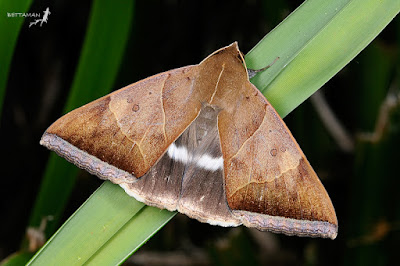
Artena dotata, copyright Shipher Wu.


Zilli (2021) had further comments on the historically fraught concept of Ophiusini. As noted in my earlier post, 'Ophiusini' has historically been recognised as a cosmopolitan group of moths but molecular studies have lead to its restriction to the Old World, North American exemplars being transferred to the related tribe Poaphilini. However, though the two groups are each supported as monophyletic by molecular data, they are not well defined morphologically. Characters previously thought distinct to one or the other do not always hold true. Ophiusini have been described as having reduced coremata but some ophiusins have coremata larger than those of some poaphilins. Ophiusins have been supposed to lack the waxy bloom on the pupa found in other noctuoids but some species do indeed have such a bloom. Some have pointed to the use of Euphorbiaceae as host plants by Poaphilini but not Ophiusini, but not all poaphilins feed on Euphorbiaceae and their use of this plant family is generally correlated with species being more generalist feeders overall.

One character that may yet distinguish the two tribes is the location of the androteca, a groove along the top of one of the leg segments in the male that contains a long brush of dense hairs (I'm not sure just what the function of this structure is meant to be but I would suspect something to do with dispersing pheromones). In Ophiusini, this structure is found on the femur of the fore leg. In Poaphilini, it is on the tibia of the mid leg. Nevertheless, Zilli (2021) questions the reliability of this feature: both arrangments are found in other tribes and neither alone is diagnostic.

Conversely, molecular phylogenies support the two tribes as sister taxa, and they share a number of distinctive features of the terminalia. While he does not formalise the suggestion, Zilli (2021) seems to feel that we might be better served by a return to a broader Ophiusini uniting the two tribes as one. I commented in my previous post that noctuoid classification has been in a continuous flux for as long as it has been a thing. It would be presumptuous to believe that it has finally been settled.

REFERENCES

Zahiri, R., J. D. Holloway, I. J. Kitching, J. D. Lafontaine, M. Mutanen & N. Wahlberg. 2012. Molecular phylogenetics of Erebidae (Lepidoptera, Noctuoidea). Systematic Entomology 37: 102–124.

Zilli, A. 2021. Tabwecala robinsoni gen. nov., sp. nov., from Vanuatu and its systematic postion in the 'Ophiusini-Poaphilini' clade (Lepidoptera, Erebidae). Nota Lepidopterologica 44: 193–211.
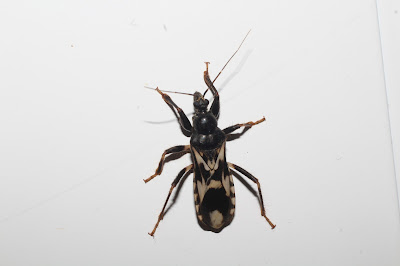
Rasahus albomaculatus, the White-Spotted Corsair

Though the Hemiptera began their long evolutionary history as plant-feeders, many of their subgroups later switched to a predatory lifestyle, their suctorial mouthparts being just as suited for stabbing flesh as vegetation. Among the most successful of the predatory bugs where the assassin bugs of the family Reduviidae.

Image copyright Jacob Gorneau.


This is Rasahus albomaculatus, a widespread assassin of the Neotropical region, found from Mexico to Argentina (Coscaron 1983). Though not one of the largest members of its genus, R. albomaculatus is a decent-sized bug, growing close to an inch in length. Rasahus is a genus of the reduviid subfamily Peiratinae, commonly known as corsairs for their fearsome aspect. Features distinguishing Rasahus from other genera of corsairs include their large eyes, a deep grove across the head in front of the ocelli, long procoxae, and well-developed spongy pads on the fore- and mid-tibiae. Rasahus albomaculatus is distinguished from other species of the genus by its colour pattern. The body is mostly black with white patterning on the wings. Stripes along the top of the wing and across the mid-length form a crude H-shape when the wings are closed, with separate spots towards the base of the wing and towards the tip. Other noteworthy features include a lack of granulation on the pronotum, and a rounded apex to the scutellum (Swanson 2018).

Corsairs are mostly predators of other insects and not often dangerous to humans (though their bite is supposed to be very painful). Indeed, they may be beneficial to humans as among their prey are believed to be other reduviids of the subfamily Triatominae, the blood-sucking "kissing bugs" that spread Chagas disease (contrary to the Wikipedia page on the western corsair R. thoracicus, corsairs do not spread Chagas themselves). Rasahus albomaculatus may provide its vertebrate co-habitants with far more comfortable living conditions.

REFERENCES

Coscarón, M. del C. 1983. Revision del genero Rasahus (Insecta, Heteroptera, Reduviidae). Revista del Museo de La Plata (nueva serie) (Zoologia) 13: 75–138.

Swanson, D. R. 2018. Three new species of Rasahus, with clarification on the identities of three other Neotropical corsairs (Heteroptera: Reduviidae: Peiratinae). Zootaxa 4471 (3): 446–472.

The Dermacentor Ticks

Pacific Coast tick Dermacentor occidentalis, copyright Jerry Kirkhart.


Among the ticks of most concern to humans are species of the genus Dermacentor. This genus of about forty known species is widely distributed in Africa, Eurasia and the Americas. Examples include the meadow tick D. reticulatus in Europe, and the wood tick D. variabilis and Rocky Mountain wood tick D. andersoni in North America. They are parasites of mammals, including both generalist and more host-specific species; records of Dermacentor individuals from reptiles and even carpenter bees (Goddard & Bircham 2010) presumably represent incidental and/or accidental associations. Species of Dermacentor are responsible for the spread of bacteria causing diseases such as Rocky Mountain spotted fever (which, despite sounding like a 1950s dance craze, is presumably not much fun), Q fever and tularemia. The ticks can also be more directly hazardous, as their bites inject a toxin that can cause tick paralysis.

Distinguishing features of Dermacentor species relative to other ticks include a rectangular base to the capitulum, relatively short, broad palps, well-developed eyes and the presence of festoons (impressed divisions of the posterior margin of the body) (Keirans 2009). Most are ornate—that is, marked on the dorsum with contrasting pale patterns—with the notable exception of the tropical horse tick D. nitens of the Americas (until recently, often treated as forming its own genus Anocentor). The function of such markings is unknown though suggestions include environmental protection, warning predators of distastefulness, or sexual signalling.

Meadow tick Dermacentor reticulatus, copyright Ferran Turmo Gort.


The majority of Dermacentor species have a three-host life cycle, dropping off the host between each of the life stages of larva, nymph and adult, and seeking out a new host after moulting. However, at least two New World species, the aforementioned D. nitens and the winter tick D. albipictus (a parasite of deer), are one-host ticks that remain on their original host between instars. In general, Dermacentor species are more resilient to dry climates than many other tick species. Individual species can differ in their climate tolerance, however. In North America, the geographical divide between D. variabilis in the east of the continent and D. andersoni in the west seems to be driven by the need for the latter of drier conditions (Yoder et al. 2007). Older instars also tend to be hardier than younger. Females of the ornate sheep tick D. marginatus, a European species, leave their host after gorging at the beginning of winter and then wait for more amoenable spring conditions before laying their delicate eggs (Dörr & Gothe 2001).

Higher relationships within the genus do not appear to have been extensively studied. A preliminary molecular phylogeny of hard ticks has suggested the possibility of a basal division between Afrotropical, Eurasian and New World lineages (Barker & Murrell 2004). Comparison with related tick genera raises the possibility of an Afrotropical origin for Dermacentor, though the genus has only a relictual presence in that continent now. However, with only a handful of species subjected to broad phylogenetic analysis to date, further testing is demanded. Does the continental divide hold true? Do the one-host species form a single clade within the genus? Inquiring minds wish to know.

REFERENCES

Barker, S. C., & A. Murrell. 2004. Systematics and evolution of ticks with a list of valid genus and species names. Parasitology 129: S15–S36.

Dörr, B., & R. Gothe. 2001. Cold-hardiness of Dermacentor marginatus (Acari: Ixodidae). Experimental and Applied Acarology 25: 151–169.

Goddard, J., & L. Bircham. 2010. Parasitism of the carpenter bee, Xylocopa virginica (L.) (Hymenoptera: Apidae), by larval Dermacentor variabilis (Say) (Acari: Ixodidae). Systematic and Applied Acarology 15: 195–196.

Keirans, J. E. 2009. Order Ixodida. In: Krantz, G. W., & D. E. Walter (eds) A Manual of Acarology 3rd ed. pp. 111–123. Texas Tech University Press.

Yoder, J. A., D. R. Buchan, N. F. Ferrari & J. L. Tank. 2007. Dehydration tolerance of the Rocky Mountain wood tick, Dermacentor andersoni Stiles (Acari: Ixodidae), matches preference for a dry environment. International Journal of Acarology 33 (2): 173–180.

Shadow of the Palaeoniscoids

Palaeoniscum freieslebeni, copyright James St. John.


Depending how you cut it, the ray-finned fishes (Actinopterygii) are arguably the most diverse group of vertebrates in the modern fauna. They are the dominant vertebrates in all aquatic environments, they encompass an enormous array of species, and they have evolved a bewildering assemblage of morphologies. But despite their current pre-eminence, the early evolution of actinopterygians remains rather understudied. The earliest actinopterygians appear in the fossil record in the Late Silurian/Early Devonian but, until fairly recently, the majority of Palaeozoic ray-finned fishes have often been lumped into a catch-all holding tank, the 'Palaeonisciformes'. This was a vague assemblage of fishes united by plesiomorphic features such as ganoid scales (heavy, bony scales with an outer layer of enamel, also found in modern gars and sturgeons), a single dorsal fin and a heterocercal tail (with the upper arm of the tail fin longer than the lower). The key genus of the group, the Permian Palaeoniscum, had a fusiform (or torpedo-shaped) body; at first glance, it would not have looked dissimilar to a modern herring. However, it lacked the mobile jaw structure of modern teleost fishes, with the maxilla and preopercular bones being fixed together. As such, it would have lacked the modern fish's capacity for suction feeding (Lauder 1980). Prey capture by Palaeoniscum would have been a simple smash-and-grab affair. Palaeoniscoid fishes remained a component of both marine and freshwater faunas until the end of the Cretaceous before being entirely supplanted by modern teleost radiations such as the ostariophysans and percomorphs.

Reconstruction of Acrolepis gigas, copyright DiBgd.


The core concept of 'Palaeonisciformes' has united fishes with a fusiform body shape like Palaeoniscum; depending on the author, more divergent contemporary fishes such as the deep-body platysomoids might be combined in the same order or treated separately. By modern standards, former 'Palaeonisciformes' probably combine stem-actinopterygians, stem-chondrosteans, stem-holosteans and possibly even stem-teleosts. As such, the term Palaeonisciformes has tended to fall out of favour, though the less formal 'palaeoniscoid' remains a useful descriptor. Nevertheless, the exact phylogenetic position of many palaeoniscoid taxa remains unestablished. Part of this is due to a lack of observable detail: though those heavy ganoid scales preserve well, they effectively cover up internal skeletal features. Many palaeoniscoids are preserved as compression fossils, effectively not much more than intriguing silhouettes. However, part of the problem is simple neglect. Palaeoniscoids are not rare fossils; in some formations, they may be the dominant part of the fauna by a large margin. They certainly deserve a closer look.

REFERENCE

Lauder, G. V., Jr. 1980. Evolution of the feeding mechanism in primitive actinopterygian fishes: a functional anatomical analysis of Polypterus, Lepisosteus, and Amia. Journal of Morphology 163: 283–317.

Herbs of Dragons and Worms

Preparing for this post has inspired me to some low-key experimentation. When it came time to assign myself its topic, I landed on the plant genus Artemisia. This is the genus that, among others, includes the culinary herb tarragon, Artemisia dracunculus. Which got me thinking that I wasn't sure if I'd ever actually eaten tarragon. I asked Christopher if he was familiar with it; he responded that all he knew about tarragon was that you had to consume it in the 1970s. Without access to a functioning Delorean, I did the next best thing and prepared a dish of tarragon chicken myself. The verdict: very tasty, though I could appreciate why tarragon might have a reputation for being somewhat difficult as it had a light flavour that I could imagine being easily overwhelmed.

Tarragon Artemisia dracunculus, copyright Cillas.


Tarragon is not the only species of Artemisia of significance to humans. This genus of composite-flowered plants comprsises over five hundred species and subspecies of herbs and small shrubs. The greatest diversity is found in arid and semi-arid regions of the Northern Hemisphere temperate zone (Sanz et al. 2008). The genus is characterised by its distinctive pollen with surface spinules reduced or absent. This pollen type is associated with the wind pollination typical of the genus, though some species do exhibit features such as sticky pollen and colourful flower-heads associated with insect visitation (Hayat et al. 2009). The flower-heads or capitula (a reminder that the 'flowers' of composite plants such as daisies and thistles actually represent a fusion of multiple flowers) of Artemisia are either disciform, with an outer circle of reduced ray florets surrounding the inner disc florets, or discoid, with disc florets only. In disciform capitula, the outer limb of the ray florets is reduced to a membranous vestige, not readily visible without minute examination. The ray florets are female whereas the disc florets are ancestrally hermaphroditic (more on that shortly). In discoid capitula, where the ray florets have been lost, all florets are uniformly hermaphroditic.

Mugwort Artemisia vulgaris, copyright Christian Fischer.


Historically, there has been some variation in the classification of Artemisia but a popular system divides the genus between five subgenera. A phylogenetic analysis of Artemisia and related genera by Sanz et al. (2008) found that the genus as currently recognised is not monophyletic, with a handful of small related genera being embedded within the clade. Time will tell whether this inconsistency is resolved by subdividing Artemisia or simply rolling in these smaller segregates, but for the purposes of this post they can be simply set aside. The subgenus Dracunculus, including tarragon and related species, falls in the sister clade to all other Artemisia. As well as being united by molecular data, members of this clade are distinguished by disciform capitula in which the central disc florets have become functionally male (female organs have been rendered sterile).

Wormwoood Artemisia absinthium, copyright AfroBrazilian.


The second clade encompasses the subgenera Artemisia and Absinthium, with disciform capitula, and Seriphidium and Tridentatae, with discoid capitula. Not all authors have supported the distinction of Artemisia and Absinthium, and Sanz et al. identify both as non-monophyletic, both to each other and to the discoid subgenera. Because of their similar flower-heads, most authors have presumed a close relationship between the Eurasian Seriphidium and the North American Tridentatae (commonly known as sagebrushes). Some have even suggested the former to be ancestral to the latter. However, Sanz et al.'s results questioned such a relationship, instead placing the Tridentatae species in a clade that encompassed all the North American representatives of the Artemisia group.

As well as the aforementioned tarragon, economically significant representatives of Artemisia include wormwood A. absinthium, best known these days as the flavouring agent of absinthe (though historically it has also been used for more innocuous concoctions). Mugworts (A. vulgaris and related species) have also been used for culinary and medicinal purposes. Sagebrushes are a dominant component of the vegetation in much of the Great Basin region of North America, providing crucial habitat for much of the region's wildlife. Artemisia species have shaped the lives of many of their co-habitants, both animal and human.

REFERENCES

Hayat, M. Q., M. Ashraf, M. A. Khan, T. Mahmood, M. Ahmad & S. Jabeen. 2009. Phylogeny of Artemisia L.: recent developments. African Journal of Biotechnology 8 (11): 2423–2428.

Sanz, M., R. Vilatersana, O. Hidalgo, N. Garcia-Jacas, A. Susanna, G. M. Schneeweiss & J. Vallès. 2008. Molecular phylogeny and evolution of floral characters of Artemisia and allies (Anthemideae, Asteraceae): evidence from nrDNA ETS and ITS sequences. Taxon 57 (1): 66–78.

The Bolivinitids

The Cretaceous was a period of significant innovation in the evolution of Foraminifera with a number of distinct new lineages making their appearance during this period. Among those, appearing in the latter part of the Cretaceous, were the first members of the modern family Bolivinitidae.

Bolivinita costifera, from the Smithsonian National Museum of Natural History.


The Bolivinitidae are free-living benthic forams with a calcareous, hyaline (glassy) test. The overall shape of the test is elongate with chambers arranged in biserial coils (that is, there are two chambers per loop). The terminal aperture is usually loop-shaped with a surrounding lip. Inside the chamber, a tooth plate (an inner protrusion of the test) runs from the aperture to the opening of the previous chamber and may protrude through the aperture (Revets 1996).

Representatives of the Bolivinitidae are found in a wide range of depths, from the shallow waters of the ocean to the bathyal zone. They may be among the most abundant forams in areas of low oxygen concentrations and are commonly associated with sustained organic matter input (Erdem & Schönfeld 2017). In other words, these are muck-lovers. Individuals growing in low oxygen conditions tend to show less pronounced surface sculpture on the test than those where the oxygen levels are higher. Conversely, individuals at deeper levels tend to be larger overall than those in shallower waters (Brun et al. 1984). As such, bolivinitids have received their fair share of attention as potential indicators of changes in environmental condition over time.

REFERENCES

Brun, L., M. A. Chierici & M. Meijer. 1984. Evolution and morphological variations of the principal species of Bolivinitidae in the Tertiary of the Gulf of Guinea. Géologie Méditerranéenne 11 (1): 13–57.

Erdem, Z., & J. Schönfeld. 2017. Pleistocene to Holocene benthic foraminiferal assemblages from the Peruvian continental margin. Palaeontologica Electronica 20.2.35A: 1–32.

Revets, S. A. 1996. The generic revision of the Bolivinitidae Cushman, 1927. Cushman Foundation for Foraminiferal Research Special Publication 34: 1–55.

Crossing the Busycon

I must admit that when I think about the biodiversity hotspots of the world, the eastern seabord of the United States would not be among the first regions to come to mind. But for this post, I'm looking at a dramatic and eye-catching radiation of molluscs for which this is their centre of distribution. I speak of the giant whelks of the Busyconidae.

Left-handed whelk or lightning whelk Sinistrofulgur sinistrum, copyright Andrea Westmoreland.


Busyconid whelks first appeared in the waters of eastern North America during the early Oligocene, about 32 million years ago, in what was then the Mississippi Sea and is now the Mississippi River Basin. As the oceans receded from the Mississippi, they spread into the Gulf of Mexico and are now found between Massachusetts in the north and the Yucatan Peninsula in the south. Except for an introduced population of the channeled whelk Busycotypus canaliculatus that has become established in San Francisco Bay in California since the 1930s, the family has never been found elsewhere. These are remarkably large snails: smaller examples are still more than five centimetres in length, and the largest of all get close to a foot (Petuch et al. 2015). Mature shells have a large body whorl, generally higher than the visible spire, with a long siphonal canal. SCulpture of the shell, if present, is dominated by spiral elements, and the shoulder of the whorls may be marked by prominent carinae and/or spines. As is standard for neogastropods, the classification of this group has shifted around a bit over the years, whether treated as their own family or as a subfamily Busyconinae of the related families Buccinidae or Melongenidae. In a recent review of the busyconids, Petuch et al. (2015) recognised fifteen living species in six genera. The number of fossil species that has been described is significantly larger (over one hundred); not surprisingly, these large solid shells have an excellent fossil record. However, it is worth noting that some of the living species may be remarkably variable in shell morphology and I don't know whether fossil representatives have been subject to the same systematic scrutiny.

Knobbed whelk Busycon carica, copyright Matt Tillett.


All busyconids are predators on bivalves, particularly on burrowing clams. In general, the whelk envelops its victim in its muscular foot and then uses the edge of the shell lip to open the clam's shell, allowing the whelk to insert its radula and rasp out the clam's flesh. The preferred method of opening the shell depends on the species of whelk and may be classed as 'wedging' and 'chipping'. 'Wedging' is the most straightforward method and believed to be the more primitive; wedgers insert the shell lip into the gap between valves and directly force them apart and/or prevent the clam shell from closing. 'Chipping' is more involved and performed by members of the genera Busycon and Sinistrofulgur. In this method, the edge of the whelk shell is rhythmically pounded against the commissure between the clam shell valves, progressively wearing at the valve margins until enough of an opening has been made to insert the radula. The process may take multiple hours of patient hammering. Chipping requires more power and a heavier shell than wedging (chipping whelks may damage their own shell as well as the prey's) but also allows the whelk to attack thicker-shelled clams.

Though each species of busyconid will generally use one or the other method of opening prey, there are borderline examples. Larger individuals of Busycotypus canaliculatus, usually a wedger, may adopt a process like chipping though their attacks on the prey shell are usually less systematic than true chippers. And while I haven't found anywhere that says as much, I suspect that young chippers may spend the earlier parts of their life as wedgers untill they have developed the shell strength for chipping. Dietl (2004) suggested that chipping behaviour may have originated twice among busyconids, based on the fossil evidence of its traces left on clam shells. The modern chippers appear to derive from a single origin in the later Pliocene. However, evidence of an earlier and now seemingly extinct chipping lineage was also found in shells from the late Miocene. These earlier chippers seemingly did not belong to any of the modern chipping genera which are not known from the Miocene deposits in which chipped clams were found. Instead, Dietl proposed that the culprit was a large Busycotypus.

Channeled whelk Busycotypus canaliculatus laying a string of egg cases, copyright Eric Heupel.


Busyconid whelks have long been of significance to people living in areas where they are found. Not only are the shells eye-catching and ornamental objects in themselves, the animals are also harvested for food (though their meat is often sold under misleading names such as 'conch' or 'clam strips'). Archaeological examples have been found of busycon shells being used for tools; Petuch et al. (2015) illustrate an example of a left-handed whelk Sinistrofulgur sinistrum shell with holes drilled into it that would have allowed it to be attached to a stick and used as a shovel. These animals are truly an icon of North America's eastern seaboard.

REFERENCES

Dietl, G. P. 2004. Origins and circumstances of adaptive divergence in whelk feeding behavior. Palaeogeography, Palaeoclimatology, Palaeoecology 208: 279–291.

Petuch, E. J., R. F. Myers & D. P. Berschauer. 2015. The Living and Fossil Busycon Whelks: Iconic Mollusks of Eastern North America. San Diego Shell Club, Inc.