Field of Science

Centaurea acaulis, Stemless Star-thistle

In an earlier post, I commented on the diversity of species of the star-thistle genus Centaurea. Among the many, many species that have been assigned to this genus is the stemless star-thistle Centaurea acaulis* of northern Africa.

*Though dissolution of the polyphyletic Centaurea may lead to this species changing places. Banfi et al. (2005) listed it under the name of Colymbada acaulis.

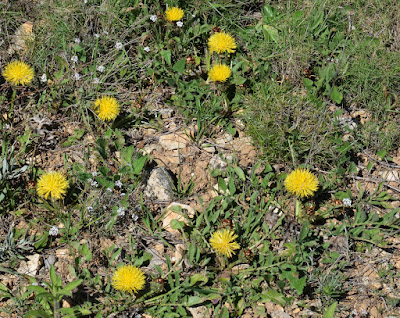
Patch of stemless star-thistles Centaurea acaulis, from L'herbiel de Gabriel.


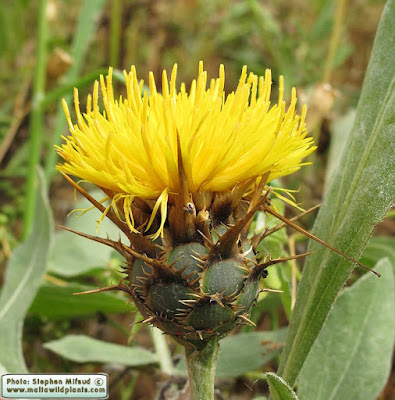
Centaurea acaulis is an inhabitant of dry, rocky habitats that is native to Tunisia and northeastern Algeria. As indicated by both the vernacular and botanical names, its growth habit lacks a central stem. Instead, the long, lobed leaves (which can be up to about a foot in length going by photos provided by Agut Escrig et al., 2021) lie prostrate on the ground. These leaves end in a large, ovate apical section with lobes running down the side of the central rib, becoming smaller towards the base. Flower heads are solitary and carry a mass of bright yellow florets. The involucral bracts (the 'scales' around the outside of the base of the flower head) are flat and green with darker longitudinal veins. The distal section of the bracts is triangular with a membranous, ciliate margin and typically (though not always) ends in a long spine. A closely related species found in northwestern Algeria and Morocco, C. oranensis, has historically been treated as a subspecies of C. acaulis (under the name C. acaulis ssp. boissieri, because botanical nomenclature is weird). However, C. oranensis was raised to species level by Greuter & Aghababian (in Greuter & von Raab-Straube, 2005) on the basis of its distinct involucral bracts, which are distally blackish, ovate and concave, with a margin of dense, long, stiff setae.

Close-up of flower head of Centaurea acaulis, copyright Stephen Mifsud.


Recent years have seen this species extending its range northwards with populations now found in Spain, Italy and Malta. In Malta, it was initially found grown in a disturbed area with particularly alkaline soil (Buttigieg & Lanfranco 2001). The mechanism of its arrival is uncertain. It could have dispersed naturally across the Mediterranean, or it may have arrived mixed into bird seed. However it got there, one might expect that as the south of Europe becomes increasingly hotter and drier, the stemless star-thistle will continue to spread.

REFERENCES

Agut Escrig, A., J. P. Solís Parejo & P. Urrutia Uriarte. 2021. Noticias sobre la presencia de Centaurea acaulis L. (Asteraceae) en la Península Ibérica. Flora Montiberica 81: 51–54.

Banfi, E., G. Galasso & A. Soldano. 2005. Notes on systematics and taxonomy for the Italian vascular flora. 1. Atti Soc. It. Sci. Nat. Museo Civ. Stor. Nat. Milano 146 (2): 219–244.

Buttigieg, R., & E. Lanfranco. 2001. New records for the Maltese flora: Centaurea acaulis L. (family: Asteraceae). Central Mediterranean Naturalist 3 (3): 147–148.

Greuter, W., & E. von Raab-Straube (eds) 2005. Euro+Med notulae, 1. Willdenowia 35: 223–239.

Lifestyles of the Rosalinidae

Among the modern foraminiferans, one of the most prominent radiations is among members of the Rotaliida, characterised by globose chambers and calcareous, hyaline test walls. Among the numerous families making up the Rotaliida are members of the Rosalinidae.

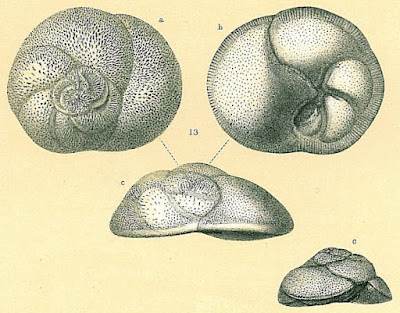
Benthic form of Rosalina globularis, from Brady (1884).


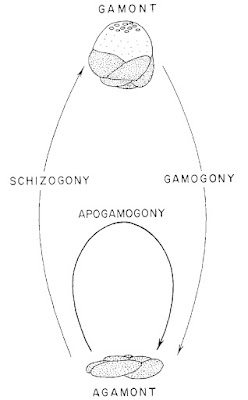
Rosalinids may be regarded as fairly typical-looking marine rotaliids with the test growing freely as a low trochospire (so a flattened cone or dish shape). The aperture of the test is a low slit on the interior margin along the umbilicus (Hansen & Revets 1992). Rosalinids have a complex life cycle involving both benthic and planktonic stages (Sliter 1965). The asexually reproducing diploid stage is benthic. Depending on conditions, diploid individuals may divide to produce other diploid individuals, resulting in several asexual generations. Eventually, however, the diploid generation will undergo meiosis to produce the haploid sexual generation (in the common species Rosalina globularis, this is induced by exposure to warmer water). In the sexual generation, a large globular chamber forms at maturity that covers the umbilical side of the test. This float chamber becomes filled with gas, allowing the foram to disperse planktonically before releasing gametes to produce the next diploid generation. Planktonic individuals are distinct enough in appearance from their benthic counterparts that they were long mistaken for distinct taxa before their identity was revealed by lab cultures.

Life cycle of Rosalina globularis, from Sliter (1965).


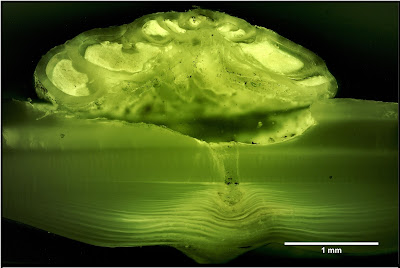
The majority of forams are particulate feeders. A network of filamentous pseudopodia radiating outwards from the cell body captures micro-organisms and other organic particles. However, one genus of rosalinids, Hyrrokkin, lives as parasites on sessile invertebrates (Cedhagen 1994). Species of this genus have variously been found on sponges, corals and bivalves. On sponges, they settle on the inhalent surface of the sponge and dissolve the underlying tissues. On bivalves, they form pits on the shell surface from which they bore holes through to the body cavity. Pseudopodia extended through this hole allow the foram to feed on host tissue. Infested hosts may bear multiple scars from the foram moving about on the outer surface. The forams may also feed on other animals such as polychaete worms or bryozoans attached to the surface of their primary host. In such cases, Hyrrokkin remains in its original pit but develops an irregularly shaped chamber with its aperture directed towards the alternate prey. Hyrrokkin species evidently do well from their rapacious lifestyle: whereas other rosalinids are only a fraction of a millimetre in diameter, Hyrrokkin sarcophaga is an absolute giant reaching around six millimetres across and with protoplasm containing thousands of nuclei. Proving once again that one may make a great deal of profit from the labour of others.

Cross-section of Hyrrokkin sarcophaga boring into shell of file clam Acesta excavata, from Schleinkofer et al. (2021).


REFERENCES

Cedhagen, T. 1994. Taxonomy and biology of Hyrrokkin sarcophaga gen. et sp. n., a parasitic foraminiferan (Rosalinidae). Sarsia 79: 65–82.

Hansen, H. J., & S. A. Revets. 1992. A revision and reclassification of the Discorbidae, Rosalinidae, and Rotaliidae. Journal of Foraminiferal Research 22 (2): 166–180.

Sliter, W. V. 1965. Laboratory experiments on the life cycle and ecologic controls of Rosalina globularis d'Orbigny. Journal of Protozoology 12 (2): 210–215.

Colus and Co.

The neogastropods have long been a challenge taxonomically. They are extremely diverse, encompassing a large number of species with a wide range of lifestyles, but they also exhibit exhibit regular patterns of convergence and/or conservatism between different lineages. Perhaps the most challenging group of all has been the whelks, commonly recognised as the superfamily Buccinoidea, a massive radiation of over 3300 known species. Whelks are particularly diverse in colder regions of the world's oceans, including amongst their number there the members of the family Colidae.

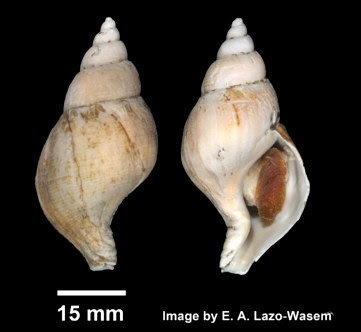
Hairy colus Colus pubescens, copyright E. A. Lazo-Wasem.

Colus has been used as the basis of a family group name at many levels of whelk classification, whether it be Colidae, Colinae or Colini. The gastropod classification laid out by Bouchet et al. (2017) recognised 'Colini' as a diverse tribe within the main whelk family Buccinidae, including a range of cold-water taxa. However, a more recent phylogenetic analysis of the buccinoids by Kantor et al. (2021) found Bouchet et al.'s concept of Colini to be polyphyletic, placing the type genus Colus outside what the called the 'core Buccinoidea'. As such, they raised Colidae to the status of a separate family and restricted it to just two genera, Colus and Turrisipho.

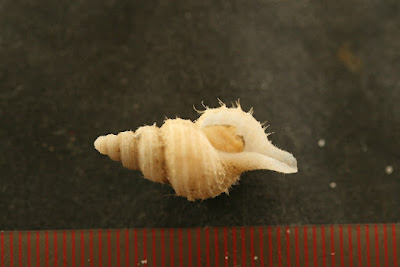
In this restricted form, the Colidae are thin-shelled, medium-sized to large whelks with the largest having shells up to twenty centimetres in length. The shells are fusiform to ovate in shape with a more or less elongate siphonal canal and covered by a brown periostracum. Axial sculpture is absent; spiral sculpture is expressed as more or less prominent cords. The aperture is closed with a operculum bearing a terminal nucleus. The animal has a more or less long proboscis. The radula bears three teeth per row; the middle tooth has a more or less square base and one to three cusps, with the middle cusp the largest, whereas the lateral teeth bear three hooked cusps with the outermost cusp significantly larger than the other two. None of these features, it should be noted, is entirely unique to the Colidae (Kantor et al. 2021).

Turrisipho dalli, from BoldSystems.


Members of the Colidae are found in the Arctic and northern Atlantic Oceans, from subtidal to bathyal depths. Because they are not targeted commercially, the life habits of colids have not been well studied. However, what we do know indicates that they are likely predators on other invertebrates (Kosyan 2007). The long proboscis of most species is probably used to pull infaunal animals such as amphipods and bivalves out of their burrows. Colids have well-developed salivary glands and it is possible that these may produce toxins as found in other neogastropods. They do not have anything like the elaborate venom delivery setups like those found in the conoids, but even a little dose of toxic saliva helps to subdue a struggling crustacean.

REFERENCES

Bouchet, P., J.-P. Rocroi, B. Hausdorf, A. Kaim, Y. Kano, A. Nützel, P. Parkhaev, M. Schrödl & E. E. Strong. 2017. Revised classification, nomenclator and typification of gastropod and monoplacophoran families. Malacologia 61 (1–2): 1–526.

Kantor, Y. I., A. E. Fedosov, A. R. Kosyan, N. Puillandre, P. A. Sorokin, Y. Kano, R. Clark & P. Bouchet. In press 2021. Molecular phylogeny and revised classification of the Buccinoidea (Neogastropoda). Zoological Journal of the Linnean Society.

Kosyan, A. R. 2007. Morphological features, ecology, and distribution of poorly studied molluscan genera of the Colinae subfamily (Gastropoda, Buccinidae) from the far eastern seas of Russia. Oceanology 47 (4): 531–536.

Velvet Photomorphs

The velvet ants of the family Mutillidae are a diverse but relatively little-studied group of insects. As well as their often retiring habits, studies of this family are hindered by the difficulty of associating sexes. Females are wingless and superficially resemble hairy ants. Males are usually winged and resemble more typical wasps (there is a small handful of species in which both sexes are flightless). What we do know of velvet ant diversity suggests a high level of endemicity with different regions each having their own distinct assemblages of genera and species. In North America, one of the most diverse recognised genera is Photomorphus.

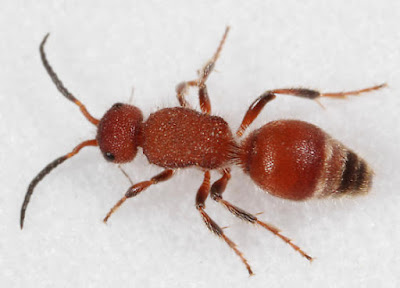
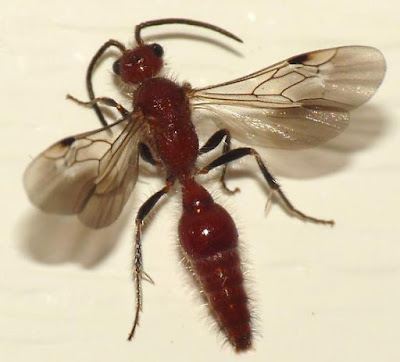
Female Photomorphus banksi, copyright Cotinis.


Species of Photomorphus are found across much of the United States and Mexico, being most diverse in the arid regions of the south-west (Brabant et al. 2010). The genus is currently divided between three subgenera, each originally described from males. Males have round, slightly protruding eyes, a more or less petiolate metasoma with a distinct constriction between the first and second segments, and a pair of ridges on the mesosternum behind the procoxae. The genus is currently divided between three subgenera: Photomorphus, Photomorphina and Xenomorphus. Males of subgenus Photomorphus have a distinct space between the mesocoxae and bidentate mandibles whereas Photomorphina males have the mesocoxae closely placed and tridentate mandibles (Manley & Pitts 2002). Females of Photomorphus have dense, silver setae on the mesosoma whereas females of Photomorphina have a less hairy mesosoma and typically have a band of plumose setae along the dorsal hind margin of the second metasomal segment (Brabant et al. 2010). The third subgenus, Xenomorphus, is known from a single Mexican species only and its female remains unidentified.

Male Photomorphus paulus, copyright J. C. Jones.


Photomorphus is part of a lineage of nocturnal mutillids common in arid regions of North America. Velvet ants develop as nest parasites of other wasps and bees; Photomorphus species are presumably no exception but their hosts are as yet unknown. A phylogenetic analysis of the North American nocturnal mutillids by Pitts et al. (2010) supported recognition of the group as a single clade but identified Photomorphus itself as polyphyletic. A clade corresponding to the subgenus Photomorphus was recovered but Photomorphina species were divided between multiple separate clades. This included the species P. myrmicoides which Brabant et al. (2010) had suggested should be moved from Photomorphina to subgenus Photomorphus. Females of P. myrmicoides have hair like that of subgenus Photomorphus but differs in the structure of the pygidial plate, a hairless area at the end of the metasoma. In the strict subgenus Photomorphus, this plate is completely smooth and shiny; in Photomorphina and P. myrmicoides, it is rough or marked by ridges. Clearly a reclassification of Photomorphus is on the cards but we are yet to see when we have the confidence to enact it.

REFERENCES

Brabant, C. M., K. A. Williams & J. P. Pitts. 2010. True females of the subgenus Photomorphina Schuster (Hymenoptera: Mutillidae). Zootaxa 2559: 58–68.

Manley, D. G., & J. P. Pitts. 2002. A key to genera and subgenera of Mutillidae (Hymenoptera) in America north of Mexico with description of a new genus. Journal of Hymenoptera Research 11 (1): 72–100.

Pitts, J. P., J. S. Wilson & C. D. von Dohlen. 2010. Evolution of the nocturnal Nearctic Sphaerophthalminae velvet ants (Hymenoptera: Mutillidae) driven by Neogene orogeny and Pleistocene glaciation. Molecular Phylogenetics and Evolution 56: 134–145.

Lichen Darklings

The beetles of the family Tenebrionidae, often referred to as the darkling beetles, are a diverse bunch. Members of this family have adapted to a wide range of lifestyles, coming in a variety of body types. Among the more obscure representatives of the tenebrionids are the members of the Southern Hemisphere tribe Titaenini.

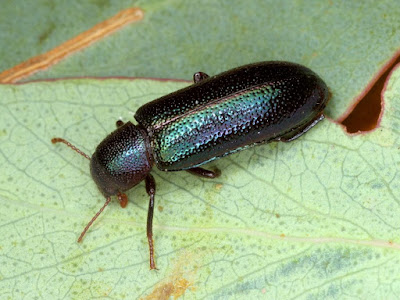
Titaena sp., copyright Martin Lagerwey.


Members of the Titaenini have a typical Gondwanan distribution, being known from southern and eastern Australia, New Zealand, New Caledonia and southern South America (Matthews & Bouchard 2008). They grow up to about a centimetre and a half in length with an elongate, parallel-sided body shape that is more or less cylindrical. The prothorax is relatively short, allowing the head to be held vertically in the Australian genus Titaena. Antennae are short with fairly simple segments not forming a club at the end. Legs have similarly simple tarsi. The tribe is distinguished from other, similar darkling beetles by the epipleura (the flattened underside of the elytral margins) which are shortened, not reaching the elytral apex. Members of the Titaenini have large repugnatorial glands opening near the end of the abdomen. In the Australian genus Titaena, at least, species are usually metallic blue or green in coloration.

The habits of the Titaenini are poorly known. As far as we do know, their larvae are specialised feeders on lichen. Adults probably pursue a similar diet. This is an exposed lifestyle, one in which you could easily come to the attention of predators, and the bright coloration of Titaena probably functions to warn off any such unwelcome interest.

REFERENCE

Matthews, E. G., & P. Bouchard. 2008. Tenebrionid Beetles of Australia: Descriptions of tribes, keys to genera, catalogue of species. Australian Biological Resources Study: Canberra.

A Spider for Christmas

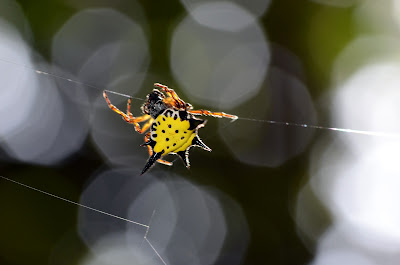
Hasselt's spiny spider Macracantha hasselti, copyright Patrick Randall.


In many warmer parts of the Old World, the spiny orb-weavers of the subfamily Gasteracanthinae are among the most eye-catching of all spiders. As well as constructing complex, easily seen webs in the manner of other orb-weavers, these spiders draw attention by their bright colours and ornate structure, often with prominent arrangements of spines on the abdomen. Here in Australia, their dramatic appearance has lead to their often being referred to as "Christmas spiders". The exact reason for this drama is uncertain. The spines are generally presumed to be for defence but the coloration has been subject to multiple proposals from an aposematic warning to functioning as a lure for flying insects.

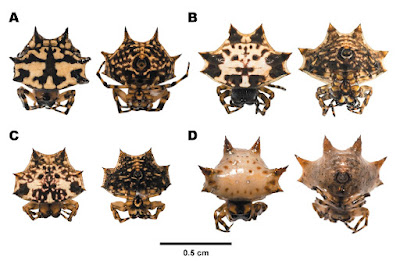
Variants of Gasteracantha kuhli, from Macharoenboon et al. (2021).


The taxonomic history of the Christmas spiders is a complicated one, going back to the early years of arachnology. Not surprisingly for such distinctive animals, a large number of species were described by early authors. However, species of spiny orb-weavers are often very variable, leading to a significant number being described as new on more than one occasion. As with other orb-weavers, males are much smaller than females, and the spines on the abdomen tend to be more poorly developed. Coloration within a species can vary considerably in brightness, tone, and patterning. Structural features such as the arrangement of spines and the development of sigilla (impressions on the dorsal surface of the abdomen that mark the placement of internal muscles) can still provide reliable indicators of species identity, as (of course) can features of the genitalia. You have to learn to look past the superficial daubings and focus on the underlying form.

Give Plateosaurus Its Due

You could make a fascinating study (and many have) just looking at the history of which dinosaurs have held the foreground of popular culture when. The Iguanodon and Megalosaurus of the late 1800s, the Trachodon and Palaeoscincus of the earlier 1900s, the stratospheric rise of Velociraptor (sensu lato) with the release of Jurassic Park. And then there are those that never quite seem to get their dues. I've commented before on the odd relegation of Camarasaurus to the status of also-ran among famous sauropods. But perhaps the ultimate example of a dinosaur forced unfairly to the background is the should-be darling of the Late Triassic, Plateosaurus.

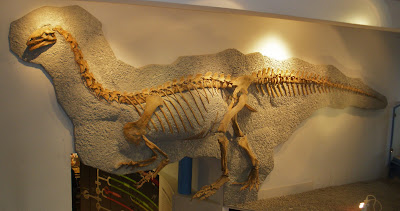
Plateosaurus 'engelhardti' in the Sauriermuseum at Frick, copyright Ghedoghedo.


Plateosaurus should, by all rights, be a superstar of dinosaur pop-culture. It was one of the first dinosaurs to reach massive size, extending up to nine metres in length and probably standing about as high (or slightly higher) than a tall man at the withers (Yates 2003). It is known from literally hundreds of specimens, many of them with large parts of the skeleton preserved, representing ages from juvenile to full maturity. Some of the bonebeds where it is found contain little but Plateosaurus and may have been formed in dramatic mass mortality events. Plateosaurus is easily the best known of the basal Sauropodomorpha, the 'prosauropods'. And yet, though Plateosaurus regularly appears in popular depictions, it rarely seems to make much more than a brief cameo. Why is this the dinosaur that gets no respect?

In part, it may be because it comes from a time period that gets less attention as a whole. The Triassic tends to get seen as a meer prelude to later, more 'exciting' parts of the Mesozoic. Plateosaurus itself, together with the other 'prosauropods', tends to also get overshadowed by its later, more eye-catching relatives, the sauropods. And when you get down to it, Plateosaurus may also be let down by the fact that it is perhaps the single most average dinosaur you could possibly imagine. Honestly, if you asked someone to depict a truly generic dinosaur, I don't think it would come out looking too different from Plateosaurus.

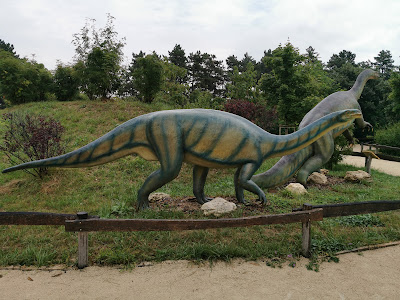
Reconstructed Plateosaurus, albeit in a now-obsolescent quadrupedal pose, copyright Elekes Andor.


All these criticisms aside, Plateosaurus is still a fascinating genus. Its remains have been found across central Europe, in Germany, Switzerland and France. The exact number of species in the genus has long been uncertain. As with other early-named dinosaur genera, 19th Century palaeontologists named several species whose application has been subject to debate. Yates (2003) recognised two species in the genus, the earlier and smaller P. gracilis, and a larger, later species that Yates labelled P. engelhardti but which, due to various taxonomic shenanigans, should probably now be called P. trossingensis. Plateosaurus trossingensis is the better known of the two species, known from extensive bone-beds found at Trossingen and Halberstadt in Germany, and Frick in Switzerland (Lallensack et al. 2021). Some have questioned whether all these bone-beds represent a single species but Lallensack et al. found that examination of skulls from different locations failed to identify specific distinctions. Both Plateosaurus species would have been among the largest land animals of their times; even the smaller P. gracilis may have still reached lengths of five or six metres. Plateosaurus had a relatively long, narrow head though comparison of this feature with other prosauropods may be complicated by post-mortem distortion.

The life posture of Plateosaurus has historically been the subject of much dispute, whether it was bipedal, quadrupedal, or shifted freely between the two. However, recent models of the range of movement of the Plateosaurus hand and fore-arm have concluded that it was incapable of turning its hands palm-downwards, so it could not have supported itself comfortably on its fore limbs (Reiss & Mallison 2014). Obviously, the capacity for quadrupedal locomotion would evolve at some point in sauropodomorph evolution (in this day and age, I don't think anyone is proposing bipedal sauropods) but it was not before Plateosaurus.

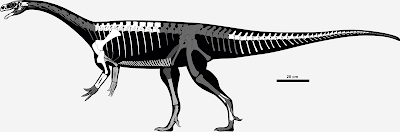
Skeletal reconstruction of Unaysaurus talentinoi, copyright Maurissauro.


The phylogenetic relationships of Plateosaurus to other sauropods have been similarly disputed. Plateosaurus is, of course, the type genus of the family Plateosauridae but the concept of that family has varied significantly over time. For a large part of the twentieth century, 'Plateosauridae' was kind of a catch-all for all moderately large prosauropods, with Anchisauridae for the smaller species and Melanorosauridae for the giants. Redefinition of Plateosauridae to include only close relatives of Plateosaurus have significantly winnowed its contents. The current closest known relative of Plateosaurus is the recently described Issi saaneq, based on a pair of near-complete skulls from Greenland (Beccari et al. 2021). This species is close enough to Plateosaurus that its remains were previously assigned to P. englehardti. Offhand, "issi saaneq" is translated by the species' authors as "cold bone" in the local Kalaallisut language, but this looks to be another situation like "mei long" where a phrase was converted into a species name without considering that noun and descriptor order is reversed in biological names.

Other likely plateosaurids include two South American species, Unaysaurus tolentinoi and Macrocollum itaquii. The status of an Indian species Jaklapallisaurus asymmetrica is more uncertain. Beyond this, things become increasingly dodgy with little agreement over the details of prosauropod phylogeny. The overall conservative appearance of prosauropods means that phylogenetic studies are heavily reliant on fine details of the osteology that are debated between authors or not preserved in key taxa. Nevertheless, it does appear that the plateosaurids were widespread in the Norian epoch of the Triassic, and are bound to catch the attention of time travellers to the period.

REFERENCES

Beccari, V., O. Mateus, O. Wings, J. Milàn & L. B. Clemmensen. 2021. Issi saaneq gen. et sp. nov.—a new sauropodomorph dinosaur from the Late Triassic (Norian) of Jameson Land, central east Greenland. Diversity 13: 561.

Lallensack, J. N., E. M. Teschner, B. Pabst & P. M. Sander. 2021. New skulls of the basal sauropodomorph Plateosaurus trossingensis from Frick, Switzerland: is there more than one species? Acta Palaeontologica Polonica 66 (1): 1–28.
Reiss, S., & H. Mallison. 2014. Motion range of the manus of Plateosaurus engelhardti von Meyer, 1837. Palaeontologica Electronica 17 (1): 12A.

Yates, A. M. 2003. The species taxonomy of the sauropodomorph dinosaurs from the Löwenstein Formation (Norian, Late Triassic) of Germany. Palaeontology 46 (2): 317–337.